


Looking for the real thing? Browse our Ancient Roman ring collection, each piece one of one, individually authenticated, with documented provenance. For the background, see the guide to Roman jewelry.
What ancient roman rings were: definition and historical context
The term ancient roman rings describes a recognisable group of finger rings most commonly encountered in surveys and collections from about the 1st century BCE through the 4th century CE, a span used in major museum overviews to frame comparative study of rings and related jewellery The Metropolitan Museum of Art rings overview.
Archaeologically, these rings are recovered from a limited set of find contexts, typically burials, hoards, settlements and stray finds; the presence or absence of secure find context strongly affects how confidently a piece can be dated or interpreted British Museum gallery and collection notes.
Functionally and socially the same objects can serve different roles in Roman society. In many cases rings acted as practical seals for impressions, as dress items set with gemstones, as personal amulets, and occasionally as items appearing in marital or funerary settings, but attributing a single fixed use to an individual ring often requires contextual evidence Philip Kiernan and Klaus-Peter Henz, Rings from the Forbidden Forest, Cambridge University Press.
Main types of ancient roman rings and how to recognise them
Collectors and researchers typically sort Roman rings into a small set of visual and functional categories: intaglio or signet rings, gemstone-set dress rings, plain bands, and rings found in marital or funerary assemblages. Each of these categories has recognisable hallmarks that help with initial classification The Metropolitan Museum of Art rings overview. For object examples see the Aurora Antiqua ancient Roman rings collection.
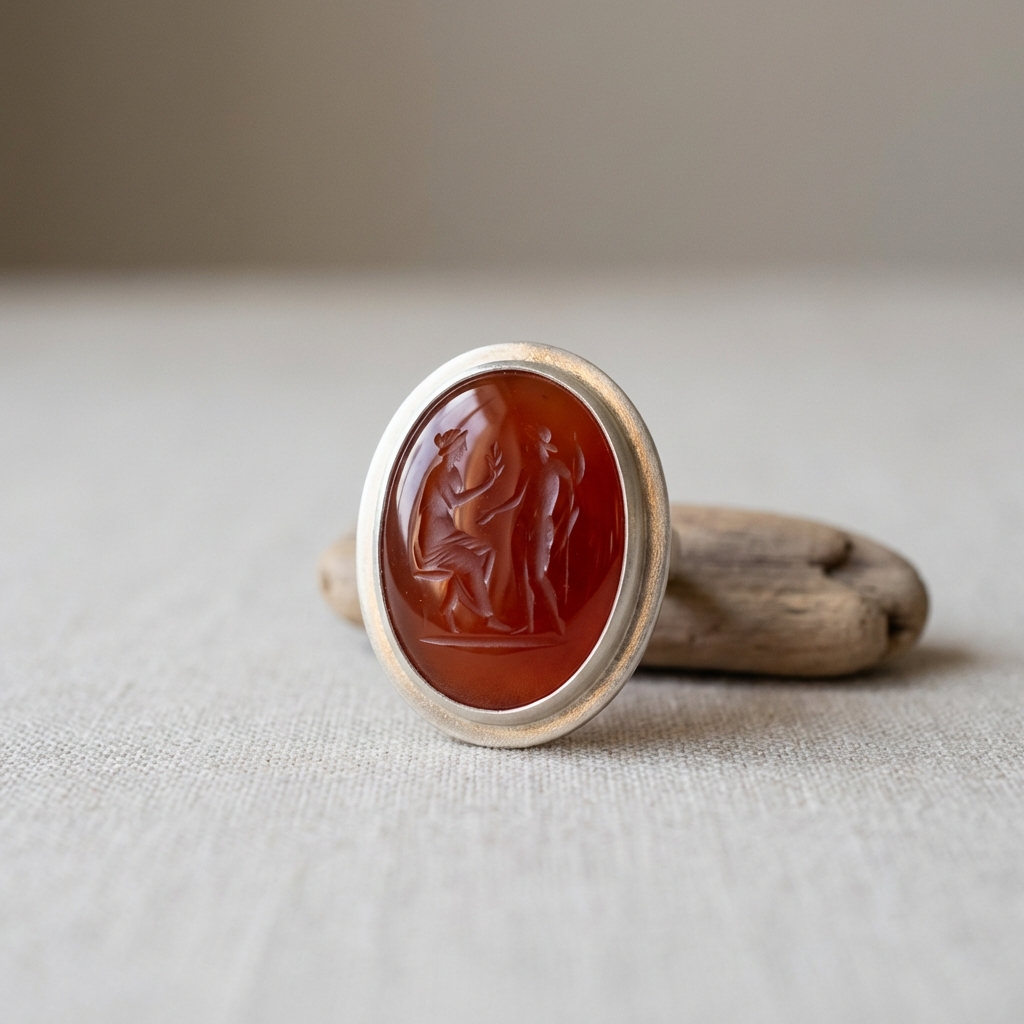
Signet and intaglio rings usually feature a carved stone or glass set into a bezel, often engraved with heraldic, mythological or personal motifs. The engraving can indicate use as a seal but some intaglios are carved for display rather than repeated sealing. Look for a well defined flat or slightly convex plane on the bezel and wear consistent with impression use Oxford Research Encyclopedias on typology and dating.
Gemstone-set dress rings and plain bands are often less obviously functional. Dress rings can be heavier, set with cabochons or intaglios, and may show decorative metalwork on the shoulders or shank. Plain bands are common in many find contexts and can be utilitarian or symbolic depending on associated finds and inscriptions British Museum Roman Britain jewellery overview.
Rings recovered from graves or burial assemblages sometimes occur alongside other personal items and can be interpreted as funerary tokens or indicators of identity, but such associations are inferential and benefit from careful documentation of the burial context Journal of Roman Archaeology on funerary assemblages.
Follow @auroraantiqua for behind the scenes on ancient rings
Please consider downloading the short condition and photo checklist for rings; it is offered as a practical, optional tool to help you prepare clear images and basic measurements for independent comparison.
Iconography and inscriptions on bezels are useful clues. A portrait head, deity scene or abbreviated lettering can suggest a sealing function or personal identification, while purely decorative motifs suggest display. However, typology is only a starting point; dating and functional attribution improve with context or scientific corroboration The Metropolitan Museum of Art rings overview.
Signet and intaglio rings
Intaglio rings intended for sealing commonly use hard stones such as carnelian or agate and display fine incisions for impression work. Signs of repeated use include slight smoothing of the carved lines and evidence of contact with soft media such as clay or wax in historic illustrations used for comparison Archaeometry on materials and techniques. Further comparative material on gems and finger rings is available from the Getty Museum Ancient gems and finger rings - Getty Museum.
Gemstone-set dress rings and plain bands
Dress rings often emphasise surface technique on the metal, such as granulation or engraved ornament, where surviving detail can help attribute an object to a relative quality tier; plain bands offer fewer internal clues and depend more on find context and metal composition for dating British Museum collection notes.
Rings in marital and funerary assemblages
When rings appear in burials or are mentioned in inscriptions, they can be read as personal tokens possibly related to marriage or commemoration, though the precise frequency of such uses across Roman society remains debated; careful documentation and comparison with published assemblages improve interpretive confidence Ring, Victoria and Albert Museum, London.
Materials and gemstones used in ancient roman rings
Gold, silver and copper-alloys such as bronze and brass were the principal metals used for Roman rings in museum collections and published find records, and intaglio stones are most commonly carnelian, agate, jasper or glass, a pattern reflected in national and museum databases Portable Antiquities Scheme find record as an example. Recent gem studies also provide material-specific analysis for green coloured gems from the Roman period Study of green coloured gems of the Roman period.
The choice of metal and stone affects how a ring survives. Bronze rings develop a compact green or brown patina, silver often shows surface darkening and occasional pitting, and gold tends to remain stable though surface wear and tiny solder joins can be visible on the shoulders or hoop The Metropolitan Museum of Art rings overview.
Romans wore a limited set of ring types, notably intaglio signet rings, gemstone dress rings, plain bands and rings appearing in funerary or marital contexts. Collectors should prioritise provenance, condition and restoration notes, use typology and comparative databases for initial dating, and request non-destructive analysis when needed.
Gemstones and glass have different preservation signatures: carnelian and agate are hard and often retain crisp carving on intaglios, jasper may show surface crazing, and glass imitations can fracture or show modern surface smoothing where repaired or re-set; these observations help with preliminary identification but are estimates without specialist testing Archaeometry on intaglio materials.
For collectors, treat stone identification and exact metal composition as provisional unless supported by testing. When available, collection history and documented analyses in catalogue entries provide stronger grounds for a confident reading of materials and date Portable Antiquities Scheme find record as a model.
How ancient roman rings were made: techniques and technical signs
Many base-metal rings were made using casting methods such as lost-wax or open-mould casting, which leave characteristic mould seam lines and occasional casting pores; these manufacturing marks are well documented in technical studies of Roman jewellery Archaeometry on materials and techniques.
Intaglios themselves were cut by hand and gemstones were sometimes re-used from earlier items; signs of re-use can include asymmetrical seats in bezels or re-cutting marks on the gem surface where older engraving was adjusted to fit a new setting The Metropolitan Museum of Art rings overview.

High-end gold rings show techniques such as soldered joins, fine engraving and granulation work on shoulders; these surface techniques require microscopic or close visual inspection to differentiate ancient practice from later repairs or modern additions Archaeometry on goldsmith techniques.
Conservation and restoration notes are essential when assessing manufacture. Modern cleaning, stabilisation or repaired joins must be recorded so that collectors can separate original technical features from later interventions Portable Antiquities Scheme guidance.
Dating and typology: what features experts use to estimate age
Typological dating relies on features such as bezel shape and hoop cross-section. Bezels may be round, oval or lozenge shaped, and hoops are described as D-shaped, circular or flat in comparative catalogues; these morphological features are commonly used as relative dating markers Oxford Research Encyclopedias on rings typology. For additional typological comparisons see a typology-focused study available from Cambridge University Press Rings from the Forbidden Forest - supplementary material.
Iconography and lettering styles on intaglios provide further clues. Certain motifs and letterforms cluster in date ranges and workshops, but workshop attribution can remain uncertain without find context or metallurgical and gem analysis to support the stylistic reading British Museum collection typologies.
Archaeological context and scientific analysis strengthen dating. Provenanced finds or pieces with metallurgical and gem identification enable firmer chronological placement than stylistic comparison alone, so secure dating typically combines typology with context or non-destructive testing The Metropolitan Museum of Art rings overview.
Uses, symbolism and social meaning of rings in Roman society
Rings served multiple roles in Roman life: as practical seals for administration and documents, as visible markers of status and dress, and as amuletic or funerary objects in burial practice. Tomb assemblages, inscriptions and curated collections all contribute to this multifaceted picture Finger Ring with Intaglio Depicting Eros (2013.1105), Art Institute of Chicago.
Seals and administrative use are indicated when intaglio designs appear suited to producing clear impressions, or when inscriptions name individuals, but such readings are stronger when supported by archaeological or documentary association Oxford Research Encyclopedias on seals and identification.
Helps match bezel shape and hoop cross-section to broad date ranges
Use as a quick matching guide
Status and personal display are visible in metal choice and decoration: gold and elaborated surface techniques likely conveyed social rank, while simpler bronze or silver items are consistent with everyday wear; interpretive caution is needed because social meaning can vary across regions and periods Ring, Victoria and Albert Museum, London.
Amuletic and funerary uses are attested when rings occur in graves with other protective items or in contexts suggesting commemoration, but the frequency of such uses across the empire is not fully settled and should be considered cautiously without strong contextual evidence British Museum burial assemblage examples.
How collectors should evaluate and document ancient roman rings before buying
Provenance and documentation should be a first filter. Prioritise pieces with clear collection history, acquisition dates and explicit conservation or restoration notes, because these materials materially improve attribution and reduce risk for buyers and researchers Portable Antiquities Scheme guidance. If you are browsing rings for reference see the Aurora Antiqua rings collection.
Condition and restoration notes are vital. Look for explicit statements about what was stabilised, what was repaired and what was left untouched, and request close-up photographs of the bezel, inside hoop marks and any soldered joins before purchase Archaeometry on conservation and technical signs.
Photographs and measurements checklist to request includes: overall weight, internal diameter or ring size, close-ups of bezel and intaglio, detailed images of shoulder motifs and shank cross-section, and macro images of patina and any repaired joins. These items make comparative research with museum catalogs and find records practical and more reliable The Metropolitan Museum of Art rings overview.

When to request non-destructive analysis. If a piece has ambiguous attribution, unusual metal composition or a re-cut intaglio, ask for non-destructive testing such as XRF for metal composition or gem testing by a qualified specialist; these analyses enhance confidence without damaging the object Archaeometry on recommended analyses.
Common mistakes and red flags when identifying ancient roman rings
Modern surface treatments and over-cleaning can mimic age. Clean, glossy surfaces on base-metal rings sometimes indicate aggressive polishing or chemical cleaning, which can remove diagnostic patina; condition notes and conservation records help distinguish genuine age from recent intervention Portable Antiquities Scheme guidance.
Relying on stylistic similarity alone is risky. While visual resemblance to museum examples is informative, stylistic attribution without provenance or technical analysis can lead to misdating or misattribution, so prefer pieces with supporting documentation Oxford Research Encyclopedias on typology limits.
Missing restoration records or vague provenance are key red flags. If a seller cannot provide a collection history, acquisition date or conservation notes, treat the item with caution and consider seeking independent advice before purchase Portable Antiquities Scheme guidance.
Practical examples: reading three illustrative cases
Case A: A bronze signet with lozenge bezel. Compare the object to published find records for similar lozenge bezels and examine hoop cross-section. If a find record with context exists, typology plus context can produce a reasonable date range; the Portable Antiquities Scheme offers comparable entries for reference Portable Antiquities Scheme find record.
Case B: A gold ring with granulation and a re-used carnelian. Surface granulation and solder joins visible under magnification point to a high quality technique, but a re-cut carnelian seat or asymmetrical bezel suggests re-use; combine visual signs with any available conservation notes to improve attribution Archaeometry on granulation and gem re-use.
Case C: An ambiguous piece without provenance. Use a short checklist when approaching the seller: ask for detailed photos and measurements, request any collection history or invoices, insist on conservation notes, and if uncertainty remains, seek non-destructive testing or an independent specialist opinion before purchase The Metropolitan Museum of Art guidance for comparison. For a related discussion see the Aurora Antiqua timeless appeal blog post.
Conclusion: how to read an ancient roman ring and next steps for buyers
Checklist summary: prioritise clear provenance and collection history, request explicit condition and restoration notes, obtain high quality photographs and measurements, compare morphological features with public databases and museum catalogues, and when necessary, pursue non-destructive analysis to clarify metal or gem composition Portable Antiquities Scheme guidance.
When to seek specialist help: if an attribution hinges on subtle tooling marks, uncertain gem identity or unusual alloy composition, consult a conservator or qualified specialist who can perform non-destructive testing and provide a report that improves confidence in dating and attribution Archaeometry on specialist analysis.
Look at the intaglio carving and bezel plane: a clear, finely cut design intended to make an impression and wear consistent with sealing suggests a signet; decorative pieces often lack impression-oriented engraving and show different wear patterns.
Ask for provenance or collection history, acquisition dates, any conservation or restoration notes, and high resolution photographs with measurements of ring size, bezel and shank.
Request non-destructive tests like XRF for unusual alloys or gem testing when attribution, dating or material identity is unclear and affects purchase decisions.
More from Aurora Antiqua
References
- Ring, Victoria and Albert Museum, London
- Philip Kiernan and Klaus-Peter Henz, Rings from the Forbidden Forest, Cambridge University Press
- Finger Ring with Intaglio Depicting Eros (2013.1105), Art Institute of Chicago
- Ring, Victoria and Albert Museum, London
- SF-A79B96, Roman copper alloy and glass finger-ring from Norfolk, Portable Antiquities Scheme, British Museum
- Gold finger ring with glass intaglio: a lioness (1995.85.2), The Metropolitan Museum of Art, New York
- Ring with Hippocampus, Cleveland Museum of Art
- Spiral Ring with Isis and Serapis, Cleveland Museum of Art
- bague, Louvre site des collections, Musee du Louvre, Departement des Antiquites grecques, etrusques et romaines
- Ancient Gems and Finger Rings: Catalogue of the Collections, The Getty
From Aurora Antiqua
We sell authenticated ancient & medieval pieces, each individually examined before listing and backed by a Lifetime Authenticity Guarantee. One of a kind, sold once, never reproduced.
Browse Ancient Roman Rings →