


Looking for the real thing? Browse genuine carved intaglio rings, each piece one of one, individually authenticated, with documented provenance. For the background, see the guide to Roman jewelry.
What is an ancient intaglio ring? Definition and context
An ancient intaglio ring is an ancient ring whose central motif is incised into a hard surface so the design sits below the surrounding plane, and which can be used as wearable decoration or, historically, to make impressions in soft materials. The term ancient intaglio ring describes both the object type and the technique, and collectors use it to refer to rings set with carved gemstones such as carnelian, agate, or amethyst as well as rings retaining their original mounts. In many catalogues the term also signals that the item comes with condition notes, measurements, and any available provenance or restoration notes.
Technically intaglio describes an incised or engraved design cut into a hard surface, in contrast to relief carving where the motif projects above the background. For carved gemstones the work requires lapidary cutting and sometimes drilling on hardstone, which is a different technical process than cutting a soft clay seal. For a clear overview of gem engraving traditions, see the Metropolitan Museum of Art's discussion of gem engravings and glyptic art Gems and Gem Engraving.
Collectors ask whether an ancient intaglio ring might be the "oldest" example of engraved work, but the archaeological record shows a more nuanced picture. Many of the demonstrably oldest engraved objects are seal devices used for impressing clay rather than small gemstone rings. Those sealing traditions developed in parallel in different regions, yet the earliest secure examples predate the widespread use of carved gemstone intaglios in rings.
Based on current archaeological syntheses, the oldest demonstrable form of engraved object is seal devices such as Neolithic stamp seals and Mesopotamian cylinder seals; carved gemstone intaglios set in rings appear later and are archaeologically prominent from the second millennium BCE onward.
For purchasing and identification, the distinction matters because seals and gem intaglios require different types of documentation and technical assessment. When a seller or catalogue uses the phrase ancient intaglio ring, it can indicate a wearable artifact with a carved gem set into a bezel, but it does not by itself prove an extraordinarily early date.
Across the article we use conditional language and encourage readers to look for provenance, publication, and clear condition notes when assessing age and significance.
The archaeological timeline: Neolithic stamp seals, Uruk cylinder seals, and the rise of the ancient intaglio ring
The demonstrably oldest engraved objects in the archaeological record are simple stamp seals from Neolithic and Chalcolithic contexts, carved in negative relief to impress a single motif into clay. These devices appear in secure stratigraphic contexts before 3500 BCE in several regions, and syntheses of the evidence place them earlier than carved gemstone intaglios used in rings. For a concise overview of seals as archaeological objects, see the Encyclopaedia Britannica entry on seals Seal (artifact).
Following the earliest stamp seals, Mesopotamian cylinder seals become prominent in Uruk period contexts and represent the first widespread use of an engraved object designed specifically to be rolled across wet clay to produce continuous scenes. The chronology and contextual evidence for cylinder seals in urban Uruk settings is well documented in museum literature and excavation reports; the British Museum provides a useful museum synthesis of cylinder seals and their contexts Cylinder seals and the use of seals in ancient Mesopotamia. Further discussion is available in the Wikipedia entry on cylinder seals Cylinder seal and in a recent overview by the Smithsonian Smithsonian.
Carved gemstone intaglios, the kind commonly set in rings, become archaeologically prominent later, especially from the second millennium BCE onward and in the Hellenistic and Roman periods afterwards. These hardstone engravings require lapidary tools and are catalogued in art historical overviews of engraved gems and glyptic art; for context on the development of gem engraving see the Oxford research overview on engraved gems Engraved Gems and Glyptic Art.
guide to reading a provenance summary and verifying publication citations
Use when assessing an early attribution
The sequence is therefore: stamp seals in the Neolithic and Chalcolithic, then cylinder seals in the Uruk period with clear stratigraphic contexts, and later the appearance and broad adoption of carved gemstone intaglios in the second millennium BCE and especially in classical eras. That order has implications for collectors and curators who encounter claims about the "oldest" intaglio.
While regional traditions such as Egyptian scarab seals develop their own forms and dating, the broad pattern from multiple syntheses is consistent: seal devices as a class provide the earliest clear evidence of human engraving for impression, and gem intaglios as wearable rings appear later in the sequence.
How intaglio techniques differ: stamp seals, cylinder seals, and gemstone engraving
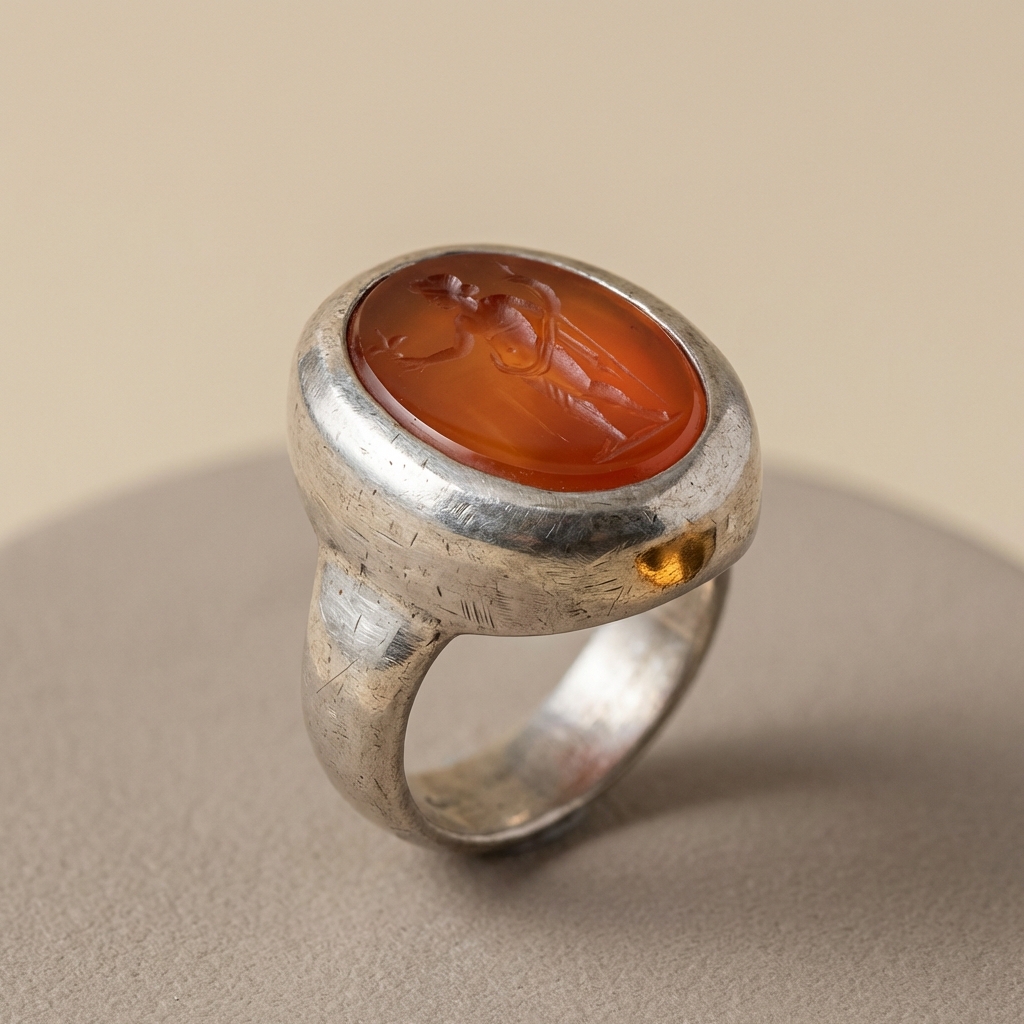
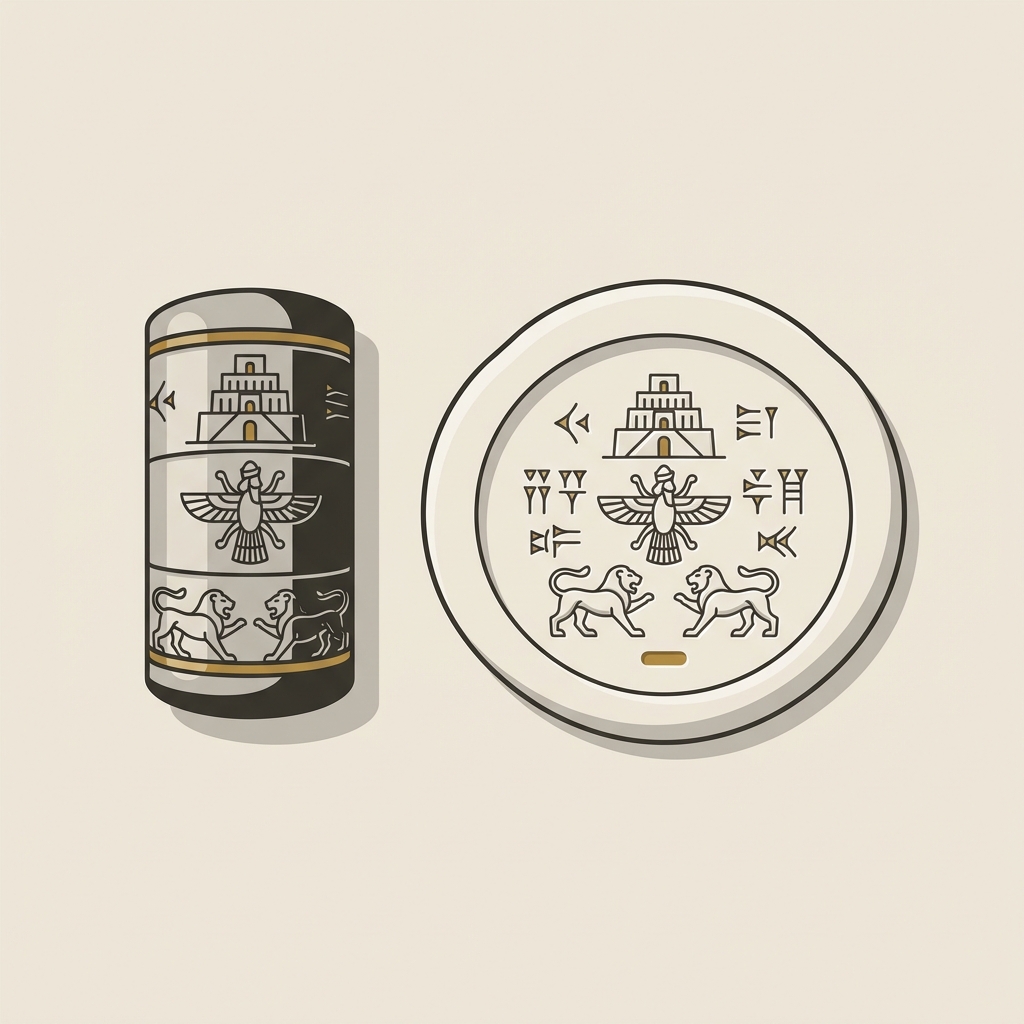
Understanding technical differences clarifies why seals and gemstone intaglios are distinct categories. Stamp seals are typically cut in negative relief to produce a single impressed motif; they are often made from softer stones or other materials suited to carving a simple design for repetition. When describing the production and use of seals, reference works on the topic help explain how negative relief supports a single impression and ease of manufacture.
Cylinder seals contrast with stamp seals because they are incised with fine line work that reads correctly when rolled, producing continuous narrative or decorative scenes. The technique and intended function are specific: a cylinder is carved around its circumference, then rolled across wet clay to preserve a continuous image. Examples and technical discussions of cylinder seals are available in collections and museum summaries that highlight Uruk period contexts Cylinder seals and the use of seals in ancient Mesopotamia.
Gemstone intaglios are a different technical challenge. Lapidary cutting of hardstone requires abrasives, drills, and careful polishing to incise motifs that will sit below the surface and often be set into a bezel. For an overview of the traditions and materials used in gem engraving, see the Metropolitan Museum overview of gem engraving Gems and Gem Engraving. Additional technical summaries are available from the Penn Museum Penn Museum.
These technical distinctions affect preservation. Softstone seals can survive as impressions in clay or as worn original objects, while finely incised cylinder seals preserve linear scenes but are often broken or fragmentary. Gemstone intaglios on hardstone can survive well but require careful assessment for modern recutting, repair, or later remounting. The type of tool marks and the substrate both inform specialist assessment of age and technique.
Evaluating claims: how to assess whether an object is the 'oldest' intaglio
When a seller or catalogue claims an object is the oldest example of intaglio, collectors should prioritise secure context and clear documentation. The strongest evidence is a documented findspot with stratigraphy or a published excavation report, because secure stratigraphic context anchors date estimates. Museum overviews and archaeological syntheses explain why stratigraphy matters for early dating of seals and similar objects Seal (artifact).
Requested documentation should include collection history that traces prior ownership, any publication citations where the object or comparable typologies are discussed, and condition notes describing repairs or restoration. Laboratory analyses such as material identification can help, for example distinguishing a modern recut from an original ancient engraving, but scientific testing is not always available and cannot replace sound provenance.
Red flags include vague or anonymous provenance statements, conflicting or absent publication citations, and condition notes that omit restoration history. Avoid accepting stylistic dating alone as sufficient proof of extraordinary antiquity, because motifs can be copied or revived in later times. Published museum catalogues and excavation reports remain the most reliable external checks when available.
Collectors can use a short verification checklist: request collection history and any publication references, ask for high magnification images of tool marks and the mounting, and seek independent material identification if the claim of exceptional age cannot be supported by documentation. When possible, consultation with a specialist in glyptic art or Near Eastern seals adds discipline to the assessment process.
Common mistakes and pitfalls when dating engraved objects
One common error is mistaking style for date. Motifs and iconographic themes travel and are often revived, so a ring carved in a later period can mimic an older style. Stylistic similarity is a useful clue but it should be corroborated with provenance and, if possible, published comparisons rather than taken as definitive proof.
Another frequent mistake is assuming gemstone intaglios predate sealing traditions. The demonstrable sequence from syntheses places simple stamp seals and cylinder seals earlier in the archaeological record than most carved gemstone intaglios, so reversing that order without strong evidence can be misleading. For a summary of the wider glyptic sequence consult museum and research overviews on engraved gems and seals Gems and Gem Engraving.
Overreliance on patina, surface wear, or visual age cues is also risky. Patina can form under many conditions, and restoration or chemical cleaning can change surface appearance. Condition notes and restoration notes that specify what was stabilised, repaired, or left untouched are therefore essential to interpret surface cues accurately.
Forgers and modern recutters often imitate tool marks and wear patterns, so careful photographic comparison at high magnification and, when available, material analysis provide the best defence against misattribution. Whenever a claim of exceptional age is made, insist on publication or laboratory reports as supporting evidence rather than relying solely on visual inspection.
Practical examples and scenarios: seals, scarabs and ancient intaglio ring case studies
Example 1, a Neolithic stamp seal. A convincing early attribution for a Neolithic or Chalcolithic stamp seal rests on a published excavation context or a collection history tying the piece to a dated site layer. When such context is recorded and a specialist publication discusses the find, the early date is much more secure than an isolated stylistic claim. For an overview of seals and their archaeological contexts see the Encyclopaedia Britannica discussion of seals Seal (artifact).
Example 2, an Uruk-period cylinder seal. Cylinder seals with clear Uruk provenance are often documented in museum collections with findspot and publication references, and those records underpin confident dating to the fourth millennium BCE in Mesopotamia. A museum synthesis of cylinder seals explains the kinds of publication trails and cataloguing that support early attributions Cylinder seals and the use of seals in ancient Mesopotamia.
Example 3, a Hellenistic or Roman carved gemstone intaglio ring. Typical documentation that supports a Hellenistic or Roman attribution includes collection history showing nineteenth or early twentieth century acquisition, catalogue entries, condition notes describing the stone and mounting, and possibly comparative references in published corpora of engraved gems. For practical context on gem engraving techniques and their later prominence, consult major museum overviews Gems and Gem Engraving. For related items see our ancient Roman rings collection Roman rings.

In practice, a collector presented with an ancient intaglio ring described as Roman should ask for the same core documentation as for seals: collection history, publication or catalogue citations if any, and clear condition and restoration notes that explain whether the gem has been recut or the mount altered. When sellers provide those documents, the assessment becomes a matter of weighing available records rather than relying on appearance alone.
Across these scenarios the consistent lesson is that context and documentation determine how confidently an object can be dated. Seals with secure stratigraphy will usually predate most gem intaglios, while well documented Hellenistic and Roman rings stand on their own evidentiary footing.
Buying checklist and conclusion: responsible steps when seeking an ancient intaglio ring
Buyer checklist, condensed. Request collection history or prior ownership notes, ask for publication citations or catalogue references if available, obtain detailed condition notes and restoration notes, seek close images of tool marks and the stone's profile, and if the claim of exceptional antiquity is central, ask whether any laboratory analysis has been performed.
Curated sellers can help by providing editorial context and transparent documentation. Aurora Antiqua presents curated ancient rings spanning Roman, Greek, Byzantine, Islamic, Celtic, medieval, and post medieval periods with condition notes and provenance and documentation references when available, which aids buyers in understanding the basis for dating and attribution.
See provenance and restoration walkthroughs on @auroraantiqua
If you have questions about documentation or want help interpreting provenance and condition notes, consult the checklist above or contact the curator for guidance.
In conclusion, the demonstrably oldest form of engraved object in the archaeological record is the class of seal devices, notably Neolithic stamp seals and later Uruk cylinder seals, rather than carved gemstone intaglios set in rings. That conclusion matters because it shapes what documentation a collector should require when evaluating an ancient intaglio ring or a seal claimed to be extremely old.
Careful assessment, reliance on provenance and publication, and clear condition and restoration notes remain the most reliable tools for collectors who wish to understand the date and significance of an object before purchase.
Seals are devices cut to impress clay, often as single-motif stamps or rolled cylinder scenes, while gemstone intaglios are hardstone carvings designed to be set in jewellery; the carving techniques and intended functions differ.
No, patina and surface wear are useful clues but can be altered by environment or restoration; provenance, publication, and condition notes are more reliable indicators.
Request collection history, condition and restoration notes, any publication or catalogue citations, and images of tool marks; laboratory analysis helps when extraordinary ages are claimed.
More from Aurora Antiqua
References
- Art & Architecture Thesaurus Full Record Display (Getty Research)
- A Corpus of Roman Engraved Gemstones from British Sites, University of Michigan Press / BAR Publishing
- Fund des Monats August 2019 (Find of the Month), Landesamt für Denkmalpflege und Archäologie Sachsen-Anhalt
- Aegean and Cypro-Aegean Non-Sphragistic Decorated Gold Finger Rings, American Journal of Archaeology
- Finger Ring with Frog, The Cleveland Museum of Art
- Amnon Rosenfeld, Michael Dvorachek, Shua Amorai-Stark, Elsevier, Journal of Archaeological Science
- Research report: export licensing and provenance, GOV.UK, Department for Culture, Media and Sport (DCMS)
- Cylinder seal, Wikipedia
- The World's Earliest Writing System May Have Been Influenced by Older Symbols, Smithsonian Magazine