


Looking for the real thing? Browse authentic ancient signet rings, each piece one of one, individually authenticated, with documented provenance. For the background, see the guide to ancient jewelry.
What is an ancient signet ring? Definition and historical functions
An ancient signet ring can be described as a wearable seal, usually a small ring with an engraved or carved surface designed to leave an impression in a soft medium such as clay or wax. In many cases these rings combined three related purposes, sealing documents or goods, identifying the owner, and signaling social status.
The idea of a personal seal has a long functional lineage, beginning with administrative impressions and evolving into portable forms. Archaeological and museum scholarship ties the practice of sealing to early administrative systems, which helps explain why signet rings were both practical tools and symbols of identity in later societies, rather than purely decorative items A Corpus of Roman Engraved Gemstones from British Sites, University of Michigan Press / BAR Publishing. The History of Signet Rings

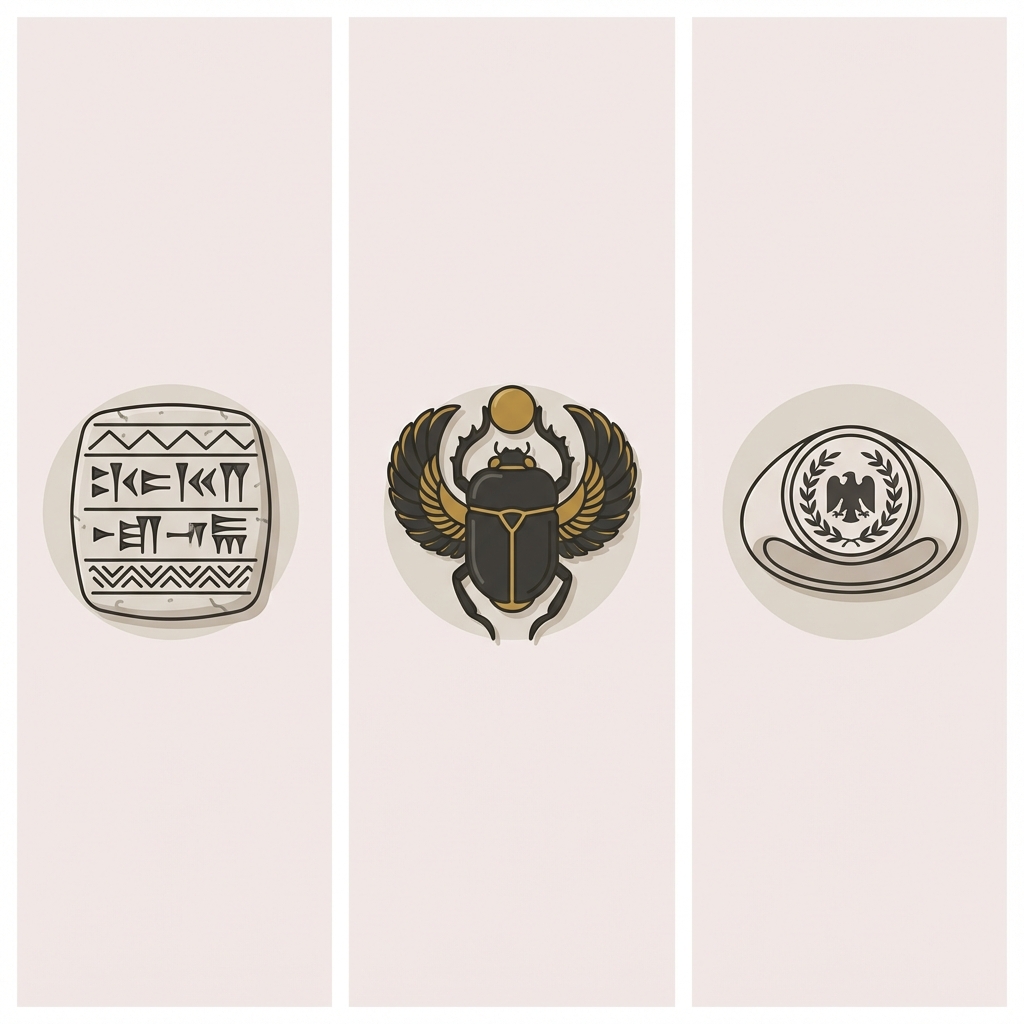
Technically, the term signet tends to refer to rings and small seals made to impress a design, while other sealing technologies, such as cylinder seals or scarabs, occupy the same broader category of sealing devices but differ in form and use. This distinction helps when comparing Near Eastern administrative tools with Mediterranean bezel-mounted intaglios. See our rings collection.
It is important to treat functions and meanings as context dependent. The same object can serve as a practical administrative seal in one region and period, and as a predominantly visible status marker in another, so cautious, evidence-based language is essential when attributing purpose to any specific piece Encyclopaedia Britannica overview of seals.
Sealing, identity, and display: three core functions
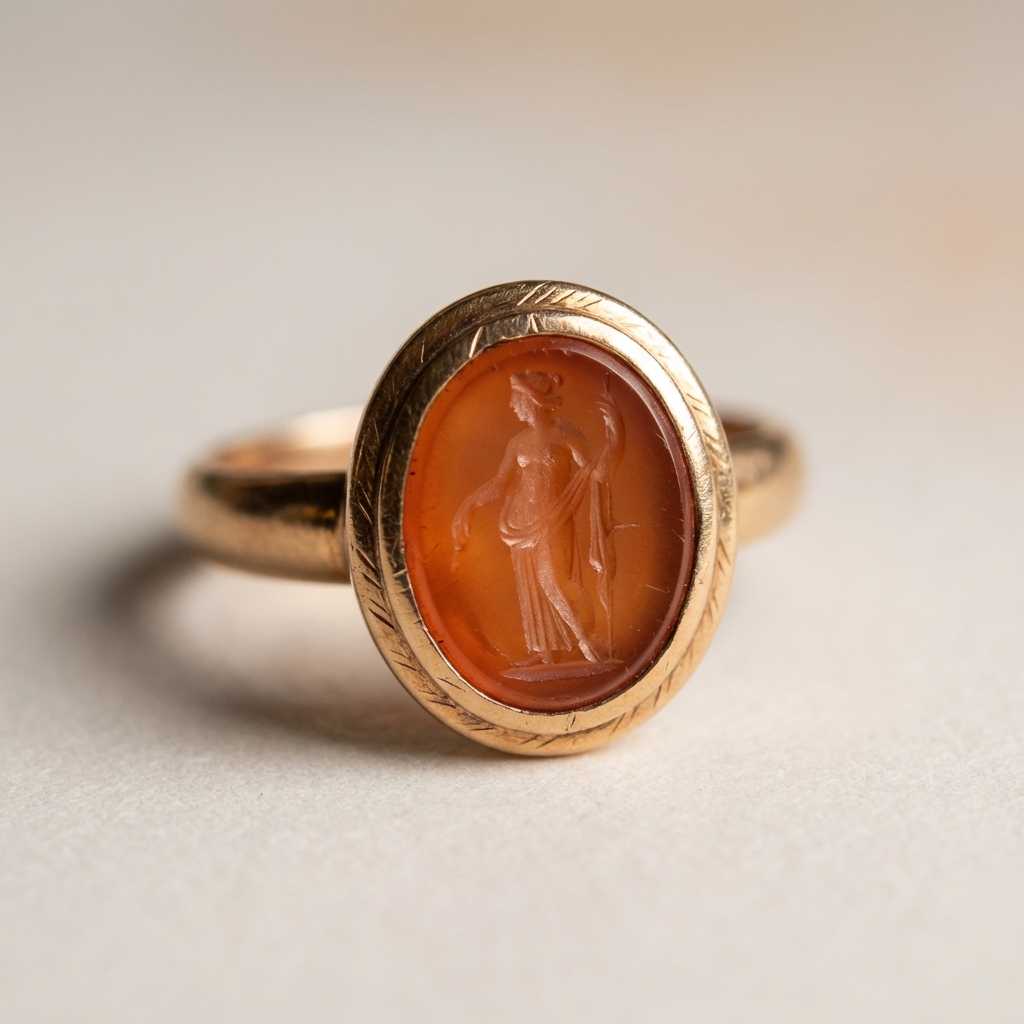
Sealing, broadly, means producing a reproducible impressed design to close or certify a bundle, document, or container. Personal wear was a convenient way to keep a seal ready for use and to make the owner’s emblem visible, turning a functional device into a portable identifier.
Display and status are often inseparable from practical use. In societies where personal insignia mattered, the visual quality of a ring, its metal, and the gemstone could communicate rank and affiliation as effectively as the impressed image itself, but such social readings need to be tied to secure context and comparanda rather than assumed.
How the term 'signet' differs from related seals and stamps
Signet rings are a subset of sealing technology, distinct in their wearable form and in many cases their intaglio technique. Earlier administrative tools like cylinder seals are functional ancestors but differ in shape and some technical usage patterns. Understanding these differences helps place objects in a cultural and chronological framework Encyclopaedia Britannica overview of seals.
Careful description, noting bezel form, wear patterns, and documented find-context, is the responsible way to discuss a signet without overreaching beyond the evidence at hand SF-A79B96, Roman copper alloy and glass finger-ring from Norfolk, Portable Antiquities Scheme, British Museum.
Early origins: Mesopotamian cylinder seals to Egyptian scarabs
The earliest administrative sealing systems, including the carved cylinder seals used to impress wet clay, are documented in Mesopotamia from around 3500 BCE and represent the functional ancestor of later personal signets; these objects show how sealing began as an administrative technology before becoming a personal identifier Penn Museum article on cylinder seals. Mesopotamian cylinder seals-Exploring glyptic images
Cylinder seals were typically rolled across clay to produce a continuous scene or register, a technique that differs markedly from the single-impression intaglios later used on rings. The administrative precision and widespread use in economic contexts help explain their early prominence in record keeping and identity affirmation.
In the eastern Mediterranean and Nile Valley, scarab seals and bezel-mounted gems appear by the late third to second millennium BCE and were used both for sealing and as personal identifiers. Scarab seals often doubled as amuletic objects and were sometimes worn as jewelry, showing the overlap between function and personal adornment British Museum discussion of seals and sealing.
Museum collections and catalogues provide the main comparanda for tracing these transitions. Many standard references that describe early sealing systems remain central to the field, which means collectors and students should rely on well-documented catalogue entries when comparing an object to these early types Metropolitan Museum overview of rings.
See behind-the-scenes provenance and condition notes on our social updates
For educational context, consult detailed catalogue entries and condition notes when comparing early sealing types and wearable seals.
Regional differences matter: Mesopotamian sealing culture emphasized administrative control across scribal networks, while Egyptian scarabs often carried personal or religious symbolism in addition to sealing function. This regional variation is why a simple one-size-fits-all story of origin is misleading.
Mesopotamia and the administrative roots
Cylinder seals from Mesopotamia show how imprinting a design became part of bureaucratic practice. The form, size, and iconographic program of these seals reflect administrative needs and the social contexts that used them, which is why they are often cited as the technological and conceptual precursors to later personal signets Penn Museum article on cylinder seals.
Even as sealing technologies evolved, the essential logic remained: a repeatable, controlled image associated with an individual or office served as a security device and a visual credential.
Scarab seals and bezel use in Egypt and the Levant
In Egypt and neighboring regions, scarab-shaped seals carved in stone or faience became common and were sometimes set into rings or worn on strings. These seals frequently combined amuletic imagery with ownership marks, and their form contributed to later bezel-mounted sealing practices British Museum discussion of seals and sealing.
When assessing a scarab or bezel-mounted gem, note the find-context and museum comparisons. Many published descriptions and catalogue entries predate 2024 and continue to form the backbone of comparative studies for these types of seals Metropolitan Museum overview of rings.
Greek and Hellenistic developments: intaglio gems and bezel mounts
In the Archaic and Classical Greek periods, a clear shift toward hand-carved intaglios and bezel-mounted gemstones occurs, with engraved motifs that can be amuletic, mythological, or clearly personal in function. Museum collections document many of these changes and supply useful comparanda for dating and attribution Metropolitan Museum overview of rings. Ancient Intaglios: From Gemstones to Modern Jewelry
Greek intaglios often emphasize figural scenes, animals, and symbolic motifs, and the engraving style, line quality, and composition can point scholars toward specific workshop traditions or chronological ranges. That said, iconographic evidence works best when combined with technical and provenance data.
Shift to engraved gems and amuletic imagery
Engraved gems in this period were chosen for both visual effect and hardness; stones such as carnelian and agate were popular because they take fine incised work and produce a clear impression when used as seals. The use of such materials reflects preferences in both local markets and long-distance trade networks.
Motifs sometimes serve amuletic purposes and sometimes serve as personal identification, and distinguishing the intended use is often a contextual judgement based on comparison with securely dated examples.
Workshop styles and how motifs help with dating
Small stylistic traits, such as how a figure’s hair is carved or how a border is handled, can be diagnostic of a workshop or period. Specialists use these micro-features alongside bezel shape and mounting technique to form dating hypotheses, recognizing that such attributions are probabilistic rather than certain Metropolitan Museum overview of rings.
For collectors, using a combination of motif study and physical examination of the bezel and engraving will yield a stronger identification than relying on motif alone. This is where intaglio signet identification becomes a practical skill rather than a matter of connoisseurship alone.
Roman use and standardization: sealing, administration, and status
From the Republic into the Imperial period, Roman practice helped standardize the wear and use of intaglio signet rings for sealing, private administration, and public display. Roman rings are well documented in museum catalogues and object studies, which show how the ring functioned across administrative and social contexts Metropolitan Museum collection search on intaglio rings. See our Ancient Roman Rings collection.
Typical materials for Roman signet rings include carnelian and other hardstones set in metals such as gold or silver. These material choices reflect both practical considerations for engraving and social values attached to metal and gemstone combinations.
By weighing iconography, engraving style, bezel and mount construction, patina and wear, and provenance documentation together, and by comparing the piece to dated museum catalogues and specialist literature
When assessing a Roman intaglio, consider the combination of iconography, bezel form, and material rather than any single trait. This combined approach reduces the risk of misattributing later copies to Roman workshops Fund des Monats August 2019 (Find of the Month), Landesamt für Denkmalpflege und Archäologie Sachsen-Anhalt.
Because the Roman period produced many well-made intaglios, distinguishing originals from later imitations requires careful comparison with dated catalogued examples and attention to surface wear and restoration notes.
Republic to Empire: why the intaglio signet became common
Roman administrative and legal practices favored repeatable seals, and the convenience and portability of a ring-mounted intaglio made it a practical tool for officials and private individuals alike. Over time the ring also accrued status value as a visible token of office or social place.
Collectors should remember that uniformity of form in Roman contexts makes stylistic judgement both possible and challenging; many variations exist within accepted Roman typologies, so conservative attribution language is recommended.
Typical materials and mounts in Roman contexts
Carnelian, agate, and similarly hard stones were common because they take a fine engraved line and hold up in repeated use as a sealing surface. Gold and silver mounts are frequently recorded in museum inventories and catalogues as typical for the Roman period Metropolitan Museum collection search on intaglio rings.
When a listing or catalogue mentions a metal mount and gemstone, cross-reference with condition notes and any available provenance information before assuming a Roman attribution; the metal and stone alone are not definitive evidence Bague : satyre jouant de la double flûte devant une statue, Musee du Louvre, Paris, Departement des Objets d'art.
Materials and manufacture: stones, metals, and carving techniques
Common stones associated with intaglio signets include carnelian, agate, and occasionally amethyst, chosen for their hardness and ability to display fine engraving. These material distributions are well documented in museum catalogues and object studies Metropolitan Museum collection search on intaglio rings.
Manufacture matters. Hand-carved intaglios differ visibly from cast or molded seals in line quality, tool marks, and finish. Recognizing these distinctions helps separate historically plausible work from later reproductions that may use different production techniques.
Typical gemstones and why they were chosen
Stones such as carnelian and agate were prized because their layered structure and relative toughness accept fine incisions without crumbling. The selection of a gemstone can reflect availability, trade connections, and aesthetic preferences in a given region and period.
Describing a gem as carnelian or agate in a listing should be done with conditional phrasing unless compositional testing is available; visual identification is useful but not definitive without laboratory confirmation.
Casting, bezel types, and hand-engraved intaglio techniques
Bezel form and mounting style provide significant clues. A tight, finely chased bezel may point to a higher-end workshop or period practice, while simpler mounts could indicate a different context or later alteration. Observing the junctions where hoop meets bezel and any soldering lines helps assess whether a ring has been remodeled or restored.
Restoration notes and condition descriptions should always accompany an attribution because stabilization, repair, or replacement parts can change the object's appearance and complicate technical reading Characterization of Castellani nineteenth-century gold jewellery by in situ, Scientific Reports.
How experts date and assess provenance: a practical framework
Dating and provenance assessment rely on multiple converging lines of evidence. Specialists commonly weigh material and manufacture, iconography, bezel and setting, patina and wear, and provenance or documentation together rather than relying on a single trait Testing and Retesting Alexander the Great, J. Paul Getty Museum and Getty Conservation Institute, Los Angeles.
Museum catalogues and object studies remain foundational comparanda, and scientific testing can strengthen claims when available. However, gaps remain in compositional testing, particularly for pieces that circulate in private markets rather than through institutional collections Portable XRF for paintings and metals authentication, npj Heritage Science (Springer Nature), DOI.
Apply a consistent checklist when evaluating a listing: note the motif and its parallels, the bezel and mount construction, the engraving technique, any surface wear or patina consistent with age, and the completeness of provenance documentation. Each item on this checklist contributes to a probabilistic assessment rather than a categorical conclusion.

Aurora Antiqua positions itself as a curator reference for buyers, offering condition notes and provenance-style summaries when available. Such information helps users apply the practical framework above without implying unconditional statements about authenticity.
Five key criteria to weigh together
Experts commonly evaluate five interlocking criteria: material and manufacturing technique, iconography and motif, bezel and mount characteristics, patina and wear consistent with age, and provenance or documentation. No single criterion is decisive on its own Testing and Retesting Alexander the Great, J. Paul Getty Museum and Getty Conservation Institute, Los Angeles.
Recording each of these elements in a checklist-style report helps collectors compare items across listings and catalogue entries. Where possible, seek third-party condition reports or scientific sampling for conclusive compositional questions.
What museum catalogues and scientific testing can and cannot tell you
Museum catalogue comparanda give visual and technical anchors for attributions, while scientific testing can confirm material composition or reveal later repairs. But institutional catalogues often predate recent analytical methods, and compositional testing is unevenly applied across private collections, leaving gaps in the public record Metropolitan Museum overview of rings.
Treat both catalogues and tests as complementary. A well-documented catalogue comparison plus a readable condition report is stronger than either element by itself.
Common mistakes and authentication pitfalls to avoid
Over-reliance on a single visible feature is a frequent error. For example, attractive patina alone is not proof of antiquity because modern treatments can simulate age; similarly, assuming age solely from a popular motif risks misattribution Reproducing bronze archaeological patinas through intentional burial, Heliyon (Elsevier, Open Access).
Misreading modern repairs and later remodels is another common pitfall. A ring with an ancient intaglio but a modern hoop is a composite object whose origin story must be told in parts, with restoration notes distinguishing original fabric from later interventions.
Over-reliance on a single feature
Single-factor attribution, such as declaring a ring ancient because its bezel looks old, can produce serious mistakes. Use a combination of manufacture, iconography, and provenance examination instead.
Ask for clear condition notes and images that show junctions, solder lines, and tool marks when assessing a listing. Good photographs and transparent restoration notes will often reveal whether a piece has been stabilized or altered.
Misreading modern repairs and later remodels
Restoration and stabilization are routine when objects enter markets or collections, but these processes change the object and its interpretation. Distinguish restoration notes from provenance chains and treat them as separate lines of information in your evaluation Bague : satyre jouant de la double flûte devant une statue, Musee du Louvre, Paris, Departement des Objets d'art.
When in doubt, request condition reports that specify what was stabilized, repaired, or left untouched; that information is essential for responsible collecting.
Practical identification checklist and buyer scenarios
Use a short, ordered checklist when viewing a listing: motif and comparanda, bezel and mount form, engraving technique, gem and metal identification, patina and wear consistent with age, and provenance documentation or prior ownership notes. Each element reduces uncertainty when combined with the others A. M. Caggiani u. a., Corroborating the autoptic identification, Wiley, Journal of Raman Spectroscopy.
Checklist items should be recorded in writing for any piece under serious consideration, and images should include close-ups of the intaglio, the bezel junctions, and any solder or repair marks.
A printable quick checklist to assess rings against core criteria
Use for initial listing screening
Three buyer scenarios illustrate how the checklist applies. First, a market listing with minimal provenance typically yields a low confidence rating, where the prudent next step is to request condition notes and high resolution images. Second, a listing that offers clear museum comparanda and consistent technical features gives mid-level confidence and justifies seeking a third-party condition report. Third, a well-documented piece with find-context and catalogue comparisons yields higher confidence though collectors should still seek transparent restoration records Metropolitan Museum collection search on intaglio rings. For more on intaglio rings see our blog post on Roman jewelry and intaglio rings.
Practical next steps for low- and mid-confidence cases include asking for detailed condition notes, requesting targeted close-up photographs of the bezel and intaglio, and considering third-party testing when material questions remain. These steps can clarify the provenance verification process for ancient jewelry.
Conclusion: how to think about origin claims and care for an ancient signet ring
Dating and origin claims are most reliable when multiple lines of evidence converge, including material and manufacture, iconography, bezel and mount characteristics, wear patterns, and documented provenance. Treat single-factor claims cautiously and prefer well-documented comparanda from museum catalogues and specialist studies A Corpus of Roman Engraved Gemstones from British Sites, University of Michigan Press / BAR Publishing.
For care and display, follow conservator-friendly practices: avoid strong chemical cleaners, support fragile mounts when worn, and record any restoration or stabilization done to the piece in clear condition notes. Restoration entries should be precise about what was done and why.
Aurora Antiqua acts as a curator reference and trust layer for buyers by providing condition notes, restoration descriptions, and provenance-style summaries when available, to help collectors make evidence-based decisions without implying unconditional statements about authenticity.
Signet devices have roots in the fourth millennium BCE with administrative seals; wearable bezel-mounted intaglios appear later and vary by region and period, so precise dating depends on multiple lines of evidence.
Photos can reveal useful clues such as bezel joints and tool marks, but confident attribution requires provenance documentation and, in some cases, technical analysis or condition reports.
Request condition notes, prior ownership or collection history, clear close-ups of repairs or soldering, and any third-party reports when available.
More from Aurora Antiqua
References
- A Corpus of Roman Engraved Gemstones from British Sites, University of Michigan Press / BAR Publishing
- SF-A79B96, Roman copper alloy and glass finger-ring from Norfolk, Portable Antiquities Scheme, British Museum
- Fund des Monats August 2019 (Find of the Month), Landesamt für Denkmalpflege und Archäologie Sachsen-Anhalt
- Bague : satyre jouant de la double flûte devant une statue, Musee du Louvre, Paris, Departement des Objets d'art
- Characterization of Castellani nineteenth-century gold jewellery by in situ, Scientific Reports
- Testing and Retesting Alexander the Great, J. Paul Getty Museum and Getty Conservation Institute, Los Angeles
- Reproducing bronze archaeological patinas through intentional burial, Heliyon (Elsevier, Open Access)
- Portable XRF for paintings and metals authentication, npj Heritage Science (Springer Nature), DOI
- A. M. Caggiani u. a., Corroborating the autoptic identification, Wiley, Journal of Raman Spectroscopy