


Looking for the real thing? Browse authentic ancient signet rings, each piece one of one, individually authenticated, with documented provenance. For the background, see the guide to ancient jewelry.
Quick answer: Can a straight man wear a pinky ring? Why an ancient signet ring matters
Yes, in many contexts a straight man can wear a pinky ring; wearing an ancient signet ring on the little finger is increasingly seen as an acceptable, and often historically grounded, styling choice when done with attention to proportion and context. Contemporary style and etiquette coverage treats signets and pinky rings as largely gender neutral, while advising attention to fit and setting, so this choice is best framed as a considered personal decision rather than a rule-bound one GQ guidance on modern ring styling.
See close examinations and provenance updates on @auroraantiqua
Read the section on how to choose a ring and review condition notes carefully before deciding to wear an antiquity; that practical step will help you balance style with conservation.
An ancient signet ring brings extra considerations compared with a modern fashion piece. Beyond visual style, an ancient ring carries collection history, patina, and any restoration notes that affect whether it is suitable for regular wear, and collectors typically prioritise documentation before making a decision British Museum signet ring guidance.
This article outlines etiquette and styling pointers, a buyer's decision framework, care and conservation guidance, and common pitfalls to avoid when adopting a pinky or signet ring as part of your wardrobe.

What is an ancient signet ring? Definition and context
An ancient signet ring is an antiquity designed to bear a carved or engraved motif, often an intaglio set into a bezel above a hoop, used historically to impress a seal in soft materials and as an identity marker; components you will see named in listings include bezel, intaglio, hoop, shoulders, and the stone or metal that forms the face. Collections and object studies show this practical sealing function across civilizations, and museum descriptions are useful references when reading condition notes and provenance statements Metropolitan Museum Heilbrunn Timeline on rings and the V&A collection entry for a comparable signet example.
When reading a listing for an ancient ring, note whether a gemstone such as carnelian, agate, or jasper is described, and how the intaglio is executed. Many listings and catalogues describe materials as appearing to be a certain stone when laboratory testing is not stated, so use that language when a listing lacks a formal assay.
Functionally, ancient signet rings served both practical and symbolic roles. In their earliest contexts they acted as seals to authenticate documents or goods; later they also signalled family identity, office, or affiliation, which shifted emphasis from sealing utility to symbolic meaning over centuries British Museum collection term for signets.
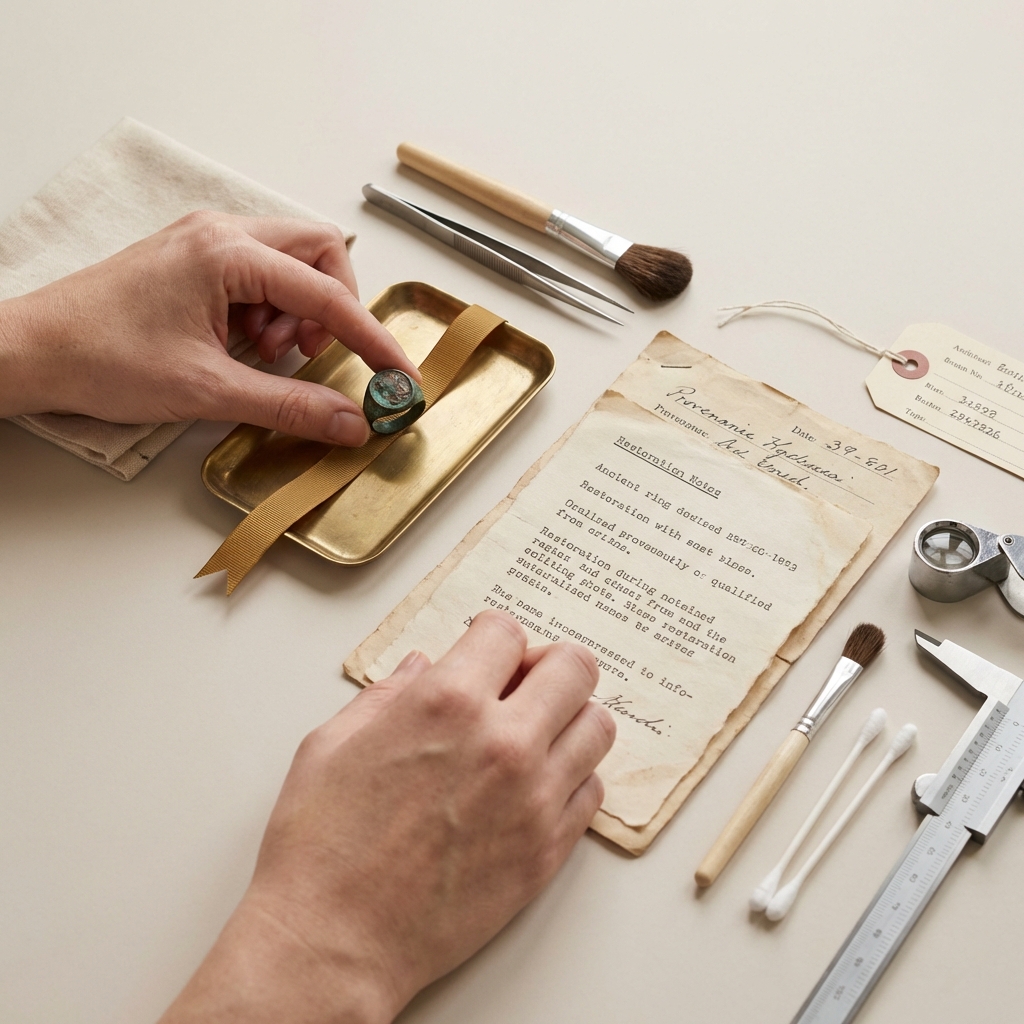
For buyers, museum collection entries and published object studies are a useful baseline for understanding typical signs of wear consistent with age, the look of patina, and how intaglio workmanship varies by period and workshop V&A article on the art of the ring and catalogues such as the Getty catalogues of ancient rings for comparative study.
A brief history: why the pinky became the signet finger
In Roman and later European practice the little finger often became the default placement for signets because it balanced sealing function with everyday wear; the position left the thumb and forefinger free for handling the tool while allowing the seal to be used without awkward rotation. This pattern appears in museum object studies and curatorial notes on rings from Roman through medieval contexts Metropolitan Museum Heilbrunn Timeline on rings.
a short checklist to compare motif clarity, sizing, and condition when assessing a signet
Use when evaluating wearability
By the medieval and early modern period, signets were frequently associated with family or institutional identity and were sometimes inherited or registered by offices, which reinforced the little finger placement as a conventional location for a personal seal. These developments are visible as changes in form and decoration in museum collections rather than as a single prescriptive change in etiquette V&A discussion of ring histories.
Over time, the role of the signet shifted from a working tool to a marker of identity and status, and that shift helps explain why wearing a signet on the pinky can read as either practical or symbolic depending on the piece and the context in which it is worn British Museum signet ring term.
Modern etiquette and styling for straight men: proportion, motif, and context
Contemporary etiquette and style sources advise that proportion and personal context should guide whether a straight man chooses a pinky ring, recommending simple motifs and correct sizing over strict gender rules; these sources note a revived interest in signets among men seeking heritage or statement pieces Debrett's signet ring guidance.
Practical styling tips include choosing a ring diameter and hoop thickness that sit comfortably on the little finger without overwhelming the hand, and selecting motifs that read clearly at a glance so the piece complements rather than competes with a watch or cufflinks. If you wear a watch on the left wrist, for example, a restrained metal tone and a compact bezel will help maintain balance.
Workplace and cultural variation matter. In settings with formal dress codes or conservative expectations, a discreet, low-profile ancient signet ring is less likely to attract unwanted attention, while in creative or fashion-forward environments a more visible motif may be appropriate. Check local norms and, when in doubt, start with occasional wear to gauge reactions GQ on modern men's ring styling.
When selecting metals and motifs, remember that an antiquity may have restoration notes or a patina you should preserve; choose pieces whose condition notes match your intended frequency of wear and which do not require heavy restoration to be wearable.
How to choose an ancient signet ring to wear: decision criteria for buyers
Start with provenance and documentation as your primary filter: request collection history, prior ownership notes, and any verification letters or cataloguing references included by the seller. For ancient rings intended to be worn, these records are the main evidence collectors use to judge suitability and context British Museum signet ring guidance. For more specific inquiries, contact pages can help you request documents from a seller contact the seller.

Next consult condition and restoration notes carefully. Look for descriptions of what was stabilised, what repairs were undertaken, and which areas were left untouched, because these details determine whether a piece can safely be worn; where possible, ask for close, high-resolution images of the hoop, shoulders, bezel junction, and the intaglio surface V&A notes on assessing rings.
Sizing for the pinky requires special attention: the little finger changes size more with temperature and activity than other digits, and an ill-fitting ring can both threaten the artifact and cause discomfort. Ask whether resizing was performed historically or recently, and whether the seller used reversible methods; consider having a conservator advise before any permanent alteration is attempted.
Review motif and material for daily wear. Harder stones with deep intaglio carving, such as cornelian or jasper described in listings, tend to tolerate occasional wear better than soft or heavily worn surfaces, while thin bezels or weakened shoulders are red flags for frequent use. If a listing lacks clear restoration notes, assume a conservative approach and avoid continuous wear until you obtain more information.
Finally, when in doubt consult a conservator or a trusted curator: they can interpret restoration notes, explain risks of specific repairs, and advise how to wear a historical ring without accelerating wear or causing damage British Museum collection advice.
Caring for and wearing an ancient signet ring: conservation and daily wear guidance
Handle ancient rings with clean hands and avoid forcing them over rough skin or sharp knuckles; patina and stable corrosion often indicate a stable surface that should not be removed, and preserving these features is part of respecting the object's condition notes and collection history V&A guidance on ring conservation.
Cleaning should be minimal and guided by conservation best practice. Avoid household polishing agents and ultrasonic cleaners unless a qualified conservator has recommended them; in many cases, gentle brushing with a soft brush and careful inspection are safer than aggressive cleaning that could remove original surfaces or intaglio detail.
Store an ancient signet ring separately from modern jewelry to prevent abrasion and to minimise chemical interaction with contemporary metals. Use padded storage or separate compartments and keep documentation together, including condition notes and any provenance paperwork, so that you can reference them if you choose to insure or professionally service the piece.
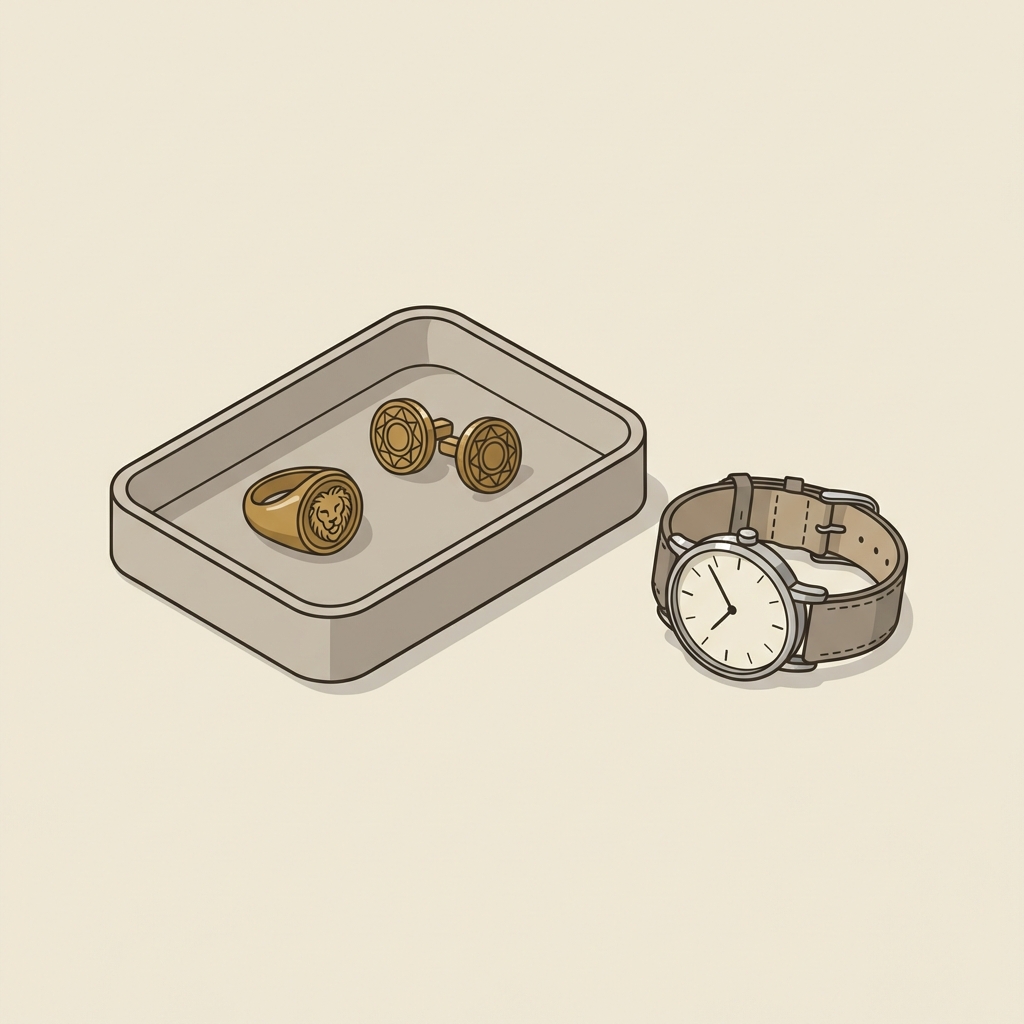
Avoid wearing a historical ring during manual labour, contact sports, or activities involving water and cleaning solvents. These situations increase the risk of loss or damage and are commonly cited reasons curators advise limiting wear of fragile artifacts British Museum guidance on handling.
Common mistakes and pitfalls when buying or wearing ancient signet rings
A frequent mistake is assuming documentation is complete when it is partial; always ask sellers for specifics about collection history, dates of acquisition, and any supporting letters or catalogue references rather than accepting general provenance phrases. Partial records require careful scrutiny because they change the piece's assessment for wear.
Another pitfall is prioritising motif appeal while neglecting condition or fit. A beautiful intaglio may sit in a thin bezel or on a hoop with hairline cracks that make everyday wear risky; ask targeted questions about the hoop, shoulders, and areas visible in close photographs V&A advice on evaluating rings.
Yes, with attention to proportion, context, and documentation; when the piece is an ancient signet ring, prioritise provenance, condition notes, and conservator advice before regular wear.
Lastly, avoid amateur repairs or resizing without professional advice; improper soldering or filing can irreversibly alter an artifact and complicate future conservation, documentation, or sale.
Practical examples and scenarios: everyday wear, formal events, and collector display
Everyday casual looks: for daily use choose an ancient signet ring with a simple motif and a modest bezel that sits flush with the finger so it does not catch on fabric. Pair it with neutral accessories and avoid stacking; proportion is especially important for a pinky ring to remain inconspicuous when that is the aim GQ styling guidance.
Formal and ceremonial contexts: when attending formal events, a slightly more ornate motif or a historically rich intaglio can be appropriate, ideally balanced by understated cufflinks or a watch. Keep documentation handy if the setting includes collectors or curators who may take an interest in the piece's history.
Collector use: many buyers decide to rotate occasional wear with display. A common approach is to use a ring for low-risk social events and keep it in controlled storage otherwise, with condition checks performed periodically. This compromise lets you enjoy wearable heritage while respecting conservation needs and provenance documentation Christie's overview of signet history. For guidance on whether to wear an antiquity periodically or keep it for display see related Q and A posts on our blog.
Conclusion: making a confident, informed choice about an ancient signet ring
To decide with confidence, prioritise provenance, clear condition notes, and appropriate sizing; these three factors together determine whether an ancient signet ring is a suitable item to wear rather than only to own. Documentation and restoration notes are the practical evidence buyers use to make that call British Museum signet ring guidance.
Next steps: measure carefully, request detailed photographs and condition reports, and if possible consult a conservator before wearing a fragile or heavily restored piece. When worn thoughtfully, a pinky ring can be a discreet way for a straight man to connect with wearable history while respecting the artifact's condition and story.
Resizing an ancient signet ring should only be done after consulting a conservator or specialist; reversible, minimal interventions are preferred and improper resizing can damage the hoop or alter documented condition notes.
Social meanings vary by region and professional setting; contemporary etiquette emphasises proportion and context over strict gender rules, so consider workplace norms and local expectations before regular wear.
Store documentation with the piece in padded, dry storage and keep digital backups of images and condition notes; include any restoration receipts or verification letters for future reference.
More from Aurora Antiqua
References
- Pliny the Elder, The Natural History, BOOK XXXIII, Perseus Digital Library, Tufts University (edition Bostock)
- Aulus Gellius, Attic Nights, Book X, LacusCurtius, Bill Thayer, University of Chicago (Loeb Classical Library edition)
- Signet Ring, Victoria and Albert Museum, London
- Ring, Victoria and Albert Museum, London
- A Corpus of Roman Engraved Gemstones from British Sites, University of Michigan Press / BAR Publishing
- William Wytlesey's ring, Victoria and Albert Museum, London
- Ring, The Cleveland Museum of Art
- Thumb Ring, The Cleveland Museum of Art
- BS EN ISO 8653:2026, TC, BSI, British Standards Institution
- Signet Ring, Victoria and Albert Museum