


Looking for the real thing? Browse our Ancient Roman ring collection, each piece one of one, individually authenticated, with documented provenance. For the background, see the guide to Roman jewelry.
Quick answer and what this article covers
Short canonical answer, gold roman numeral ring
The simple, canonical Roman‑numeral representation of the Arabic number 666 is DCLXVI, formed by the letters for 500, 100, 50, 10, 5 and 1 written in descending order; modern reference works explain this straightforward additive formation.
That form matters both when you are reading an inscription on an ancient ring and when a jeweller lays out numerals for a contemporary engraving, because the additive sequence dictates which letters appear and how much space they require on a bezel. For a clear reference on standard values and conventional forms consult the Encyclopaedia Britannica on Roman numerals Encyclopaedia Britannica.
See provenance and restoration details on @auroraantiqua
The article includes comparative examples and a practical checklist later on to help you evaluate inscriptions and plan engravings without making assumptions about symbolism.
What readers will learn and why it matters for rings
Readers will learn how to convert 666 into Roman letters, why that sequence is written additively as DCLXVI, how inscriptions show up on museum rings, and which condition and provenance notes to request when assessing a gold Roman numeral ring for purchase.
The guidance is aimed at collectors and history‑minded buyers who want practical steps for reading, verifying and commissioning numerals while respecting conservation concerns.
How Roman numerals work: rules and common forms
Values of the main symbols
Roman numerals use a small set of letters with fixed modern values: D for 500, C for 100, L for 50, X for 10, V for 5 and I for 1; these core symbols are the basis for converting Arabic numbers into canonical Roman strings, as summarized in modern reference charts Unicode Roman numerals chart.
Additive versus subtractive formation rules
In common usage numerals are formed by grouping symbols from largest to smallest and adding their values; subtractive pairs such as IV or IX are limited and only used in specific cases, which explains why many numbers are represented by straightforward additive sequences rather than by subtraction.
Understanding these formation rules helps when you are comparing an engraved string on a ring to a printed reference because the presence or absence of subtractive pairs changes which letters ought to appear.
Why 666 appears as DCLXVI: a step-by-step conversion
Breakdown of 666 into component symbols
To convert 666, split the number into component values: 500 + 100 + 50 + 10 + 5 + 1, which map directly to the letters D, C, L, X, V and I, yielding the ordered string DCLXVI; this mapping and the canonical form are confirmed in standard explanations of Roman numerals Roman numerals explained. For additional scholarly discussion see a chapter on number interpretation Methods at SAGE.
Each symbol contributes its full value in the additive system, so no subtractive notation is needed or used for this number, and the letters simply appear in descending order to show the total.
The Roman representation of 666 is the additive sequence DCLXVI. Collectors should use that canonical mapping when reading inscriptions, but must rely on high‑resolution photos, condition and restoration notes and provenance to decide whether an engraving is original, modern or symbolic.
Because there is no subtraction involved, the sequence reads as distinct letters, which can make engraving layout predictable but also lengthier than a few compact numerals might seem.
Historical use of numerals and inscriptions on Roman rings
Examples from museum collections
Roman rings and intaglios in museum collections show letters, names, workshop marks and occasional numerals cut or engraved into bezels and shanks, offering real examples of personal inscriptions on jewellery; see searchable collection pages for comparative examples Metropolitan Museum of Art collection search. You can also compare authentic pieces in our Ancient Roman Rings collection, and consult historical catalogues such as Catalogue of the Engraved Gems and Finger-Rings in the Ashmolean Museum, II: Roman, BAR Publishing, via Fulcrum.
What inscriptions commonly signified
Typical inscriptions recorded in collections include ownership marks, names, office titles, informal workshop marks or short dates; while engraved numerals occur, there is limited evidence that the apocalyptic symbolism later associated with the number 666 was commonly inscribed on personal Roman jewellery.
When you examine a ring with numerals, treat the inscription as one piece of evidence among condition notes and provenance rather than as proof of a particular symbolic reading.
Practical considerations for gold Roman-numeral rings
Bezel size and character count
Bezel area and overall ring proportions determine how many characters will fit legibly; long additive sequences such as DCLXVI require space or condensed lettering, so designers often choose compact capitals and test layouts before committing to engraving. For viewing related inventory see our Rings collection.

For an antiquity being offered for sale, look for explicit condition and restoration notes and high‑resolution images that show the bezel and any engraving clearly; sellers who provide provenance and well‑lit detail shots make it easier to judge how an inscription sits within the original design.
Font, capitals and preserving patina
Engravers commonly use classical capital forms to match historical appearance and to keep strokes even on small surfaces, and many conservation-minded buyers choose to preserve original patina rather than rework an inscribed area; professional guides recommend mockups so the layout, spacing and letter height are tested before any irreversible work is done GIA engraving and personalization guide.
Interpreting inscriptions: symbolism, dating and provenance
How to read symbolic claims cautiously
Symbolic interpretations are sometimes tempting, but a cautious, evidence‑first approach is better: tie symbolic readings to comparable archaeological examples or to secure provenance rather than assuming modern meanings apply to ancient wearers.
Tying an inscription to a date or workshop
Dating an inscription often requires stylistic comparison, metallurgical context and documented collection history; provenance and written documentation are central to making a credible case that an engraving is original to a particular period or workshop.
Request written provenance and condition notes whenever a purported date or workshop attribution affects your interpretation.
How to verify and document a ring with Roman numerals before buying
Checklist for photos and documentation
Ask the seller for high‑resolution macro photos of the bezel, profile shots showing setting and shank, interior marks and any hallmarks, plus full‑ring views; these images allow inspection of character shapes, tool marks and surface condition before a purchase decision.
Photo and documentation checklist for inscribed rings
Use high resolution images
Also request written restoration or condition notes that describe any stabilisation, filled losses or replaced components so you can assess whether an engraving might have been altered or affected by repairs, and consider a third‑party inspection if inscription authenticity would change the object’s interpretation.
When to request third-party reports
When an inscription is central to meaning or value, ask for independent specialist reports or a condition report from a conservator; third‑party input can clarify whether tool marks and letter forms are consistent with ancient techniques or with later modern tooling.
Common mistakes and red flags when reading numerals on artifacts
Misreading worn or corroded characters
Wear, corrosion, polishing or accreted surface deposits can change letter shapes and lead to misreads, so always compare multiple images and, when possible, examine lighted angles that reveal incision depth and stroke direction.
Assuming modern engraving conventions always apply
Be wary of overly regular lettering, new tool marks, or lettering styles that match contemporary engraving fonts rather than historic forms; inconsistencies between a ring’s condition notes and its lettering are a practical red flag.
When in doubt, ask the seller to describe how the inscription was recorded in prior catalogues or collection entries rather than relying solely on photos.
Examples and scenarios: reading inscriptions on modern engraved rings versus ancient pieces
Comparison of design choices
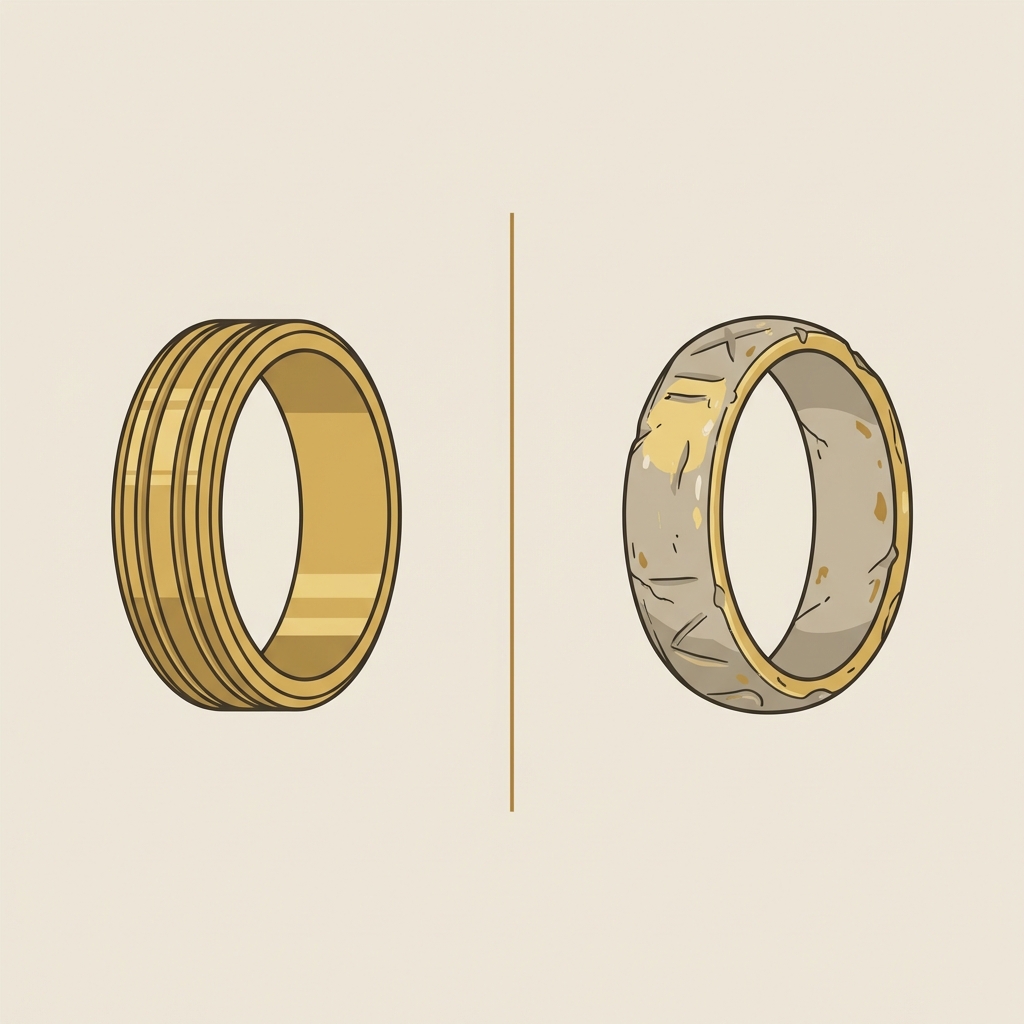
Modern engraved commemorative rings often use mechanised tools and contemporary fonts designed for consistency, while museum examples typically show hand‑cut irregularities, signs of wear and stylistic variation that reflect period workshops and use; engraving guides can help distinguish modern tool signatures from hand‑cut forms GIA engraving and personalization guide. See marketplace examples such as custom Roman numeral rings on Etsy.
How context changes meaning
The same letter string may be a modern personalization on one piece and an ancient ownership mark on another; strong provenance and clear condition notes change the likely reading of an identical inscription, which is why collectors should compare listings and collection records rather than assume identical meaning.
When sellers present both high‑res photos and provenance notes, you can usually separate likely modern additions from original engraving by comparing style, tool marks and documented collection history.
How to commission accurate Roman-numeral engraving today
Choosing lettering, testing templates and conservation preferences
If you commission a gold Roman numeral ring, test the layout on paper or wax templates and confirm the capital forms and spacing with the engraver before work begins; small bezels may favour condensed capitals or short sequences, so mockups prevent overcrowding.
Specify conservation preferences in writing, for example whether any existing patina should be preserved, and treat the engraving as a design decision that should respect the object’s age and any prior repairs; professional engraving guides outline safe practices for personalization and conservation GIA engraving and personalization guide.
Communicating condition and restoration preferences to an engraver
Be explicit about areas to avoid and whether the engraver should work only on a new insert or a modern surface rather than on historically significant patina; clear written instructions reduce the risk of irreversible changes.
Conservation and restoration notes to watch for with ancient rings
What restoration descriptions should include
Good restoration notes record stabilised areas, filled losses, replaced mounts or shanks, and any cleaning or polishing performed, giving you the context needed to judge whether an inscription was affected by treatment.
How repairs affect visual reading of numerals
Repairs near an inscription can shift letter spacing or obscured stroke ends; when restoration affects an inscribed area, ask for before‑and‑after photos and a conservator’s note so you can see how the treatment changed the appearance.
Sellers who provide clear restoration notes and photographic evidence make it easier to decide whether a numeral sequence like DCLXVI is original or altered.
Short case studies from collections and listings
Museum example highlights

Major collections include examples of inscribed Roman rings that illustrate a range of practices from owner names to workshop marks; consulting museum records helps you see authentic letter forms and common placements on bezels and shanks Metropolitan Museum of Art collection search.
Aurora Antiqua listing as a reference
An illustrative listing from a specialised dealer shows how condition notes, provenance description and clear photos are presented together to help buyers evaluate inscriptions; when sellers combine documentation with detailed images it becomes feasible to compare an offered ring to museum examples rather than to rely on description alone Aurora Antiqua listing. For related reading see our Roman Empire blog.
Summary: what to remember about 666 and Roman numerals on rings
Key takeaways
The canonical Roman‑numeral form for 666 is DCLXVI, an additive sequence of D, C, L, X, V and I written in descending value, and that form is what you should expect to see when translating or laying out the number for engraving Encyclopaedia Britannica.
Practical next steps for buyers
When assessing a gold roman numeral ring, prioritise high‑resolution photos, written restoration and condition notes, and clear provenance; request mockups before commissioning modern engraving and consider specialist input when an inscription affects interpretation.
Major collections include examples of inscribed Roman rings that illustrate a range of practices from owner names to workshop marks; consulting museum records helps you see authentic letter forms and common placements on bezels and shanks Metropolitan Museum of Art collection search.
The standard Roman‑numeral representation of 666 is DCLXVI, formed additively from the letters for 500, 100, 50, 10, 5 and 1.
Roman rings do show inscriptions and occasional numerals, but there is limited evidence that the specific symbolic number 666 was commonly inscribed as a motif on personal jewellery.
Request high‑resolution macro photos, written condition and restoration notes, any provenance or prior ownership documentation, and consider a third‑party inspection if the inscription affects interpretation.
More from Aurora Antiqua
References
- Signet Ring, Victoria and Albert Museum, London
- Catalogue of the Engraved Gems and Finger-Rings in the Ashmolean Museum, II: Roman, BAR Publishing, via Fulcrum
- Fund des Monats August 2019 (Find of the Month), Landesamt für Denkmalpflege und Archäologie Sachsen-Anhalt
- A Corpus of Roman Engraved Gemstones from British Sites, University of Michigan Press / BAR Publishing
- Talismans, Visitatori salutem, Szepmuveszeti Muzeum / Museum of Fine Arts, Budapest
- Object ID, International Council of Museums
- Hallmarking Act 1973, UK Government, legislation.gov.uk (The National Archives)