


Looking for the real thing? Browse authenticated ancient rings, each piece one of one, individually authenticated, with documented provenance. For the background, see the guide to ancient jewelry.
Short answer: Is there a Scottish version of the ancient claddagh ring?
Shortly put, the named ancient claddagh ring, defined by the hands-heart-crown motif, is best understood as an Irish iconographic type tied to Galway in the early modern period, and it does not have a separately attested Scottish counterpart under the same name; Scotland instead offers related forms that served similar social roles.
Not as a named, regionally attested type; the Claddagh is an Irish motif from Galway, while Scotland produced gimmel and posy rings that served similar social purposes but differ in form and diagnostic features.
For collectors and curious readers this means that when a listing calls an item a Scottish Claddagh, the safer interpretation is to treat that label as an interpretive shorthand rather than a precise attribution, and to expect instead to see gimmel or posy type features if the piece is genuinely Scottish in origin. When a concrete historical description of the Claddagh is needed, museum and reference summaries provide the conventional framing of the motif and region Claddagh ring.
What the Claddagh actually is: origin, iconography and dating
The Claddagh is primarily an iconographic design, recognised for the hands-heart-crown motif, and it is conventionally associated with Galway in Irish histories and summaries; the motif is identified by its visual elements rather than by a mechanical construction or a particular inscription style Claddagh ring.
Dating references typically place the emergence and popularisation of the Claddagh motif in the early modern centuries, commonly framed around the 17th to 18th centuries in secondary literature; such dates are presented as conventional estimates based on surviving examples and recorded accounts rather than precise workshop invoices The history and symbolism of the Claddagh ring.
Scottish analogues: gimmel and posy rings in context
Scotland does not appear to have a distinct Claddagh type that matches the hands-heart-crown motif as a named national emblem; instead, collectors and historians point to gimmel rings and posy rings as close functional analogues used across Britain, including Scotland, for betrothal and friendship purposes British Museum collection.
quick visual comparison of ring features
Use while viewing listing photos
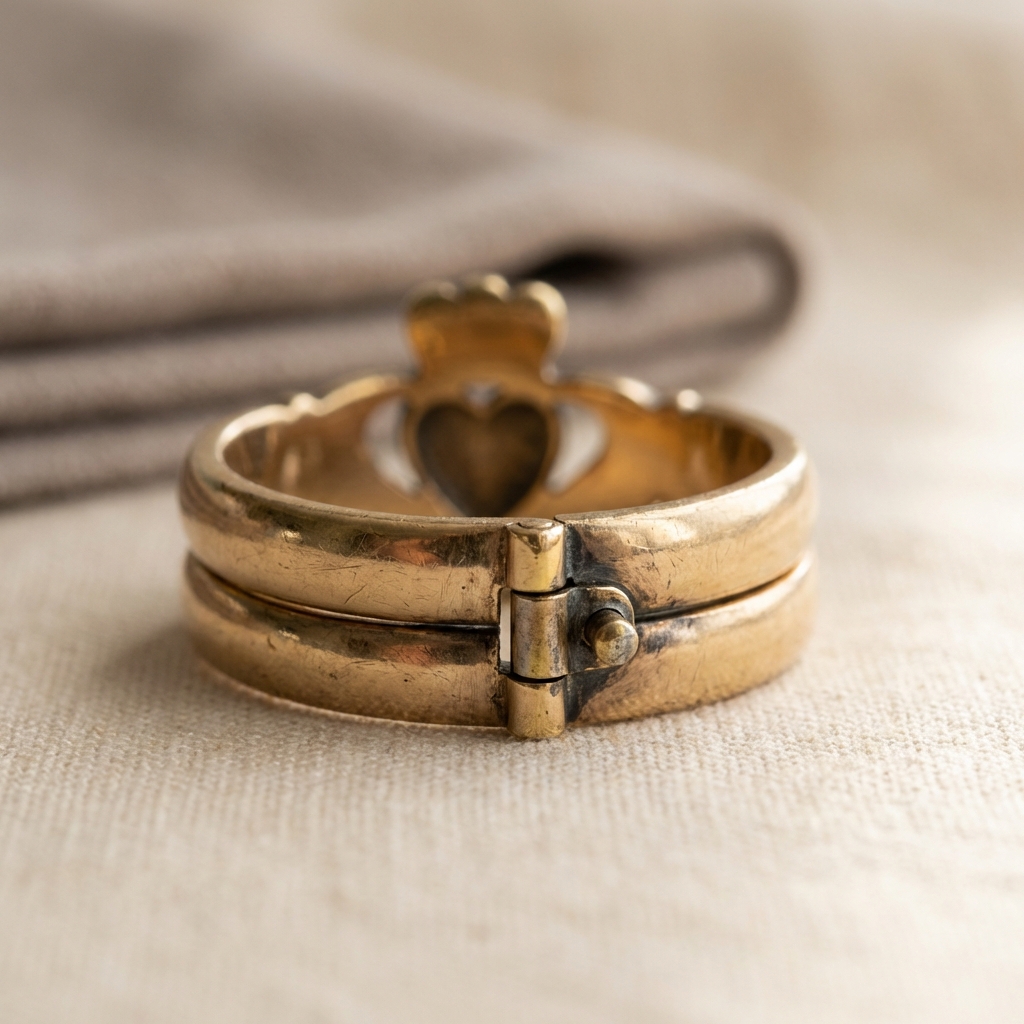
Gimmel rings are mechanically composite, made as two or more interlocking bands that close to form one ring, while posy rings are typically single bands with short interior inscriptions; both types were known in Scotland and across Britain and can perform the same social functions the Claddagh served in Ireland Posy rings. For a working example of a gimmel ring in a museum collection see the V&A record Gimmel Ring | V&A.
How gimmel rings work: form, dating and Scottish examples
Gimmel rings, often written Gimmal in older catalogues, are identifiable by their linked construction: two or three bands that articulate at matching joins or small hinges so the separate parts rotate or nest together to make a single wearable band; these mechanical features are diagnostic and highly useful when assessing provenance and dating British Museum collection. See a specific British Museum example here: Gimmel-ring (British Museum object).
Collectors should look for clear photographs of the joins, any surviving hinge pins, matching tool marks across the component bands, and consistent patina where the pieces meet, because these technical clues are far more reliable for attribution than a seller's headline; specialist surveys of gimmal rings also frame their use from the late medieval into the early modern period across Britain, including Scotland Gimmal and posy rings: technical features and social use.
Posy rings: inscriptions, motifs and use in Scotland
Posy rings are simple bands that carry short engraved verses, mottos or dedications on the interior surface, and they were commonly exchanged as tokens of affection or commitment in England and Scotland from the 16th to the 18th centuries; the inscription content, language and script are often key clues to dating and regional origin Posy rings.
When assessing a posy ring, clear photographs of the interior inscription are essential because the wording and letter forms can sometimes indicate local language use, dialectal spellings or script style that help narrow a probable date and place of manufacture Scottish jewellery: rings, love tokens and betrothal practices. See an NMS item record for a comparative finger ring NMS finger ring record.
Key visual and technical differences: Claddagh versus gimmel versus posy
At a glance the three types can be discriminated by form: the Claddagh is recognisable by raised iconography, the gimmel by its multiple bands and mechanical joins, and the posy by interior engraved text; understanding this distinction helps prevent mislabelling in listings and auctions Claddagh ring.
In photos, look for raised sculptural elements for iconography, visible seams or hinge plates for mechanical assembly, and clear images of the inner band for inscriptions; overlap is possible, for example a ring formed of joined bands that also carries an internal inscription, and in such cases multiple lines of evidence are needed British Museum collection.
How collectors can evaluate claims of Scottish origin
Start with hallmarks and assay marks: when present, these marks provide formal dating and place-of-assay clues that are often decisive; ask sellers for close-ups of any marks and request transcriptions of stamped letters and symbols so they can be checked against assay records Gimmal and posy rings: technical features and social use.
Aurora Antiqua acts as a curator and reference layer for buyers by emphasising condition notes, documented provenance when available, and restoration summaries to help place a piece within comparative material culture. Visit the Aurora Antiqua store for more information.

When hallmark evidence is absent or inconclusive, technical features such as matching joins on a gimmel, the patina development at join lines, and the hand-engraved character of a posy inscription are the next best indicators; photograph requests should therefore prioritise these views and any visible tool marks that indicate manual fabrication Posy rings.
Common mistakes and red flags in online listings
Sellers commonly conflate motif with origin, for example applying the Claddagh label to any ring described as expressing love or friendship; this overreach is a common mistake and one reason to prefer technical evidence over promotional language Scottish jewellery: rings, love tokens and betrothal practices.
Red flags include photos that crop out hallmark areas, inscriptions that appear machine-etched rather than hand-incised, inconsistent patina where repairs are claimed, and modern solder visible under magnification; in those cases request higher magnification images and explicit restoration notes before considering purchase Gimmal and posy rings: technical features and social use.
A practical buying checklist for an ancient claddagh ring or Scottish analogue
Photos and measurements to request: full-band profile, close-up of any hallmarks, interior inscription images with scale, detailed shots of joins or hinges, and a clear image of the stone or bezel if present. These views let you read marks and assess mechanical joins that are critical for attribution British Museum collection. You can also compare listings to items in our rings collection.
Documentation and condition items to verify: provenance notes or collection history, any verification letters, written restoration notes that state what was stabilised or repaired, exact measurements and weight, and an explicit statement about whether any testing was done on metal or stones. Ask sellers for a dated provenance chain where possible and copies of any conservator reports Gimmal and posy rings: technical features and social use.
Care, conservation and how restoration is reported
Restoration and preservation notes should state what work was undertaken, whether stabilisation or active repair was done, the materials used in any repair, and the conservator or workshop responsible; clear notes help collectors understand how an object was treated and what to expect in handling Gimmal and posy rings: technical features and social use.
For basic handling and storage, avoid harsh cleaning, store rings away from reactive metals or damp conditions, and use soft padded boxes with inert supports; if a piece shows loose joins, flaking corrosion or unstable stones, consult a professional conservator rather than attempting household repair Scottish jewellery: rings, love tokens and betrothal practices.
Use a three-step framework: first visually classify the piece by iconography, mechanical structure and inscription; second verify technical markers such as hallmarks, joins and tool marks; third check provenance and catalogue references or accession numbers. This method keeps attribution work transparent and repeatable.
Comparative case study framework: how to compare catalogue examples
What would shift an attribution? Convincing hallmarks that match Scottish assay offices, matching workshop tool marks across components, or a clear provenance chain into a recognised Scottish collection would all strengthen a Scottish attribution; conversely, a clearly identifiable hands-heart-crown motif with Irish provenance would argue for an Irish Claddagh reading The history and symbolism of the Claddagh ring. Compare also to items in our Celtic Rings collection.
Where to research further: museums, catalogues and specialist literature
Start with national collection databases such as the British Museum, the V&A and National Museums Scotland to find comparable entries and catalogue descriptions, because institutional records often record technical details and accession histories that commercial listings omit British Museum collection.
Specialist journals and catalogues, and published surveys of gimmal and posy types, are useful for technical comparanda and for reading articles that discuss social use and dating; where possible request accession numbers and catalogue citations to follow a trail into primary records Gimmal and posy rings: technical features and social use.
Open questions for researchers and curators
Cataloguing work across Scottish institutional records remains incomplete or dispersed, which leaves open questions about whether some Scottish workshops produced Claddagh-like iconography in any sustained way; targeted primary-catalogue work would clarify whether hybrid designs exist and where they were made Scottish jewellery: rings, love tokens and betrothal practices.
Researchers might prioritise cross-collection searches for similar motifs or hybrid pieces, systematic recording of tool marks and assay data, and digitisation of previously unindexed accession notes to make workshop-attribution patterns more visible.
Conclusion: a practical verdict for collectors
In summary, the Claddagh is best read as an Irish iconographic type closely associated with Galway, while Scotland supplied functional analogues-gimmel and posy rings-that fulfilled similar love and betrothal roles; reading a listing that claims a Scottish Claddagh therefore requires careful technical and provenance checks rather than acceptance of the label on faith Claddagh ring.
Practical next steps are straightforward: ask for full images of hallmarks, joins and inscriptions, request restoration and provenance notes, compare the item to institutional examples, and, when in doubt, seek a specialist opinion or conservator report before purchase; careful curation and documentation are the best protections for buyers of one of a kind ancient rings Gimmal and posy rings: technical features and social use.
No, the Claddagh design as a named hands, heart and crown motif is conventionally associated with Ireland, especially Galway; Scotland has related ring types but not the same named tradition.
Gimmel rings and posy rings are the closest functional analogues in Scotland and Britain, used for betrothal and friendship, though they differ in construction and markings.
Request clear close-ups of hallmarks, interior inscriptions, joins or hinges, and written provenance and restoration notes; these items are essential to assess origin and authenticity.
More from Aurora Antiqua
References
- Claddagh Rings, National Museum of Ireland, Dublin
- Posy ring, London Museum (formerly Museum of London)
- About us, International Association of Dealers in Ancient Art
- Object ID, International Council of Museums
- Research report: export licensing and provenance, GOV.UK, Department for Culture, Media and Sport (DCMS)
- E.C.C.O. Professional Guidelines (II): Code of Ethics, European Confederation of Conservator-Restorers'
- Decoding the Jewels, Sidestone Press, published with National Museums Scotland
- Catalogue of the Engraved Gems and Finger-Rings in the Ashmolean Museum, II: Roman, BAR Publishing, via Fulcrum
- Publication 561 (12/2025), Determining the Value of Donated Property, Internal Revenue Service (IRS), USA
- Claddagh ring, Wikipedia