


Looking for the real thing? Browse genuine ancient rings for sale, each piece one of one, individually authenticated, with documented provenance. For the background, see the guide to buying ancient artifacts.
What an ancient Claddagh ring is and why authenticity matters
Origins and typical forms of the Claddagh motif, ancient claddagh ring
An ancient Claddagh ring is an example of an ancient ring type carrying the familiar heart and hands motif, usually set above a hoop and, in older examples, mounted with simple bezels and occasional small intaglios or stones. The motif itself has deep roots in Irish decorative traditions and appears across a range of historic rings held in museum collections, but care is needed when assigning a firm date to any single object.
For collectors, authenticity matters because it affects how the piece is described, conserved, and contextualised. A confirmed antiquity changes conservation choices, what condition notes emphasise, and the kinds of provenance information to seek. This is about trustworthy interpretation and responsible collecting, not assurances about financial outcomes.
In practice, authenticating a Claddagh ring is a layered process. The four main lines of inquiry used by dealers and specialists are: check official hallmarks and maker marks, perform non destructive metal testing such as XRF, compare stylistic and wear features with documented museum examples, and verify provenance with independent appraisals when needed. These steps together increase confidence in an attribution.
For context, museum collections provide many of the comparative examples specialists use when dating and describing Claddagh rings. The National Museum of Ireland and similar collections document notable examples with condition and dating notes that are useful comparison points.
Quick verification workflow: a buyer's first checks
Step 1: Start with close photographs and a careful visual inspection. Look for any hallmarks or maker marks on the inner hoop, under the bezel, or on the shoulders. Record the ring size, visible repairs, and any unusual features before asking for further information from the seller.
Step 2: Request non destructive testing results, ideally an XRF summary. If a seller cannot provide testing or clear hallmarks, plan to pause until you can obtain either clear photographs for a specialist to assess or an independent test report. Beginning with marks and photos conserves time and expense while exposing obvious inconsistencies early.
Step 3: Compare the ring's basic design elements with trusted museum examples, focusing on bezel shape, band profile, engraving style, and wear consistent with age. Small stylistic details can indicate a likely period or reveal modern tooling marks that suggest reproduction.
Step 4: If hallmarks are present and match known assay charts, that is strong initial evidence. If hallmarks are absent or inconclusive, follow up with non destructive testing and consider an independent appraisal. This ordered workflow is the standard used by specialists in 2024 to 2026 and helps buyers manage risk efficiently.
Follow @auroraantiqua for behind the scenes finds and authentication tips
Save or download the printable checklist later in this guide for reference when evaluating a listing or an estate piece.
How to document what you see: take at least five clear images, including an overall oblique view, a closeup of the bezel, a full shot of the inner hoop, and detail shots of any marks or repairs. Use a plain, neutral background and consistent lighting, and include a millimetre scale or ruler where possible.
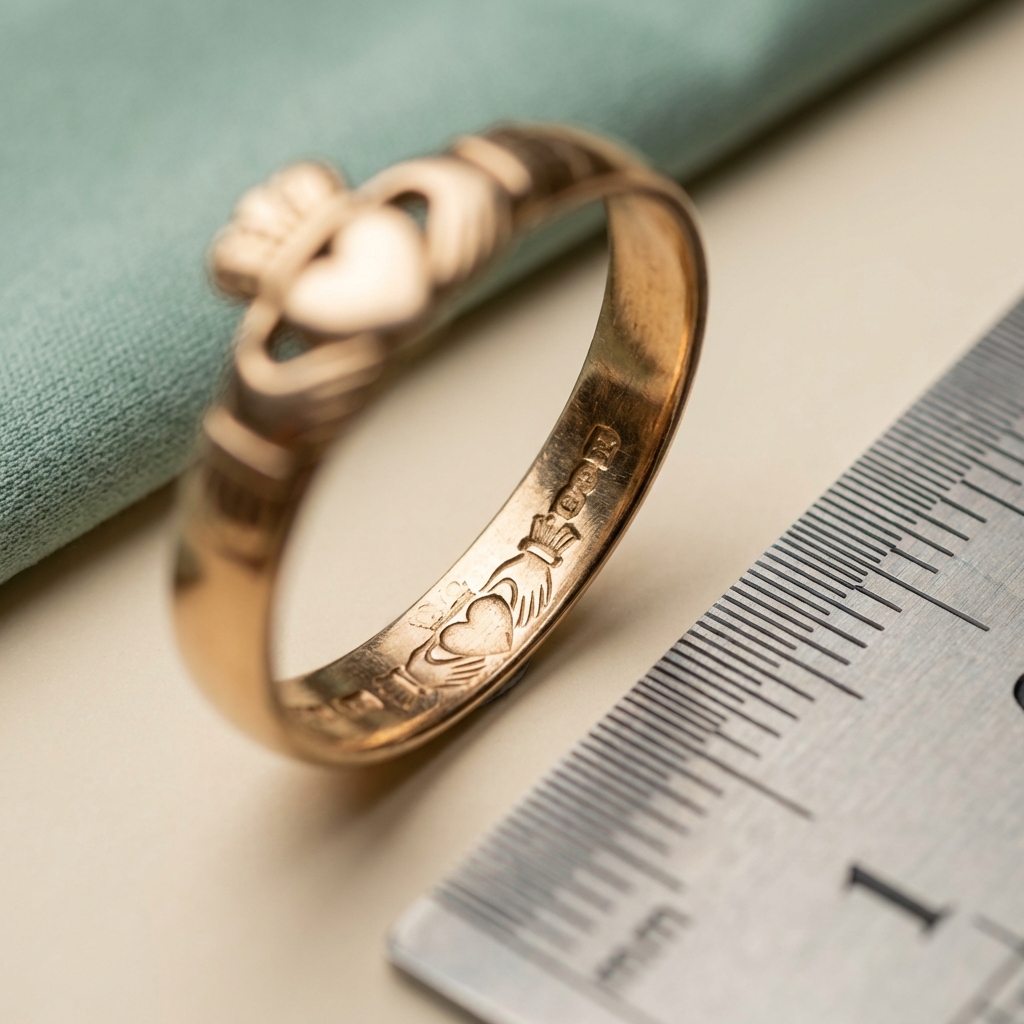
Immediate red flags that should prompt a pause include mismatched metal tones where solder joins are visible, hallmarks that look inconsistent with the metal, or modern solder lines across historic wear patterns. These indicators do not prove forgery by themselves, but they increase the need for testing and expert review.
Reading hallmarks and maker marks
Common UK and Irish assay marks to know
The primary role of official assay and hallmark guides is to verify precious metal fineness and to offer date and place marks when present. When hallmarks are legible, they can materially strengthen an attribution by linking an item to a known assay office and a period, and the assay offices publish charts and guidance to help users decode marks The Goldsmiths' Company assay guidance. The Dublin Assay Office also publishes a detailed hallmarking process Dublin Assay Office hallmarking process.
Photograph any marks with a macro lens or a high resolution phone camera and label each image with its location on the ring. Even partial marks can be useful, because assay-office charts and registries allow partial matches based on symbol shape, letter style, and sequence.
Use assay-office hallmark charts and searchable registries to compare marks you have recorded. The Birmingham Assay Office and others explain how to read date letters and maker marks, which can help narrow the possible time range for a marked ring Birmingham Assay Office hallmark guide. Free tools such as a hallmark finder also help decode marks.
When marks are worn, blurred, or absent, remember that absence of marks does not automatically mean inauthenticity. Many historic rings circulated before modern hallmarking regimes or had marks obliterated by wear or repair. Lack of marks, however, increases the value of lab testing and specialist assessment.
When absence of marks matters
If a ring lacks any assay marks, insist on an independent metal test and clear provenance. A non marked silver ring may still be old, but you will need more corroborating evidence to arrive at a confident attribution. Recording the absence of marks with photographs is also important for any future appraisal or dispute.
Non destructive testing and laboratory checks
How XRF testing works and what it reveals
XRF, or X ray fluorescence, is a non destructive instrumental technique commonly used by jewellers and laboratories to confirm metal composition without damaging historic pieces. It produces a concise summary of elemental composition that can help distinguish modern alloys from older metal mixes and is widely used in professional practice GIA guidance on XRF testing. The London Assay Office also describes hallmarking methods and testing approaches for assay and hallmark verification London Assay Office hallmarking methods.
Typical XRF outputs list elemental percentages or relative intensities for silver, copper, gold, and other trace metals. Compare those numbers with expected alloy ranges for the period in question, but treat results as one part of the evidence because surface enrichment or corrosion layers can influence readings.
Begin by photographing any hallmarks and the ring overall, request or arrange non destructive metal testing such as XRF, compare stylistic details with museum examples, and obtain an independent appraisal when uncertainty remains.
When asking a seller or laboratory for an XRF summary, request a simple table or statement that shows the major elements detected, the instrument type if available, and the date the test was done. If a local jeweller offers XRF, ask whether the machine is calibrated and whether the test captures a representative reading of the ring surface.
If XRF is inconclusive or suggests conflicting evidence, an accredited laboratory or a conservator can add microchemical testing or metallurgical assessment and advise whether sampling would be necessary for definitive results. In many cases, an accredited lab report combined with stylistic comparison and provenance will resolve most questions.
When to ask for lab reports or conservator checks
Ask for a lab report when marks are missing, when the alloy composition looks inconsistent with the seller description, or when the ring is being offered at a price that would warrant further verification. Conservators can also advise on condition and on whether prior restorations could have altered hallmark areas or surface composition.
Arrange testing through reputable local laboratories, museum conservation departments, or specialist jewellery laboratories. Make sure you receive a dated report, a description of methods used, and either the raw XRF readout or a clear summary that you and an independent expert can review.
Stylistic comparison: dating by design and wear
Key stylistic features to compare
Stylistic comparison uses observable design features to estimate date and workshop practice. For Claddagh rings key markers include bezel shape, how the heart and hands are modelled, band profile thickness, engraving depth and style, and how the shoulders transition into the bezel. These details, examined against museum examples, can indicate nineteenth century forms, later revivals, or recent reproductions.
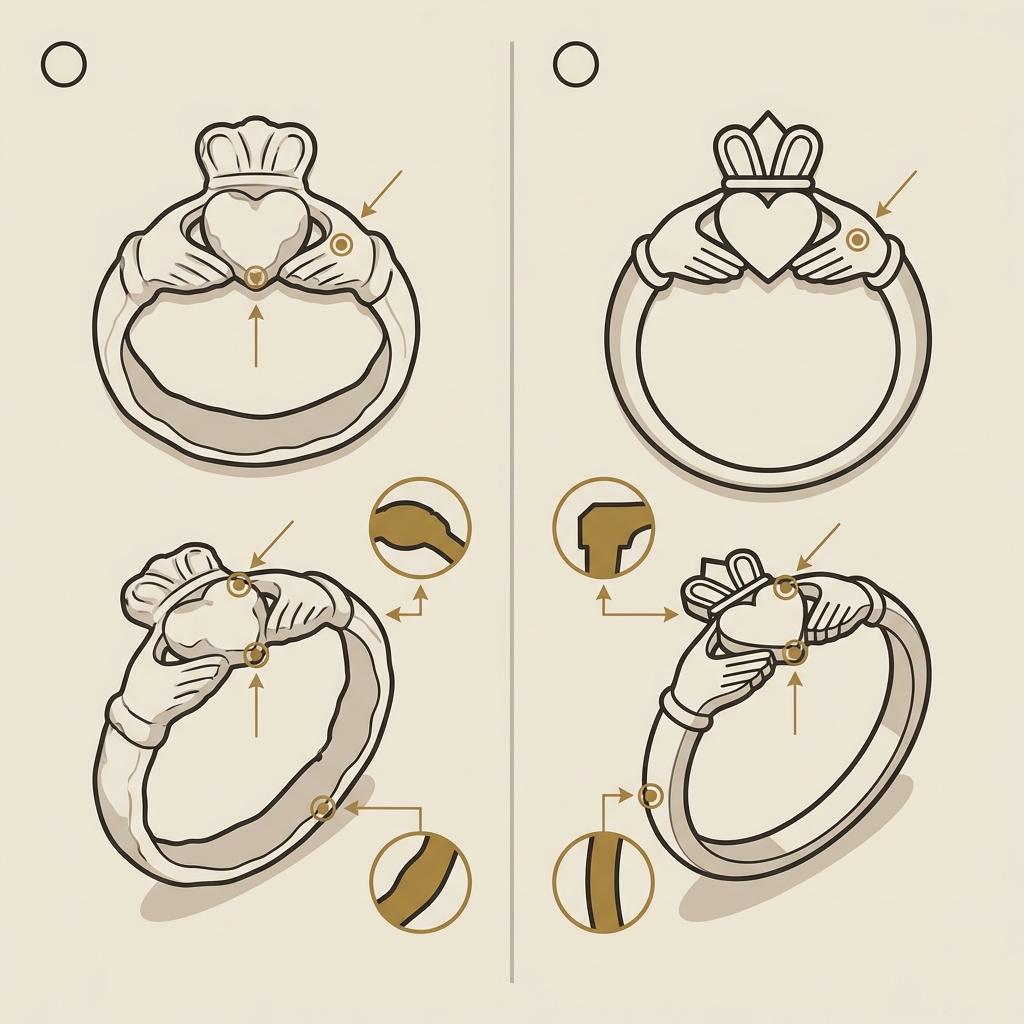
Avoid relying on a single stylistic trait. Reproductions can copy a bezel shape or motif but often miss subtleties in tool marks and finishing. A systematic comparison across several stylistic markers reduces the risk of being misled by a single matching detail.
Examples from museum collections
Consulting museum catalogues and object essays helps ground visual comparison in documented precedent. The Victoria and Albert Museum and other institutions publish essays and images that show how variants in the Claddagh motif developed and how regional workshop habits affected form over time V and A object essay on the Claddagh ring.
When you find a good match in a museum entry, note the documented attributes and condition notes and compare them point by point to the offered ring. Use those comparisons in correspondence with a seller or a specialist to frame precise questions about dating and restoration history.
Provenance, documentation and independent appraisals
What provenance documents add
Clear provenance elements such as documented collection history, prior ownership notes, and independent specialist letters or certificates materially strengthen an authenticity case. Provenance shows the path an object took, and when documentation ties a ring to a dated collection entry or sale catalogue it becomes stronger evidence rather than a standalone claim Journal review on provenance and authentication.
However, paperwork can be incomplete or forged, so every document should be checked. Cross check seller statements against catalogue references, collection inventories, and any available stamps or accession numbers. When possible, request scans of original invoices, catalogue entries, or collection records rather than brief summaries.

How to verify certificates and collection history
Practical steps to check provenance include verifying named previous owners through independent catalogues, checking for matching accession numbers in institutional records, and asking where the object was conserved. If you receive a certificate, examine the credentials of the issuing specialist and whether the language and methods match established practices for jewellery reports.
When provenance is partial, treat it as a useful clue but not conclusive proof. Combine partial provenance with hallmark checks, XRF results, and stylistic comparison to form a probability based judgement about authenticity. If uncertainty remains, obtain an independent appraisal from a conservator or accredited laboratory before completing a transaction.
Common mistakes, red flags and a final decision checklist
Typical authentication errors to avoid
Common errors include overreliance on surface appearance alone, taking seller supplied paperwork at face value, and misreading partial hallmarks as complete matches. Visual similarity to a museum example is helpful, but reproductions often copy a few visual cues while omitting others that require close inspection. Readers can also reference the site's Q and A on the Claddagh ring curse what is the Claddagh ring curse.
Another frequent mistake is ignoring the condition of hallmark areas. Repairs and rebands can remove or obscure marks, and restoration work can introduce later solder or alloys that confuse simple visual inspection. When in doubt, escalate to testing and specialist advice.
A printable checklist to use before buying
Use this short checklist as a minimum before committing to a purchase: 1) Request clear photographs of the ring including inner hoop and any marks, 2) Ask for an XRF summary or arrange testing if marks are absent, 3) Compare the ring to at least two museum documented examples for stylistic matches, 4) Request provenance documents and check issuing specialist credentials, 5) Obtain an independent appraisal when conflicting evidence remains. See the Q and A on how to wear a Claddagh ring if you're single for practical wearing guidance how to wear a Claddagh ring if you're single.
If evidence conflicts or remains inconclusive, pause and ask for a third party report. An independent conservator or accredited laboratory can often resolve discrepancies, or at least describe which tests would be required to reach a higher confidence level.
How to proceed: buying, selling or getting an appraisal for an ancient Claddagh ring
If you decide to buy
If you choose to move forward with a purchase, collect and record all documentation before transfer. Ask the seller for dated photographs, any XRF or lab reports, detailed condition notes, and a clear statement of provenance. Keeping a single folder with these files helps if you later commission an independent appraisal. See guidance on who is supposed to buy a Claddagh ring who is supposed to buy a Claddagh ring.
Negotiate terms that allow you to return the item if an independent appraisal reveals major inconsistencies. If a seller refuses reasonable verification steps, treat that reluctance as a cautionary sign and consider walking away or arranging third party testing before payment.
Quick online check of assay office hallmark charts and registries
Use official assay charts for matching
If you need further expert help
To commission an appraisal, contact a qualified jewellery conservator or an accredited laboratory that issues written reports with method descriptions. A useful appraisal will list examined marks, testing performed, stylistic comparators, and an opinion on the degree of confidence in any attribution.
When you receive a report, check whether the appraiser used non destructive methods such as XRF and whether they referenced museum comparators or assay office charts. If the report remains ambiguous, ask which further tests would materially change the level of confidence and whether sampling would be required for a definitive result.
Summary of the best practice workflow: examine hallmarks and maker marks first, request or obtain non destructive metal testing, compare stylistic features with museum examples, and secure an independent appraisal when doubt remains. Treat authenticity as a probability based judgement built on multiple independent lines of evidence.
Look for modern machine finish, inconsistent soldering lines, sharply cast motifs without wear on high points, and hallmarks that do not match known assay charts; these suggest reproduction but further testing is needed.
No, XRF provides metal composition which helps rule out modern alloys but should be combined with stylistic comparison, hallmark checks, and provenance for a stronger attribution.
Not necessarily. Many older rings lack marks due to age or repair. Absence of marks increases the need for XRF testing and an expert appraisal before purchase.
More from Aurora Antiqua
References
- Claddagh Rings, National Museum of Ireland, Dublin
- Richard Joyce and the oldest known Claddagh ring, Galway City Museum
- The King of Claddagh · Mainistir Phádraig Naofa · Bailiúchán na Scol, Dúchas.ie, National Folklore Collection
- The History of The Assay Office, The Company of Goldsmiths of Dublin, The Assay Office (Dublin Castle)
- Compulsory Marks, The Company of Goldsmiths of Dublin, Assay Office Dublin Castle
- Hallmark Identification, The Company of Goldsmiths of Dublin, The Assay Office (Dublin Castle)
- Legislation, The Company of Goldsmiths of Dublin, Assay Office Dublin Castle
- S.I. No. 441/2019, Hallmarking (Irish Standards of Fineness) Regulations 2019, Electronic Irish Statute Book
- Hallmarking, The Goldsmiths' Company, The Goldsmiths Company Assay Office
- Hallmarking Process, Assay Office Dublin