


Looking for the real thing? Browse our full ring collection, each piece one of one, individually authenticated, with documented provenance. For the background, see the guide to ancient jewelry.
What an ancient Claddagh ring is and where the tradition comes from
An ancient Claddagh ring is a closed hoop bearing a hands-heart-crown motif that, in modern cultural references, represents friendship, love and loyalty; the object is conventionally traced to the Claddagh village near Galway, Ireland, and its symbolism is central to how people buy and give the ring today, as described by standard cultural sources Encyclopaedia Britannica and related histories CladdaghRings.
The three visual elements have a straightforward reading that helps explain why the ring functions as a social token: the hands can signify friendship, the heart love, and the crown loyalty or fidelity, a combination that makes the ring suitable for multiple kinds of giving and exchange rather than a single formal use Claddagh Ring Museum.
While the motif and local stories are well known, scholarly literature also records uncertainty about early makers and precise timelines, and some attributions rely on later popularisation in the 18th and 19th centuries rather than contemporary maker records; this means claims of substantially earlier origins should be treated with caution and checked against documentation Journal of the Royal Society of Antiquaries of Ireland.

Who traditionally buys or gives a Claddagh ring
Historically and in many modern Irish contexts the Claddagh has been given by a romantic partner as an engagement or wedding token, a practice that remains widely recognised and that helps explain why partners commonly seek the ring for proposals or marriage gestures Encyclopaedia Britannica.
Follow @auroraantiqua for provenance and restoration insights
Before you buy any older Claddagh, read the listing's condition and provenance notes carefully to understand what you are paying for.
Beyond romantic use, the ring is also frequently exchanged between friends and family as a friendship or heirloom token, a social function that fits the hands-heart-crown motif and which means many buyers are not looking for a formal engagement ring but for a meaningful personal exchange The King of Claddagh · Mainistir Phádraig Naofa · Bailiúchán na Scol, Dúchas.ie, National Folklore Collection.
Tourists and members of the Irish diaspora form an important buyer group as well; people who seek a tangible connection to Irish heritage will buy the ring as a souvenir, a gift to family, or a wearable reminder of identity, sometimes without the formal wearing rules used locally BBC Travel and with broader context on Irish jewellery traditions My Irish Jeweler.
These buyer types overlap in practice: a single listing might attract a partner buying for a proposal, a family member looking for an heirloom, and a visitor seeking a cultural souvenir, which is why sellers and curators often present multiple use suggestions in their descriptions without implying a single correct way to own the ring. See our Q and A on who typically buys a Claddagh ring who is supposed to buy a Claddagh ring for more buyer-oriented framing.
Wearing conventions and what they tell you about the wearer
One of the practical reasons the Claddagh ring is used in engagements and friendships is that its wearing conventions can communicate relationship status at a glance; a common guide is the hand and the heart orientation, where placement on right versus left and whether the heart faces inward or outward are interpreted as signals of single, taken, or engaged status National Museum of Ireland collections record.
These conventions are living traditions rather than legal rules, and practices vary by household, region and era, so a buyer should treat wearing customs as informative rather than definitive; in other words, the conventions can help match a ring to a recipient but they do not enforce a single meaning.
Traditionally, Claddagh rings are bought by romantic partners for engagements and marriages and by friends, family or diaspora buyers as friendship or heritage tokens; wearing conventions and documented provenance help clarify the intended meaning for a given purchase.
For a buyer choosing a ring for a specific intent, understanding these customs can help: for example, someone buying as a friendship token may encourage the recipient to wear the ring openly on the right hand, while a partner preparing a proposal may discuss the left hand and inward-facing heart for ongoing commitment The Irish Times.
Buying an ancient or antique Claddagh ring: provenance, condition and verification
When a Claddagh is offered as antique or ancient, provenance and condition notes become essential because visual similarity alone cannot establish age or maker attribution; reliable listings describe collection history, prior ownership notes and any conservation work performed Research report: export licensing and provenance, GOV.UK, Department for Culture, Media and Sport (DCMS).
Useful documents to seek include a clear collection history, dated photographs in previous collections where available, conservation or restoration records, and independent reports or museum references when they exist; each of these items increases the confidence that a ring is correctly dated and attributed Journal of the Royal Society of Antiquaries of Ireland and practical provenance guidance Provenance - Antique Jewelry University.
Provenance and condition checklist for an older Claddagh ring
Use this as a minimum review before purchase
Third party verification can mean a museum entry, an expert report, or documentation tied to a previous collection; absence of such signals does not prove inauthenticity but it increases uncertainty enough that buyers should treat claims of great age with caution and consider a specialist assessment if the listing asserts unusually early origins Journal of the Royal Society of Antiquaries of Ireland.
If a piece is described as ancient or unusually early, a specialist assessment is advisable: surface patina, alloy composition, and tool marks are features experts review to evaluate age and workshop attribution, and those technical observations are what make provenance statements verifiable rather than descriptive opinion.
A buyer decision framework: how to choose the right Claddagh ring for your goal
Start by defining your purpose clearly: are you buying a wearable token for everyday use, a symbolic ring for a ceremony, an heirloom to pass down, or a collector piece where documentation matters most. This initial purpose will determine how strict you should be about condition and provenance.
Step 1, wearable token: if you want a ring to wear daily, prioritize structural integrity and clear restoration notes that describe any repairs. A well described ring will note stabilization or replaced sections and will explain whether the piece is safe for regular wear.
Step 2, symbolic or heirloom purchase: for gifting within a family, aim for a balance of patina and legibility in the motif and seek documentation that connects the ring to a provenance chain even if it is partial; condition notes should explain conservations done, as these can affect how an heirloom will age with future generations New Acquisitions of Archaeological Material and Works of Ancient Art, Association of Art Museum Directors (AAMD).
Step 3, collector purchase: if the primary goal is historical interest or inclusion in a curated collection, require third party reports or museum references and expect a higher level of provenance detail; collectors should also budget for authentication and any necessary conservation work Journal of the Royal Society of Antiquaries of Ireland.
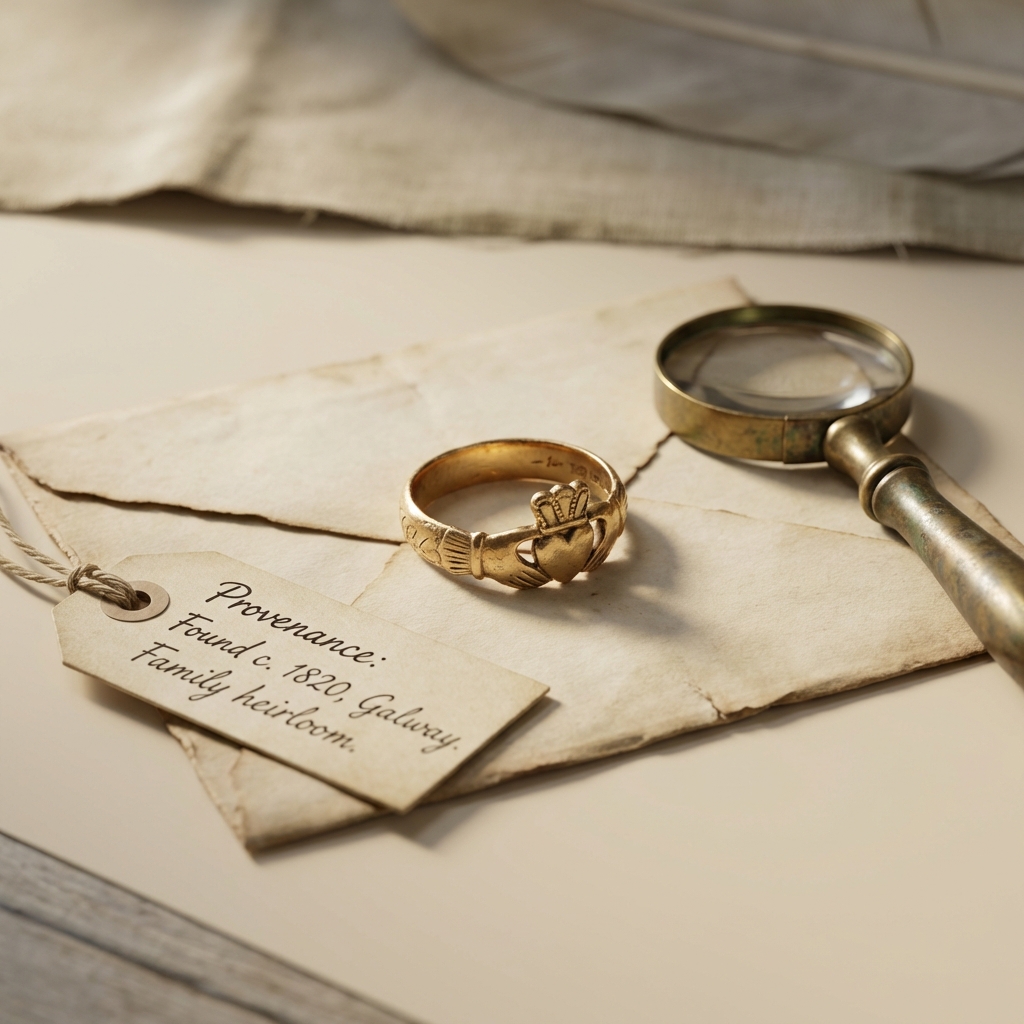
When you balance historical interest with wearability, accept that older rings often show wear consistent with age and may have sympathetic restorations; clear restoration notes let you judge whether a piece retains original structure or whether significant parts were replaced, which matters for both display and wear.
Common mistakes and red flags when purchasing older Claddagh rings
A common error is assuming visual similarity equals historical attribution; many modern makers reproduce the hands-heart-crown motif, so without documentation a ring that looks old may be a later creation or a deliberate historicising piece Journal of the Royal Society of Antiquaries of Ireland.
Red flags in listings include vague provenance statements, no photographs of hallmarks or interior inscriptions, and absence of conservation or stabilization notes; these gaps reduce the buyer's ability to assess age and origin and should prompt follow up questions to the seller. If you need to follow up, use our contact page to request details contact.
Another mistake is overlooking restoration that changes appearance or structure; heavy polishing, filled or replaced bezels, and reconstructed shoulders can alter how the ring reads historically and practically, so ask for close-up images and written restoration notes before purchase About us, International Association of Dealers in Ancient Art.
Constructive next steps when you see these red flags are simple: request provenance documentation, ask for conservation records, request additional photographs under raking light, and if needed, consult a specialist for an opinion before completing the purchase.
Practical buyer profiles and short scenarios
The romantic partner: a buyer preparing a proposal who wants an engagement Claddagh should prioritize ring fit, an inward-facing wearing example for the left hand if that is the intended convention, and clarity about any restorations that might affect long term wear; for a partner the symbolic meaning often matters more than perfect archival provenance Encyclopaedia Britannica.
The diaspora buyer: someone in an Irish diaspora community may be motivated by heritage and identity and will often accept later dates if the ring carries recognisable motifs and clear condition notes; for this profile, readable provenance such as family history statements or documented previous ownership can be especially meaningful BBC Travel.
The collector: a buyer seeking an authentic antique example should insist on independent documentation, museum references if available, and a conservative restoration history; collectors also prioritize clear photos of hallmarks, tool marks, and interior markings that can be compared to established maker attributions Journal of the Royal Society of Antiquaries of Ireland.
Inherited rings: when a ring comes with family history, treat the story as an important lead but still seek tangible documentation; family provenance can increase the personal value of a piece but does not replace external verification if the historical claim is central to the buyer's decision.
Summary and next steps for readers
In short, the Claddagh ring is traditionally bought by romantic partners for engagement or marriage and by friends, family and diaspora buyers as tokens of friendship, heritage or identity, with wearing conventions that vary by household and region Encyclopaedia Britannica.
Quick checklist before any purchase: check documented provenance, read condition and restoration notes, and seek third party or specialist confirmation when the listing claims unusual age or early maker attribution Publication 561 (12/2025), Determining the Value of Donated Property, Internal Revenue Service (IRS), USA.
Aurora Antiqua presents curated ancient rings with condition notes, restoration summaries and provenance references where available to help buyers make informed choices, and descriptions are offered as a trust layer rather than a blanket guarantee about origin or age.
Orientation commonly uses hand and heart direction to signal single, taken, or engaged status, but practices vary by household and region so it should be treated as a cultural convention rather than a strict rule.
Request collection history, conservation or restoration records, dated photographs from prior ownership when available, and any independent or museum references that support the age claim.
Possibly, but check condition and restoration notes first; some older rings have stabilisations or fragile elements that make daily wear inadvisable without conservation work.
More from Aurora Antiqua
References
- Claddagh Rings, National Museum of Ireland, Dublin
- Richard Joyce and the oldest known Claddagh ring, Galway City Museum
- The King of Claddagh · Mainistir Phádraig Naofa · Bailiúchán na Scol, Dúchas.ie, National Folklore Collection
- Research report: export licensing and provenance, GOV.UK, Department for Culture, Media and Sport (DCMS)
- New Acquisitions of Archaeological Material and Works of Ancient Art, Association of Art Museum Directors (AAMD)
- About us, International Association of Dealers in Ancient Art
- Publication 561 (12/2025), Determining the Value of Donated Property, Internal Revenue Service (IRS), USA
- Auction Terminology, Christie's
- Hallmark Identification, The Company of Goldsmiths of Dublin, The Assay Office (Dublin Castle)
- Client Challenge, JSTOR