


Looking for the real thing? Browse genuine ancient rings for sale, each piece one of one, individually authenticated, with documented provenance. For the background, see the guide to ancient jewelry.
What is a Claddagh ring? Definition and context
The Claddagh ring is an Irish ring form defined by three visual elements, a heart held between two hands and topped by a crown, and the arrangement is conventionally read as heart equals love, hands equal friendship and crown equals loyalty. This dominant reading appears in modern reference works and museum descriptions and helps explain why collectors and buyers interpret the object as a symbol of relationships and community; the term ancient christian ring is sometimes used by readers asking whether that symbolism is inherently religious, a question addressed below Encyclopaedia Britannica.
Historically, examples labelled as Claddagh rings appear in collections and local narratives tied to Galway and the Connemara region, where the motif circulated as a community emblem rather than as a liturgical device Claddagh Ring Museum / Thomas Dillon’s Claddagh.
Typical historical materials include plain gold or silver bands, sometimes set with a bezeled gem or intaglio, and finished with a patina or wear consistent with age; these physical signs help distinguish genuine period pieces from later reproductions or stylistic echoes. When assessing listings, look for clear photos of the hoop, shoulders and bezel, plus condition notes that describe any repairs or stabilisation.
Follow @auroraantiqua for provenance, restorations and fresh finds
Explore Aurora Antiqua’s editorial notes and curated listings to see condition descriptions, provenance summaries, and restoration notes that help clarify whether a ring was presented as a personal token or a devotional object.
For collectors, a short working definition is useful: a Claddagh ring is an ornament that uses the heart, hands and crown motif as a cultural emblem of connection; it can be an antiquity when dating and condition support that label, and it is a subject for provenance and iconographic study rather than a single, fixed meaning. (see our rings collection)
Symbols explained: heart, hands and crown
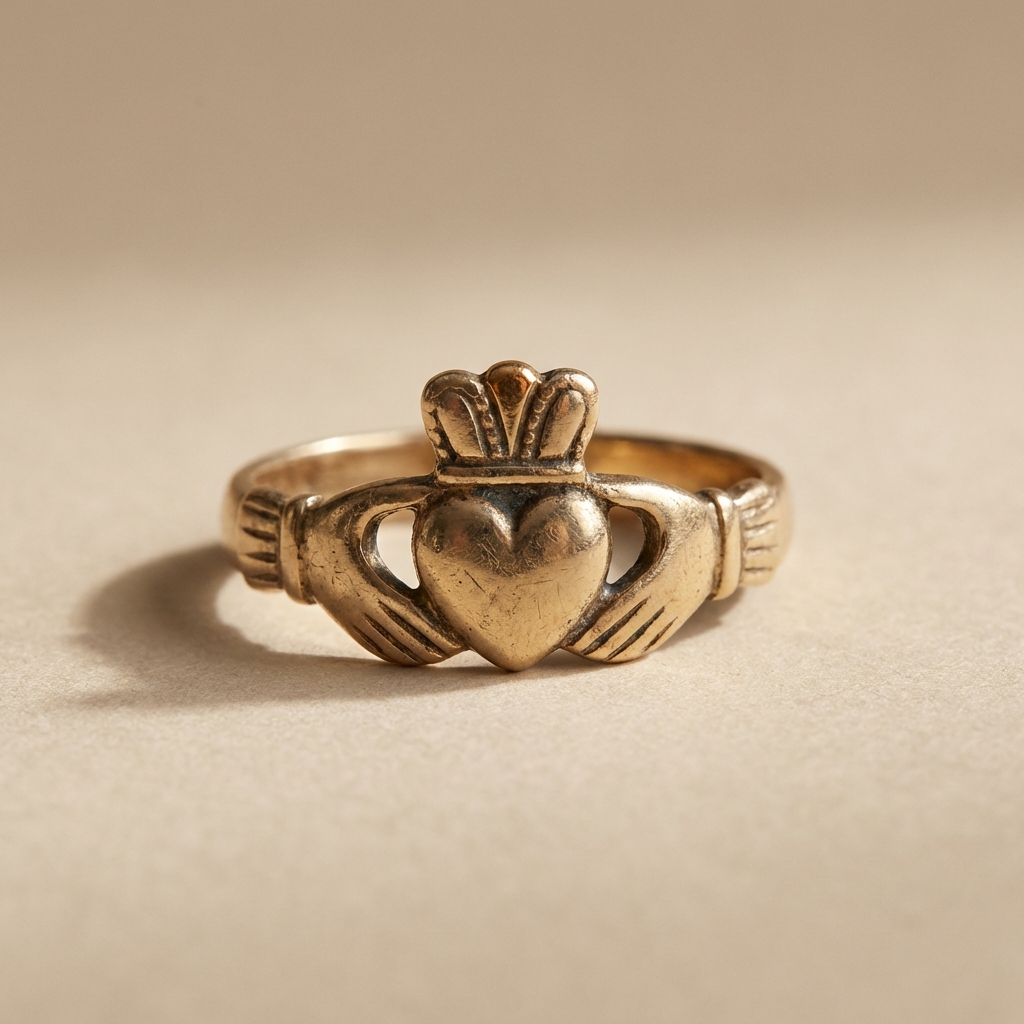
Curators and reference works consistently present the three-part motif as a coherent iconographic statement: heart for love, hands for friendship and crown for loyalty. This reading forms the foundation of museum labels and broad interpretive texts that guide public understanding Encyclopaedia Britannica. See a popular summary https://emeraldisle.ie/claddagh-rings.
In practice, small variations in execution can change how a ring reads. A more elaborate crown, additional engraving on the shoulders, or an intaglio carved into the bezel can shift emphasis toward status or personal heraldry rather than a straightforward friendship token. These design differences are the sorts of details curators note when they catalogue pieces for public display or sale.
Origin story and Richard Joyce: myth, local tradition and evidence
The familiar origin story credits a Galway goldsmith, popularly named Richard Joyce, with creating the Claddagh design after captivity and return; the tale is widespread in local tradition and later retellings and remains part of the ring's popular narrative History Ireland. See a commercial account of the motif's modern jewellery history https://www.claddaghringjewelry.com/celtic-jewelry-history-made-in-ireland-jewellery/.
Scholars and archival researchers caution that primary documentary evidence for this specific anecdote is limited and debated, and that the Joyce narrative is best treated as a compelling local story rather than confirmed provenance for the entire motif Journal of the Galway Archaeological & Historical Society.
No. The Claddagh is principally a cultural Irish emblem that can have religious associations for individuals, but it is not an official or doctrinal Christian symbol.
When you encounter a listing or label that attributes a ring directly to the Joyce story, ask for item specific documentation such as collection history or contemporary references; without those, the narrative remains useful for cultural context but weak as definitive proof.
The Claddagh in Irish cultural context and museum narratives
Museums and local collections situate the Claddagh in the Galway and Connemara maritime world, where community identity and fishing village traditions shaped how the motif circulated; such regional framing is common in interpretive labels and collection notes Claddagh Ring Museum / Thomas Dillon’s Claddagh. For discussion of whether the ring is treated as a Catholic object see our blog post Is a Claddagh ring Catholic?
Local collection histories and catalogues often emphasise oral tradition, community practice and the ring's role in social rituals rather than asserting liturgical or doctrinal use. These museum narratives help explain why the Claddagh is treated first as a cultural emblem in public interpretation Galway City Museum.
Cultural revival movements in the 19th and 20th centuries also increased the motif’s visibility and helped standardise the modern reading of the three symbols; revival contexts are important when dating a design or understanding how meanings shifted into commercial and ethnic identity uses.
Religious associations: use by Christians and doctrinal status
Contexts where Christians have used the ring (weddings, pilgrimages, devotional wear) (ancient christian ring)
Christians, particularly in Ireland, have commonly worn the Claddagh ring in wedding contexts and as a personal devotional or commemorative token; museums and reference works note frequent appearance of the motif in such social and religious settings Catholic Encyclopedia. See one Christian version of the origin tale https://usfireland2010.wordpress.com/2010/08/18/origin-of-the-claddagh-ring/.
At the same time, authoritative sources make clear the Claddagh is not an official liturgical emblem or a doctrinal symbol recognised by church authorities; it remains a cultural object that individuals may use in religious practice without altering its general cultural status Encyclopaedia Britannica.

Because the ring has been worn in devotional situations, collectors should separate the object as cultural motif from any personal religious use. Provenance and documentation attached to an individual piece determine whether a specific ring was intended as a devotional object at the time of its use.
Modern global use: secular meanings, ethnic identity and revival
Throughout the 20th and 21st centuries the Claddagh has spread beyond Ireland as a marker of ethnic identity, romance and friendship; market revival and diaspora communities have played a large role in that diffusion and in shifting the ring toward predominantly secular meanings Claddagh Ring Museum / Thomas Dillon’s Claddagh.
This modern global usage means that contemporary sight of the motif does not automatically indicate religious function. Commercial revival, souvenir markets and jewellery trends can overlay and sometimes obscure any devotional history that a specific object might have. See related items in our Aurora Antiqua blog and collections.
Framework: how to assess whether an ancient ring was used as a religious token
Collectors can apply a short hierarchy when judging whether a single ring was used as a religious token: highest weight is given to contemporaneous documentation and clear collection history, followed by recorded context of find, then iconographic specificity that ties the object to devotional practice. Museum cataloguing practice helps show how these priorities are applied in professional settings Claddagh Ring Museum / Thomas Dillon’s Claddagh.
Iconography matters: a Claddagh motif accompanied by explicit religious marks, inscriptions invoking saints, or association with pilgrimage tokens increases the likelihood of devotional use. Conversely, a plain decorative example with no recorded religious context is more plausibly a secular cultural token.
Provenance checklist for assessing a ring's religious association
Start with documented ownership chain
When condition notes indicate restoration or replacement of elements, treat those changes carefully. Restored bezels or replaced stones can remove or obscure original devotional features; good listings will describe what was stabilised and what remains original, which helps weigh interpretive claims Claddagh Ring Museum / Thomas Dillon’s Claddagh.
Decision criteria for collectors: when religious significance matters to value and display
Clear decision points help a buyer decide whether religious association should affect purchase, documentation or display. Prioritise contemporaneous records and explicit provenance over oral tradition, and require accession numbers or verification letters to move from plausible to probable regarding devotional use Claddagh Ring Museum / Thomas Dillon’s Claddagh.
Condition and restoration notes alter interpretive certainty as well. A ring that retains original surface features and inscriptions gives stronger evidence than one with extensive modern repairs; conservators’ reports or restoration notes in a listing are therefore relevant to weighing religious-use claims.
For display and ethical considerations, label items honestly. If a ring may have been used devotionally but lacks contemporary proof, describe it as a cultural token with possible devotional associations and record exactly what documentation supports any stronger statement.
Typical mistakes and myths to avoid when judging religious meaning
A common error is to treat the Richard Joyce origin story as proof that all Claddagh rings were created with a religious intent. The Joyce narrative remains a compelling local tradition but lacks the direct contemporary documentation required to treat it as conclusive provenance for individual pieces History Ireland.
Another mistake is assuming liturgical status from modern devotional use. Because Christians have often worn Claddagh rings, the motif can carry personal religious significance; however, institutional church teaching does not recognise the design as a doctrinal emblem, and that distinction matters for accurate description Catholic Encyclopedia.
To avoid being misled by listings, request specific provenance items: names of previous owners, catalogue references, museum accession numbers, and any conservator reports. Absent those, treat strong claims about religious function with caution.
Practical examples and short case studies
Museum-labelled examples often include collection history and interpretive notes that show how curators reach conservative conclusions. A museum entry that lists donor, accession date and place of find gives far more support for any religious claim than a private listing without such details Galway City Museum.
Consider a private-listing scenario: a seller offers a worn gold ring with a heart, hands and crown and cites a family story linking it to a pilgrimage. If no supporting documentation is provided, the claim should be treated as part of the ring’s modern biography rather than as proof of historical devotional use. Request collection history or a verification letter to raise the claim beyond family lore.
How to read provenance and documentation on a listing
Key documents that increase confidence include contemporary sale records, museum accession numbers, and letters from recognised experts or custodial institutions. Listings that provide these references allow a buyer to move from speculation to a reasoned judgement about religious function Claddagh Ring Museum / Thomas Dillon’s Claddagh.
Restoration and condition notes should be precise. Good notes describe which parts were stabilised, what was replaced, and which surfaces are original. Language such as stabilised crack in hoop or replaced bezel should be treated differently from vague statements claiming full restoration without detail.
Sample cautious listing language: "Attributed to 18th to 19th century style; family provenance to Galway; no accession number provided." Sample stronger language: "Formerly in the X collection, accessioned 1952, conservation report available." Prefer the latter when evaluating religious-use claims.
Caring for an ancient ring you intend to wear
Handle wearable antiquities carefully. Store rings in padded boxes away from humidity and extreme temperature changes, and avoid wearing them for heavy manual work. Preserving patina and structural integrity should guide any decision to put an antiquity into regular use.
Avoid home cleaning with abrasive chemicals or ultrasonic devices. These can remove patina and damage stones or thin metal. When in doubt, consult a conservator; small stabilising repairs often preserve more historical information than aggressive restoration.
Seek a conservator for any repair or resizing that would alter the hoop. A conservator can document interventions in restoration notes, which you should keep with the object's provenance record, and that documentation helps future researchers and buyers understand what remains original.
Quick buyer checklist and next steps
Essential questions to ask a seller include: what is the documented collection history, are there any accession numbers or catalogue references, can you see conservator or restoration reports, and are there detailed photographs of hallmarking and wear? Prioritise documentation over appealing narrative alone Claddagh Ring Museum / Thomas Dillon’s Claddagh. Visit the Aurora Antiqua homepage for suggested documentation templates.
If documentation is missing, ask for time-stamped photos, condition notes, and any earlier sale records. If these are still not available, consider seeking an independent evaluation before purchase or treating the item as a decorative piece rather than a verified historical religious token.
When you acquire a ring, label it clearly with any provenance you have, include restoration notes and a short statement about whether devotional use is probable, possible or undocumented. Clear labelling preserves research value and supports ethical display choices.
Conclusion: the best short answer to 'Is a Claddagh ring religious?'
The clearest, evidence-aligned answer is that the Claddagh is principally a cultural symbol that can carry religious meaning for some wearers or communities, but it is not by design an institutional Christian emblem; readers asking whether a single ring is an ancient christian ring should rely on item-level provenance and documentation rather than on the motif alone Encyclopaedia Britannica.
Respect personal meanings while remaining rigorous about historic claims. If devotional association matters for your collecting goals, require contemporaneous records or expert verification, and label the object honestly when displaying or listing it.
Yes. Individuals and communities may use the Claddagh as a devotional or commemorative token, but that personal use does not make the design an official church emblem.
No. The Joyce story is a local tradition and later retelling; it is not sufficient on its own to establish religious intent for individual rings without item-specific documentation.
Contemporaneous records, museum accession numbers, collection histories and conservator or verification letters are the strongest supports for a devotional-use claim.
More from Aurora Antiqua
References
- Claddagh Rings, National Museum of Ireland, Dublin
- Richard Joyce and the oldest known Claddagh ring, Galway City Museum
- The King of Claddagh · Mainistir Phádraig Naofa · Bailiúchán na Scol, Dúchas.ie, National Folklore Collection
- William Wytlesey's ring, Victoria and Albert Museum, London
- Ring, Victoria and Albert Museum, London
- Gimmel Ring, Victoria and Albert Museum, London
- Getty Provenance Index, J. Paul Getty Trust, Getty Research Institute, Los Angeles
- Hallmarking Act, 1981, Electronic Irish Statute Book, Office of the Attorney General, Ireland
- Hallmark Identification, The Company of Goldsmiths of Dublin, The Assay Office (Dublin Castle)
- galwaycitymuseum.ie
From Aurora Antiqua
We sell authenticated ancient & medieval pieces, each individually examined before listing and backed by a Lifetime Authenticity Guarantee. One of a kind, sold once, never reproduced.
Browse Authenticated Ancient Rings →