


Looking for the real thing? Browse genuine Greek rings for sale, each piece one of one, individually authenticated, with documented provenance. For the background, see the guide to ancient jewelry.
What people mean by the 'Greek ring' myth: definition and research consensus
The phrase 'Greek ring' myth often appears in sales copy and popular histories to suggest that a single type of ancient object carried uniform, magical properties across time and place. In careful usage the claim implies that one ring form or motif conferred a fixed power, protection, or meaning in ancient Greek societies, a position that recent studies treat as a modern interpretive layer rather than a straightforward ancient belief. Recent literature emphasizes that this popular framing can be traced to selective readings of texts and later antiquarian traditions, and that scholarship in the 2020s has pushed back on such generalizations with regionally grounded comparisons and typological analysis American Journal of Archaeology review.
To reach a clear working definition for readers: the 'Greek ring' myth, as used in the market and popular writing, is the idea that there was a single, recognisable Greek ring type that reliably carried a particular magical property or fixed symbolic meaning across the Greek world. This is a useful shorthand for storytelling, but it collapses the long chronological span from the Archaic through the Hellenistic periods and the geographic diversity of Greek-speaking regions and colonies, where rings served varied functions and bore different motifs.
Archaeological and museum records show a wide variety of ring types and functions rather than a single unified object class, so the myth is better seen as a modern narrative built from later interpretive traditions and market simplification. For a concise overview of ring types, functions, and their documented uses in collections, see the Metropolitan Museum of Art’s summary on ancient rings Metropolitan Museum of Art overview of rings and the Ancient Greek Rings collection on our site.

How the phrase is used in popular culture and sales copy
In popular writing and some sales descriptions the 'Greek ring' is presented as a symbol of protection, a key to hidden knowledge, or a talisman tied to a single mythic story. These descriptions can be appealing to buyers and readers, but they often omit the careful prosopography, typology, and provenance work that underpins academic claims. Market narratives may compress centuries of variation into a single evocative image to aid storytelling, which is why documentation and specialist literature are important for separating evocative language from historically grounded interpretation.
What scholars mean by 'myth' in this context (ancient greek rings)
Scholars use the word 'myth' here to describe a constructed narrative that fills gaps in evidence with culturally resonant ideas. In the case of rings, episodic references in classical texts and striking motifs on engraved gems have been woven together by later commentators and collectors into durable modern stories. Scholarship in the 2020s stresses regional variation and workshop conventions, and cautions against treating literary or market tropes as direct evidence for a uniform ancient practice Cambridge Classical Review commentary.
Material and archaeological evidence for ancient greek rings
Chronology and geographic spread: Archaic through Hellenistic and Greek colonies
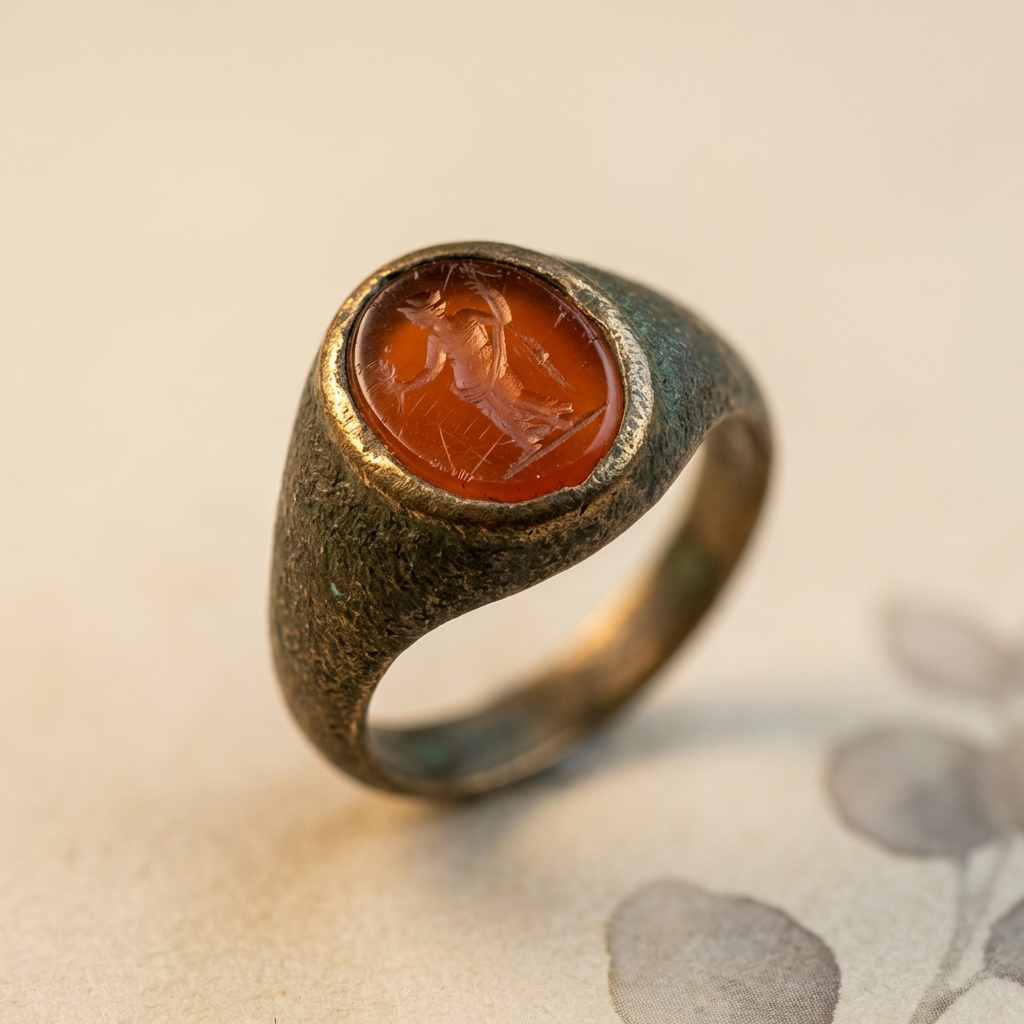
The material record shows that rings were produced across a long span of time, from the Archaic into the Hellenistic periods, and in Greek-speaking communities across the Aegean, the mainland, and colonial settlements. Assemblages in museum catalogues and excavation reports document signet rings, plain bands, and rings set with engraved gems in many contexts, which supports a picture of long-term production and local variation rather than a single era of manufacture.
These chronological and geographic patterns matter because they affect how motifs and uses should be interpreted: a motif on an Archaic signet from a coastal colony may have different social meaning than a Hellenistic intaglio found in an inland administrative context. For practical summaries of types and functions in collections, museum catalogues provide typologies and comparanda that help situate individual rings Catalogue of the Engraved Gems and Finger-Rings in the Ashmolean Museum, II: Roman, BAR Publishing, via Fulcrum.
Common materials and manufacturing techniques
Typical materials include gold and bronze for hoops, and a variety of hardstones such as carnelian, agate, and occasionally semi-precious gems for intaglios and insets. Manufacturing traces important to identification include the method of setting a gem, tool marks on metal, and signs of reworking or later repairs. These physical features can indicate whether a ring was intended primarily as personal ornament, as a seal, or as a fitted intaglio for impression use.
Typology and material analysis also clarify function: a deeply carved intaglio with a durable band form and wear consistent with repeated handling is strong evidence for use as a signet or seal, while thin, fragile settings with decorative motifs may be better understood as personal ornament. For guidance on typology and provenance practices that underpin these interpretations, museum catalogues and conservation reports are essential resources and comparable catalogues such as the Getty Museum catalogue are useful Getty Museum resource.
See behind the curation at @auroraantiqua
Check condition notes and provenance documents before relying on a broad symbolic claim about an ancient ring.
Core functions: signets, seals, amulets and personal ornament among ancient greek rings
Signet rings and administrative use
One clearly documented role for many rings was administrative: signet rings with engraved intaglios were used to bear individual marks and seal impressions for private and public transactions. Museum entries and published catalogues link specific intaglio designs to sealing functions where the wear and depth of incision produce consistent impressions, and such uses are attested across Greek-speaking regions. For broader historical context see the Gem Society overview on signet rings History of signet rings.
The physical evidence for sealing includes reversed intaglio designs intended for impression, wear patterns on the face of the gem, and associated finds such as sealing clay or lead. These combined observations form the basis for attributing administrative use rather than ascribing a purely ritual or magical function.
Use this checklist to record provenance and condition details for a ring
Keep original documentation copies with your records
Amuletic and protective uses in context
Alongside sealing and identification, some rings may have had amuletic or protective roles in particular contexts. Iconography that evokes deities or protective creatures can be consistent with an apotropaic reading, but this interpretation depends on contextual support from findspot, associated objects, and contemporary textual references rather than assuming every such motif functioned as an amulet.
For instance, a ring found in a domestic or burial context with repeated cultic objects may reasonably be read as having protective associations, while the same motif on a bureaucratic seal in an administrative archive is more plausibly a personal emblem or workshop design. Museum typologies and provenance records help make these distinctions visible in published studies "Sappho" Earring, Harvard Art Museums / Arthur M. Sackler Museum, Cambridge, Massachusetts.
Iconography on ancient greek rings: gods, animals and hybrid creatures
Engraved gems and ring faces frequently display an array of motifs, from gods and hero figures to animals and hybrids such as griffins or sphinxes. These images circulated widely and could express personal identity, civic affiliation, or perceived protective power depending on context and audience.
The 'Greek ring' myth presents a modern, simplified narrative that a single ring type had uniform magical properties; collectors should prioritise provenance, condition notes, typology, and specialist literature to evaluate such claims.
Common motifs do not automatically translate into a single function. A griffin, for example, may serve as a family emblem in one instance, a workshop motif in another, and an apotropaic sign in a third; determining which reading fits requires comparison with securely dated and documented finds and with regional iconographic vocabularies. The British Museum’s object records illustrate this range in motif use and interpretation British Museum collection entries.
Because motifs repeat across media and centuries, iconographic readings must be careful about scale and distribution. A hybrid creature painted on pottery and carved on an intaglio does not mean both served identical social functions; each context needs independent assessment and, ideally, comparative publication to support claims about identity or protection.
How classical texts and later traditions shaped the 'Greek ring' narrative
Classical literature contains episodic references to rings in varied social contexts, including personal gift exchanges, oaths, and emblematic uses, but these references are not consistent evidence for a blanket magical property attached to a ring type. Literary passages are often situation-specific and ambiguous, and later interpreters can amplify a memorable image into a generalized story.
Hellenistic, Byzantine, and especially early modern antiquarian traditions frequently reinterpreted classical episodes, sometimes adding moral or mystical layers that fit new contexts and tastes. Over time these layered readings contributed to a modern narrative in which certain motifs were presented as inherently 'protective' or 'magical' without the archaeological or typological support required by contemporary scholarship; recent work on Byzantine signet monograms offers a useful example Walters Journal note on Byzantine signets. Oxford Research Encyclopedia entry on jewellery.
Dating, provenance, and scientific testing: how experts separate history from myth
Provenance, secure dating, and museum cataloguing practices are central to distinguishing historically grounded interpretations from market-driven narratives. When objects come with well-documented findspots, excavation records, and comparanda, scholars can place motifs and forms within a local chronology and workshop tradition, which reduces the need to rely on later or secondary sources for meaning.

Scientific techniques such as metallurgical analysis, microscopic wear studies, and gem characterization can determine manufacturing technology, repair history, and sometimes relative chronology, but they do not by themselves prove a symbolic interpretation. These analyses are best used alongside typology and documented provenance when assessing claims about a ring’s function or meaning boucle d'oreille, Louvre site des collections, Musée du Louvre, Département des Antiquités grecques.

Readers should prioritise clear condition notes, detailed provenance statements, and specialist publication when evaluating sweeping symbolic claims. Reputable museum catalogues and peer-reviewed studies remain the most reliable sources for confirming context and function and to our Rings collection.
Decision criteria for buyers and collectors evaluating claims about ancient greek rings
Buyers can use a short checklist to evaluate whether a seller’s interpretive claims are plausible: 1) Is there a documented findspot or collection history? 2) Are condition notes and restoration notes provided and transparent? 3) Are there high-quality photographs and measurements? 4) Are comparanda or catalogue references cited? 5) Has any scientific testing been reported? If several of these items are missing, treat broad symbolic claims with caution.
Ask sellers for catalogue references or published comparanda, and request written restoration notes that explain what was conserved, repaired, or left original. When a listing relies primarily on evocative language or mythic storytelling without documentary support, it is prudent to seek independent opinion or additional comparanda in the specialist literature. Compare listings where provenance is clear with specific product entries such as our Chimaron listing Chimaron product page.
Common mistakes and modern misreadings to avoid about Greek ring symbolism
A frequent error is overreading single motifs: assuming that a single image proves a fixed function across time and regions. Another is confusing later tradition or nineteenth and twentieth century antiquarian assumptions with ancient practice. Both mistakes are common in market descriptions that prioritise narrative appeal.
Dating errors, decontextualised finds, and thin provenance immediately increase the risk of misinterpretation. When motif, date, and findspot are not independently verified, symbolic readings are speculative and should be presented as such rather than as established fact "Sappho" Earring, Harvard Art Museums / Arthur M. Sackler Museum, Cambridge, Massachusetts.
Practical examples and scenarios: reading two anonymized case studies
Case 1: A listing describes a ring as a 'protective signet, used to ward off harm' and shows a carved hybrid creature. If the listing includes a clear findspot in a burial context, detailed condition notes, and comparanda in published catalogues, a protective interpretation may be plausible. If these elements are absent, the claim rests on modern narrative rather than contextual evidence. For comparative practice on signet identification and function, museum overviews are helpful Metropolitan Museum of Art overview of rings. See comparable listings such as the Chimaron ring for an example of a carved hybrid creature Chimaron.
Case 2: An intaglio bearing a deity is sold with sweeping mythic claims tying it to a specific ritual use. Examine photographs for wear consistent with sealing, request restoration notes, and look for comparable published examples in catalogue literature. If the gem shows deep reversed cutting and matching impressions exist in archival seal collections, administrative use is likely; without that corroboration, ritual claims remain speculative. Fitzwilliam Museum resources are useful for gem comparanda Catalogue of the Engraved Gems and Finger-Rings in the Ashmolean Museum, II: Roman, BAR Publishing, via Fulcrum.
Conclusion: how to read claims about ancient greek rings and where research still needs to go
In summary, the 'Greek ring' myth overstates a complex and varied historical reality by presenting a single, uniform function or magical property where the material and textual record shows diversity. For collectors and researchers, the priority should be provenance, condition notes, comparanda, and specialist literature rather than evocative market narratives.
Open questions remain about specialized ritual uses and the social networks that circulated particular motifs. Progress will come from studies that pair well-documented archaeological finds with careful textual analysis and broader publication of provenanced material to allow comparanda and distributional studies to mature American Journal of Archaeology review.
It claims that a single ring type or motif in the ancient Greek world had a uniform magical power or fixed meaning across regions and periods.
Look for documented provenance, detailed condition and restoration notes, catalogue comparanda, and any reported scientific testing; absence of these is a warning sign.
No, such motifs can indicate identity, workshop design, or protective meaning depending on context and supporting evidence.
More from Aurora Antiqua
References
- Hellenistic Gold Eros Jewellery: Technique, style and chronology, BAR Publishing, Oxford, via Fulcrum
- Aegean and Cypro-Aegean Non-Sphragistic Decorated Gold Finger Rings, American Journal of Archaeology
- Catalogue of the Engraved Gems and Finger-Rings in the Ashmolean Museum, II: Roman, BAR Publishing, via Fulcrum
- "Sappho" Earring, Harvard Art Museums / Arthur M. Sackler Museum, Cambridge, Massachusetts
- boucle d'oreille, Louvre site des collections, Musée du Louvre, Département des Antiquités grecques
- Trésor hellénistique trouvé à Délos en 1964, École française d'Athènes, via Persée
- Pliny the Elder, The Natural History, BOOK XXXIII, Perseus Digital Library, Tufts University (edition Bostock)
- Aulus Gellius, Attic Nights, Book X, LacusCurtius, Bill Thayer, University of Chicago (Loeb Classical Library edition)