


Looking for the real thing? Browse authentic Medieval & Crusader rings, each piece one of one, individually authenticated, with documented provenance. For the background, see the guide to medieval jewelry.
What is a medieval pendant? Definition and historical context
A medieval pendant is a small object suspended from a cord, chain or mount and worn at the neck or attached to dress; in many contexts it can be devotional, amuletic or purely decorative. Collectors and historians commonly use the term to cover simple loops and cross pendants as well as small reliquary mounts and token pendants, and museums emphasise that similar forms appear across the medieval centuries, with variation by region and period V&A medieval collection and V&A collections search
Examine suspension type, mounting and bezel, surface wear and joins, request high-resolution photos, and compare with labelled museum entries and finds records; ask for condition and restoration notes and consider a conservator report for unclear or high-value items.
As a category, the medieval pendant often served multiple social roles: it could mark devotion when shaped as a cross or saint, act as an amulet, or function as a personal token worn close to the body; distribution and social reach vary by place and date, so some uses are better documented than others British Museum medieval Europe
Overview of medieval jewellery types: where the pendant fits in
Pendants sit within a wider ensemble of medieval personal adornment that includes brooches, rings, necklaces and girdle fittings. Brooches often doubled as fasteners and decorative elements, rings could serve as seals as well as personal jewellery, and girdle fittings marked costume and status; museum overviews and finds reporting provide the primary typology used by researchers and collectors The Met jewellery overview

Brooch types commonly recorded in finds databases include annular, penannular and flat plate brooches, while rings range from simple copper-alloy bands to gold intaglio rings with engraved imagery. Pendants and necklaces often overlap in function with these items, since a pendant may be hung from a neck chain or attached to clothing as a mount Portable Antiquities Scheme report and a PAS record DENO-65C775
For collectors, understanding how these categories relate helps when reading a listing: a described brooch might be wearable jewellery or a practical closure, and a ring labelled as decorative could also be a seal-ring with a carved intaglio used for identity. Comparative use of museum records and finds datasets aids in judging frequency and typical contexts British Museum medieval Europe
Typical materials and manufacturing techniques for medieval pendants
Medieval pendants were made from a range of metals and materials, including gold, silver, copper-alloys such as bronze, and sometimes lead alloy; organic materials and glass were also used for insets or simple beads. Technical reviews and museum conservation notes summarise these materials and their tendencies in medieval personal adornment technical review of materials and techniques
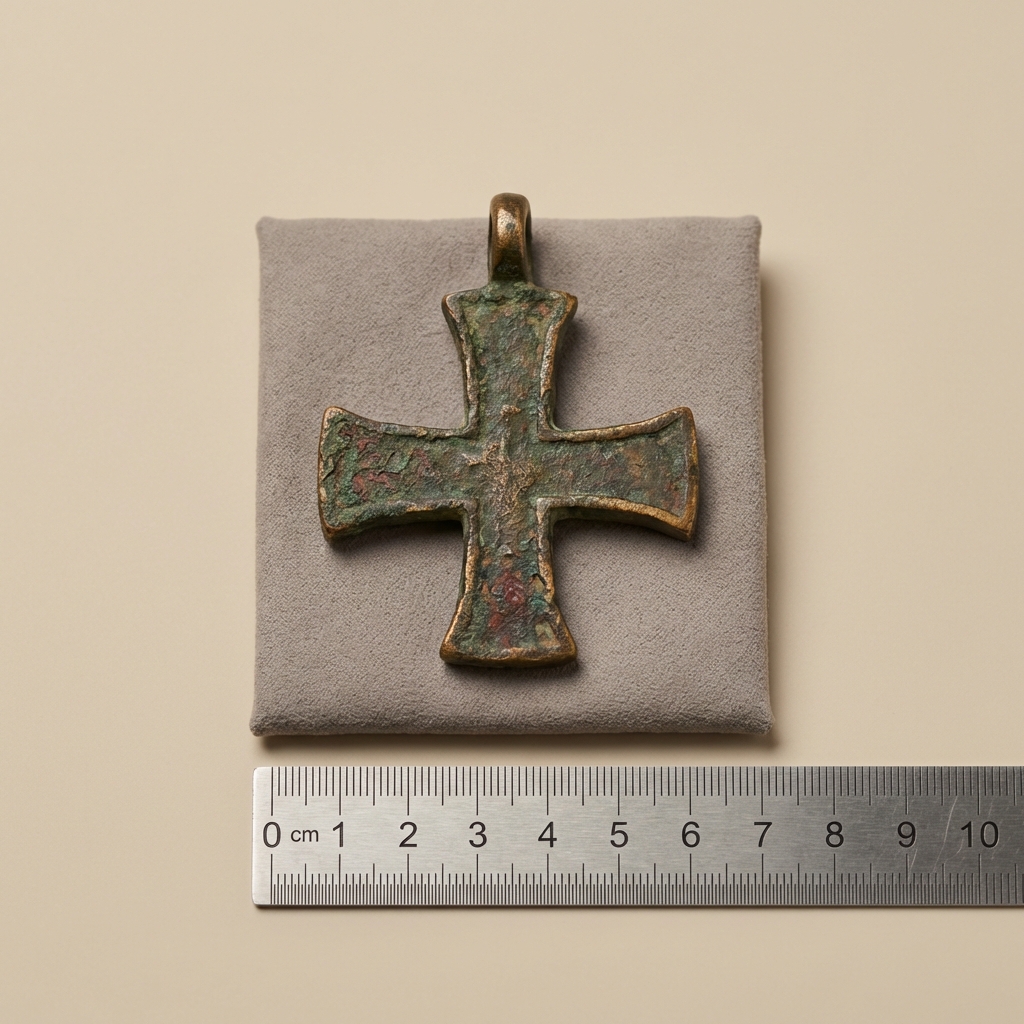
Common manufacturing techniques include casting and forging for the overall shape, soldering for joins, and decorative methods such as granulation, filigree, and enamel work like cloisonné or champlevé. Stone intaglio setting appears in rings and occasionally pendants, and many pieces bear evidence of wear or later repairs visible under close inspection V&A medieval collection
Follow @auroraantiqua for provenance details and restoration insights
See curated examples and documentation that can help you compare photos and condition notes before considering a purchase.
Recognising technique helps with dating and attribution: a specific combination of granulation, cloisonné enamel and certain suspension forms can point to regional workshops or periods, but technical clues are best used in combination with dated museum examples and finds records rather than alone materials and techniques review
How medieval pendants were worn and what they signified
Pendants often served devotional roles, with crosses and saintly images worn to signify faith or seek protection. Smaller reliquary pendants could contain fragments associated with sacred figures and were worn close to the body for devotional practice; museum entries commonly describe these functions when objects are catalogued V&A medieval collection
Beyond explicit devotional use, pendants could be amuletic or personal: iconography such as saints, symbolic animals or inscribed motifs sometimes signalled a wearers identity, trade or protective intent. Interpreting iconography requires careful comparison with dated and contextualised museum examples because similar motifs recur across regions with different meanings British Museum medieval Europe
Regional variation: Norman, Viking, Byzantine and Islamic influences
Distinctive regional workshops created characteristic motifs and technical signatures: Norman and Anglo-Saxon brooch forms differ in their construction from Viking penannular types, while Byzantine and Islamic workshops show different iconographic programs and enamel styles. These regional patterns are central to comparative identification but are not always definitive on their own The Met jewellery overview
Finds reporting schemes supply distribution data that highlight clusters of particular brooch and pendant types in northern and insular Europe, which helps when assessing a claimed origin for an unprovenanced piece. Such databases are useful comparative tools when used alongside labelled museum examples Portable Antiquities Scheme report

Because provenance chains are often incomplete for items in the market, workshop attributions can remain tentative; careful comparison with dated museum records and consultation of finds databases reduce the risk of a misattribution but do not always resolve ambiguity British Museum medieval Europe
Dating and identifying a medieval pendant: a practical approach
Start with a visual checklist that notes suspension type, bezel shape, mounting style, decoration, and wear patterns. These visible cues are practical first steps for forming a provisional estimate of period or region, provided they are compared to dated examples in collections The Met jewellery overview
Examine technical features such as join types, surface finish and evidence of soldering or repair; such details often survive in photographs and can guide attribution when read alongside documented museum entries and finds records Portable Antiquities Scheme report
A short comparison checklist to match a listing to museum records
Use with labelled museum images
When assessing a listing, request high-resolution images of the suspension and any hallmarks, and look for consistent wear rather than freshly altered surfaces; such photographic detail can reveal later repairs or modern interventions not apparent in a brief description The Met jewellery overview
Condition, restoration and conservation: what buyers must check
Many medieval objects display wear consistent with long use and later repairs; sellers should provide clear condition notes that describe what has been stabilised, repaired or left untouched so buyers can evaluate risk and value. Museums and conservation bodies recommend transparent reporting of such work V&A medieval collection

Conservation guidance advises avoiding abrasive cleaning and seeking stabilisation for corroding metals before any display or wear. When a listing mentions active cleaning or aggressive polishing, treat that as a potential red flag unless detailed restoration notes are available Historic England conservation advice
Provenance and documentation: reading collection history
Useful provenance details include prior ownership, collection history, verification letters and catalog references when present. These elements help establish a chain of custody and contextualise an item relative to museum comparanda, though many market items retain incomplete chains British Museum medieval Europe
Gaps in documentation do not necessarily disprove age, but they increase the need for caution and for triangulation using museum examples and finds databases. When provenance is partial, independent reports or condition assessments become more important V&A medieval collection
Practical buying checklist for a medieval pendant
Ask the seller for specific condition history, any restoration work, provenance documents, testing reports and precise measurements; these questions help you assemble the information needed to compare a listing with dated examples and conservation practice Historic England conservation advice
Request high-resolution images showing suspension, mounts, hallmarks, and any repairs, and always insist on a scale in at least one photograph. Photographs that reveal joins, solder lines or tooling marks are often decisive for preliminary assessment Portable Antiquities Scheme report
Red flags include vague provenance, claims of extensive cleaning without documentation, or unverifiable testing statements. Acceptable condition phrases include 'wear consistent with age' and explicit restoration notes that explain what was stabilised or conserved V&A medieval collection
Typical mistakes and red flags when identifying medieval pendants
Over-relying on stylistic similarity alone can lead to misattribution because later copies and modern recreations can mimic period styles; stylistic comparison should always be corroborated with documentation, technical details or lab reports when available Portable Antiquities Scheme report
Aggressive cleaning that removes patina is a common problem, as it can erase diagnostic surface features. Conservation guidance recommends stabilisation and non-invasive assessment before considering further cleaning or display Historic England conservation advice
Museum examples and case studies: reading labelled pendants
Labelled museum records are valuable models for comparative identification because they document features, dating rationale and provenance elements that are often missing in market listings. Major collections provide searchable entries that collectors can use for side-by-side comparison V&A medieval collection and examples such as the British Museum roundel roundel.
Consulting entries in the V&A, the British Museum and The Met helps illustrate what thorough documentation looks like, including condition notes and collection history. These records also demonstrate how small technical details are used to support attributions The Met jewellery overview
Care, display and wearing advice for medieval pendants
Handle medieval pendants with clean hands and minimise exposure to chemicals and lotions; padded storage and secure mounts reduce mechanical stress, and conservator advice should be sought for fragile items before any wearing. These conservative practices align with standard guidance for metalwork and jewellery care Historic England conservation advice
If a pendant shows active corrosion, seek conservation-grade stabilisation rather than attempting home cleaning. Short-term wear can be acceptable for robust pieces, but fragile mounts or attached residues may need protection or professional treatment first V&A medieval collection
When to seek professional assessment or scientific testing
Consider a conservator condition report, metallurgical analysis or independent provenance research for high-value pieces, items with unclear provenance, or objects that show complex restoration. Technical testing can clarify materials and join techniques but may be invasive and should be weighed against benefit materials and techniques review
Ask what a proposed test will reveal, whether sampling is required, and if results will meaningfully change attribution or treatment. For many collector purchases, careful photographic comparison and condition documentation provide sufficient evidence without immediate scientific testing V&A medieval collection
Putting it together: a short guide to buying a medieval pendant responsibly
Research: compare the listing to labelled museum entries and finds records. Request documentation and photographs: high-resolution images of suspension, mounts and any hallmarks are essential. Ask targeted questions about condition and restoration and request copies of any provenance documentation or verification letters British Museum medieval Europe and consult our collections highlights
Post-purchase: digitise and keep all documentation, record condition with dated photographs, and store the pendant in padded, acid-free materials. If you plan occasional wear, preserve the documentation and consult a conservator for fragile or corroding items Historic England conservation advice
Conclusion: medieval pendants as wearable history
Pendants are often meaningful, used objects that carry layered histories visible in wear, repair and iconography; treating them as objects with stories helps collectors preserve their context and value as artifacts. Careful, evidence-led collecting relies on documentation, condition notes and comparison with museum records V&A medieval collection
Aurora Antiqua positions itself as an expert curation reference that highlights provenance, condition and restoration notes to help collectors make informed decisions. This role is offered as a trust layer and educational resource rather than a guarantee of specific outcomes for individual items British Museum medieval Europe
Look for consistent wear, period-appropriate suspension and mounting, and compare decorative and technical features with labelled museum examples; request clear condition notes and high-resolution photos before deciding.
Short-term wear can be acceptable for robust, stable pieces, but fragile or corroding items should be stabilised by a conservator before regular wear.
Useful documentation includes prior ownership or collection history, condition and restoration notes, any verification letters, and clear photographs showing suspension, mounts and hallmarks.
More from Aurora Antiqua
References
- Signet Ring, Victoria and Albert Museum, London
- Ring, The Cleveland Museum of Art
- Ashmolean Museum: British Archaeology Collections, Thame Hoard, University of Oxford
- Ring, Victoria and Albert Museum, London
- Devotional finger ring, London Museum (formerly Museum of London)
- Ring, Victoria and Albert Museum, London
- Kunera, laatmiddeleeuwse insignes en ampullen (late medieval badges and ampullae), Radboud Universiteit Nijmegen
- Ashmolean Museum: British Archaeology Collections, Gold, University of Oxford
- anello, opera isolata, ambito Italia centrale (sec XV) anello ca, Istituto centrale per il catalogo e