


Looking for the real thing? Browse authenticated ancient rings — each piece one-of-one, individually authenticated, with provenance.
What is metal contact dermatitis and how does copper fit in?
Allergic contact dermatitis is an immune mediated skin reaction that occurs where a substance touches the skin, typically causing redness, itching and sometimes small blisters or vesicles near the contact site, as described in national patient guidance NHS guidance on contact dermatitis.
Metals are a frequent cause of allergic contact dermatitis, most commonly nickel, with cobalt and other metals also implicated in clinical reviews; copper specific allergy is less common but documented in case reports and clinical literature a clinical review on metals and allergic contact dermatitis, and earlier review Copper allergy revisited.
Not all skin problems from touching copper are immunological allergy. Some reactions are irritant contact dermatitis from friction or corrosion products, and some green staining of skin comes from metal salts leaving a surface stain rather than a true allergic process. Readers should distinguish visible staining from the typical signs of allergy.
Brief definition of allergic contact dermatitis
In plain terms, allergic contact dermatitis is a delayed immune response that usually develops after repeated exposure to a sensitising substance, with local signs that typically appear at the point of contact and which can flare with continued exposure Mayo Clinic overview of allergic contact dermatitis.

Where copper ranks compared with nickel and cobalt
Compared with nickel and cobalt, copper is an uncommon sensitiser. Case reports and device related literature demonstrate that copper allergy can occur in susceptible individuals, but it is not as frequently identified as nickel allergy in routine testing a case report linking copper to widespread dermatitis.
Who should avoid wearing copper jewelry?
People with a history of allergic contact dermatitis, especially to metals or base metal jewellery, are at higher risk of reacting to new metal contacts and should approach copper jewellery with caution. When in doubt, clinical assessment is sensible NHS guidance on contact dermatitis.
Individuals with active atopic dermatitis or chronic eczematous skin conditions are more likely to develop symptomatic reactions to base metals during flare ups, and may find prolonged contact with an authentic copper piece troublesome unless testing or barrier measures are used a clinical review on metals and allergic contact dermatitis.
People with prior allergic contact dermatitis to metals, active atopic dermatitis, a known severe copper allergy, or a history of widespread reactions after a copper device should avoid prolonged contact with copper jewellery without specialist advice.
Anyone who previously developed a widespread reaction or persistent dermatitis after contact with a copper medical device, such as a copper intrauterine device, should treat known severe copper allergy as a contraindication to further implanted copper and seek specialist advice, rather than assuming jewellery exposure is safe a case report of device related copper dermatitis.
Collectors who plan frequent skin contact with an ancient copper ring should consider testing or conservative barrier strategies before extended wear, because repeated contact increases the chance of a symptomatic response in someone predisposed to metal allergy Mayo Clinic guidance on allergic contact dermatitis.
High risk groups
Summarising, the higher risk groups include people with prior allergic contact dermatitis, those with active atopic dermatitis, and anyone with prior adverse reactions to base metal jewellery or to copper containing medical devices NHS guidance on contact dermatitis.
Situations where avoidance is prudent
Avoidance is especially prudent when a person has already had a positive copper patch test or a documented widespread reaction after a copper device insertion, or when the intended use of the piece involves prolonged skin contact without the ability to maintain a barrier.
How copper-related skin reactions typically present
Local signs at the contact site are the most common presentation when metal causes dermatitis. Look for redness, persistent itching, and in some cases small clear or yellowish vesicles at the spot where a ring or bracelet touches the skin NHS guidance on contact dermatitis.
With ongoing exposure the affected area may become raw or weepy, and secondary scratching can lead to crusting or infection. These patterns are typical of allergic contact dermatitis and help distinguish it from simple irritation or surface staining.
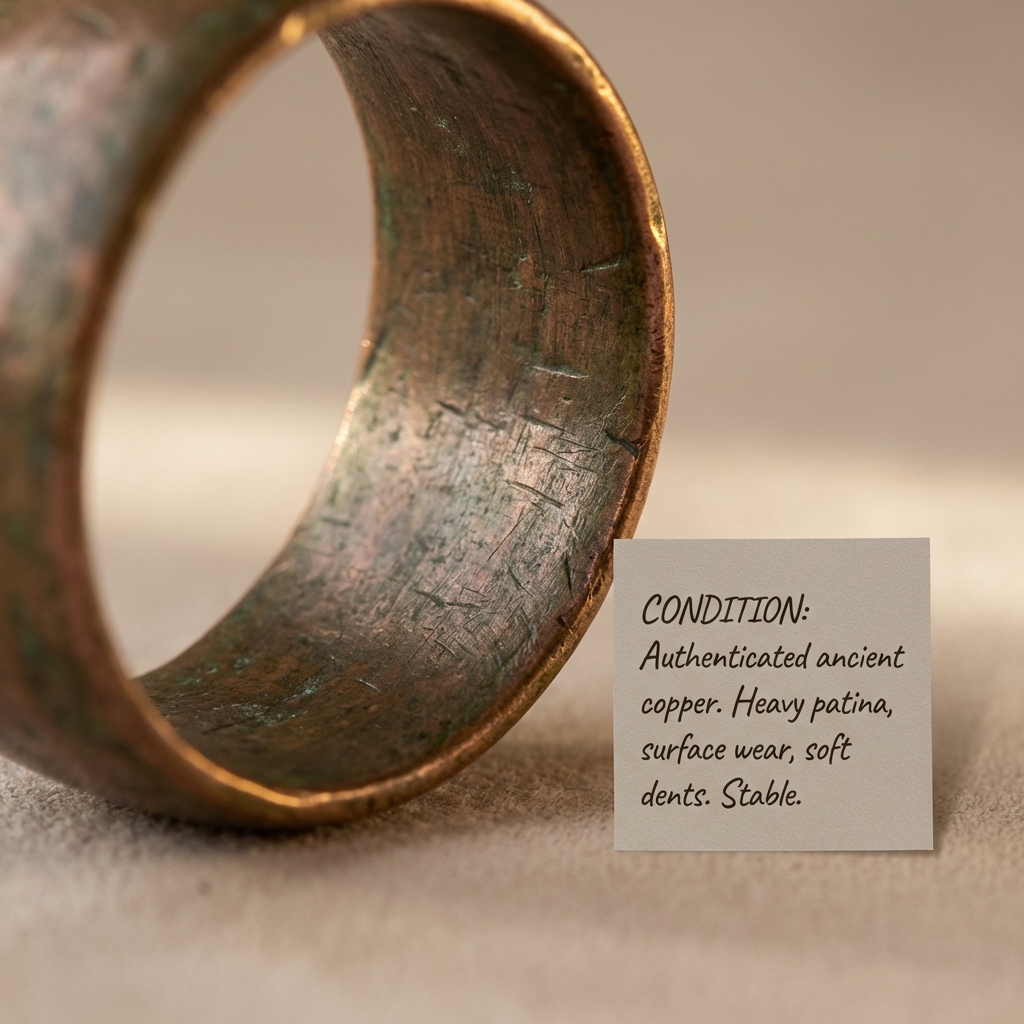
There are reports where copper related allergy has led to more widespread or distant dermatitis beyond the immediate contact site, particularly in device related cases where internal exposure occurred; such examples show that copper sensitisation can present beyond a fingertip rash in some individuals a case report linking copper to widespread dermatitis.
Distinguishing causes is important because not all redness near a ring equals allergy. Irritant contact dermatitis from friction, detergents, or local skin dryness can mimic allergy. A visible green patina on the skin often reflects metal salts and surface corrosion rather than an immune response, although staining can coexist with allergy.
Local signs at contact sites
Early local signs most often stay at the contact margin and may resolve when contact stops. Noticing the exact distribution of redness and the timing related to wearing a particular copper item helps clinicians assess causation Mayo Clinic overview of allergic contact dermatitis.
When reactions become widespread or systemic in reports
Case literature shows that when internal copper exposure caused a reaction, the pattern could be widespread and prolonged, a clinical circumstance that has led professional bodies to advise specialist management in device cases CDC guidance on contraceptive device contraindications.
How a diagnosis is made: patch testing and clinical pathways
If metal allergy is suspected, seeing a dermatologist or a contact dermatitis centre is the recommended first step because they can perform a controlled patch testing sequence and interpret results in context guidance on patch testing and diagnosis in contact dermatitis (see Contact Dermatitis, Patch Testing, and Allergen Avoidance).
Patch testing involves placing small amounts of potential allergens in standardised patches on the back, leaving them in place for a specified period and then reading reactions at designated times. This process helps confirm whether someone is sensitised to copper specifically or to other metals in a series. For practical instructions see instructions for patch testing.
Preparation for patch testing and interpretation should be discussed with the clinician, because certain topical treatments or recent sun exposure can affect results. Self testing at home with improvised materials is not a substitute for clinical patch testing and can be misleading.
Pre test checklist for dermatology referral
Bring photos of reactions
When patch testing identifies copper sensitivity, clinicians will advise avoidance and discuss alternatives. If testing is negative, clinicians can help explore other causes such as irritant dermatitis or contact with residues and can suggest barrier and management strategies tailored to the individual.
When to see a dermatologist or contact dermatitis centre
Seek specialist review when a skin reaction is persistent, spreading, or causes significant discomfort, or when a person has a history of multiple metal reactions and plans to wear or handle an ancient piece regularly patch testing guidance from specialist societies.
What patch testing involves and what it can show
Patch testing can include a metal series with a range of common metallic sensitisers; where clinically indicated, copper can be included to identify true sensitisation. Results help guide whether wearing an item is likely to be safe with precautions.
Risk management and safer metal alternatives
For short term or occasional wear, simple barrier strategies can reduce direct skin contact. These include wearing the ring over a thin liner, using a removable finger sleeve, or limiting continuous wear to brief periods while monitoring the skin for signs of reaction Mayo Clinic guidance on managing contact dermatitis.
Applying clear protective lacquers or coatings to the metal surface can reduce direct contact, but collectors should use such treatments cautiously because they alter the original surface and should be recorded in restoration notes and condition notes to preserve documentation for future owners.
For people with confirmed metal sensitivity, lower reactivity metals are commonly recommended alternatives; implant grade titanium, platinum and certain high karat golds are among the options clinicians suggest, but choice should be guided by patch test outcomes and specialist advice expert guidance on patch testing and metal alternatives.
Barrier and short term strategies for occasional wear
Short contact trials, where a person wears the piece for a few minutes under observation, are a pragmatic way to test tolerance before prolonged use. Keep a simple diary of any skin changes and stop wear immediately if signs appear.
Longer term alternatives for people with confirmed sensitivity
When ongoing wear is important to the collector, clinicians can advise on suitable replacement mounting metals or on wearing options that preserve the artifact while reducing skin exposure, always with attention to documentation and conservation concerns.
Practical guidance for collectors handling ancient copper rings
Before buying, review listing photos carefully for surface condition, visible corrosion or repairs, and read condition notes and restoration notes to understand whether the item has been stabilised, coated or altered in ways that affect skin contact and appearance NHS guidance on contact dermatitis. You can also browse our Ancient Roman rings collection.
Look for provenance or documentation references on the listing because those records help explain a piece's history and any prior conservation work, which is valuable both for health considerations and for stewardship of the object.

Before wearing an authentic ancient copper ring regularly, try a short contact trial, consider a temporary barrier, and if you have a history of metal sensitivity, arrange clinical patch testing first. These steps protect your skin and help preserve the object.
What to check on a listing and in condition notes
Checklist items to review include clear scale photos, close ups of the interior band, explicit restoration notes describing any lacquers or stabilisation, and any provenance or collection history. Record these details for future reference and for clinical consultations if a reaction occurs.
Steps to try before wearing a piece regularly
Begin with a brief trial on clean, dry skin, inspect for early signs at 24 and 72 hours, and stop wearing the ring if redness or itching develops. If irritation occurs, photograph the site and save all seller documentation to assist any clinical assessment. For more on whether to wear ancient rings see can you wear ancient rings.

Common mistakes and pitfalls to avoid
A frequent mistake is assuming green skin staining proves allergy. Green patina often reflects metal salts and surface corrosion and can be removed or suppressed without implying sensitisation, although both can coexist.
Avoid self diagnosis and improvised home patch testing. Clinical patch testing under a trained clinician gives a standardised interpretation and is preferable when a true allergy is suspected patch testing guidance from specialist societies.
Failing to record restoration treatments is another pitfall. If a collector or conservator applies coatings to reduce skin contact, note those actions in restoration notes and condition notes because they matter for conservation and for later readers of the listing.
When to seek specialist care and closing advice
Red flags that warrant urgent clinician review include a rapidly spreading dermatitis after device insertion, persistent widespread skin symptoms, or severe reactions that do not ease after stopping contact. These patterns should prompt specialist assessment rather than home care alone CDC guidance noting copper allergy concerns in device contexts.
Seek clinical assessment and keep condition records
If you have persistent skin symptoms related to wearing a metal piece, consider documenting the reaction and consulting a dermatologist or a contact dermatitis centre for assessment and testing.
For collectors the practical checklist is straightforward, record condition and restoration notes, try short contact trials, use barrier methods if needed, and seek patch testing when a history or repeated reactions suggest sensitivity expert guidance on patch testing and diagnosis.
Not necessarily. Green staining is often due to metal salts or surface corrosion and does not by itself prove an allergic reaction. Observe for persistent redness or itching and seek assessment if symptoms continue.
Yes, stop wearing the ring and document the skin changes. If the rash is persistent or spreading, consult a dermatologist for evaluation and possible patch testing.
Yes. Clinicians commonly recommend implant grade titanium, platinum, or certain high karat golds as lower reactivity alternatives, guided by patch test results and specialist advice.
References
- https://www.nhs.uk/conditions/contact-dermatitis/
- https://onlinelibrary.wiley.com/doi/10.1111/cod.13888
- https://www.sciencedirect.com/science/article/abs/pii/S0190962201608442
- https://pubmed.ncbi.nlm.nih.gov/36912345/
- https://www.mayoclinic.org/diseases-conditions/contact-dermatitis/symptoms-causes/syc-20352712
- https://www.cdc.gov/reproductivehealth/contraception/mmwr/mec/summary.html
- https://www.contactderm.org/public-resources/patch-testing-guidelines
- https://pmc.ncbi.nlm.nih.gov/articles/PMC6170075/
- https://stanfordhealthcare.org/content/dam/SHC/clinics/menlo-medical-clinic/docs/Allergy/Patch%20Testing.pdf
- https://auroraantiqua.com/products/the-celestia
- https://auroraantiqua.com/collections/ancient-roman-rings
- https://auroraantiqua.com/collections/rings
- https://auroraantiqua.com/blogs/questions-and-answers/can-you-wear-ancient-rings