


Looking for the real thing? Browse genuine crusader rings for sale, each piece one of one, individually authenticated, with documented provenance. For the background, see the guide to medieval jewelry.
What people mean by an antique knights templar ring
The phrase antique knights templar ring commonly appears in listings and conversations to describe medieval or later rings that carry Christian crosses, star motifs, or simple signet forms associated in market literature with crusading orders and medieval piety. In practice, most items marketed under this label are crusader-era or medieval signet rings attributed by style or by a claimed collection history rather than by a single, archaeologically diagnostic type, so readers should approach the label as a working description rather than a firm identification The New Knighthood, Malcolm Barber.
Common market motifs that prompt a Templar attribution include simple Latin crosses, small star or rosette motifs, and plain signet shapes that resemble medieval private seals. These motifs appear across a wide range of medieval jewellery and do not by themselves prove membership in any specific order; many surviving rings with crosses are devotional or personal items made for lay owners during the crusader era Medieval Rings and Signet Rings, The Metropolitan Museum of Art.
Sellers and cataloguers often adopt shorthand labels to make objects legible to buyers: crusader ring, medieval cross ring, or Templar-style signet. These labels are descriptive and aim to capture a likely period, motif, or intended use rather than to state a definitive institutional affiliation. Because there is no unique Templar ring type, the same object may be described differently across listings depending on the seller's emphasis on motif, condition, or an asserted provenance note The New Knighthood, Malcolm Barber. For related listings see our Medieval Crusader Rings collection.
Typical motifs associated with Templar attributions
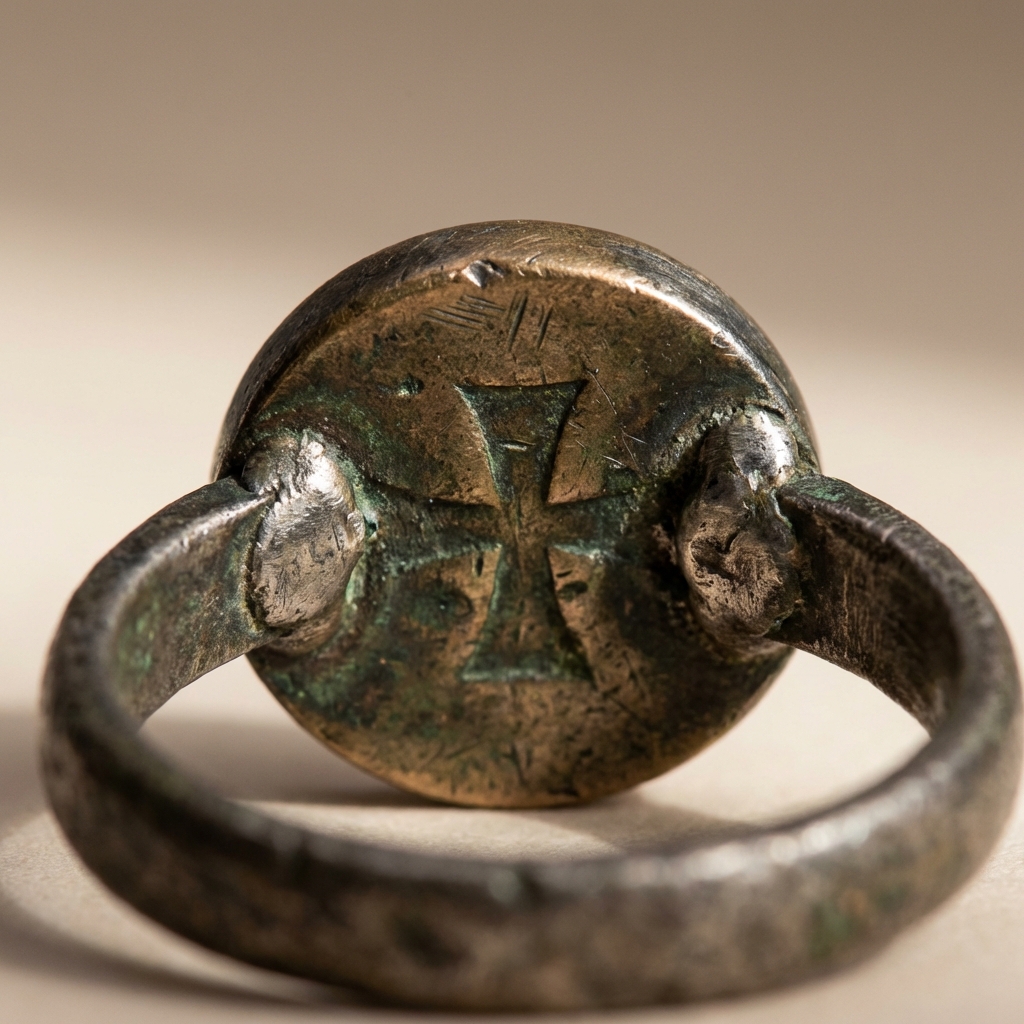
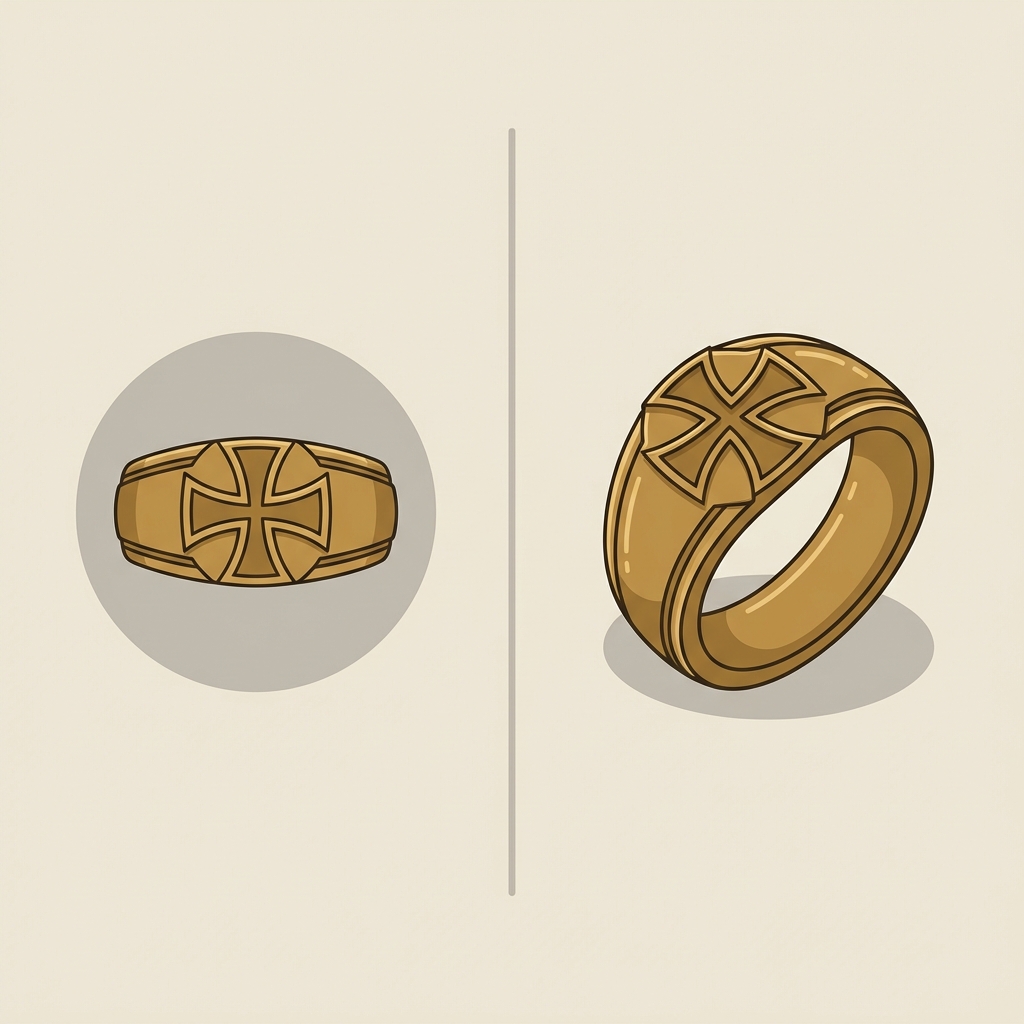
Expect to see cross motifs, small star shapes sometimes described as the Star of Bethlehem, and rounded signet bezels in items labelled as Templar. These motifs were widely used across medieval Christian communities, and their presence points to a religious reference rather than a guaranteed organisational link. When evaluating a listing, note whether the description explains why the motif suggests a crusader-era date or whether it merely repeats a conventional label Medieval Rings and Signet Rings, The Metropolitan Museum of Art.
Common market motifs that prompt a Templar attribution include simple Latin crosses, small star or rosette motifs, and plain signet shapes that resemble medieval private seals. These motifs appear across a wide range of medieval jewellery and do not by themselves prove membership in any specific order; many surviving rings with crosses are devotional or personal items made for lay owners during the crusader era Medieval Rings and Signet Rings, The Metropolitan Museum of Art.
Market attributions sometimes rest on a claimed findspot, a previous owner noted in a catalogue, or stylistic similarity to museum examples. Such connections can add persuasive context, but stylistic similarity and a thin ownership note do not substitute for documentary proof, and attribution remains conditional unless supported by clear provenance or technical analysis Medieval Rings and Signet Rings, The Metropolitan Museum of Art.
The phrase antique knights templar ring commonly appears in listings and conversations to describe medieval or later rings that carry Christian crosses, star motifs, or simple signet forms associated in market literature with crusading orders and medieval piety. In practice, most items marketed under this label are crusader-era or medieval signet rings attributed by style or by a claimed collection history rather than by a single, archaeologically diagnostic type, so readers should approach the label as a working description rather than a firm identification The New Knighthood, Malcolm Barber.
Why scholars and museums do not use a single Templar ring type
Scholars and museum cataloguers treat medieval rings as part of broader material cultures where motifs circulate across workshops and regions; this makes a single 'Templar' type difficult to define robustly. The consensus in specialist literature is that there is no uniquely diagnostic Templar ring form and that attributions to specific orders need supporting evidence beyond surface decoration The New Knighthood, Malcolm Barber.
Museum catalogues typically present rings with careful qualifiers: estimated date ranges, suggested workshop or regional attributions, and notes on similar securely dated examples used for comparison. Cataloguing practices emphasise comparanda rather than categorical labels, and curators will highlight uncertainty when an object lacks clear ownership records or scientific dating Medieval Rings and Signet Rings, The Metropolitan Museum of Art.
Limitations of stylistic attribution
Stylistic attribution can suggest a likely period or region, but it is rarely sufficient to prove membership in a particular order. Workshops produced popular shapes that circulated widely, and devotional crosses or stars do not carry institutional insignia that can be traced securely to the Order of the Temple. For collectors this means that labels promising a direct Templar link should be treated as provisional unless supported by documentation or testing The New Knighthood, Malcolm Barber.
How museum catalogues present medieval rings
When museums publish rings, they typically include photographs, condition notes, and references to closely dated comparanda. These entries are valuable for buyers because they show how curators weigh stylistic evidence against documented provenance and scientific data. Comparing a listing to museum examples can help narrow dating and function, but it cannot replace secure collection history or export paperwork where legal and ethical questions arise Medieval Rings and Signet Rings, The Metropolitan Museum of Art.
A practical framework to assess an antique knights templar ring
A clear, step by step approach helps separate plausible attributions from optimistic marketing. Start with a careful physical inspection, then move to paperwork, compare with museum examples, and consider testing if provenance is unclear. This ordered process aligns with guidance used by find-reporting projects and museum acquisition protocols Portable Antiquities Scheme.
Step 1: Examine physical condition and patina
Look for consistent surface patina, wear patterns on the hoop and bezel, and tool marks that match hand tools rather than modern machining. A uniform patina and wear consistent with age can support a medieval date, while sharp modern tooling marks or inconsistent surface colour can indicate later alteration. Photographs at high magnification of the bezel, hoop join, and any soldered repairs are particularly useful when assessing condition Portable Antiquities Scheme.
Step 2: Review documentation and collection history
Request all available paperwork: prior ownership notes, auction or catalogue references, export permits, and any verification letters. A clear chain of custody that predates modern collecting helps reduce legal and ethical risk. Auction houses and major sellers commonly advise that concise or absent provenance statements should be treated with caution How to Buy Antiquities, Christie’s.
Legally most people may wear historic rings, but buyers should prioritise clear provenance and export documentation to avoid legal and reputational risks, and be prepared to explain the historical context when wearing symbols that modern groups may view differently.
Step 3: Compare with securely dated museum examples
Place the ring next to published museum examples and note where it matches or diverges in form, proportion, and decorative detail. Museum comparanda give context on likely date ranges and workshop practices, but matching a motif is evidence of similarity not proof of organisational ownership. When comparanda are cited, prefer examples with clear dating and provenience to build a reasoned argument about likely period Medieval Rings and Signet Rings, The Metropolitan Museum of Art.
Step 4: Consider scientific testing when needed
If provenance remains disputed or if the object is of high value and the buyer needs greater certainty, seek third party technical reports that can include alloy analysis, X-ray imaging, or microscopic examination of tool marks. Scientific testing supplements stylistic comparison and documentation but is typically used when questions cannot be resolved through paperwork and comparanda alone Portable Antiquities Scheme.
Legal and ethical checklist before you buy
Buyers should be aware that international rules and museum ethics prioritise provenance and lawful export when dealing with medieval antiquities. The UNESCO 1970 Convention and the ICOM Code of Ethics frame professional practice and inform commercial due diligence, so clear documentation consistent with these standards reduces legal and reputational risk Dealing in Cultural Objects (Offences) Act 2003, The National Archives, legislation.gov.uk.
Key documents that meaningfully reduce risk include export permits, dated acquisition records that show lawful transfer, and catalogued prior ownership in a recognised collection. Lacking these items increases the chance that an object was illicitly excavated or exported without proper authority, a continuing concern for buyers and institutions working ethically with antiquities Code of Ethics, International Council of Museums (ICOM), Paris.
Key international rules that matter to buyers
The UNESCO 1970 Convention and museum codes concentrate on preventing illicit import and export and on requiring reasonable provenance checks for acquisitions. While legal detail varies by jurisdiction, following these international norms is a responsible baseline for private collectors and sellers handling medieval material 1995 Convention, UNIDROIT, International Institute for the Unification of Private Law, Rom.
Red flags in export and ownership history
Watch for short provenance statements such as unclear 'private collection' dates, inconsistent paperwork, or gaps that start in the recent past without explanation. These concise statements often precede problematic sales. Also be cautious when export paperwork is missing or when documentation dates do not align logically with acquisition claims; such inconsistencies are commonly highlighted by auction house buying guides as reasons for further inquiry How to Buy Antiquities, Christie’s.
How to buy responsibly: due diligence and buyer questions
Before purchasing, prepare a short script of specific questions to ask the seller or auction house and keep a checklist of documents you need to see. This makes it easier to compare listings and to escalate concerns to a specialist when necessary. Auction houses and experienced dealers recommend requesting full provenance and condition documentation as a standard part of due diligence How to Buy Antiquities, Christie’s. You can also compare similar items in our rings collection.
Sample questions you can ask in a message or on the phone include: What is the complete ownership history of the ring? Are there export permits or acquisition records that predate 1970? Have any technical reports or conservation records been produced? Can you provide close-up, calibrated photographs showing the bezel, hoop, and any repairs? These queries mirror the practical expectations used by museums and major auction houses How to Buy Antiquities, Christie’s.

Ask for condition notes that describe conservation or restoration work, not merely market-friendly language. Restoration notes should explain what was stabilised or repaired and whether interventions were reversible; do not assume that treatment implies authentication, as restoration is a conservational action rather than proof of date or ownership Portable Antiquities Scheme.
Track provenance, documentation, and condition requests from sellers
Use alongside catalogue references
When paperwork remains incomplete, a technical report can help, but it will not always resolve provenance gaps. Technical analysis is best used to confirm material plausibility or to reveal later alterations; it does not create a legal chain of ownership where none exists. Treat scientific reports as a supplement to, not a replacement for, documentary provenance Portable Antiquities Scheme.
Can anyone wear an antique knights templar ring? Social and etiquette considerations
Legally, wearing a historic ring with Templar imagery is permitted in most jurisdictions, and private ownership of an ancient ring is generally lawful when acquired with appropriate documentation. Social meaning, however, can vary: modern groups that use Templar symbolism differ in how they regard public display of certain insignia, and some orders treat particular emblems as internal regalia rather than public symbols The New Knighthood, Malcolm Barber.
If you plan to wear a piece publicly, consider context and intent. Explain to curious interlocutors that the ring is a historical object and, if relevant, clarify whether it is a curated antiquity rather than a modern emblemed item. Clear, honest language about provenance and age reduces confusion and shows respect for contemporary groups that use related symbolism How to Buy Antiquities, Christie’s.
Legal permission versus social meaning
Ownership and the right to wear antique motifs are different from social acceptance. A historically minded wearer should anticipate questions and be ready to describe the ring's documented history or the limits of that documentation. Context matters: a museum label or a private explanation changes how observers read the symbol compared with wearing overtly organisational regalia in a contemporary ceremonial context The New Knighthood, Malcolm Barber.
How modern Templar groups may view historic symbols
Modern organisations vary widely in their use of Templar imagery; some are fraternal groups with internal insignia while others adopt medieval symbolism more loosely. If your concern is etiquette rather than legality, a brief inquiry to a relevant group or a public statement about the ring's historical status can prevent misunderstandings. Remember that historical ownership is different from modern organisational affiliation, and present your intent clearly if asked How to Buy Antiquities, Christie’s.
Common mistakes and red flags collectors make
A frequent error is to rely solely on stylistic similarity when assessing a claim. Because motifs were widely copied and shared across regions and periods, a matching cross or star motif is suggestive but not determinative. Treat stylistic matches as a starting point for further enquiry, not as definitive proof Medieval Rings and Signet Rings, The Metropolitan Museum of Art.
Ignoring incomplete provenance is another common pitfall. A short provenance line without dates or supporting documents leaves unanswered questions about lawful export and prior ownership. Auction house guides advise that concise or absent provenance statements are legitimate reasons to pause or to request additional verification How to Buy Antiquities, Christie’s.
Overreliance on stylistic similarity
Stylistic comparison is useful but limited. Workshops repeated successful forms and devotional motifs spread widely, so similarity often indicates common taste rather than direct institutional connection. Use comparanda to narrow likely dating and function, then confirm with paperwork or testing when necessary Medieval Rings and Signet Rings, The Metropolitan Museum of Art.
Ignoring incomplete provenance
Buyers should be wary of optimistic stories that are unsupported by paperwork. Ask for acquisition dates, previous catalogue references, and export documentation. Where gaps remain, assume uncertainty and seek further verification before concluding that the object is a securely attributed Templar-related piece How to Buy Antiquities, Christie’s.
Practical examples and scenarios: reading three sample listings
Example A: A listing describes a 12th to 13th century silver ring with full condition notes, a documented ownership chain to a named 19th century collector, and an export permit dated before 1970. In such a case the documentation substantially reduces legal risk and makes a tentative attribution more credible, though scholarly claims about a specific order should still be cautious. Clear records and corroborating references are what museums and auction houses look for when accepting a medieval attribution UNESCO 1970 Convention.
Recommended next step for Example A: Confirm the catalogue references and request photographs of the paperwork. If the documents are consistent and plausible, consider commissioning a technical report only if questions remain about material composition or alterations Portable Antiquities Scheme.
Example B: A listing claims a Templar provenance on the basis of a cross motif and a short, undated 'private collection' note with no export paperwork. This situation is common and should prompt caution: stylistic claims alone do not establish lawful ownership or organisational affiliation Medieval Rings and Signet Rings, The Metropolitan Museum of Art.
Recommended next step for Example B: Request full provenance details, high-resolution photos of the patina and joins, and any available historic catalogue citations. If the seller cannot provide these, it is reasonable to decline or to require a written assurance of lawful export before proceeding How to Buy Antiquities, Christie’s.
Example C: A listing contains good photos and a stylistic argument but shows an export permit that postdates an asserted earlier catalogue entry, creating a paperwork inconsistency. This gap is a red flag because mismatched dates commonly point to problems in the chain of custody. When export paperwork does not align logically with prior ownership claims, pause and seek clarification from the seller and, if needed, from a specialist UNESCO 1970 Convention.
Recommended next step for Example C: Ask for scanned copies of the permit and the earlier catalogue entry, and consider getting a third party opinion from a conservation laboratory or a recognised specialist to clarify the timeline before making an offer Portable Antiquities Scheme.
Aurora Antiqua Logo
Conclusion and a short buyer checklist
Three quick questions to ask before you buy: Can the seller provide a coherent ownership history? Are there export permits or dated acquisition records? Do condition and restoration notes match photographs and plausibly support a medieval date? These three points condense the article’s practical advice and reflect professional acquisition standards that reduce legal and reputational risk How to Buy Antiquities, Christie’s.
Where to find further expert help: consult published museum catalogues for comparanda, consider the Portable Antiquities Scheme for identification guidance, and seek a recognised conservation laboratory or a qualified specialist when provenance or condition remains unclear. Aurora Antiqua aims to act as a careful curator reference by presenting condition notes, restoration details, and provenance context where available, helping buyers make informed, ethical choices. For more background see our Questions and Answers: What is a Knights Templar ring.
Authenticity relies on a combination of consistent patina and wear, documented provenance, comparison with securely dated museum examples, and, when necessary, third party technical reports; stylistic similarity alone is not sufficient.
In most jurisdictions wearing historic Templar imagery is legal, but buyers should ensure the object was acquired with appropriate documentation and be aware that modern groups may have social expectations about certain insignia.
Request prior ownership records, dated acquisition notes, export permits where applicable, full condition and restoration notes, and any technical or conservation reports that exist.
More from Aurora Antiqua
References
- Code of Ethics, International Council of Museums (ICOM), Paris
- 1995 Convention, UNIDROIT, International Institute for the Unification of Private Law, Rom
- Dealing in Cultural Objects (Offences) Act 2003, The National Archives, legislation.gov.uk
- Stolen Works of Art Database, INTERPOL
- Research report: export licensing and provenance, GOV.UK, Department for Culture, Media and Sport (DCMS)
- New Acquisitions of Archaeological Material and Works of Ancient Art, Association of Art Museum Directors (AAMD)
- Silver and plate, Icon, The Institute of Conservation (UK)
- How to Care For Your Jewellery: The Ultimate Guide by the National Association