


Looking for the real thing? Browse genuine crusader rings for sale, each piece one of one, individually authenticated, with documented provenance. For the background, see the guide to buying ancient artifacts.
What an antique knights templar ring means: definition and historical context
antique knights templar ring
Collectors and historians use the phrase antique knights templar ring to describe a ring that is said to date from the crusading period or to have belonged to a member of the Knights Templar, an order founded around 1119 with origins in Jerusalem; institutional overviews emphasise that direct attributions to the Order require documentary evidence rather than visual similarity alone Encyclopaedia Britannica
In practice, the phrase often covers a range of objects: medieval devotional rings, signets, or later pieces that carry a revivalist Templar association, and those different histories matter for collectors because they affect how one interprets iconography and condition British Library
See behind the scenes at @auroraantiqua
Before you form a buying judgement, consult condition notes and any provenance details listed with an item to understand what is documented and what is inferred.
There is no single, universally recognised medieval Templar ring type in museum collections; curatorial surveys note that many objects later labelled Templar reflect nineteenth and twentieth century revivalism rather than verifiable medieval ownership British Library
That means the most responsible way to read a claimed attribution is as a hypothesis that needs testing through provenance checks and, when appropriate, specialist examination rather than as an automatic identification based on motif alone Smithsonian Magazine
Common motifs and symbols linked to crusader era rings
Cross types and devotional imagery
When rings from the crusader period carry Christian symbolism, the most commonly recorded motifs are simple cross forms, in particular variations like the cross pattée and the Latin cross; these designs are consistent with devotional use and with broader crusader-era imagery British Library
Medieval examples more often show basic devotional iconography than elaborate heraldry, so the presence of a cross or related symbol can suggest a Christian owner or user in a crusader context but does not by itself demonstrate Order membership The National Archives

Star and Bethlehem motifs and simple iconography
Star designs and Bethlehem motifs appear in crusader era material and later medieval devotional objects, and these can indicate a wider devotional vocabulary rather than a unique Templar badge The Metropolitan Museum of Art
Because motif types overlap across regions and centuries, specialists advise caution: a star or Bethlehem motif may be historically plausible for a crusader era ring but, without context, it is not conclusive evidence of Knights Templar ownership The National Archives
How specialists identify an antique knights templar ring: materials, manufacture and wear
Expected materials and bezel types
Professionals begin identification with material and construction: medieval rings are most commonly found in bronze or silver and only occasionally in gold, and those materials influence preservation and surface evidence Portable Antiquities Scheme Portable Antiquities Scheme finger-rings guide
Bezel types vary, from simple cast bezels to hand-cut signet faces and incised intaglio work, so noting whether a bezel appears cast, soldered, or engraved helps place a ring in a broad manufacturing tradition The Metropolitan Museum of Art
A claimed Templar attribution suggests a possible connection to crusader era contexts, but it proves nothing without reliable provenance, archival references, or independent specialist confirmation.
Manufacturing features: intaglio, casting, signet faces
Key manufacturing markers include intaglio carving, hand casting traces, and the shape of signet faces; for example, a flat, worn signet face with evidence of hand-tool marks is more consistent with medieval working methods than a modern machine-made impression Portable Antiquities Scheme
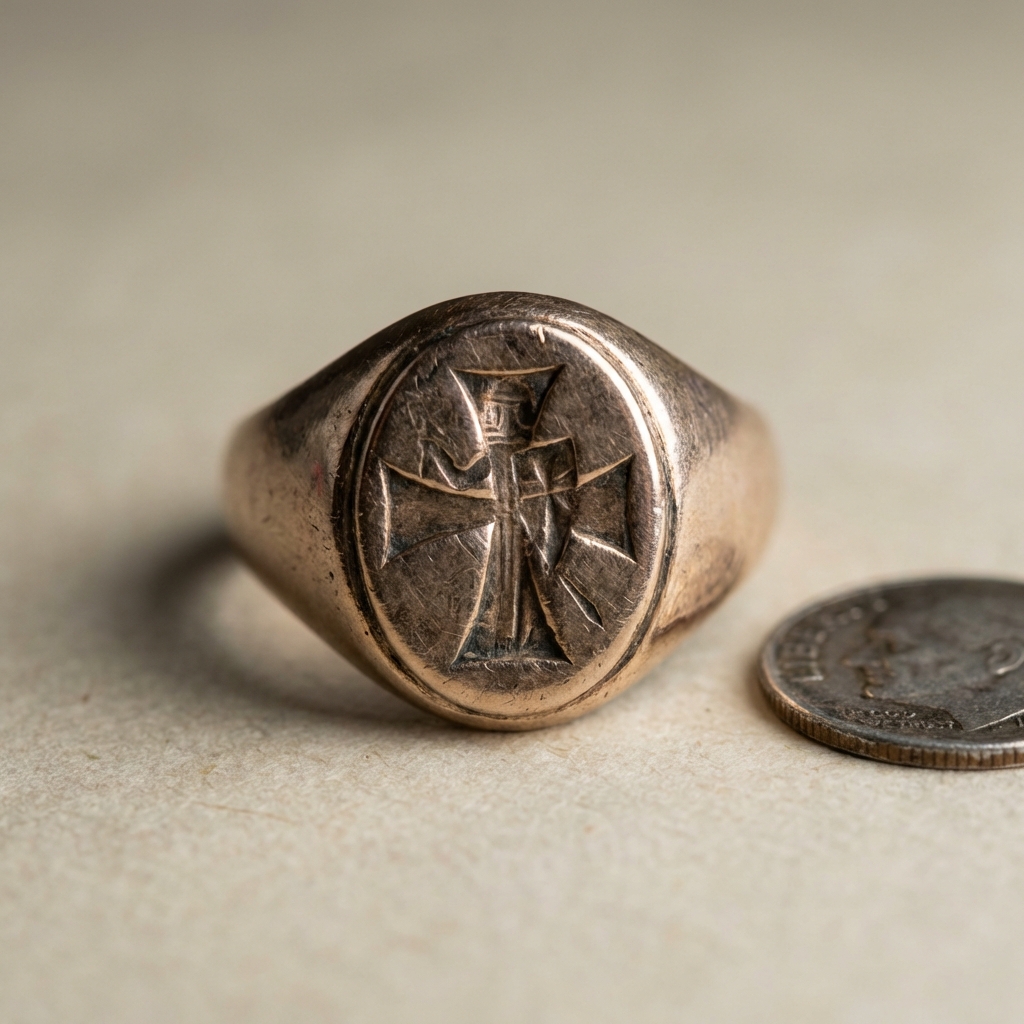
Experts treat these markers as clues rather than proof: manufacturing features can indicate period-appropriate techniques but dating and attribution still rely on comparative evidence and, where possible, specialist testing The National Archives
Wear patterns, patina and loss of detail as practical markers
Wear consistent with age, such as a stable patina, localized abrasion on contact points, and softened or lost fine detail on intaglio areas, is a practical marker that curators use to assess whether a ring has long-term wear consistent with medieval use Portable Antiquities Scheme
At the same time, these surface signs can be affected by later cleaning, conservation, or deliberate artificial ageing, so they increase or decrease confidence only when considered alongside provenance and technical reports The Metropolitan Museum of Art
Provenance, archival checks and scientific testing for attributions
Types of provenance that strengthen an attribution
Provenance elements that materially strengthen an attribution include a recorded findspot, documented collection history, and sale records that demonstrate continuity of ownership; these items of documentation help place a ring within an archaeological or archival context rather than in a market narrative alone Portable Antiquities Scheme A closer look at the Portable Antiquities Scheme
Without such records, a stylistic resemblance to crusader motifs is a weaker basis for asserting Knights Templar ownership; museums and archives therefore encourage clear provenance before accepting Order attributions British Library

What scientific and specialist reports can confirm
Specialist reports and scientific analyses, such as metallurgical testing, microscopy of surface features, and, where appropriate, thermoluminescence or residue analysis, can help confirm period-appropriate manufacturing techniques and materials and thereby increase attribution confidence The National Archives
For collectors, an independent specialist report that outlines methods, findings, and limitations offers a stronger basis for assessing a Templar claim than visual assessment alone Portable Antiquities Scheme
Public databases and archive resources for preliminary comparison
Public tools such as national archives and online databases provide useful comparanda for preliminary checks; they allow buyers to compare motifs, materials, and manufacturing clues with documented examples held in public collections Portable Antiquities Scheme
These resources are a starting point rather than a final authority, and collectors should pair database comparisons with provenance queries and, when indicated, professional reports British Library See our Medieval Crusader Rings collection.
How revivalism and market stories create common misattributions
19th and 20th century romantic attributions
The nineteenth and twentieth centuries saw a strong revivalist interest in the Knights Templar that produced objects, literature, and market labels linking ordinary medieval rings to the Order, and many modern attributions trace back to these romantic narratives rather than to medieval documentation British Library

Understanding that revivalism shaped public ideas about Templar rings helps explain why provenance gaps often coincide with bold historical claims in listings and catalogues Smithsonian Magazine
Signs that a claim may be modern or embellished
Red flags include dramatic, story-driven descriptions without documentary references, a lack of findspot or collection history, and attributions that rely solely on motif similarity rather than on archival or scientific evidence British Library
When stylistic similarity is presented as the primary basis for Order ownership, collectors should treat the attribution as tentative and seek further documentation or independent evaluation Portable Antiquities Scheme
Decision framework and buying checklist for collectors
Simple checklist to use before purchase
Start with high quality photos, clear measurements, and condition notes that discuss patina, corrosion, and any repairs; ask for close views of the bezel, hoop, and signet face where present Portable Antiquities Scheme Compare with our rings collection.
Request any provenance documentation available, including prior sale records, collection history, or findspot information, and note whether restoration notes describe interventions that affect original surfaces The National Archives
When to pause and request specialist input
If a listing claims Knights Templar ownership but lacks a findspot or collection continuity, pause and ask for documentation or an independent specialist report; the absence of records materially lowers attribution confidence British Library
Similarly, if restoration has altered intaglio or signet faces so that original tool marks are obscured, request conservation records to understand what remains original and what was replaced or consolidated Portable Antiquities Scheme
How to weigh condition, restoration notes and documentation
Treat restoration notes as essential reading: careful, reversible conservation that stabilises a ring is different from invasive repair that replaces original material, and those differences affect how confidently one can attribute the object to a period or owner The Metropolitan Museum of Art
When documentation and technical reports align with stylistic and material indicators, confidence grows; when they diverge, prefer documented context and independent analysis over appealing stories The National Archives
Practical scenarios: three collector case studies
Scenario A, photo only listing with a Templar claim: immediate questions include what provenance is offered, whether high resolution images of the bezel and hoop are provided, and whether the seller will permit a specialist to inspect or report; without a findspot or sale record, the sensible outcome is to buy with reservation or decline Portable Antiquities Scheme For an example see this PAS record.
Scenario B, ring with collection history but no scientific report: here ask for copies of sale catalogues, prior ownership documentation, and any conservation records; a conditional purchase with an independent specialist review can be reasonable when collection history is continuous but technical confirmation is absent British Library
Preliminary public comparison checklist for medieval rings
Use simple search terms like "crusader ring" and "medieval signet" when comparing
Scenario C, ring with comparable museum parallels: when a seller provides museum comparanda or published parallels, verify those comparisons in public databases and ask whether independent testing was performed; a museum parallel increases confidence but does not substitute for provenance or specialist testing The Metropolitan Museum of Art
Across scenarios, the practical action steps are consistent: document requests, specialist review when indicated, and careful reading of restoration notes before deciding Portable Antiquities Scheme
Conclusions and responsible next steps for interested collectors
Summary of key takeaways
Motif and material can suggest a crusader era origin, but the most reliable path to a Knights Templar attribution is documentary context and specialist corroboration rather than motif alone British Library
Use public databases for comparison, request provenance documentation, and ask for independent reports where the attribution would materially affect your decision Portable Antiquities Scheme
Practical next steps and resources
Begin with database comparison and archive searches, then consult a conservator or a qualified specialist for technical advice if provenance is incomplete or the listing is high value The National Archives See our Q&A: what is a Knights Templar ring.
Finally, prioritise transparent documentation: when provenance, condition notes, and independent reports are available, they turn appealing claims into assessable evidence
There is no single visual test. Confirming ownership requires documentary provenance, such as a findspot or continuous collection history, plus specialist examination and, when suitable, scientific testing.
No. Crosses and stars are historically plausible for crusader era objects but they do not prove Order membership without supporting provenance or technical analysis.
Request high resolution photos, condition and restoration notes, documentation of provenance or past sales, and permission to seek an independent specialist report if needed.
More from Aurora Antiqua
References
- Signet Ring, Victoria and Albert Museum, London
- Medieval gold signet ring, Collections Online, Amgueddfa Cymru, Museum Wales, Cardiff
- anello sigillo (anello a castone con sigillo) età medievale, Istituto centrale per il catalogo e
- Ring, Victoria and Albert Museum, London
- Finger ring, London Museum (vormals Museum of London)
- Internet Archaeol. 33. Bland. Response: the Treasure Act and Portable, Internet Archaeology, University
- The Portable Antiquities Scheme and the Treasure Act, Papers from the Institute of Archaeology, UCL Institute
- Research report: export licensing and provenance, GOV.UK, Department for Culture, Media and Sport (DCMS)
- The Past Polluted: A Pigovian Approach to the Black Market in Antiquities, International Journal of Cultural
- Spring Brings a Wave of Baby Animals to the Zoo, Smithsonian Magazine