


Looking for the real thing? Browse genuine crusader rings for sale, each piece one of one, individually authenticated, with documented provenance. For the background, see the guide to medieval jewelry.
What is an ancient knights templar ring? Definition and context
Definition and common uses of the term: ancient knights templar ring
The phrase ancient knights templar ring is often used in marketplace listings to describe an archaeological or historically styled ring that appears to date from the Crusader period or medieval centuries, and that typically carries Christian or pilgrimage iconography rather than modern fraternal emblems. When sellers use that language they may mean an antiquity with maker or workshop origin in the medieval era, or a ring that is inspired by Crusader motifs; the claim should be read as an attribution that can be supported or contested by provenance and condition notes.
Scholarly and museum collections show that medieval rings associated with Crusader contexts commonly bear crosses, starburst motifs, pilgrim symbols or simple intaglio carvings consistent with devotional use; these are archaeological objects and are not the same as later fraternal Knights Templar regalia that developed within Masonic and chivalric revival movements. For visual comparisons and classification examples see major museum entries for medieval rings which illustrate typical crusader iconography and workmanship Metropolitan Museum collection examples and Aurora Antiqua's medieval crusader rings collection medieval crusader rings.
In marketplace language, "Knights Templar" may function as a stylistic attribution rather than as proof of continuous institutional membership to a historical order. Sellers sometimes adopt evocative period labels to describe motif, provenance hypotheses or regional attributions; responsible listings make clear whether the term is used as an archaeological attribution or simply as a stylistic shorthand.
See more behind the scenes at @auroraantiqua
If you are evaluating a listing described as an ancient knights templar ring, pause to review provenance and condition notes and compare the item visually to museum entries before assuming a direct historical link to any fraternal order.
How archaeological Crusader rings differ from fraternal regalia
Archaeological Crusader rings are physical artifacts created in medieval workshops and used in devotional or personal contexts; their age is supported by material condition, patina, and archaeological comparanda. By contrast, modern Knights Templar regalia within Masonic contexts are symbolic items produced long after the medieval period and follow fraternal design conventions rather than archaeological production techniques. This distinction is important because a ring can be medieval in date without having any direct institutional link to later chivalric societies.
Collectors should therefore treat the label 'Knights Templar' as a claim requiring documentation, especially when listings blur archaeological attribution and fraternal symbolism. When provenance or collection history is provided it helps clarify whether the ring is presented as a medieval antiquity, a later commemorative item, or a modern piece inspired by medieval motifs.

Masonic rings versus Crusader-era Templar rings: origins and visual cues
Historical origins of Masonic symbols
Modern Masonic regalia and the emblematic Square and Compasses developed within fraternal and craft traditions in the post medieval period and carry a different symbolic vocabulary than medieval devotional rings; authoritative introductory guidance on Freemasonry explains the origins and use of these symbols within the fraternity Encyclopaedia Britannica on Freemasonry. Practical discussion of ring meaning and wearing can also be found on Lodge46's blog What is the meaning of a Masonic Ring.
Because Masonic symbolism evolved in a fraternal context, rings that display the Square and Compasses, the letter G in some jurisdictions, or lodge jewels are most often modern or modernly produced to serve member identification and lodge regalia, rather than being medieval artifacts. Guidance on conduct and wearing of Masonic regalia is discussed in practical terms at MasonicShop MasonicShop article.
Common motifs on medieval Crusader rings and how to read them
Medieval Crusader-era rings often carry crosses, starburst motifs, pilgrimage signs, or carved intaglio scenes of saints. These motifs should be read alongside material signals such as hand-hammered shanks, surface wear consistent with prolonged use, and patina layers that indicate age. Museum catalogues of medieval rings can provide visual comparators to help separate period work from later reproductions British Museum collection entries.
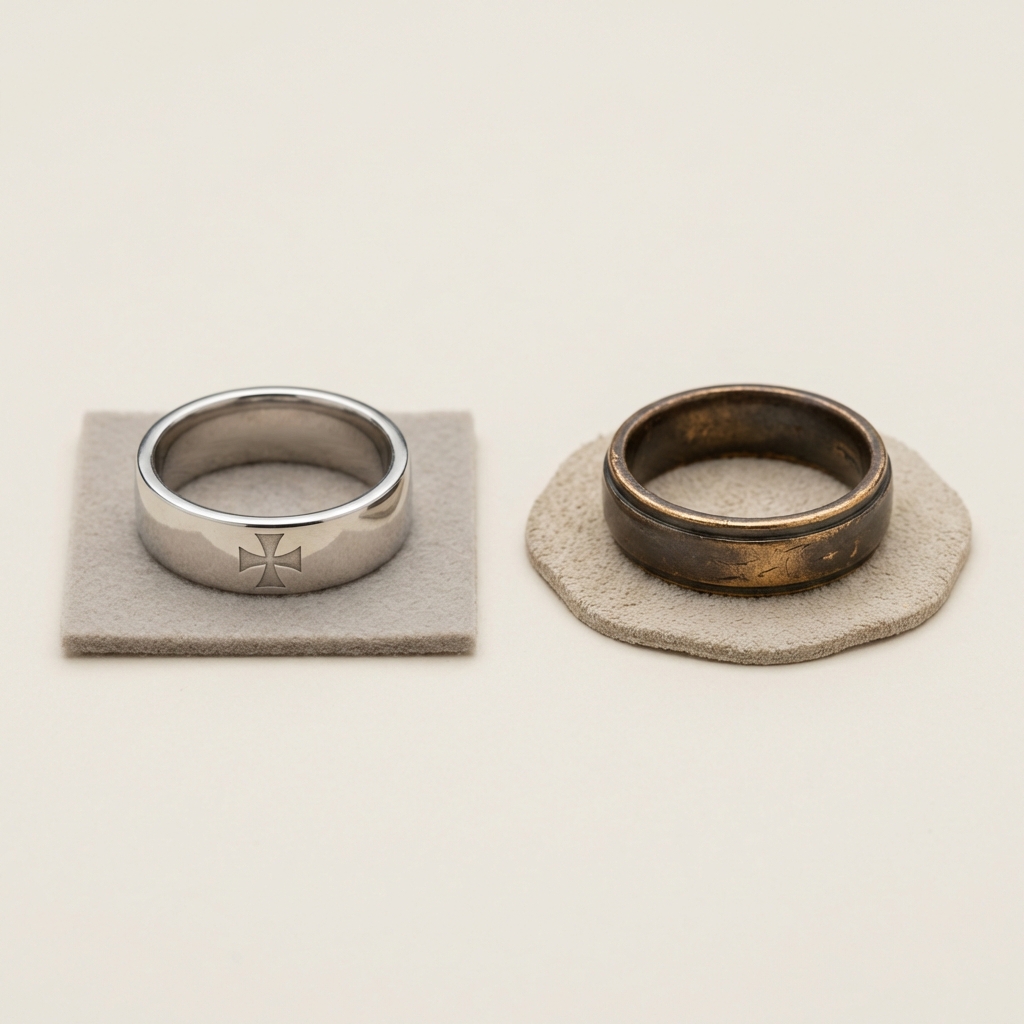
Visual cues are useful but not definitive: a cross motif alone does not prove age or direct relation to any particular medieval order. Even well executed period style rings can be commemorative or later reproductions, so motif assessment should prompt further verification such as provenance checks or condition assessments when an item is described as an ancient knights templar ring.
Who can wear a Masonic ring? Lodge rules and etiquette
Grand Lodge authority and jurisdictional variation
Customary Masonic practice is that rings bearing the Square and Compasses and other official emblems are intended for initiated Freemasons and are often tied to degree status; however rules can vary by jurisdiction and lodge tradition, and individual Grand Lodges publish guidance about allowable regalia and insignia use United Grand Lodge of England guidance.
Because each Grand Lodge sets authoritative rules for its members, what is acceptable in one country or state may differ in another; many Grand Lodges also publish etiquette notes concerning officer jewels and other insignia, and some explicitly discourage non-members from wearing lodge-specific regalia Grand Lodge of Scotland dress and regalia guidance. The Grand Lodge of Ohio also provides an overview of ring meaning and use The Grand Lodge of Ohio guidance.
Wearing an explicit Masonic ring as a non-member can be culturally sensitive and potentially misleading; consult the governing Grand Lodge guidance for the relevant jurisdiction and prefer secular or historically inspired designs if you are not initiated.
Typical membership stages tied to regalia use
In many Masonic systems, certain forms of regalia are associated with advancement in degree, and wearing officer-specific items is reserved for those who hold the corresponding office or degree. Rings are often considered personal tokens of membership and may be worn by initiated members as a private or public sign of affiliation, subject to local custom and Grand Lodge rules.
If you are unsure whether a particular ring is appropriate to wear in public, contact the Grand Lodge governing the jurisdiction where you intend to wear it or consult published guidance for that jurisdiction before doing so.
Cultural sensitivity: why non-members should be cautious wearing Masonic emblems
Potential social and fraternal misunderstandings
Wearing a clearly Masonic emblem as a non-member can be culturally sensitive because such symbols identify the wearer as part of a fraternal network and can create misunderstandings about membership or privileges. Observing local lodge etiquette helps avoid unintended offense or misrepresentation in social and fraternal contexts.
Some lodges and jurisdictions expect that only initiated members wear official insignia in certain settings, and there are historical and social reasons for those expectations; respecting those conventions reduces friction and preserves the symbolic meaning attached to regalia.
When wearing a symbol can be misleading
Wearing an item that closely resembles official regalia while not being a member can be misleading to others who recognize the symbol, especially in formal or lodge related settings. For those attracted to the aesthetic but not to membership, choosing secular or historically inspired designs avoids confusing signals and respects fraternal traditions.
Identifying a genuine Crusader or Knights Templar archaeological ring
Motifs, materials and manufacturing traits to check
To assess whether a ring is likely medieval, examine motifs in combination with physical traits: hand finishing marks, irregularities in casting or forging, a stable patina, wear consistent with long term use, and simple tooling marks consistent with pre industrial workshops. Museum collection entries show examples that help collectors evaluate these signals against a known corpus Metropolitan Museum collection examples.
Look at the bezel and intaglio for stylistic consonance with known medieval examples and check the hoop and shoulders for hand finishing; a well formed, subtle patina and non uniform wear patterns often indicate age while strongly uniform surfaces or perfectly consistent casting can suggest a modern production. Use careful photography and magnified inspection to note these details before drawing conclusions.

Red flags that suggest later reproduction or misattribution
Common red flags include modern tool marks, overly uniform machine casting, aggressive polishing that removes original surface, vague marketing language that conflates medieval origin with Masonic affiliation, and lack of any provenance or condition notes. Listings that rely on evocative but unsupported claims should be treated with skepticism and prompt further questions of the seller.
If a listing asserts a Templar institutional link without clear collection history or scientific support, demand documentation or consider independent assessment before assuming a direct medieval institutional provenance.
What to check in a listing: provenance, condition notes, restoration notes
Essential documentation items to request
Ask the seller for clear provenance statements, collection history, and any verification letters or certificates. Provenance that identifies prior collections, documented auction history, or reliable acquisition notes strengthens an attribution; transparent sellers include these references and explain gaps or uncertainties in the record Aurora Antiqua product documentation example.
Measurements, high resolution images from multiple angles, and notes about repairs or stabilization are part of essential listing information. If such details are missing, request them before committing to a purchase.
How restoration and stabilization are described
Sellers describe interventions in different ways; common terms include 'stabilized', 'repaired', or 'left untouched'. 'Stabilized' typically indicates minimal measures to prevent further deterioration, while 'repaired' may refer to structural fixes that alter the object's present condition. Ask for precise descriptions and photographs of any repairs, and clarify whether restored areas are visible and how they influence handling or display.
Remember that visible restoration does not automatically negate historical value, but it does affect how a piece is presented and cared for. Good listings separate condition notes from provenance to allow buyers to evaluate both independently.
A practical buying checklist for collectors
Step by step pre-purchase checks
Before buying, verify provenance, request condition and restoration notes, examine detailed photos, and ask for any available third party assessments. For items described as an ancient knights templar ring, treat the listing claim as an attribution that needs supporting evidence rather than proof on its own.
Collector checklist for provenance, condition and restoration checks
Use as a prompt for seller questions
Use the checklist to structure your queries and to compare listings; note inconsistent or missing answers as potential reasons to delay a purchase or seek independent verification.
Questions to ask the seller or listing agent
Key questions include: Where did this piece come from, what documentation supports that history, what specific repairs were made and when, do you have high resolution images of the areas of repair, and has the piece been tested or assessed by an independent specialist? Clear, prompt answers to those questions are a positive sign of seller transparency.
If the seller references museum comparisons or published catalogues, ask for the exact catalogue entry or accession number so you can verify the comparison yourself rather than relying solely on the seller's summary.
Common mistakes and pitfalls when buying Templar or Masonic-style rings
Typical listing misrepresentations
Buyers commonly accept stylistic claims as proof of age, confuse medieval origin with later Masonic affiliation, or overlook restoration disclosures that materially affect the object's appearance. Marketing language that emphasizes evocative labels without documentation is often the first signal of an overclaimed listing.
Cross checking with museum examples and demanding provenance and condition notes reduces the risk of paying for a misattributed or modern commemorative piece.
How restoration or reproduction claims can mislead buyers
Overpolished pieces, replacement components, or modern soldering can change a ring's character and may be obscured by flattering photography. Replicas and commemoratives are frequently marketed using period style terms, so look for precise dating claims, workshop attributions, and explicit statements when a piece is described as a later reproduction.
When in doubt, consider seeking a third party opinion or declining a purchase until documentation is sufficient to support the seller's claims.
How Aurora Antiqua documents and presents related pieces
What buyers can expect from curated listings
Aurora Antiqua presents curated ancient rings spanning Roman, Greek, Byzantine, Islamic, Celtic, medieval, and post medieval periods, and typically provides provenance and condition notes, restoration and preservation notes, and editorial historical content that explains cultural context and symbolism as part of each listing. This level of transparency helps collectors understand the basis for dating and attribution Aurora Antiqua 'Bethlehem' listing. The curated ancient rings collection is available on the site curated ancient rings.
Such listings model the documentation buyers should expect: clear measurements, photos showing the areas of repair or patina, and collection history when available. Even with good documentation, independent verification remains advisable for high value or uncertain attributions.
Examples of documentation style and content
Example listings that include collection history, archival photographs, condition reports, and restoration notes give buyers the context to judge a claim that a ring is medieval. Where documentation is incomplete, responsible sellers usually state the gaps explicitly rather than obscuring uncertainty with marketing language.
As a collector, treat transparent documentation as a quality signal and prioritize listings that separate provenance, condition and restoration information clearly.
Alternatives for non-members who like the look
Secular and historically inspired choices
If you admire the aesthetic of medieval or Templar motifs but do not wish to wear official Masonic emblems, choose secular designs or pieces explicitly described as 'inspired by' period motifs. Many contemporary artisans create wearable pieces that reference medieval iconography without using fraternal insignia, which avoids confusion and respects lodge customs.
Commissioning a modern artisan to produce a ring using historical motifs, materials, and hand finishing is another ethical option that produces a wearable object with a clear contemporary provenance and avoids misrepresenting affiliation.
Commissioning contemporary pieces with period motifs
When commissioning, share museum references or descriptive notes about desired motifs and ask the maker to document materials and techniques. That documentation becomes part of the piece's provenance and helps future owners understand its origin as a modern work inspired by historical forms rather than an archaeological artifact.
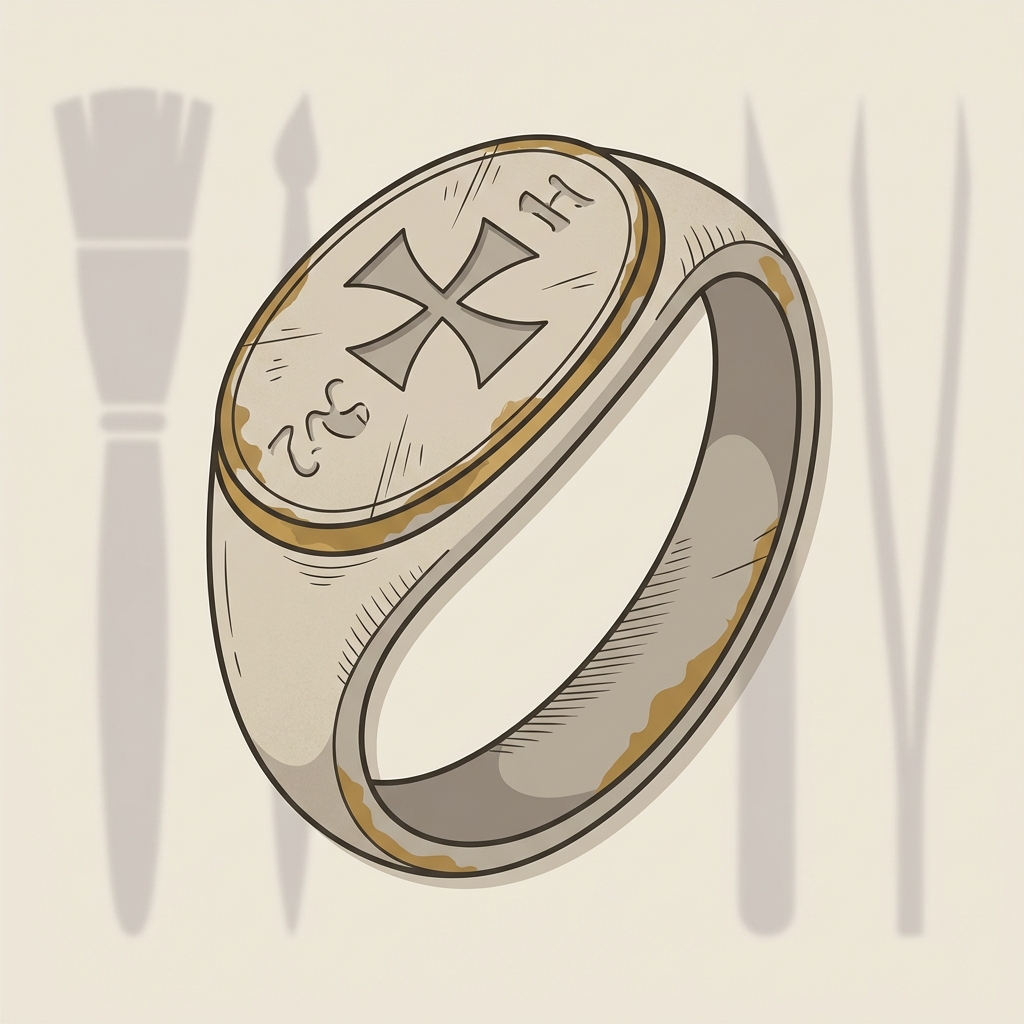
When commissioning, share museum references or descriptive notes about desired motifs and ask the maker to document materials and techniques. That documentation becomes part of the piece's provenance and helps future owners understand its origin as a modern work inspired by historical forms rather than an archaeological artifact.
Caring for ancient rings: preservation, handling and display
Basic preservation guidelines
Avoid aggressive cleaning and chemical polishes; patina often carries informative surface history and can be damaged by indiscriminate polishing. Simple conservation measures such as secure storage, low humidity, and minimal handling preserve surface evidence and slow further deterioration.
When in doubt, assume conservative care: stabilizing storage environments and avoiding DIY treatments preserves options for future professional conservation.
When to consult a conservator
Consult a conservator for structural repairs, complex corrosion, or when an item's condition seems unstable. Professional conservators can document the object's condition, recommend targeted interventions, and provide reports that improve a piece's documentation record for future sale or study Aurora Antiqua condition notes example.
Reading listings: two short case examples
Example A: a curated product listing with provenance
Consider the 'Bethlehem' medieval Crusader silver ring listing as a model: the product page includes provenance description, condition and restoration notes, and clear measurements that allow a buyer to assess the claim and compare to museum examples. Using such a listing as a template, check that the seller separates documented collection history from stylistic attribution 'Bethlehem' product page and compare with the medieval crusader rings collection medieval crusader rings collection.
When a seller supplies comparable museum references and photographs of the specific ring's detail, it becomes easier to evaluate whether the attribution is plausible or requires further verification.
Example B: a museum collection entry used for comparison
Museum entries from established collections provide visual and technical references that help judge an attribution: compare motif, proportions, patina and documented provenance of the marketplace item against the museum object and note where differences appear. Examples from the Metropolitan Museum and the British Museum illustrate how catalogue descriptions present context and dating evidence Metropolitan Museum examples.
Using museum entries as comparators is a practical way to spot inconsistencies in commercial listings and to form informed questions for the seller about materials, dating, and restoration.
When to seek third-party verification or expert opinion
Types of independent verification available
Independent verification options include provenance paperwork checks, assessments by specialist dealers or academics, and scientific testing when appropriate. For questions about whether an item is a Masonic emblem or a medieval artifact, consult both specialist literature and the relevant Grand Lodge guidance on regalia to clarify social and legal expectations United Grand Lodge of England guidance.
High value or uncertain attributions warrant independent assessments rather than reliance on seller claims alone. Third-party reports and condition assessments add confidence and evidence to a purchase decision.
Situations that warrant further testing or legal advice
If provenance is contested, if the seller makes exceptional claims of institutional connection, or if a piece may have cultural patrimony questions, pause and seek specialist help. In some cases legal or export restrictions may apply and those are matters for qualified advisors with knowledge of relevant jurisdictions.
Err on the side of caution for high value items or when a piece could be subject to cultural heritage laws; independent documentation and expert advice help protect both buyer and seller.
Conclusion: respectful collecting and wearing of ancient Knights Templar rings
Key takeaways
Distinguish carefully between medieval Crusader artifacts and later Masonic regalia; the two are different in origin, symbolism, and social meaning. Verify provenance and examine condition and restoration notes before accepting attributions that a ring is an ancient knights templar ring or a Masonic emblem.
Respect lodge etiquette and Grand Lodge guidance when considering wearing explicitly Masonic symbols; non-members who like the aesthetic should choose secular or historically inspired alternatives to avoid misrepresentation and cultural sensitivity issues Grand Lodge of Scotland guidance.
Customary practice is that rings bearing official Masonic emblems are intended for initiated members; because rules vary by Grand Lodge, consult the relevant lodge guidance before wearing such symbols in public.
No, a cross motif is common in many periods and regions; motif alone is not proof of medieval date or institutional affiliation and should be checked alongside provenance and material evidence.
Ask for clear provenance or collection history, high resolution photos, measurements, and explicit condition and restoration notes; seek third party assessment for high value or uncertain attributions.
More from Aurora Antiqua
References
- E.C.C.O. Professional Guidelines (II): Code of Ethics, European Confederation of Conservator-Restorers'
- Archaeological materials, Icon, The Institute of Conservation (UK)
- ICOM-CC, International Council of Museums, Committee for Conservation
- Research report: export licensing and provenance, GOV.UK, Department for Culture, Media and Sport (DCMS)
- New Acquisitions of Archaeological Material and Works of Ancient Art, Association of Art Museum Directors (AAMD)
- Auction Terminology, Christie s, Auktionshaus
- Silver and plate, Icon, The Institute of Conservation (UK)
- How to Care For Your Jewellery: The Ultimate Guide by the National Association