


Looking for the real thing? Browse genuine crusader rings for sale, each piece one of one, individually authenticated, with documented provenance. For the background, see the guide to medieval jewelry.
Antique knights templar ring for sale: what this phrase means and why context matters
The phrase antique knights templar ring for sale commonly appears in listings where sellers try to convey historical association and market appeal; in practice it can mean anything from a securely provenanced medieval ring to a 19th century revival piece or a modern object styled after medieval motifs. Use of that phrase in a title or description signals an attribution claim, not proof, and buyers should treat it as the start of a research process rather than a conclusion.
When a listing uses the phrase antique knights templar ring for sale, the crucial follow ups are clear: ask for collection history, condition notes, and any verification letters that accompany the object. Many commercial listings will conflate evocative language with evidence, so insist on documentation and conservative dating language such as approximate centuries or phrases like "described as" rather than absolute statements about origin.
Objects labeled with the Templar name in online catalogues typically fall into three broad categories: authentic medieval pieces that have continuous or traceable provenance, items from later revival movements that borrow Templar motifs, and modern reproductions or forgeries created to look old. The visual similarity between these categories means that photographs alone are rarely sufficient to settle attribution; detailed condition notes and provenance matter more than a persuasive photograph.
For buyers, a useful shorthand is to prioritise listings that provide at least two of the following: a documented collection history, clear restoration and condition notes, and an independent statement from a conservator or archivist. If those items are missing, approach the listing as ambiguous until further evidence is supplied, and be prepared to ask specific questions about measurements, wear patterns, and previous owners. (See our rings collection for comparable listings: https://auroraantiqua.com/collections/rings.)
Follow @auroraantiqua for behind the scenes provenance and restoration notes
Before you move deeper into listings, review the checklist later in this article and request provenance and condition notes from the seller to clarify any Templar attribution claims.
To read material culture claims responsibly, replace romance with questions: where did the ring appear before the current seller, what photographic detail can demonstrate wear consistent with age, and is there an archival reference or verification letter? By making those questions standard parts of correspondence, buyers reduce the role of myth in valuation and focus conversations on evidence and uncertainty.
Who were the Knights Templar? A concise historical overview
The Knights Templar were founded around 1119 in Jerusalem as a religious military order combining monastic vows with armed service to protect pilgrims and maintain a presence in the Latin East; they evolved into a distinct institutional form over the 12th century and beyond, often described in reference works that summarise the Order's origins and early mission Encyclopaedia Britannica.
From the 12th century onward, the Order developed houses, estates, and a cross regional administrative network that supported both military activity in Outremer and economic operations in Europe. Their estate management and property holdings allowed the Templars to act as landholders and to engage in early banking and credit practices, which in turn made them a significant medieval financial actor in many regions.
That institutional complexity is important for collectors. A ring or small object said to be Templar related should be evaluated against this background: affiliation with a military monastic order implies certain patterns of dress, insignia, and regional circulation, but it does not automatically make any object bearing a cross or a knight motif an authentic Templar artifact. The order's administrative reach varied by locality and period, so local provenance is often the most informative detail for attributing small portable objects like rings.
The 1307 arrests, the Chinon material, and the suppression: what collectors need to know
Between 1307 and 1312 a sequence of arrests, interrogations often conducted under duress, and a papal legal process led by Pope Clement V resulted in the formal suppression and redistribution of many Templar properties; historians emphasise the political context of these events when evaluating later claims about guilt or innocence Cambridge University Press.
The Chinon parchment and related papal documents shed light on how the papacy handled the Templar cases, including complex legal steps and partial absolution attempts, and they underline that confessions obtained under pressure must be treated cautiously when reconstructing events or assessing legacy claims Vatican Chinon documents. Further reading includes the Chinon Parchment entry on Wikipedia https://en.wikipedia.org/wiki/Chinon_Parchment and a Law Library of Congress post that discusses the documents https://blogs.loc.gov/law/2011/09/templar-secrets-at-the-law-library-of-congress/. For a broader public account see a History Channel piece on the Vatican archives https://www.history.com/articles/step-into-the-vaticans-secret-archives.
Scholars treat the Knights Templar as a multifaceted medieval institution that cannot be reduced to a simple moral judgement; understanding their history requires attention to institutional roles, political context, and archival records.
For collectors this history matters because a large number of Templar properties and movable goods were seized, redistributed, or entered other collections in the early 14th century; the dispersal and later reattributions create gaps in provenance that can be exploited by revivalist narratives. When a seller links an object to the pre 1312 period, ask whether any archival citations tie the piece to known post suppression transfers, inventories, or documented owners.
Understanding the politics of the suppression also helps buyers interpret statements about confessions, trials, and guilt. Many modern myths conflate legal processes with moral verdicts, but the archival record is nuanced and shows both papal legalism and royal pressure, which together complicate simple narratives that a popular listing might present as fact.
Templar symbols, material culture, and later attributions to rings
Certain motifs have become popularly associated with the Templars in the modern imagination, including crosses, paired knights, and simplified heraldic devices; these motifs appear in a variety of medieval objects but can also be reused or stylised in later periods History Today.
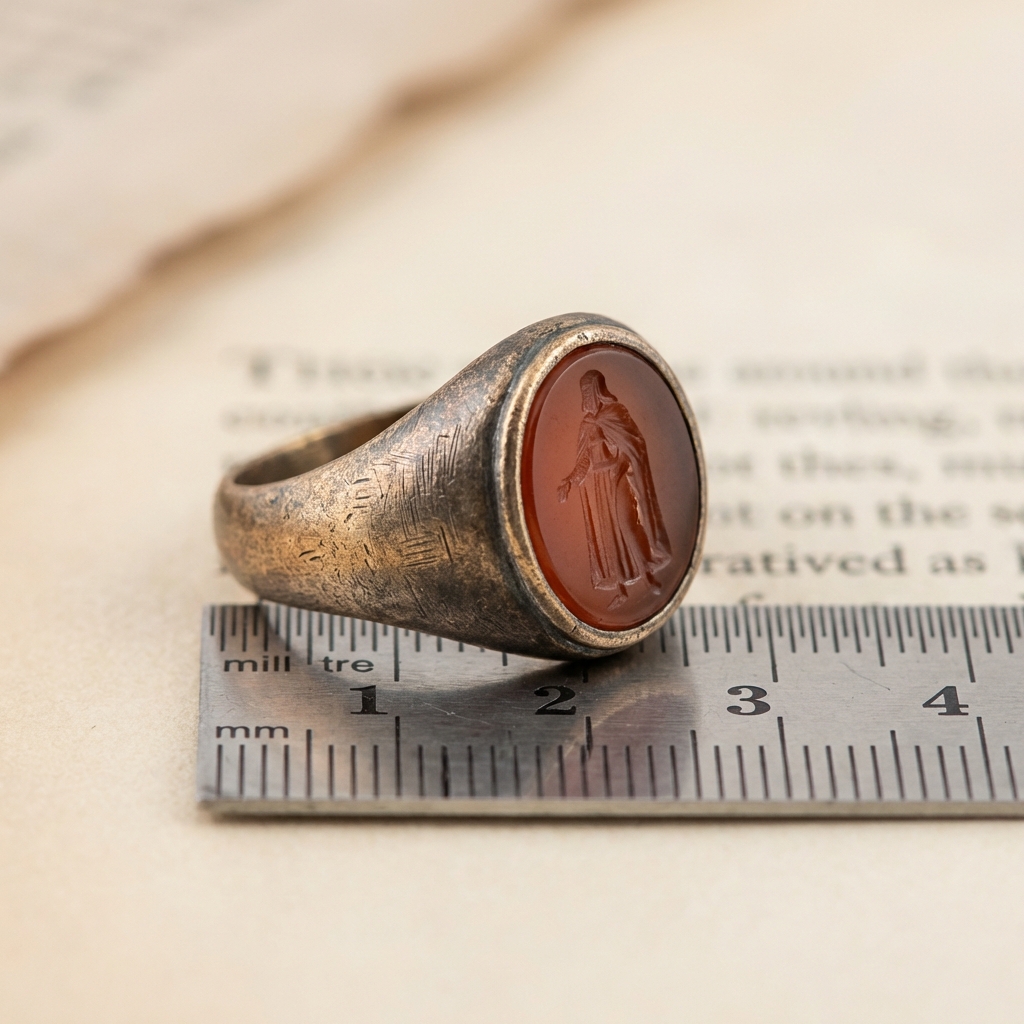
Iconography alone is rarely decisive. An intaglio or a bezel bearing a cross or a knightly figure should prompt questions about carving technique, gemstone type, and wear consistent with long use rather than immediate attribution to a specific medieval order. Over time certain motifs were adopted by revival movements and by collectors who valued Templar associations, so motif presence must be weighed against condition, context, and documentary ties.
Collectors should take particular care with inscriptions, tool marks, and mounting styles. These physical signals often reveal more about date and workshop practices than isolated motifs. If the ring includes an intaglio or a gemstone set in a style documented in a particular region or workshop, that technical information can be more valuable for attribution than a symbol that later audiences will read as "Templar."
Myth, revivalism, and why popular narratives matter for buyers
Since the 19th century the Templars have been heavily mythologised in literature and popular culture, and those narratives have shaped market demand and modern collecting practices in ways that often outpace what the medieval archives actually record History Today.
Market descriptions that rely on romantic narratives tend to emphasise drama over documentation, which makes provenance and condition notes the decisive features for buyers. An evocative story in a listing can increase desirability without adding objective information about an object's medieval history, so treat dramatic phrasing as a prompt to ask for documentation rather than as historical proof.
Aurora Antiqua serves as a curator and presents selected objects with condition notes and collection history when available; for one of our curated listings see 'Bethlehem' - Medieval Crusader Silver Ring 12th-13th CE.
How to evaluate an antique knights templar ring for sale: a step by step checklist
Start by requesting documentation. Ask the seller for provenance notes that list prior owners, any collection history, and dates associated with transfers. Request explicit restoration notes describing what was stabilised or repaired, and insist on clear photographs that show the ring from multiple angles, including the interior band and any hallmarks or maker marks. When sellers provide verification letters, ask who issued them and whether they are based on archival citations or visual inspection. For examples of curated listings, consult our medieval crusader rings collection https://auroraantiqua.com/collections/medieval-crusader-rings.
Second, carry out visual and technical checks on the listing images and descriptions. Look for wear consistent with age in the bezel and hoop, check for tool marks consistent with medieval production, and study gemstone settings for signs of modern re cut or replacement. Measurements and consistent scale references in photos reduce the chance that proportions are misrepresented.
Third, interpret restoration and condition notes conservatively. Stabilisation that preserves original surfaces and documents interventions supports attribution better than heavy reworking that removes diagnostic marks. Where restoration is extensive, ask the seller to detail what is original and what was altered, and request dated photographs when available.
Finally, use the checklist to prioritise purchases: a well documented, modest piece is generally a stronger candidate for collectors than an undocumented object with dramatic attribution. If price and documentation conflict, treat the former as secondary to verifiable evidence about the object's history and condition.
Provenance and documentation: what counts and how to read it
Provenance evidence takes many forms, each with different strengths. Collection history entries that name prior owners and dates are useful, verification letters from recognised experts add interpretive weight, and archival citations that reference inventories, sales records, or collection catalogues provide the most substantial link to the past. Where available, independent archival ties are the strongest form of provenance because they can be re checked by researchers.
Partially documented histories require caution. A plausible but undocumented story of continuous ownership across centuries is weaker than a short, well documented chain of custody. Buyers should prefer sellers who use conservative dating language, such as "described as 12th to 13th century" or "likely medieval based on stylistic and technical features," and who attach condition and restoration notes to support those claims About us, International Association of Dealers in Ancient Art.
items to request from a seller as documentary evidence
Ask for scans where possible
When encountering vague provenance claims, ask targeted follow ups: can the seller provide a dated photograph, a previous auction lot number, or a scanned inventory entry? These concrete items are easier to verify than family anecdotes and often reveal whether the chain of custody is demonstrable or asserted without documentary backing.
Condition, restoration notes, and how they change interpretation
Common conservation terms appear in listings and it helps to know what they typically mean. Stabilised or stabilisation usually indicates efforts to slow deterioration without replacing original material. Consolidation refers to treatments that strengthen fragile surfaces. Full restoration implies more extensive interventions that may have altered original surfaces or removed patina. Requesting dated photographic records of any work performed can clarify the degree and timing of interventions.
Restoration affects interpretation because it can obscure diagnostic features such as tool marks, maker punches, or original mountings. When restoration is transparent and documented, it is easier to separate original features from later repairs. If documentation is absent or the seller is vague about the scope of work, treat attribution claims with skepticism and consider whether the restored appearance might be misleading.
Measurements, close ups of the interior band, and high resolution images of the bezel and shoulders are particularly informative. These details show how the ring was worn and whether the hoop has been resized, both of which affect dating and functional interpretation. Always ask for centimetre or millimetre scale images rather than relying on un scaled photos.
Common mistakes and red flags when assessing Templar related rings
A frequent error is overreliance on motif alone to determine date and origin. A ring bearing a cross is not automatically a Templar object; similar symbols circulated widely across medieval and post medieval contexts. Motif based attribution without supporting documentation is a weak claim and a common sign of a listing driven more by narrative than by evidence.
Red flags include missing collection history, stock phrases that lean on romance rather than detail, and photographs that obscure key areas such as the interior band or bezel base. Avoid listings that provide only a dramatic story without dates, measurements, or restoration notes. Asking for specific images and citations will separate careful sellers from those relying on a marketable story.
When confronted with anachronistic language, such as references to modern organizations or modern place names without explanation, pause and seek clarification. Sellers sometimes use modern terminology for ease of audience comprehension, but unchecked anachronism can disguise a revival piece presented as medieval.
Practical examples: reading three typical listing excerpts
Example A, a well documented listing, might state clear prior ownership, provide dated photographs showing consistent wear, and include a conservator's note describing limited stabilisation. That combination supports the seller's claim enough to move to a valuation question or a request for further archival checks. Ask the seller for scans of the conservator note and any invoices related to work performed.
Example B is myth driven. It may boast dramatic provenance such as "found in a lost Templar chest" with no supporting documents and use evocative phrasing instead of measurements. In that case, request precise images, measurements, and any available collection history. If the seller cannot provide these, treat the attribution as speculative.
Example C is ambiguous. It offers photos and a description like "described as medieval" but lacks named prior owners or archival citations. The right follow up is targeted: request additional close ups, the ring's weight and internal diameter, and any paperwork the seller has received. If those items are missing or the seller is evasive, the buyer should either accept the uncertainty at a lower price or walk away.
Mini case studies: three buyer scenarios and recommended actions
Scenario one: a collector on a budget seeking wearable history. If documentation is partial but photographs and condition notes show consistent age and limited restoration, the buyer may accept modest uncertainty and prioritise aesthetic and structural integrity. Recommended actions include obtaining measurements, requesting a dated stabilisation note if work was done, and negotiating price to reflect the documentation gap.
Scenario two: a high end buyer prioritising archival provenance. This buyer should require archival citations or a clear chain of custody and consider commissioning a short provenance report from a qualified researcher before purchase. The extra expense can change the purchase calculus but is often justified when provenance is central to the object's value to the collector.
Scenario three: deciding between a well documented lesser piece and a dramatic but undocumented object. The conservative recommendation is to favour the documented item, because documentation reduces interpretive risk. If the buyer chooses the dramatic object, they should budget for external verification and accept that the object may remain ambiguous despite testing.
Legal and ethical considerations when buying Templar associated objects
Legal and export issues vary by jurisdiction, but common concerns include export restrictions, cultural property regulations, and the potential for objects with unclear recent histories to be subject to claims. Buyers should check local rules before completing a cross border purchase and ask the seller about export paperwork when applicable.
Ethical collecting matters because transparent provenance helps protect cultural heritage and the legitimate interests of previous owners. Preference for documented histories supports responsible collecting practices and reduces the likelihood of acquiring objects that may be subject to claims or problematic ownership histories. When provenance is incomplete, consider whether further research or declining the purchase is the better ethical choice.

When to seek external verification: experts, labs, and archives
Verification options include archival research to locate documentary mentions, consultation with a specialist curator or conservator who can assess technical features, and scientific testing when material analysis will help answer specific questions about metal composition or stone origin. Not every ring requires scientific analysis, but where high value or unique claims are at stake, third party checks are sensible steps.
To find credible experts, present a concise dossier of all seller documentation and images, and ask for a written opinion that states the basis for any attribution. Remember that expert opinions are interpretive and may differ; treat them as informed judgments rather than irrefutable proof. Archives and independent citations, when available, provide the most durable support for an attribution claim Publication 561 (12/2025), Determining the Value of Donated Property, Internal Revenue Service (IRS), USA. If you need to contact us about a listing, use our contact page https://auroraantiqua.com/pages/contact.
Conclusion: were the Templars good or bad and what that means for buyers of Templar rings
Scholarly consensus treats the Knights Templar as a complex institution whose activities combined religious, military, and economic roles; historians caution against assigning a single moral label of good or bad because the Order's practices and reputation varied across time and place Encyclopaedia Britannica.
For buyers considering an antique knights templar ring for sale, the practical takeaway is clear: prioritise provenance, condition notes, and conservative dating language. These documentary and physical elements matter far more than evocative listing language or motifs that later revivalists popularised. Aurora Antiqua's role as a curator is to provide context, condition notes, and collection history where available so buyers can make informed decisions about wearable history.
When in doubt, ask specific documentary and photographic questions, consider outside verification for high value claims, and accept uncertainty as part of collecting older objects. A cautious, evidence focused approach protects both historical integrity and buyer confidence.
It is a market phrase indicating an attribution claim that ranges from a documented medieval ring to a modern revival piece; always request provenance, measurements, and condition notes to clarify the claim.
No. Motifs can be reused or copied in later periods; attribution should be supported by technical features, documentation, and condition notes.
Consider external verification for high value or unique claims, or when documentation is incomplete and the purchase depends on establishing an accurate date or origin.
More from Aurora Antiqua
References
- The Past Polluted: A Pigovian Approach to the Black Market in Antiquities, International Journal of Cultural
- About us, International Association of Dealers in Ancient Art
- Code of Conduct, Antiquities Dealers Association (ADA), Grossbritannien
- Publication 561 (12/2025), Determining the Value of Donated Property, Internal Revenue Service (IRS), USA
- Auction Terminology, Christie s, Auktionshaus
- Stolen Works of Art Database, INTERPOL
- 1995 Convention, UNIDROIT, International Institute for the Unification of Private Law, Rom
- Chinon Parchment, Wikipedia