


Looking for the real thing? Browse our full ring collection, each piece one of one, individually authenticated, with documented provenance. For the background, see the guide to buying ancient artifacts.
What we mean by ancient wedding rings: definitions and scope
How this article uses the term
For this article, ancient wedding rings refers to rings that have credible contextual, inscriptional or literary support linking them to marriage or betrothal practices, rather than every personal ring from antiquity. That distinction separates generic ancient ring types from objects plausibly used as marital tokens, and it matters because the same form can serve very different functions depending on find context and documentation. The working definition used here follows museum practice in privileging context and corroboration over typology alone, so a catalogue entry or contemporary text that connects a ring to a wedding is the strongest evidence.
Geographic and chronological scope covered
This guide focuses on evidence from the eastern Mediterranean and Near East, with particular attention to Egypt, Greece, Rome and Mesopotamia across broad prehistoric classical and early medieval spans. It treats claims regionally and temporally, and does not assume a single, uniform ritual in all areas. Readers should expect that what counts as a probable wedding token in Rome may be very different from rings found in Egyptian tombs or in Mesopotamian household records. For general reference on ring functions in museum collections, see the Metropolitan Museum of Art overview on rings Metropolitan Museum of Art overview on rings.
See curated examples and documentation at Aurora Antiqua
This article presents guidance and examples and Aurora Antiqua offers curated ancient rings and contextual editorial notes to help collectors follow up on particular examples in the market.
Why rings mattered in antiquity: common functions and meanings
Seals, amulets and status markers
Rings in legal and household contexts
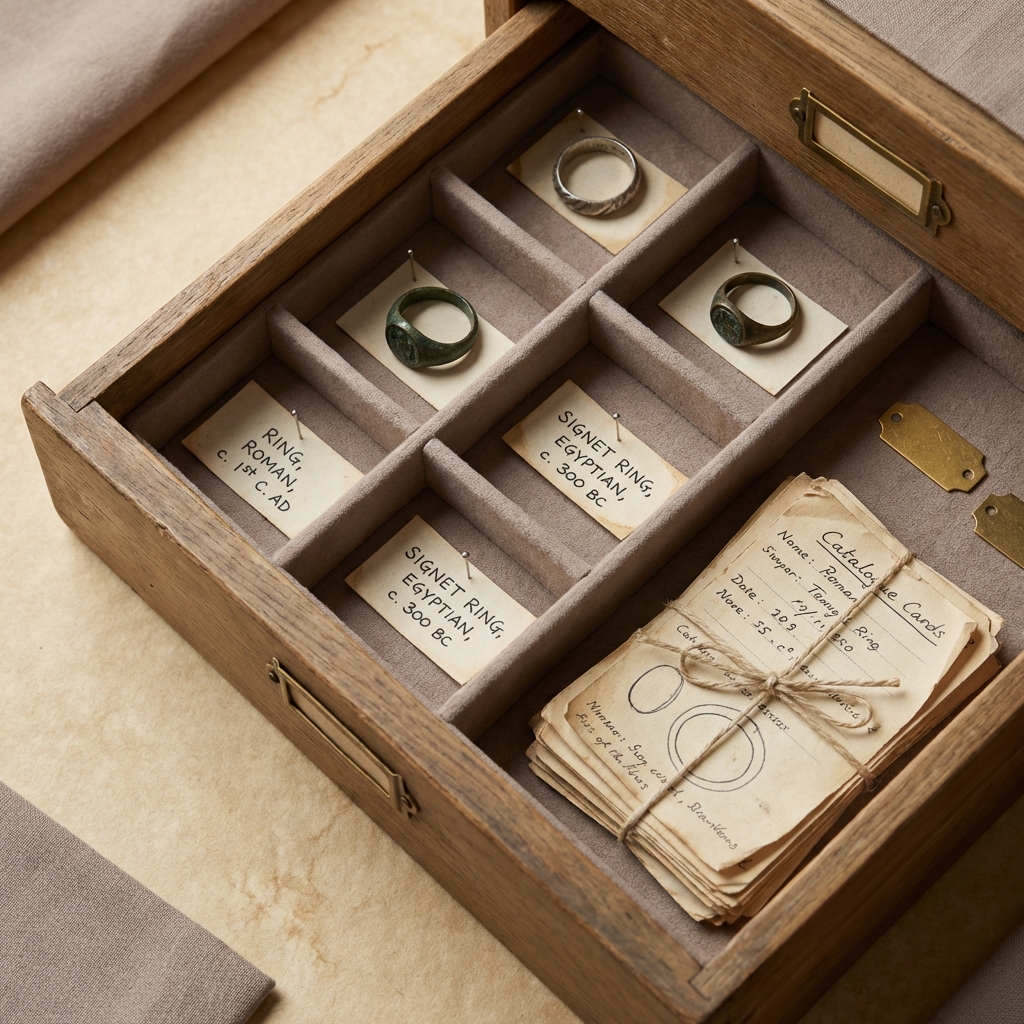
Because rings could act as seals they appear in legal or household records alongside transactions and contracts, which means a ring linked to a household document might have legal implications rather than representing a personal vow. For a broader overview of how museums interpret the overlapping roles of rings, consult the discussion in scholarly museum catalogues and overviews Journal of Hellenic Studies article on Greek rings.
Roman evidence: rings used in wedding rituals and as marital tokens
What literary and legal sources say
Roman literary and legal sources provide the clearest direct evidence that rings played a role in wedding ceremonies and marked marital status in the Republic and Imperial periods; texts describe betrothal and marriage ceremonies that include rings in symbolic exchange. Those textual sources are supported by museum-held examples that match described typologies, making the Roman case the most secure for interpreting certain rings as marital tokens, provided dating and provenance align.
Material parallels held in public collections help tie textual descriptions to objects, but collectors should treat any proposed correlation between an object and a text as tentative without clear provenance or published parallels, and may consult relevant offerings such as our ancient Roman rings collection alongside published parallels Oxford Research Encyclopedias entry on marriage in ancient Rome.
Some cultures, especially Rome, used rings in documented wedding rituals, while in Greece, Egypt and the Near East rings had multiple functions and only sometimes served as nuptial tokens; each claim requires context and corroboration.
Museum examples and typologies (signet, iron hoops, intaglios)
Common Roman types associated with marital contexts include simple metal hoops and signet or intaglio rings whose imagery or inscriptions can be read in a domestic or legal register; museums catalogue comparable pieces that illuminate how these forms circulated as personal and civic items. Even with typological matches, however, secure provenance and dating remain essential to assert a wedding-related function with confidence.
Greek and Hellenistic practices: exchange tokens, amulets and occasional nuptial roles
Rings as seals and amulets in Greek contexts
Greek and Hellenistic rings frequently functioned as seals or amulets and sometimes appear in exchange contexts that could include marriage-related gifts, but the evidence does not support a single, uniform wedding ring ritual across the Greek-speaking world. Objects catalogued as intaglios or amulet rings often carry iconography whose meaning depends on local practice and period.
Instances where rings appear in wedding-related scenes or exchanges
Catalogue essays and studies show occasions where rings are mentioned or depicted in what might be nuptial exchanges, but these cases are often circumstantial and best read alongside inscriptions or comparative material rather than used to define a universal practice Journal of Hellenic Studies article on Greek rings. Comparable museum pieces include dedicated wedding rings in museum collections such as the Walters Wedding Ring, 3rd-4th century.
Egypt and the Near East: funerary, administrative and marital symbolism
Egyptian funerary and iconographic evidence
In Egypt rings are commonly found in graves and temple deposits and sometimes appear with iconographic references that scholars interpret as related to status or household roles, occasionally including betrothal symbolism. Because many Egyptian rings entered archaeological contexts as grave goods, their presence alone rarely proves a ritual use as a wedding pledge without accompanying textual or inscriptional evidence.
Mesopotamian household, legal and contractual uses of rings
Near Eastern sources, particularly in Mesopotamia, tie rings to household transactions and contractual practice, which can link rings to marriage agreements in specific cases where the text or seal context indicates such a role. These legal contexts show how rings could function pragmatically in household and family arrangements rather than solely as personal ornaments Cambridge overview on marriage in ancient Mesopotamia.

How to assess a ring as a possible ancient wedding ring: a practical framework
Contextual evidence checklist
When evaluating whether a ring is plausibly an ancient wedding ring, start with provenance: a clear find context, published collection history, or excavation report is far stronger than a vague or private discovery claim. Look for inscriptions using marital language, contemporary catalogue comparisons, or legal texts that place rings in betrothal or household agreement contexts; such corroboration moves an attribution from possible to plausible.
Inscriptional and iconographic clues
Inscriptions naming spouses, dedications, or iconography associated with household or marital deities increase the likelihood that a ring served a nuptial role. Typology and material comparisons should be used cautiously and always in combination with contextual notes and published parallels Victoria and Albert Museum overview on the history of the wedding ring. For an example record in a public collection see the V&A ring record Ring, unknown.
Provenance checklist for assessing a claimed ancient wedding ring
Start with documentation you can verify
Decision criteria for collectors: provenance, condition and documentation
Types of provenance and what they mean
Collectors should prioritize documented provenance in this order of strength: published excavation or museum accession, continuous documented collection history, then documented purchase records with supporting paperwork. Vague statements like discovered decades ago without documentation are common red flags and make functional claims about a ring much harder to support.
How restoration and conservation affect interpretation
Restoration can alter a ring's appearance and sometimes obscure inscriptional detail, so transparent restoration notes and before-and-after images are crucial. Conserved or stabilized pieces are acceptable when treatments are described, but collectors should ask whether repairs affect key features used to argue a marital function and request condition details when in doubt Victoria and Albert Museum overview on the history of the wedding ring.
Condition, restoration and conservation: reading listing notes carefully
Common restoration treatments and what they imply
Sellers commonly disclose stabilization, soldered repairs, or stone re-seating; each treatment should be described with clear restoration notes. Minor stabilization that secures a hoop is different from aggressive reconstruction that alters profile and decorative detail, and that difference matters when matching an object to published parallels.
Patina, wear and signs described as 'consistent with age'
Patina and wear patterns can help support an age estimate but cannot alone prove a ritual function. When a listing claims wear 'consistent with age', request high-resolution photos of the bezel, shoulders and any inscribed surfaces, plus measurements to compare with museum catalogues and published pieces Metropolitan Museum of Art overview on rings. For direct object comparison see a Met object record Gold finger ring - Roman - Late Imperial.
Common mistakes and pitfalls when identifying ancient wedding rings
Overreliance on typology without context
A frequent error is to classify a ring as a wedding token solely because its style resembles a museum example while ignoring gaps in provenance. Typology alone cannot substitute for inscriptional or contextual evidence; the same hoop or intaglio form might be a signet, an amulet, or an ornament in different contexts.
Misreading multifunctional objects as marital tokens
Because rings could serve multiple roles, misinterpretation happens when sellers or buyers conflate seal use with marital symbolism without supporting texts or parallels. The safest corrective is to demand published museum comparisons or documentary references that explicitly tie function to marriage in comparable contexts Metropolitan Museum of Art overview on rings.
Practical examples and scenarios: reading museum comparisons and listing notes
Case study 1: a Roman intaglio ring assessed against textual sources
When a Roman intaglio is proposed as a wedding ring, check whether its iconography or inscription appears in texts describing betrothal, and then look for museum parallels with secure provenance. A match between a literary description of a betrothal custom and a securely published museum example strengthens the interpretation, but the chain of custody and dating must remain consistent for a convincing attribution.
Case study 2: a Greek amulet ring with possible nuptial symbolism
For a Greek amulet ring, the process is similar but often more tentative: identify iconography that might relate to marriage, search catalogue essays for comparable exchange contexts, and treat the marital reading as one interpretation among others unless inscriptions or contextual evidence tighten the claim Journal of Hellenic Studies article on Greek rings.
How museums and scholarship interpret rings: limits of the archaeological record
Why context, publication and combined analysis matter
Museums interpret rings by combining provenance, typological comparison and published literature; without publication or clear context, objects remain difficult to assign a specific ritual function. Curators favor published parallels and secure accession histories when assigning a marital interpretation.
Open questions and research gaps
Open gaps include unpublished private finds and incomplete provenance chains that prevent confident functional assignments in some regions. Ongoing work that pairs material analysis with publication of excavation reports will help reduce uncertainty, but for now many claims in the private market remain conditional and require careful documentation to support marital readings British Museum overview on objects and rings in ancient Egypt.
Buying responsibly: questions to ask, red flags and documentation to request
Provenance checklist for sellers
Ask sellers for the find context, prior collection history, any museum or publication references, detailed condition and restoration notes, and clear photographs or measurements. If those items are missing or vague, treat claims about a ring's ritual use with caution and seek more documentation before deciding.
When to request third party comparison or specialist input
If a ring is being offered as a wedding token and the provenance is incomplete, request a third-party comparison to published museum catalogues or a specialist opinion; such input is especially important for high-value purchases or when inscriptions are central to the claim Oxford Research Encyclopedias entry on marriage in ancient Rome.

Conclusion: what we can and cannot say about ancient wedding rings
Summary of regional differences and key takeaways
In short, Roman sources and museum examples provide the clearest support for rings used in wedding rituals, while Greek, Egyptian and Near Eastern evidence is more varied and often context-dependent. Identifying an object as an ancient wedding ring requires corroborating context, inscriptions or contemporary texts rather than relying on typology alone.
Next steps for collectors and curious readers
Collectors should prioritize provenance, condition notes and published museum comparisons, and use conditional language when describing objects. Seek documentation, ask for specialist comparisons when needed, and remember that many rings in the market are multifunctional artifacts best understood within their archaeological and textual contexts. For related reading see our blog on Roman topics Roman Empire.
Rings were widespread as personal ornaments, seals and amulets across Egypt, Greece, Rome and the Near East, but their specific use as wedding tokens varied by region and context.
No. Patina and wear support an age estimate but cannot alone confirm a ring's marital function; inscriptions, provenance and published parallels are needed.
A clear provenance or collection history that ties the item to a secure find context or museum accession is the most important document to request.
More from Aurora Antiqua
References
- Internet History Sourcebooks: Medieval Sourcebook, Internet Medieval Sourcebook, Fordham University, New York
- Gimmel Ring, Victoria and Albert Museum, London
- Ring, Victoria and Albert Museum, London
- The Form of Solemnization of Matrimony, The Church of England
- Aulus Gellius, Attic Nights, Book X, LacusCurtius, Bill Thayer, University of Chicago (Loeb Classical Library edition)
- Pliny the Elder, The Natural History, BOOK XXXIII, Perseus Digital Library, Tufts University (edition Bostock)
- Pliny the Elder, The Natural History, BOOK XXXIII, Perseus Digital Library, Tufts University (edition Bostock)
- Law Reform (Miscellaneous Provisions) Act 1970, section 3, The National Archives, legislation.gov.uk
- Client Challenge, JSTOR
- Ring, Victoria and Albert Museum