


Looking for the real thing? Browse authenticated Ancient Roman rings, each piece one of one, individually authenticated, with documented provenance. For the background, see the guide to buying ancient artifacts.
Did Romans wear gold jewellery? A concise definition and archaeological overview
Scope: time periods and types of objects
Short answer, yes. Museum collections and archaeological reports document widespread use of gold across Roman contexts, including rings, necklaces, earrings and hair ornaments from the late Republic through the Imperial period and with continuity into Late Antiquity; the phrase gold ring roman is a common search term among collectors because rings are one of the most frequently found and well preserved gold object types in those assemblages. Evidence in major public collections supports this distribution and helps define the kinds of objects to expect in the archaeological record Metropolitan Museum of Art overview.
That continuity is not uniform across every province or social group. Excavations, cemetery reports and published hoards show both high status sets and more modest gold items, and regional differences in styles and quantities are apparent in the corpus. The statement that Romans wore gold should therefore be read with nuance: use and visibility varied by place, time and social circumstance.
Key museum and hoard evidence
Large museum catalogues and hoard publications form the backbone of our knowledge, providing typologies and dated examples that researchers use to place single finds within broad chronological frames. The British Museum collection and related published hoards illustrate how rings, in particular, recur across contexts from the late first centuries BCE and CE onward, enabling comparative attributions based on shape, mounting and iconography British Museum Roman Britain gallery.

Archaeological context matters: rings recovered from sealed hoards or well documented burials carry more secure dating than isolated finds without documentation. Where context is absent, typological comparison with illustrated catalogue material often becomes the primary way to suggest a date.
Gold ring roman: social meaning and who wore gold in Roman society
Evidence from portraits, inscriptions and funerary assemblages
Images, inscriptions and burial goods together show gold jewellery functioned as visible markers of wealth, gendered display and sometimes social office, though the precise meaning in any single case can remain open to interpretation. Portraits and funerary assemblages that include gold items are among the ways historians read social signals embedded in personal adornment (read more in our blog post), while inscriptions and dedicatory contexts occasionally link rings to marital or office-bearing status.
Yes, archaeological and museum evidence shows Romans wore gold jewellery including rings, but use varied by time, place and social status and must be assessed with context and technical checks.
Variation by class, gender and province
Not everyone had the same access to gold. Literary sources, funerary evidence and regional finds suggest that elite households and certain urban contexts show higher rates of gold use, whereas provincial and rural assemblages may present fewer examples or different kinds of gold display. This uneven pattern underlines why broad statements should be accompanied by attention to class, locale and the archaeological record.
Recovery bias also affects what we see. Wealthier burials and hoards are more likely to have been preserved, excavated and published, so published corpora can overrepresent high status display relative to everyday use.
Materials and metallurgy: what Roman gold rings were made of
Common alloying with silver and copper and implications for purity
Analytical studies using non-destructive methods show Roman gold objects were commonly alloyed with silver and copper, so measured purity varies and is not uniformly 24-carat. Portable XRF surveys and laboratory work have demonstrated a range of alloy recipes across object types and regions, which helps explain the variety of colours and the different working properties of the metal in surviving pieces Emilie Riha, Der römische Schmuck aus Augst und Kaiseraugst (Roman jewelry from Augst and Kaiseraugst), Römermuseum Augst.
Alloy composition affects visible traits: higher silver content shifts hue toward paler tones, while copper brings warmer gold colours and affects long term surface behaviour. For buyers and curators, knowing likely alloying helps set expectations for colour, softness and appropriate conservation approaches.
What XRF and laboratory studies can and cannot tell us
Portable XRF provides quick, non-invasive compositional snapshots that are useful for preliminary assessment, but it has limits. Surface enrichment, corrosion layers and sampling location can bias results, and the method usually reports elemental proportions without detailing manufacturing heat histories or trace impurities that full laboratory analysis might reveal.
For legal and ethical reasons, destructive sampling for microstructural or isotopic work is generally restricted, so many attributions combine XRF results with visual and microscopic observations to form cautious interpretations rather than absolute proofs.
How Roman gold rings were made: techniques, workshops and typologies
Key techniques: casting, granulation, filigree, repoussé, intaglio setting
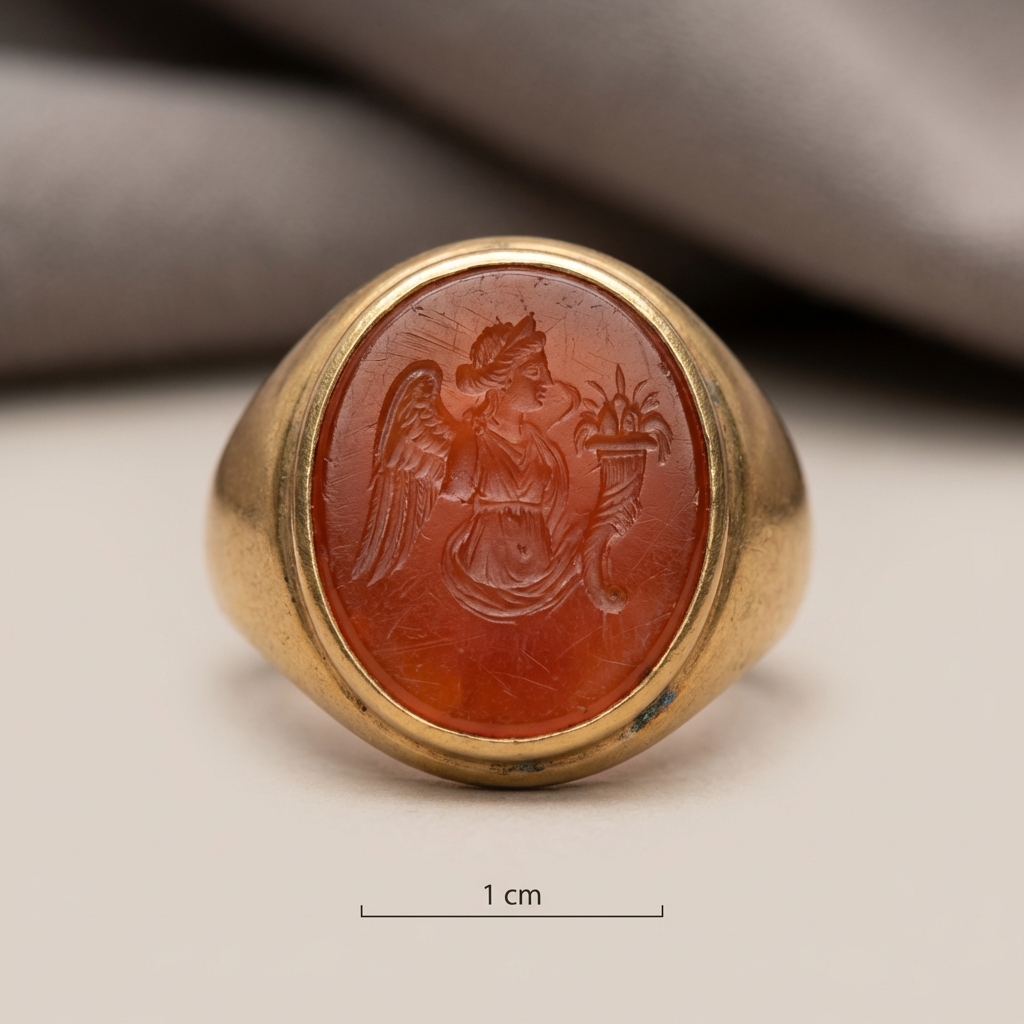
Several well attested goldsmithing techniques appear across Roman ensembles. Casting provided basic shapes, while granulation and filigree added decorated surfaces, and repoussé and chased work produced relief. Intaglio settings for carved stones are a recurring feature of rings, especially signet or intaglio rings where the bezel was intended to carry an image or inscription. These techniques leave recognisable markers that specialists use to read manufacture and date Oxford synthesis on Roman jewellery and goldsmithing.
Granulation clusters, fine solder fillets, filing marks on inner bands and the manner of bezel seating are all useful visual cues. Photographs that capture these details are essential in any responsible listing because they allow comparators to compare features with securely dated examples in museum catalogues.
Workshop evidence: moulds, toolmarks and production traces
Archaeological finds of mould fragments, toolmarks and waste show that production often occurred in urban workshops where multiple techniques were combined. Moulds indicate casting stages, while toolmarks and filing textures reveal finishing practices. These production traces help attribute objects to broad workshop traditions and sometimes to regional production styles.
@auroraantiqua behind the scenes and fresh-find updates
If a listing does not include clear close-ups of the interior band, bezel base and any visible toolmarks, ask the seller for additional photos and any existing documentation before considering purchase.
Where multiple rings from the same findspot share toolmark patterns or alloy signatures, researchers can hypothesise about local workshops and circulating styles, but proving a single workshop attribution usually requires more targeted publication and technical study.
Dating and attribution: using typologies and context to place rings in time
Limitations of stylistic dating and importance of find context
Typologies drawn from hoards and museum catalogues remain the primary method to date and attribute Roman rings, but precise dating often depends on find context and stylistic comparison. A ring with a familiar bezel motif can be placed in a broad chronological band, yet small stylistic overlaps between late Republican and early Imperial work mean that precise year-level dating is frequently not possible without contextual association Bagues et anneaux à l'époque romaine en Gaule, Persée, Persee (CNRS, ENS de Lyon, Ministere francais).
Contextual data such as sealed stratigraphic layers, associated coins or well documented burial contexts increase confidence in date ranges. Isolated collectibles, especially those without excavation records, require careful caveating when sellers or catalogues propose firm dates.
How hoards and catalogue typologies inform dates
Hoards, published finds and museum catalogues offer illustrated series that allow comparators to match form, setting style and iconography. Comparing a candidate ring against well dated parallels is the usual first step in attribution, and where hoard associations exist the resulting typology can be relatively tight.
Readers should treat published attributions as expert interpretations based on the available evidence rather than absolute chronologies. New finds and technical studies continue to refine typologies, so attributions sometimes shift as the corpus grows.
How to assess a gold ring roman before you buy: decision criteria and checklist
Provenance and documentation to look for
A combination of provenance documentation, visible manufacture markers, compositional data and clear condition and restoration notes forms the most reliable pre-purchase picture; see our ancient Roman rings collection.

What to inspect in photos and condition notes
Request specific photographic views: clear close-ups of the interior band, the bezel base, the shoulders and any visible toolmarks, plus in-hand scale shots that show thickness and proportion. Condition notes should describe patina, evidence of cleaning, and any restoration joins or modern soldering. Good listings also include measurements in millimetres and a weight in grams.
Where XRF or other non-destructive compositional results are offered, check whether the report specifies measurement location and whether it is a surface or bulk result. That context helps interpret whether the value reflects the original alloy or surface-enriched material Portable Antiquities Scheme guidance.
Make a short checklist for the seller: provenance documentation, interior band close-up, bezel base shot, XRF or compositional note if available, and clear restoration notes. If any of these items are missing, the listing should be treated cautiously and follow-up questions asked.
Common pitfalls, forgeries and typical mistakes buyers make
Signs that suggest modern reproduction or heavy modern restoration
There are several red flags to watch for. Implausible provenance statements without supporting paperwork, uniform modern solder lines that do not match ancient joining techniques, and toolmarks inconsistent with known period practices all warrant scepticism. Some modern reproductions imitate ancient surfaces convincingly, so surface appearance alone is rarely decisive.
Measured alloy values can be misleading: modern alloys formulated to mimic ancient recipes may return similar XRF profiles, so compositional data should be combined with manufacture markers and documentation rather than treated as definitive proof of age Portable XRF for paintings and metals authentication, npj Heritage Science (Springer Nature), DOI. (XRF supplier comparison)
Mistakes in relying solely on visual appearance or unsupported claims
Buyers often assume that a worn interior band equals antiquity or that a certain colour of gold guarantees an ancient recipe. Neither is reliable in isolation. Patina can be simulated and wear patterns can be artificially induced. When in doubt, ask for third-party reports or condition statements from a qualified conservator.
It is reasonable to request that sellers avoid absolute dating claims when context is absent, and instead present materials as informed attributions with clear caveats. Responsible listings will note the basis for attribution and indicate limits of certainty.
Practical buying, care and what Aurora Antiqua provides to buyers
Practical checklist for purchase and post-purchase care
non-destructive pre-purchase checks to request from seller
Ask for measurement location
Before purchase, prioritise documentation, measurements and condition notes. After acquisition, store gold antiquities in stable, low humidity conditions away from reactive materials, avoid ultrasonic cleaning, and consult a conservator for any necessary stabilisation. Restoration notes matter: pieces with modern stabilisation require different handling than untouched items.
As a curator and seller, Aurora Antiqua aims to present curated ancient rings spanning Roman, Greek, Byzantine and later periods with clear condition notes and provenance-style documentation where available. Listings are intended to help buyers understand what they are purchasing and why it matters, without making absolute authenticity guarantees.
How to read restoration and provenance notes in listings
Restoration notes should describe what was stabilised, what was repaired and what was intentionally left untouched. Provenance-style documentation that lists prior collection history or verification letters increases interpretive clarity but does not eliminate the need for physical or technical checks. Treat all documents as part of a combined assessment rather than a singular proof.
If a seller references lab work, ask for the original report details such as date, analyst and measurement location. Non-destructive checks are the norm for responsible online commerce in antiquities; invasive sampling is generally reserved for research contexts and must be justified and documented.
Gold rings are well represented in museum collections and hoard publications, but their frequency varies by region, social context and preservation bias.
Portable XRF gives non-destructive compositional data useful for assessment, but it should be combined with manufacture markers, provenance and condition notes rather than used as sole proof of age.
Request close-ups of the interior band, the bezel base, shoulders, any toolmarks, measurements in millimetres and in-hand scale images, plus clear condition and restoration notes.
More from Aurora Antiqua
References
- Luxury Arts of Rome, The Metropolitan Museum of Art, New York
- Internet Archaeol. 40. Atkinson and Preston. Objects of personal adornment, Internet Archaeology, Council
- A Roman jeweller's hoard from Snettisham, Norfolk, Antiquity 60, no. 229 (July 1986), pp. 137 to 139
- Emilie Riha, Der römische Schmuck aus Augst und Kaiseraugst (Roman jewelry from Augst and Kaiseraugst), Römermuseum Augst
- Bagues et anneaux à l'époque romaine en Gaule, Persée, Persee (CNRS, ENS de Lyon, Ministere francais)
- Gold ring, Roman, Imperial period, 2nd to 3rd century CE, Acc. 41.160.450, The Metropolitan Museum of Art, New York
- Characterization of Castellani nineteenth-century gold jewellery by in situ, Scientific Reports
- Portable XRF for paintings and metals authentication, npj Heritage Science (Springer Nature), DOI
- Hallmarking Guidance Notes: practical guidance in relation to the Hallmarking Act 1973, the UK Assay Offices