


Looking for the real thing? Browse genuine Roman rings for sale, each piece one of one, individually authenticated, with documented provenance. For the background, see the guide to buying ancient artifacts.
What a roman gold ring is and why value varies
A roman gold ring refers to an ancient ring crafted or adapted in the Roman period that typically combines a gold hoop with a bezel, sometimes set with an intaglio or carved gemstone. Look for period features such as simple or faceted bezels, intaglio iconography, narrow shoulders, and a surface patina that is consistent with age; these visual cues help define an ancient ring but do not alone prove market value. When present, official hallmarks and assay marks are an important first visual cue about declared metal fineness and should be checked early in any assessment, as outlined in public hallmarking guidance https://www.assayofficelondon.co.uk/hallmarking/what-is-a-hallmark#convention, Goldsmiths' Company Assay Office.
Value for collectors depends on several interacting drivers: metal fineness or alloy composition, whether a gemstone is genuine and significant, provenance and collection history, the objects condition and any restoration notes, and current market demand for the motif or period. Legal and ethical considerations also matter; clear provenance and export history can materially affect whether a piece is marketable. Describe these factors carefully when evaluating a roman gold ring and keep language conditional, since attribution and value often require specialist verification.
See detailed case notes and short restoration videos on @auroraantiqua
When considering listings, always request clear condition notes and any provenance documentation before committing to a purchase.
Typical periods and styles
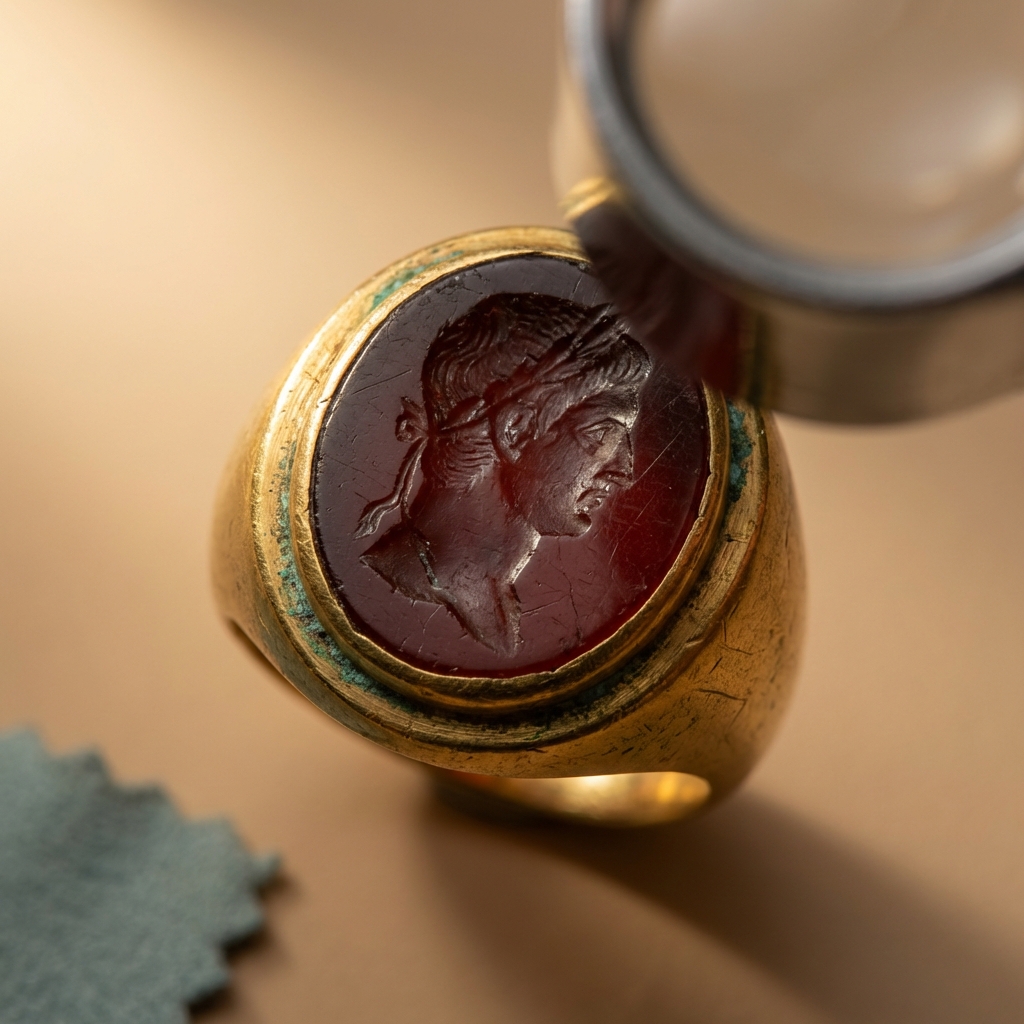
Roman rings span a long timeframe and include republican and imperial era examples that vary in style from plain hoops to intaglio signet rings. Common materials are gold and bronze, and gemstones such as carnelian or agate often appear in a bezel as an intaglio. Styles can signal broad dating and cultural origin, but workshops and local traditions overlap, so stylistic notes should be treated as suggestive rather than definitive.
What collectors mean by value
Collectors usually mean a combination of historical interest, condition, documented provenance, and market desirability when they use the word value. A ring with clear collection history and corroborating technical reports will be easier to place at auction or to insure than one with no paperwork, while identical stylistic examples without documentation can be harder to sell.
Step 1: Quick non-destructive checks you can do at home
Start with photographs and a loupe or magnified images to survey hallmarks, surface wear, and signs of plating or modern repair. Look for refashioned joins, inconsistent patina, or tooling marks that do not match expected wear patterns. A careful magnified inspection can reveal hallmarks when they exist, and visible marks should be noted and photographed for comparison with authoritative hallmark charts and guidance Hallmarking, The Goldsmiths' Company, London.
Follow a tiered workflow: start with careful visual checks and high quality photos, then use non destructive elemental testing for metal composition, request a recognized gemological laboratory report if the stone is important, and finally commission an accredited independent appraisal that combines technical evidence with auction comparables; always check provenance and export documentation before buying or selling.
Use simple physical screens with caution. The heft test, which compares perceived weight to expected density, and a magnet check can reveal obvious non precious fillers or ferrous impostors, but these home checks are limited and sometimes misleading for plated, composite, or ancient objects. Avoid destructive methods such as acid testing on documented antiquities; these can damage historic surfaces and complicate later professional analysis.
What to inspect in photos
When reviewing photos, request at least one high resolution close up of the bezel, the hoop shoulder, and any marks inside the band. Include scale, clear lighting, and both full ring and detail shots. Note any visible repairs or areas where soldering appears recent, and ask the seller to describe restoration work in the condition notes if it is not obvious.
Simple physical checks and their limits
Remember that loupe and heft checks are screening tools rather than confirmations. They can flag obvious problems or reasons to ask for further testing, but they do not replace laboratory or specialist evaluation when the metal or gemstone materially affects value.
Step 2: When to call in lab tests and what they show
Non destructive elemental analysis such as portable XRF and other spectroscopic methods can give reliable data about alloy composition without sampling, and these methods are increasingly used by conservators and commercial analysts; for an initial technical readout, professionals often rely on this type of analysis Hallmarking, The Assay Office Birmingham.
If the stone materially affects the rings value, obtain a recognized gemological laboratory report rather than relying on visual identification. Accredited labs describe identity, treatments, and sometimes origin, and their reports are the market standard for valuation and auction purposes GIA gem identification.
Non-destructive elemental analysis (pXRF and spectroscopy)
Portable XRF (pXRF) instruments report the elemental make up of an alloy and can suggest whether a gold object is consistent with ancient alloying practices or modern alloys, but the raw output requires interpretation from a specialist who understands surface enrichment, corrosion, and potential contaminants. pXRF is useful as a non sampling first step but must be read alongside context and condition notes.
When you need a gemological laboratory report
Ask for a formal lab report whenever a gem is central to price or attribution. A laboratory report from a recognized institution will state identity, any enhancements, and often weights and measurements; for buyers and appraisers this information is indispensable in forming a reliable market estimate.
Step 3: How provenance and documentation change sellability
Clear provenance and export or ownership documentation materially affect whether an ancient ring can be legally traded and how attractive it is to reputable buyers or auction houses. International frameworks that address illicit trafficking make provenance and export records important to disclose and to verify before resale UNESCO information on provenance and illicit trafficking.
Useful provenance evidence includes collection history, prior ownership notes, export permits where applicable, and verification letters if available. Preserve any documentation alongside lab reports and condition notes when marketing a piece, as combined records reduce legal and reputational risk and assist potential buyers in their due diligence.
What constitutes useful provenance
Useful provenance ties an object into identifiable ownership or institutional history, such as documented collection transfers, auction records, or dealer invoices. Even partial histories help, but gaps in provenance can limit saleability and raise questions that require specialist advice to resolve.
Documentation that reduces legal risk
Export permits, legal ownership documents, and any prior export or customs paperwork can be decisive for whether a ring can be legally transferred across borders. Sellers should disclose what they have and buyers should ask for copies before completing a purchase.
Step 4: Getting a formal valuation and which experts to consult
For insurance, estate, or sale valuations, engage an accredited independent appraiser who will combine technical lab certificates with market and auction comparables to produce a reasoned value opinion; guidance on choosing qualified appraisers and what an appraisal includes is widely available from appraisal bodies Publication 561 (12/2025), Determining the Value of Donated Property, Internal Revenue Service (IRS), USA.

Appraisers typically describe condition, list lab reports and tests used, and compare similar auction results to form a valuation. When asking for an appraisal, request a written report that cites any laboratory certificates and notes which auction comparables were used so you can retain a clear record for insurance or resale.
What accredited appraisers do
Accredited appraisers work to community standards and are trained to interpret reports from gemological labs and elemental analyses alongside auction results and market trends. Choose an appraiser with documented credentials and experience in antiquities and historical jewelry when possible.
Combining lab reports and market data
A reliable valuation is rarely based on a single source of evidence; instead an appraiser will combine lab findings with condition notes and comparables to reach a market estimate. Keep copies of every report and document used in the appraisal for future reference.
Common errors and traps that lead to misjudging value
Simple home tests and visual ID can create false positives. For example, surface enrichment, plating, or modern repairs can mimic higher fineness, and hallmarks can be misread or absent for older pieces, so a loupe check alone should not be the final word Hallmarking Guidance Notes: practical guidance in relation to the Hallmarking Act 1973, the UK Assay Offices.
Another frequent trap is assuming stone identity by eye. Many colored stones can look similar at a glance; only a recognized gem lab can reliably differentiate certain gems or detect treatments that materially affect value.
False positives from simple tests
Magnet checks, heft tests, and loupe inspection are useful early filters, but they can give the wrong impression when a ring is composite, plated, or heavily restored. Treat home checks as reasons to request professional tests rather than as proof.
Misreading condition and restoration
Ignoring restoration notes or not asking whether an object was stabilized or repaired can lead to misattribution and inflated expectations. Always ask sellers to detail any conservation work in the condition notes.
Non-destructive tools and technologies used by professionals
Portable XRF and related spectroscopy are now common tools for elemental screening (see GEMORO XRF) and can deliver rapid compositional data without sampling, but raw results require expert interpretation to account for surface effects and corrosion Portable XRF for paintings and metals authentication, npj Heritage Science (Springer Nature), DOI.
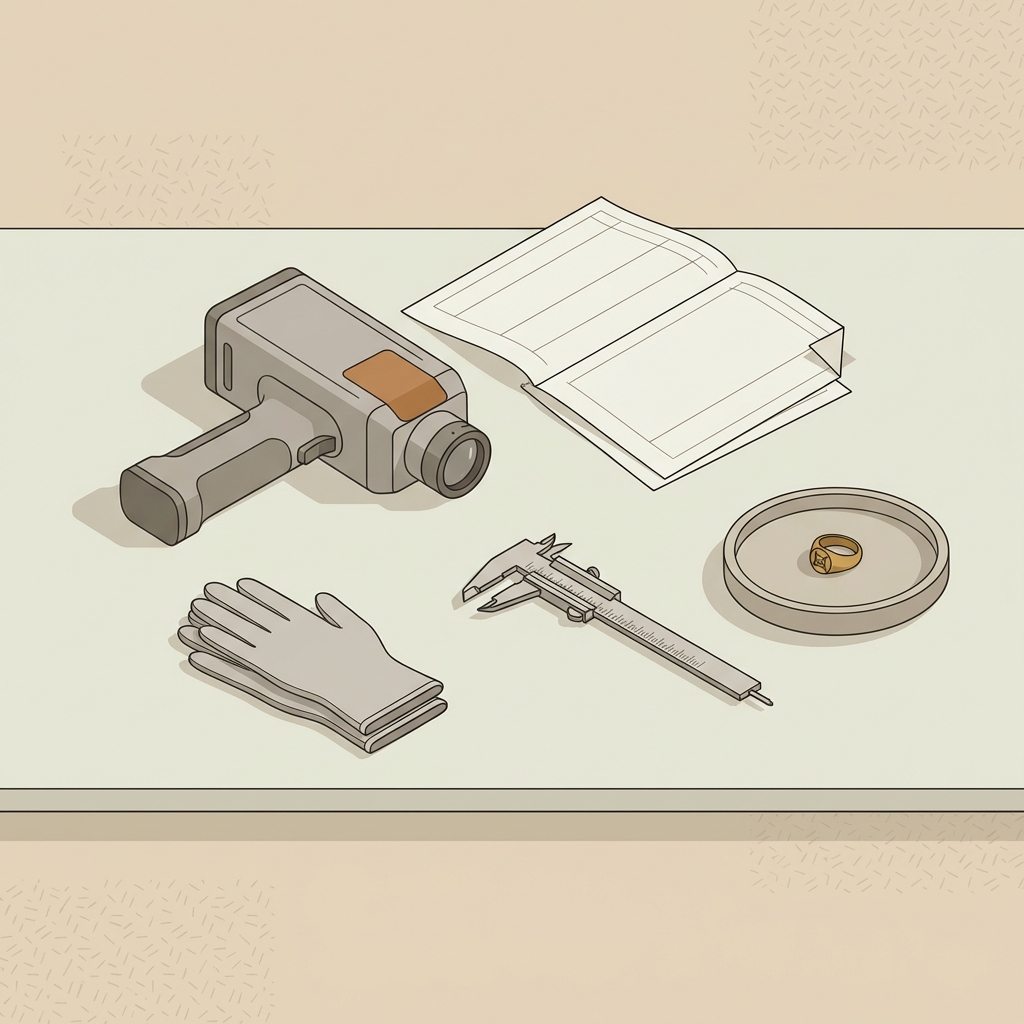
a pre test checklist for non destructive verification
Interpretation requires a specialist
Instrumental output should be read by a conservator or specialist who can place elemental ratios in context and advise on next steps, such as whether a formal lab certificate or targeted sampling is justified. Access to portable instruments has expanded, but interpretation remains the professionals task.
What pXRF can and cannot tell you
pXRF reports elemental presence and relative concentrations at or near the surface. It is excellent for screening but cannot by itself prove age or workshop attribution; technicians use it to rule in or out alloy types before commissioning further testing.
How professionals interpret results
Professionals corroborate pXRF with condition notes, microscopy, and sometimes targeted lab analysis. Because surface enrichment and corrosion can bias readings, expert correlation with other evidence is essential to reach a confident conclusion.
How restoration and condition notes affect value and care
Restoration descriptions such as stabilized, repaired, or left untouched should be precise and accompanied by photographs where possible. Clear restoration notes help buyers understand what was done and whether the work affects attribution or display considerations Auction Terminology, Christie's.
Buyers should ask which materials were used in any conservation treatment and whether repairs were reversible. When restoration is disclosed, it should be recorded alongside lab reports so future examiners can understand interventions.
Typical restoration descriptions
Common phrases you may see include stabilized, meaning fragile areas were consolidated; repaired, indicating joins or fills were made; and left untouched, which signals that no consolidation was performed. Each has implications for care and for how the piece is presented to collectors.
What to ask about conservation
Request details on the methods and materials used, who carried out the work, and any before and after documentation. Conservative care that respects original surfaces is generally preferred, and reporting should be transparent.
Practical scenarios: reading a roman gold ring listing
Approach listings with a structured checklist: examine photographs for bezel and intaglio detail, compare measurements to known standards, look for hallmarks or maker marks, read condition and restoration notes, and request provenance documents and any lab reports. If a listing cites assay or lab results, ask for the full certificate rather than an excerpt, and compare the listed tests to the sellers condition notes About us, International Association of Dealers in Ancient Art.
Red flags include vague or missing provenance, no close up photos of hallmarks or the bezel, and sellers who decline to provide copies of certificates or condition reports. When these appear, ask targeted questions and consider an independent appraisal or a request for additional testing before proceeding.
How to read photos and measurements
Check that photos show the ring on a plain background with scale and that measurements include ring size, bezel dimensions, and gemstone size. If sizes are missing, request them before bidding or buying.
Red flags and confidence signals
Confidence signals include clear hallmarks, documented lab reports, readable condition notes, and a coherent provenance trail. Red flags are evasive answers, inconsistent photographs, or missing details that prevent a basic technical or historical assessment.
Selling or buying: legal and ethical steps to take
Before buying or listing an ancient ring, check export and ownership history and consider international frameworks that address illicit trafficking; absence of provenance can pose legal and ethical risks for both buyer and seller UNESCO information on provenance and illicit trafficking.
If ownership history is incomplete and the risk of illicit origin seems plausible, seek specialist legal or provenance advice before completing a transaction. Reputable channels will request documentation and may refuse consignments that cannot be cleared ethically or legally.
Export and ownership checks
Ask sellers for export permits, customs records, and any provenance paperwork they hold. Keep copies of everything and factor any outstanding research or legal checks into your decision to buy or sell.
Working with reputable channels
Prefer dealers, auction houses, and platforms that require provenance documentation and that maintain transparent condition and restoration records. This reduces legal risk and helps protect cultural heritage.
When a gemstone materially changes the valuation
Certain stones such as high quality amethyst, carnelian with a fine intaglio, or unusually large or well preserved semi precious gems can materially affect the valuation of a ring; in these cases a recognized gemological laboratory report is the appropriate next step GIA gem identification.
Ask for gem weights, measurements, and any notes about treatment in the laboratory report, and combine that information with alloy or metal testing and provenance to arrive at a reasoned valuation.
Which stones most affect price
Large or rare gemstones, stones with unusual clarity for the period, or historically significant types of intaglio carving can all increase interest. Conversely, modern replacements or heavily treated stones often reduce desirability and should be disclosed.
Why lab reports for gems matter
Gem labs provide standardized, widely accepted documentation of identity and treatment that appraisers and auction houses use to compare and price items objectively. Without such a report, valuation is speculative when a gemstone is central to price.
A short checklist to decide if a ring is likely valuable
Five quick checkpoints: visible hallmarks or assay marks; clear provenance or collection history; presence of lab reports or credible appraiser notes; transparent condition and restoration records; and a reputable selling channel or auction comparable. If most items on this checklist are present, the ring is a candidate for formal appraisal and sale; if not, proceed cautiously Research report: export licensing and provenance, GOV.UK, Department for Culture, Media and Sport (DCMS).
When to escalate: seek an accredited appraisal if the ring shows multiple confidence signals or if you plan to insure, resell at auction, or include the piece in an estate. Keep all documents together so future buyers or insurers can verify the chain of evidence.
Five quick checkpoints
Write down observations for each checkpoint and request missing documents before purchase. This documented trail simplifies later resale and can protect both buyer and seller.
When to escalate to experts
Escalate when lab results, provenance gaps, or high expected value are present. An accredited appraiser and recognized labs form the next tier of evidence after your initial checks.
Resources and next steps for collectors
Seek accredited gemological laboratories for gem identification and independent accredited appraisers for valuations; professional bodies and appraisal organizations list qualified practitioners who follow community standards and can supply formal certificates and written appraisals Publication 561 (12/2025), Determining the Value of Donated Property, Internal Revenue Service (IRS), USA.
Aurora Antiqua can serve as a curator reference for collectors by providing condition notes, contextual editorial background, and provenance style documentation when available, helping buyers understand what documentation to request while avoiding definitive authenticity claims without supporting lab or appraisal evidence. See our article The Timeless Appeal of Roman Jewelry for related editorial background.
Where to find labs and appraisers
Start with recognized gem labs for stone identification and look for appraisers with documented credentials and experience in historical jewelry. Ask for written reports that you can retain with the objects records.
How Aurora Antiqua can help as a curator
As a curated seller of ancient rings and small artifacts, Aurora Antiqua provides condition notes and contextual information to help buyers decide what tests or documents to request, while advising that formal lab or appraisal evidence is needed before making definitive claims about attribution or market value.
Final summary: practical rules of thumb
Use a tiered approach: begin with careful visual checks and good photographs, then seek non destructive elemental testing such as pXRF for alloy information, request a recognized gemological laboratory report for any stone that materially affects value, and finally commission an accredited independent appraisal to combine technical reports with auction comparables. When present, hallmarks remain a high confidence visual cue about declared metal fineness and should be part of your first assessment https://www.assayofficelondon.co.uk/hallmarking/what-is-a-hallmark#convention, Goldsmiths' Company Assay Office.
Always treat provenance and export documentation as essential parts of sellability and legal acceptability. Keep condition notes, restoration records, lab certificates, and appraisal reports together so future buyers or institutions can verify the objects history. When in doubt, pause and seek a specialist opinion rather than relying on home tests or informal visual ID.
A portable pXRF provides a rapid elemental readout but requires specialist interpretation to account for surface effects and corrosion; it is best viewed as a screening tool rather than a final verdict.
Hallmarks are a high confidence visual cue about declared metal fineness when present, but they do not by themselves prove age, provenance, or market value.
Get an accredited appraisal before insuring, selling at auction, or transferring an estate interest, or whenever lab reports and provenance suggest a piece may have significant market value.
More from Aurora Antiqua
References
- https://www.assayofficelondon.co.uk/hallmarking/what-is-a-hallmark#convention, Goldsmiths' Company Assay Office
- Hallmarking, The Goldsmiths' Company, London
- Hallmarking, The Assay Office Birmingham
- Hallmarking Guidance Notes: practical guidance in relation to the Hallmarking Act 1973, the UK Assay Offices
- Portable XRF for paintings and metals authentication, npj Heritage Science (Springer Nature), DOI
- Auction Terminology, Christie's
- About us, International Association of Dealers in Ancient Art
- Publication 561 (12/2025), Determining the Value of Donated Property, Internal Revenue Service (IRS), USA
- Research report: export licensing and provenance, GOV.UK, Department for Culture, Media and Sport (DCMS)
- Gem Identification Lab Class, Gemological Institute of America