


Looking for the real thing? Browse our Ancient Roman ring collection, each piece one of one, individually authenticated, with documented provenance. For the background, see the guide to Roman jewelry.
What is a roman gold ring? Definition, context and why purity matters
A roman gold ring is an ancient ring produced in Roman-period contexts or attributed to Roman workshops, with dating usually given as an estimate tied to provenance or stylistic attribution; the phrase roman gold ring appears in many listings and condition notes to indicate this contextual attribution.
Collectors should expect such an ancient ring to show wear consistent with age, a surface patina, and sometimes repairs recorded in restoration notes. Jewellery rarely survives untouched, and these visible details are important when interpreting composition and testing results.
Unlike modern manufactured jewellery, Roman gold objects were often deliberate alloys rather than chemically pure native gold; workshop practice and recycling produced a wider range of compositions in personal ornaments than in state coinage, a point visible in museum research on Roman jewellery practices British Museum research on Roman gold jewellery.

Terminology collectors will encounter includes provenance, condition notes, restoration notes, patina, bezel, intaglio and workshop attribution. Each term helps explain why a measured alloy percentage may not tell the whole story: provenance and conservation actions affect what tests read at the surface.
When a listing describes an intaglio or a bezel, those elements can influence how an analyst tests the metal, because gems, inlays or heavy bezels can require targeted spot measurements or sampling strategies during analysis.
How specialists test Roman gold: XRF versus destructive assays

Portable and bench XRF are the routine non-destructive screening tools used for rapid elemental screening of ancient gold, but they measure near-surface composition and can be biased by surface contamination or conservation layers; understanding this limitation is essential when reading results XRF in archaeometry: principles and limitations and for practical best-practice advice VRXRF guidance.
In practice, XRF reports should state the instrument make and model, the calibration standards used, the spot size and the elements reported. Spot size matters because a small probe can avoid solder or inclusions, while a larger spot will average over a wider area and may mix metal from joins or repairs.
Analogy helps: XRF reads the metal near the surface like a scanner that sees only the outer skin, so a cleaned surface or a historic repair can shift the apparent composition without changing the total bulk alloy beneath the surface.
Destructive methods such as fire assay and ICP-MS provide the most precise total gold percentage and trace-element signatures, and they remain the reference methods when sampling is permitted by conservation policy; these assays are recommended for conclusive work on small finds when a sample can be taken Analytical protocols for precious metals.
Bench laboratory workflows often combine both approaches: XRF for non-destructive screening and targeted destructive assays for verification or research, with labs reporting whether values are weight percent Au or expressed as alloy ratios and whether uncertainties are included.
What coin studies tell us - and what they do not - about Roman gold purity
Analyses of Roman coinage show the Roman state frequently targeted high gold content for official solidi and aurei during many periods, and early Imperial issues often exceed about 90 percent gold, which establishes a useful benchmark for state-controlled metal standards Overview of Roman gold coinage composition.
Hoard reports and museum publications continue to refine chronological trends, and recent hoard studies underscore how coin datasets can track episodes of deliberate debasement or regional differences in minting practice Hoard of Roman gold solidi report.
Compare coin datasets with jewellery datasets
Use as a quick diagnostic
Despite the value of numismatic data, coinage is more standardized than workshop jewellery, and many published datasets remain coin-heavy; that imbalance means coin trends cannot be directly equated to how local workshops alloyed personal ornaments.
The open question for collectors and researchers is how representative coin-based timelines are for the full range of workshop practice; more linked datasets that connect jewellery XRF readings with third-party assays would improve this comparison, but such datasets remain limited.
Why jewellery shows more variability: workshop practice, recycling and aesthetics
Roman jewellery and workshop gold typically vary more than coinage because gold was frequently recycled, alloyed for colour or hardness, and mixed in local workshops, producing a broad range of purities across regions and periods, a pattern documented in collection studies on Roman gold working practices British Museum research on Roman gold jewellery.
Workshops often re-melted scrap, refashioned older ornaments and combined metals recovered from different sources. That recycling practice means an ancient ring may contain metal with different histories in its hoop, shoulders and bezel, and a single spot measurement can miss that internal variation.
Alloying choices were also aesthetic and practical: adding copper produced warmer, redder tones and increased hardness, while silver or paler alloys gave different visual effects. These deliberate choices mean colour and working properties were sometimes prioritized over pure gold content.
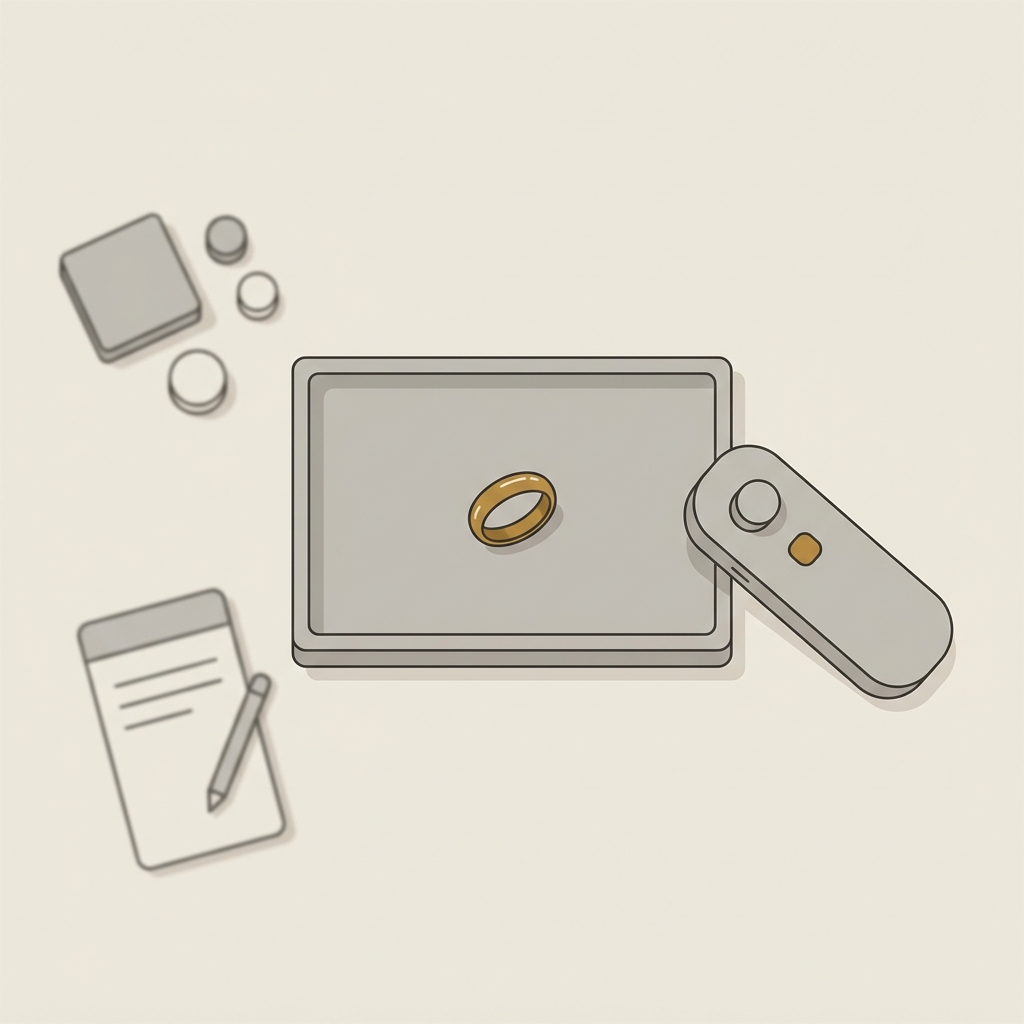
Small repairs, sheet joins and historic soldering are common and can alter how surface measurements read; restoration notes that describe stabilized joins or replaced solder are therefore relevant for interpreting analytical results.
How to read an XRF report for a roman gold ring: a checklist for buyers
Start by checking five key report elements: instrument make and model, spot size, measurement depth or analysis mode, the calibration standards used and whether results are reported as weight percent Au or as alloy ratios; these details affect how indicative a surface reading will be of total bulk composition XRF in archaeometry: principles and limitations.
Also look for the list of elements reported. At minimum a useful XRF summary will report gold, silver and copper and give uncertainty estimates or repeated-spot averages to show measurement variability rather than a single isolated value.
Checklist item: examine whether the lab notes any surface treatments, cleaning or recent conservation, since these can bias near-surface readings. If conservation actions are recorded, ask for pre- and post-treatment measurements where possible.
Behind the desk at Aurora Antiqua
Download a printable lab-report key to compare XRF outputs with basic destructive assay terminology and typical report fields.
Suggested questions to request from the seller or lab: was XRF used, which spot(s) were tested and can the lab provide instrument details and raw spectra? Also ask whether a destructive assay exists or if sampling would be permitted under conservation-safe conditions.
Treat surface XRF percentages as indicative rather than absolute without confirmatory assay; XRF is an excellent screening tool, but it cannot always replace a fire assay or ICP-MS when precise bulk composition is required.
Practical buyer steps: combining documentation, condition and lab data
Begin by reviewing provenance and condition notes; a transparent collection history and clear restoration notes reduce uncertainty and help interpret any analytical results that follow, including XRF summaries or lab certificates British Museum research on Roman gold jewellery.
Next, examine available lab reports. Prefer listings that disclose XRF instrument details, spot size and whether uncertainty or repeated measurements are provided. Those details allow you to judge how representative the reported percentage is of the whole item.
If documentation is unclear, ask for targeted photos of joins, hallmarks and the interior of the hoop, and request that any XRF data include spot locations. Photographs paired with a lab note can reveal whether a reported reading likely reflects a repaired area or intact original metal.
Independent lab testing is reasonable when documentation is unclear, for high-price items, or where a seller permits sampling under conservation-safe protocols; destructive assays are the standard for definitive bulk composition, but they require permission and careful sampling by an accredited lab Analytical protocols for precious metals.
Common errors and pitfalls when assessing composition
Surface bias is a frequent problem: soil encrustation, corrosion products or modern cleaning agents can skew XRF results and produce misleading apparent gold percentages; analysts note this limitation in best-practice discussions of XRF use XRF in archaeometry: principles and limitations.
Over-interpreting coin data is another risk: coinage datasets are valuable but are not direct proxies for workshop jewellery; extrapolating from coin trends to assert a jewellery composition without item-specific analysis can mislead buyers and researchers Hoard of Roman gold solidi report.
State coinage often targeted higher gold content and greater standardization, whereas personal jewellery typically shows wider variability because of recycling, local alloying choices and workshop practice; combining provenance, condition notes and lab data is the best approach for assessing a roman gold ring.
Single-spot XRF readings are commonly advertised but can be insufficient. A single spot may fall on a cleaned area, a soldered join or a later repair and therefore not represent the ring's bulk alloy; asking for multiple spots or cross-section data reduces this uncertainty.
Common listing errors to watch for include the absence of lab method details, vague provenance language and missing restoration disclosure. When these elements are absent, treat measured percentages as provisional and ask for more documentation before making a decision.
Practical examples and short case studies
A hoard coin report illustrates how coin datasets inform chronological trends: modern hoard analyses publish compositional summaries that can show periods where gold content changed, and these studies help date changes in state minting practice Hoard of Roman gold solidi report.
Consider an example listing format from a curated shop: a good listing presents condition notes, restoration notes, provenance or collection history and any analytical results. Such transparency helps buyers weigh an XRF screen against the visible condition and documented interventions Aurora Antiqua listing of the Minerva ring.
In practice, an XRF read showing elevated copper near a bezel could reflect a solder or repair, whereas a destructive assay across the hoop and bezel would reveal whether those differences are local or consistent throughout the object; reading both results together produces a more balanced judgment.
These short case comparisons show why collectors should combine visual evidence, condition notes and lab reports rather than relying on a single metric to judge a roman gold ring's composition and likely workshop history.
Summary and responsible next steps for collectors
Key takeaway: Roman gold was rarely chemically pure in the modern sense, and jewellery commonly shows variable alloying due to recycling and workshop practice; collectors should treat reported percentages as part of a broader documentation set rather than as definitive proof alone British Museum research on Roman gold jewellery.
Next steps: review provenance and condition and restoration notes first, prefer XRF reports that disclose instrument and spot size, and consider destructive assays where conservation policy and sampling permissions allow; combined evidence offers the clearest basis for an informed purchase XRF best-practice guidance.
When in doubt, consult a qualified conservation scientist or an accredited laboratory for independent testing and ask sellers for raw spectra or repeated-spot data to better understand measurement variability.
Responsible collecting emphasizes transparency of documentation, cautious interpretation of single-spot analyses and a willingness to seek confirmatory assays for high-value or uncertain items.
An XRF report provides a rapid, non-destructive surface measurement of major elements such as gold, silver and copper. It is useful for screening but can be biased by surface contamination or repairs, so treat it as indicative rather than definitive without further testing.
Not always. Destructive assays like fire assay or ICP-MS give the most precise bulk percentages but require sampling. For many purchases, transparent provenance, repeated XRF spots and clear restoration notes can be sufficient; use destructive assays for high-value or uncertain cases.
Request detailed provenance and condition notes, ask for XRF instrument and spot information, seek photos of joins and interior surfaces, and consider independent laboratory testing when documentation is incomplete or the item is costly.
More from Aurora Antiqua
References
- Hallmarking, The Assay Office Birmingham
- Investigating Ancient “Bronzes”, J. Paul Getty Museum and Getty Conservation Institute, Los Angeles
- Portable XRF for paintings and metals authentication, npj Heritage Science (Springer Nature), DOI
- Combining synchrotron radiation techniques for the analysis of gold coins from, Scientific Reports
- Internet Archaeol. 40. Atkinson and Preston. Objects of personal adornment, Internet Archaeology, Council
- Gold ring, Roman, Imperial period, 2nd to 3rd century CE, Acc. 41.160.450, The Metropolitan Museum of Art, New York
- A Roman jeweller's hoard from Snettisham, Norfolk, Antiquity 60, no. 229 (July 1986), pp. 137 to 139
- Client Challenge, Springer