


Looking for the real thing? Browse our Ancient Roman ring collection — each piece one-of-one, individually authenticated, with provenance.
What people mean by a gold ring stamped roman
When someone types gold ring stamped roman into a search box they are usually trying to understand whether a visible inscription or brief marking on a ring is evidence that the object is an ancient Roman piece. In practice, that short phrase bundles two separate questions: what the mark itself indicates, and what other evidence is needed to support a claim of antiquity.
High-status Roman rings are commonly gold mounts set with hardstone intaglios used as personal seals and display pieces, and museum literature shows this combination across many dated examples from the late Republic into the early Imperial period, which is a useful baseline for comparison Metropolitan Museum of Art article on Roman jewelry. See related items in our ancient Roman rings collection for comparison.
The most important evidence is a consistent typological match to museum examples, a clear provenance or collection history, transparent condition and restoration notes, and technical analysis such as XRF when needed.
Because collectors and sellers often use short search phrases, the phrase gold ring stamped roman has also become shorthand for several scenarios: a modern ring stamped with the word Roman by a studio, a vintage piece labeled by a previous owner, or a genuine antiquity where the term appears in a listing. Each scenario calls for different evidence and different levels of scrutiny.
Quickly put, a visible label reading Roman is not conclusive on its own. Authentication is best handled by layering typological comparison, clear provenance and condition notes, and where appropriate, technical analysis such as XRF or microscopy to support the stylistic evidence.
Common usages of the phrase
Searchers often mean one of three things: identification of an ancient Roman ring, a request to verify a seller label, or advice about interpreting a short stamp or inscription. For collectors, the primary concern is whether the object matches known Roman types and whether its documented history supports an ancient origin; museum comparisons help with the first part and documented provenance helps with the second Metropolitan Museum of Art article on Roman jewelry.
For example, many antique rings on specialist lists pair gold settings with carnelian or agate intaglios, and when a listing includes condition notes and measurements it becomes far easier to compare to reference examples rather than relying on a single short label. Browse our broader rings collection to see how different mounts and intaglios are presented.
Why a modern 'Roman' stamp causes confusion
The word Roman stamped or inscribed on a hoop or inner band can derive from many sources: a modern hallmark added by a jeweler, a descriptive tag applied in a private collection, or rarely, a later ancient inscription meaning something different. Short modern markings can be ambiguous and should not be the sole basis for believing a piece is ancient.
When a stamped label is present, the practical next steps are to compare the mark and the ring's typology with museum examples, request high-resolution images and measurements, and review any provenance statements or conservation notes that accompany the listing.
Quick takeaways
First, gold ring stamped roman as a search term signals the need for layered verification rather than acceptance of the mark alone. Second, rings with gold mounts and hardstone intaglios such as carnelian are a typical high-status Roman combination and are a starting point for comparison with reference collections Metropolitan Museum of Art article on Roman jewelry. Third, clear provenance, condition notes and technical tests strengthen a claim of antiquity but are not always present for private items.
How Roman gold jewelry was made and typical ring features
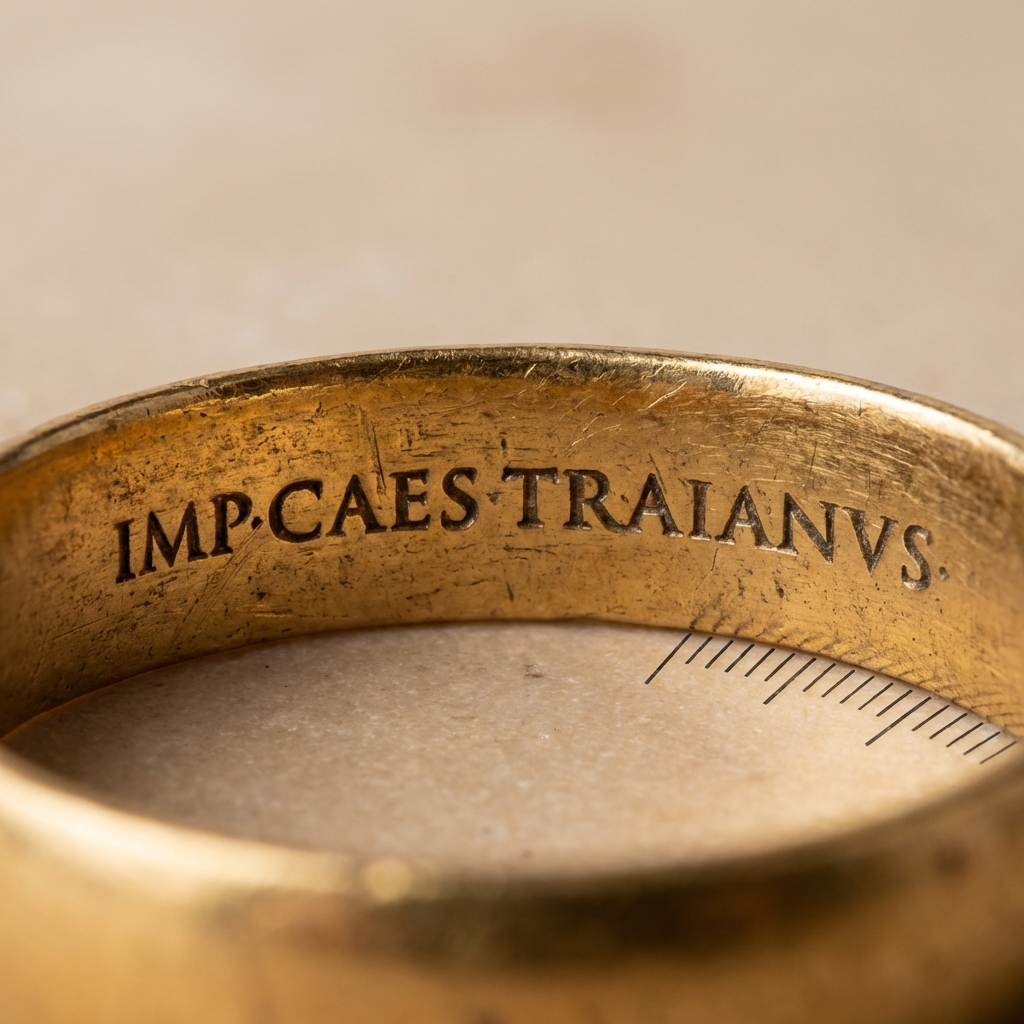
Roman high-status jewelry frequently combines high-karat gold mounts with hardstone intaglios such as carnelian or agate. These hardstones were commonly cut as seal intaglios and set into bezels that could be raised above the hoop, allowing the image to be used for sealing wax and for display Metropolitan Museum of Art article on Roman jewelry.
Typical ring features to watch for include the bezel, which secures the intaglio; the hoop, which may be plain, ridged or rounded; and the shoulders, which can be decorated or left simple depending on date and social context. Observing these elements helps align a piece with known typologies.
Construction techniques varied by workshop and period but Roman practice often involved raising the bezel from a sheet or casting a small setting that was then finished by hand. Tool marks, the method of bezel attachment and signs of ancient wear can all contribute to a typological assessment.
Iconography on intaglios is another clue: classical deities, military motifs, portrait heads and symbolic animals are common subjects. For example, Athena or Minerva motifs appear in several documented Roman intaglio rings, and where a listing provides clear images this can help narrow down parallels in museum and specialist collections Aurora Antiqua product listing 'Minerva' as a curation exemplar.
Dating by typology is always approximate and usually expressed as a range. Comparing bezel shape, iconography and mounting style against dated museum examples is a standard method for arriving at a likely period estimate.
Materials and common gemstones
Gold used in Roman high-status rings typically has a high gold content, and hardstones such as carnelian, agate and jasper were preferred for intaglios because they hold fine engraved detail and take a good polish. When a listing describes a stone as carnelian or agate, note that visual identification can be persuasive but is not a substitute for testing when precision matters.
Metal composition can often be checked non-destructively with XRF, which gives a useful profile of elemental composition and can help indicate whether a metal is consistent with expectations for ancient high-karat gold or with modern alloys.
Construction techniques and mounting styles
Many Roman rings show evidence of hand finishing: filing, chasing and slight asymmetry consistent with manual work. Raised bezels, collet settings and simple soldered hoops are among the constructions you will see in comparative collections, and each feature can be compared with published typologies or reputable listings to build a case for dating Metropolitan Museum of Art article on Roman jewelry.
Look for signs of ancient finishing such as rounded edges and patina within crevices, and distinguish these from modern filing or machine marks which tend to be sharper and more regular.
Iconography and function of rings in Roman society
Rings often functioned as seals, personal tokens and status markers. Intaglio images could carry personal, civic or religious meaning, and owners used them to sign documents or to display affiliation. The function and image can therefore inform a typological assessment and sometimes support a contextual date range.
Keep in mind that iconographic parallels are helpful but not definitive on their own; they are one thread in the layered evidence you should gather when considering a purchase.
What a stamp or marking can and cannot prove for a gold ring stamped roman
A stamp that reads Roman or contains a brief inscription does not by itself prove antiquity. Short or modern markings may have been added later, and ambiguity in placement or letter form reduces evidentiary weight. Treat a modern label as a starting point rather than a conclusion when evaluating a ring.
Practical first checks include comparing the stamp with marks shown in reference examples, inspecting the placement of the stamp relative to the hoop and bezel, and requesting high-resolution images of the mark and surrounding metal. These steps often reveal whether the marking is old, medieval, or modern in style Metropolitan Museum of Art article on Roman jewelry.
Follow @auroraantiqua for behind-the-scenes looks at curated ancient rings
Explore curated ancient rings with clear condition notes and provenance examples to see how responsible listings present evidence without overstating certainty.
Examine the mark for signs of ancient punch tools versus later stamping methods. Ancient punches and tooling leave characteristically variable impressions, whereas modern stamping tools tend to create uniform, deep impressions; photos taken at multiple angles and with scale are essential for this kind of assessment.
Types of stamps and brief modern markings
Marks can range from ownership initials to descriptive tags, maker marks or later hallmarks. A modern studio mark reading Roman can be a modern jeweler's choice of word rather than a statement of archaeological provenance, so always ask how and when that mark was applied and whether documentation accompanies the claim.
When a listing provides clear collection history and dates of previous ownership, those documents add weight to a stamp. Conversely, ambiguous phrases such as appears Roman or may be Roman should prompt extra caution and specific requests for provenance details.
Why short or modern 'Roman' stamps are inconclusive
Short inscriptions lack context. Without accompanying typological evidence, documented provenance or testing, a one-word stamp is insufficient to establish that a ring is a Roman antiquity. Sellers can help by providing full provenance statements and condition notes that describe when and how a mark was recorded.
For many private items it is common for the listing to point to comparable museum examples and to offer measurements and high-resolution imagery so potential buyers can run parallel comparisons themselves Aurora Antiqua product listing 'Minerva' as a curation exemplar.
Practical first checks to do when you see a stamp
1. Request high-resolution images of the mark at multiple angles and with a scale. 2. Ask for clear measurements of band width, bezel dimensions and stone size. 3. Compare the mark and typology to trusted references and museum examples. 4. Request provenance documentation and condition or restoration notes. Each of these steps narrows uncertainty before you consider technical testing.
When asking a seller for information, use clear, specific language such as I would like close-up images of the inner band and a description of any known restoration, and ask whether any lab tests exist for the metal or stone.
Technical analysis and when to request scientific tests
Scientific methods like XRF and microscopy are commonly used to corroborate stylistic and documentary evidence. Micro-XRF analysis and other elemental methods can provide supporting data without damaging a piece.
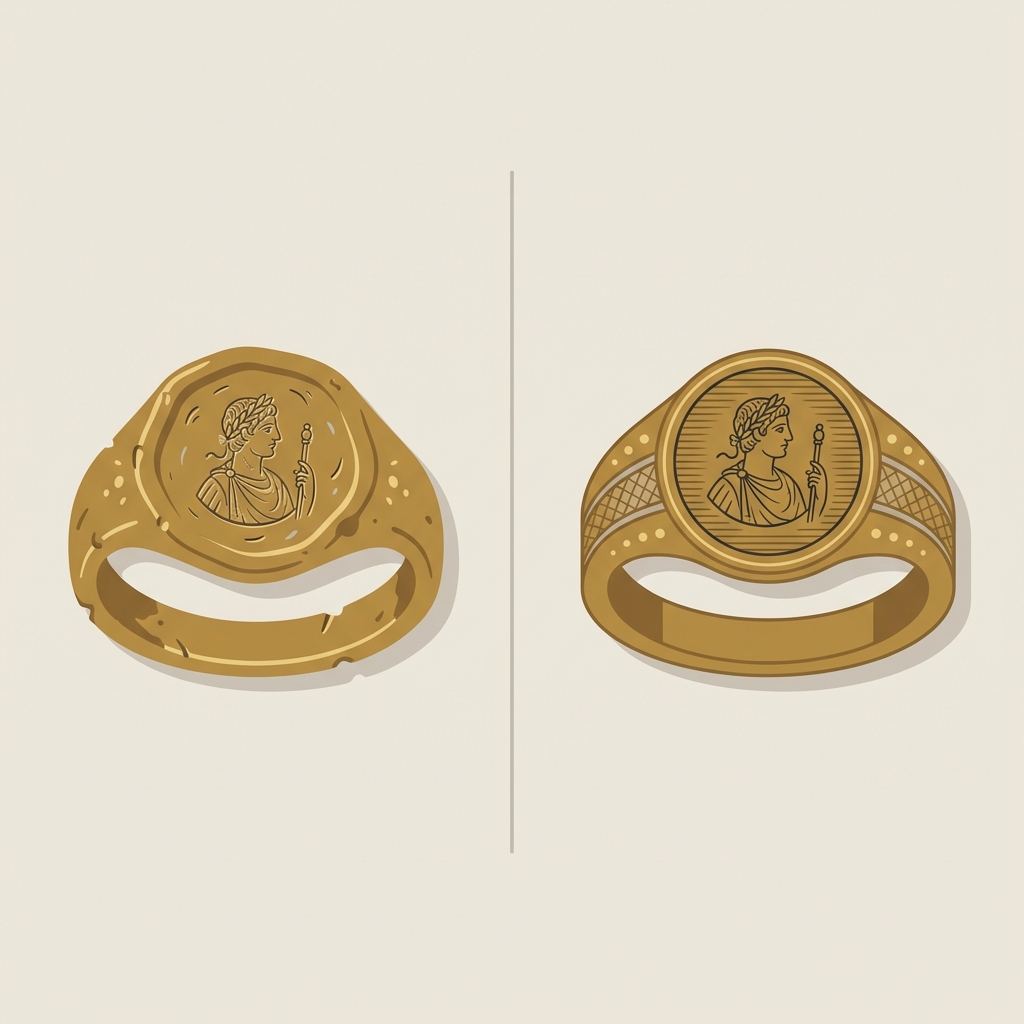
XRF is accessible and non-destructive, making it a practical first test when available. It can show whether a gold alloy has impurities or modern trace elements that suggest a more recent make. Guides on analyzing XRF results for gold explain how to read elemental profiles, and microscopy helps differentiate ancient tool marks from modern filing or conservation work by showing micro-features of the surface and joins.
Common lab methods include XRF for metal composition, optical or scanning microscopy for surface detail, and metallurgical analysis when sampling is possible. Each method can confirm certain technical aspects but none replaces provenance or typological comparison; rather, they complement those lines of evidence. For practical lab guidance on detecting counterfeit or modern interventions with XRF see resources like detecting counterfeit jewelry with XRF.
Common lab methods: XRF, microscopy, metallurgical analysis
XRF is accessible and non-destructive, making it a practical first test when available. It can show whether a gold alloy has impurities or modern trace elements that suggest a more recent make. Microscopy helps differentiate ancient tool marks from modern filing or conservation work by showing micro-features of the surface and joins.
Metallurgical analysis that requires sampling is less common for private sales because it can be invasive, but when done by a reputable lab it can provide deeper insight into fabrication techniques and alloying that are consistent with specific periods or workshops.
What each test can and cannot show
XRF can indicate whether the metal composition is plausible for an ancient high-karat gold piece, but it cannot by itself prove age because alloy composition may be replicated in modern work. Microscopy can highlight wear consistent with age, but interpreting those features benefits from experience and comparative examples.
Expect laboratory statements to describe methods, detection limits and the elements found rather than to assert absolute provenance. Ask labs for a plain-language summary of what their results imply about the piece's compatibility with Roman typologies when such interpretation is appropriate.
How to read a report or lab statement
Look for clear descriptions of method, date of test, equipment used and the analyst's qualifications. A concise lab statement that includes an XRF spectrum or elemental breakdown and a short interpretive note is more informative than a simple pass or fail. When in doubt, seek an independent expert opinion to interpret technical results alongside typology and provenance.
Remember that not all private items have lab reports; absence of tests is common and means you should weigh documentary and typological evidence more heavily in your decision.
Assessing provenance, condition notes and restoration histories
Provenance statements that list prior ownership, exhibition history or references to collection catalogues are especially helpful because they create a paper trail. Buyers should request any documentation that supports a chain of custody or prior expert review, and treat such documents as part of the overall weight of evidence Aurora Antiqua product listing 'Minerva' as an exemplar of clear documentation.

Condition notes should describe patina, edge rounding, any stabilisation performed, and whether repairs were made and when. These notes help distinguish ancient wear consistent with age from recent damage or modern interventions, and they serve as an honest representation of what a buyer is acquiring.
Restoration histories that explain exactly what was stabilised or conserved, and whether any soldering or replacement elements were added, are valuable. Transparent listings that include before and after photos or conservation reports allow potential buyers to assess treatment history themselves.
What to look for in provenance statements
Helpful provenance elements include named previous owners, dates or acquisition notes, references to exhibitions or catalogs, and any letters of verification from recognized specialists. Even partial provenance can be useful when combined with typology and condition notes.
If a listing claims a work came from a particular collection, ask for documentation such as acquisition receipts, export paperwork if relevant, or visible references in older sale catalogs. These items strengthen the chain of custody and reduce the weight of an unverified stamp alone.
How condition and restoration notes affect trust
Condition notes that are candid about wear consistent with age, and that explain conservation work, increase a seller's credibility. Conversely, vague statements such as good condition without detail can be a red flag that warrants follow-up questions and requests for clearer images and measurements.
When restoration is documented, note whether the work was stabilisation intended to preserve the artifact or restorative work that altered original material. Both can be acceptable, but buyers should know what was done and when.
Using curated listings as exemplars
Curated product listings that combine clear provenance, condition notes and high-resolution images are useful exemplars for buyers learning how to evaluate a ring. They show how transparent documentation looks in practice and what evidence to request when a listing is sparse or ambiguous. See our updates and examples in the news section for how we present exemplars.
Using such exemplars helps buyers formulate precise questions for sellers and clarifies which documents and images are necessary before making a decision.
Common mistakes, red flags and seller claims to be cautious about
A common mistake is over-reliance on a single visual cue such as an inner-band stamp reading Roman. That alone is weak evidence because marks can be modern, misinterpreted, or added by previous owners without expert verification Metropolitan Museum of Art article on Roman jewelry.
Ambiguous provenance language is another red flag. Phrases like said to be Roman or believed Roman should prompt requests for specific documentation and clear photo evidence before you proceed further with a purchase.
Over-reliance on a single visual cue
Visual cues are useful starting points but they require corroboration. For example, patina and edge rounding consistent with age are meaningful when paired with typology and documented conservation notes; without that support, such features are insufficient on their own to establish antiquity.
Documented conservation reports or stabilisation notes are preferable to vague descriptions because they explain what was done and can reveal instances where modern work might be mistaken for ancient fabrication methods Aurora Antiqua product listing as an example of condition transparency.
Ambiguous provenance language
When provenance is given in vague terms, ask specific questions: who owned it, when was it acquired, and are there any documents or sale records? A document trail, even if incomplete, increases confidence more than broad or promotional statements.
Also take care with seller language that implies certainty without backing evidence. Responsible sellers present probable dating with qualifiers and point to the evidence they used to reach that conclusion.
Confusing modern restorations with ancient features
Modern repairs can mimic ancient joins if done by skillful restorers. To reduce this risk, request high-magnification images and clear restoration notes that specify the materials and dates of work. Microscopy or a lab report can often show modern solder residues or filing patterns that distinguish recent interventions from ancient manufacture.
Wear consistent with age such as soft edge rounding, ancient tool marks and internal patina are standard indicators used by curators, but interpreting them correctly benefits from comparative examples and, when available, scientific support Aurora Antiqua product listing as a comparative exemplar.
Practical buying scenarios and a step-by-step checklist for a gold ring stamped roman
Scenario A: buying with full provenance and a lab report. If a listing includes named prior owners, dated acquisition documentation, clear condition notes and an XRF or microscopy report, the next steps are to verify the documents, confirm the lab credentials and compare the ring's typology with museum examples. A seller who provides these items upfront reduces your need for additional tests, though an independent opinion can still be prudent for high-value pieces.
Scenario B: listing with reasonable provenance but no lab tests. In this case, request high-resolution images, ask for detailed measurements and a conservation history, and consider commissioning a targeted XRF test or independent expert opinion if the purchase is important to you.
ToolType: checklist Purpose: A simple verification checklist to copy when evaluating a stamped ring Fields: High-resolution images, Measurements, Provenance documents Defaults: , , Params: Notes: Keep copies and dates for each document
Scenario C: brief stamp and sparse documentation. Treat these listings with caution. Ask for the exact phrasing used in any prior catalogs or labels, request multiple images including the inner band and bezel, and set an acceptable risk threshold for yourself. If the seller cannot provide more detail, be prepared to walk away or to insist on an independent check before payment.
Here is a compact step-by-step checklist to follow before paying for a stamped ring: request high-resolution images and scale, obtain full measurements of band and bezel, ask for provenance documents and dates of prior ownership, read condition and restoration notes carefully, and when appropriate commission XRF or a microscopy report or seek an independent expert opinion. Use this checklist as a minimum standard for moving forward.
Example language you can use when requesting information: Could you provide close-up images of the inner band inscription, full measurements of the hoop and bezel, and any documentation or conservation notes you have for this piece? If available, please also share lab reports or the name of the testing lab.
Conclusions and responsible next steps for collectors
The best practice for evaluating a gold ring stamped roman is a layered approach: compare the object to museum typologies, review provenance and condition notes, seek scientific tests when warranted, and obtain independent expert opinion if the purchase depends on a claim of antiquity Metropolitan Museum of Art article on Roman jewelry.
Curated sellers who present clear documentation, transparent condition and restoration notes, and helpful comparative imagery make it easier for buyers to weigh evidence. Such listings are useful learning tools even when you do not plan to buy immediately Aurora Antiqua product listing 'Minerva' as a curation exemplar.
Prioritise the documents and tests that matter most: provenance or collection history, high-resolution images and measurements, clear condition/restoration notes, and XRF or microscopy for the metal and surface when uncertainty remains. These steps will help you make a measured, informed decision rather than relying on a single brief stamp.
No. A single stamp that reads Roman is not conclusive. It should be weighed with typological comparison, provenance documentation and, where useful, technical analysis.
XRF is a common, non-destructive first test for metal composition. Microscopy can also reveal surface features and signs of repair, but tests should complement provenance and typology.
Ask for high-resolution images, full measurements, provenance or collection history, and clear condition or restoration notes. If available, request lab reports or independent opinions.
References
- https://www.metmuseum.org/toah/hd/romj/hd_romj.htm
- https://auroraantiqua.com/collections/ancient-roman-rings
- https://auroraantiqua.com/collections/rings
- https://auroraantiqua.com/products/museum-grade-roman-gold-ring-with-carnelian-intaglio-of-athenas-head-1st-century-bc-ad-rare-roman-ring-certified-artifacts
- https://www.bruker.com/en/products-and-solutions/elemental-analyzers/micro-xrf-spectrometers/m4-tornado/origin-study-ancient-coins.html
- https://www.vrxrf.com/resource/guide/how-do-you-analyze-xrf-results-for-gold/
- https://ims.evidentscientific.com/en/insights/worth-its-weight-in-gold-detecting-counterfeit-jewelry-with-xrf
- https://auroraantiqua.com/blogs/questions-and-answers
- https://auroraantiqua.com/products/authentic-roman-bronze-ring-numerius-octagonal-bezel-with-numeral-motif-1st-4th-century-ad-eu-53-us-6-5
- https://auroraantiqua.com/products/the-celestia