


Looking for the real thing? Browse authenticated ancient rings, each piece one of one, individually authenticated, with documented provenance. For the background, see the guide to buying ancient artifacts.
Quick summary: what 916 usually means and why context matters
A short definition of 916 in jewelry practice
In modern hallmarking practice the numeric mark 916 is commonly used to indicate 22-carat gold, meaning roughly 91.6 percent gold by mass when interpreted alongside an official assay or hallmark. This interpretation should be read alongside hallmarks and any assay office documentation rather than taken alone, especially for older or repaired pieces; official guidance on hallmarking explains how numeric fineness marks are used in context The Goldsmiths' Company Assay Office guidance.
For collectors of ancient rings it is important to remember that a visible 916 mark on a small Roman ring may reflect a later addition, a modern re-hallmark, or even a recent repair; marks can be added, altered or obscured over time and therefore need corroboration from documentation and condition notes.

Why a numeric mark alone is not the whole story
Marks can be persuasive but not definitive. A standalone 916 stamp is one piece of evidence rather than a conclusive assay, and it is most reliable when accompanied by an assay report or hallmark from a recognised office, or by provenance that documents the item history; for background on hallmarking and fineness marks see the British Hallmarking Council overview British Hallmarking Council guidance.
Common places for numeric marks on rings are the inner hoop, the shoulder area, or under a bezel. Wear, corrosion or restoration work can hide or distort stamps; photograph any marks carefully and include scale in the image so future reviewers can see the mark in context.
Follow @auroraantiqua for behind-the-scenes testing and provenance notes
Download a short printable testing checklist to document visual checks and simple hands-on tests before you escalate to lab work.
Visual and low-cost checks you can do first
Careful visual inspection: patina, joins, and tool marks
Start with detailed photographs under even light, showing the inner hoop, bezel, shoulders and any soldered joins. Look for differences in colour and surface texture: a consistent patina and uniform wear across the ring is more typical of long-term use, while abrupt colour shifts or shiny edges near joints can indicate later soldering or plating.
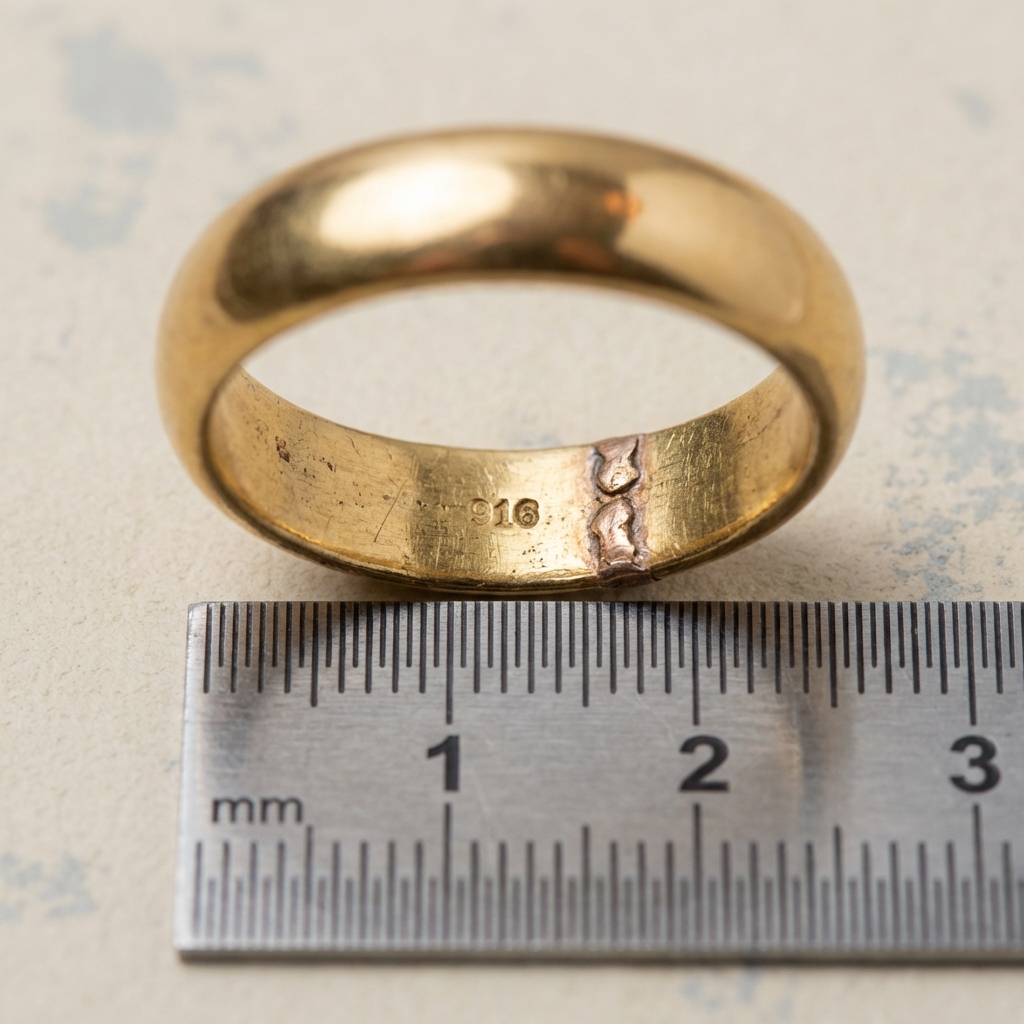
Examine joins and solder lines with a loupe or magnifier. Fresh solder or bright reglued seams usually stand out against older, worn metal. Note any evidence of filing, modern tool marks or replacement bezel work in your condition notes.
Examine joins and solder lines with a loupe or magnifier. Fresh solder or bright reglued seams usually stand out against older, worn metal. Note any evidence of filing, modern tool marks or replacement bezel work in your condition notes.
Simple hands-on tests: magnet, weight, and acid spot test
A magnet test is the least invasive first check: genuine gold is not magnetic, so a strong attraction suggests ferrous components or heavy base-metal cores. This test only rules out certain fakes and will not prove a ring is 22-carat gold, but it can flag obvious base-metal substitutions without touching the surface.
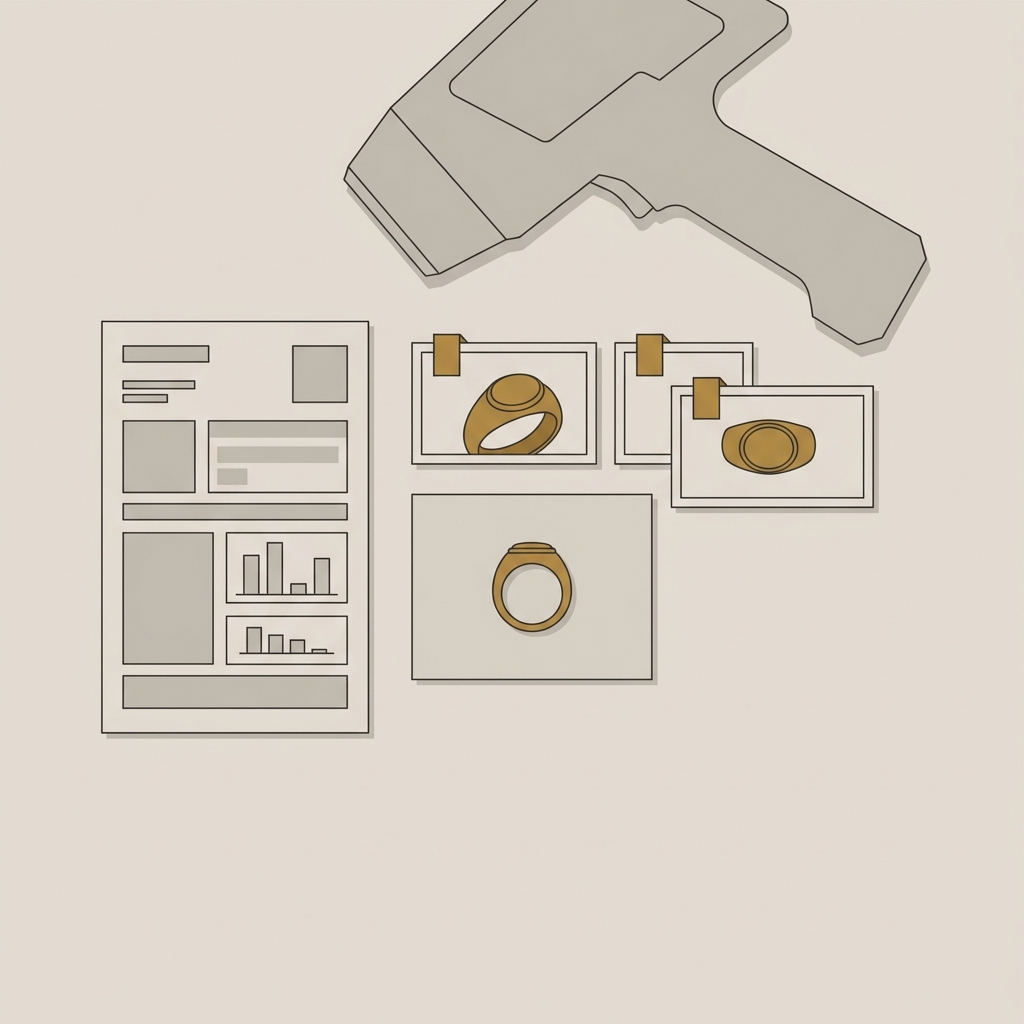
Density checks using precise scales and water displacement can reveal large discrepancies from the expected density of 22-carat gold, but they become unreliable for very small, hollow or mounted rings because attached stones, repairs or hollows change the result. When you run a density check, note scale calibration, temperature and any attached non-metal parts.
Non-destructive instrument tests: what XRF tells you and what it does not
How handheld and lab XRF work in simple terms
Handheld and laboratory X-ray fluorescence instruments provide a rapid, non-destructive readout of surface composition and are widely used as a screening tool by museums and conservation labs; they are valuable for an initial compositional profile and for documenting the presence of alloying elements Hallmarking, The Assay Office Birmingham. For a practical industry discussion see VRXRF.
Treat the 916 stamp as an important clue, not proof: document the ring, do visual and non-destructive checks, use XRF as a screening tool and commission a certified assay when results conflict or when legal or high-value proof is needed.
Common XRF pitfalls for small and plated rings
XRF measures the elements present near the instrument beam and can be biased by surface plating, corrosion layers or thin overlays, so a single portable reading can overrepresent a surface coating and not the bulk metal. For small Roman rings with potential gilding or restorations, XRF should be treated as a compositional screen rather than a definitive assay Investigating Ancient “Bronzes”, J. Paul Getty Museum and Getty Conservation Institute, Los Angeles. Further technical notes on penetration and limitations are discussed at GoldMarket.
When you receive an XRF pdf report, check for the measurement protocol and beam settings, and ask whether multiple spots were scanned. Good documentation helps you judge whether the reading likely represents bulk alloy or a surface phenomenon.
A practical step-by-step testing workflow for a small ancient ring
Order of checks to minimise risk and cost
Step 1: Photograph and measure. Take calibrated photos of all sides, closeups of any marks and a scale image. Record weight on a precise scale and note condition observations and any visible repairs. Browse our rings collection.
Step 2: Visual and magnet screening. Do the magnet test and detailed visual inspection described earlier and record results with dated photos. If both checks raise no flags, proceed to non-destructive instrument screening.

When to escalate to lab testing or assay offices
Step 3: Portable XRF screening. If available, have a conservator or lab operator run a portable XRF and provide a documented pdf report. Remember that XRF is a screening tool and that surface coatings can bias results NIST XRF guidance. See a guide to detection limits at PortableAs.
Step 4: Density check corrections. If you perform a water displacement test, correct the calculation for attached mounts, hollow sections or stones. For small or hollow rings the density method often loses precision and should not be the sole basis for a fineness claim GIA guidance on density and spot tests.
Step 5: Certified assay for high value or disputed items. If tests disagree, the ring is of high value, or you need legally defensible proof, commission a certified laboratory assay or get an assay office report; keep chain-of-custody photos and the lab's documentation.
Decision criteria: when a ring should be treated as likely 22-carat and when to doubt the mark
Combining evidence from marks, tests and documentation
Consider the full package: a consistent 916 mark supported by clear hallmarks or an assay letter, matching XRF results that are documented, and provenance or condition notes that do not show later plating or repair all increase the probability that the ring is 22-carat. When these lines of evidence align, the designation is more credible; the British hallmarking overview explains the importance of context when reading fineness marks British Hallmarking Council guidance.
Conversely, if a 916 mark appears alongside inconsistent patina, signs of recent soldering, or XRF readings that vary between spots, treat the mark with caution and consider a certified assay if the item is valuable.
Red flags that outweigh a visible 916 mark
Be particularly cautious if you see obvious plating lines, abrupt colour changes at joins, or if the ring is hollow and small such that density checks are unreliable. These red flags often require microscopy or lab work to resolve rather than relying on a single handheld test.
For legally defensible authentication of an ancient ring, a documented laboratory assay, such as a fire assay or a lab XRF with a documented protocol, is recommended; this level of certification is what assay offices and conservation labs provide when provenance or legal questions are at stake Assay office guidance.
Typical mistakes and common pitfalls to avoid
Misreading plated items and polished surfaces
Surface gilding and replating can give the visual impression of high-fineness gold while a base-metal core or earlier repair remains underneath. Look for edges where plating wears or peels and document these areas closely with macro photographs.
Over-reliance on a single test result
One common error is to accept a single instrument readout or an acid spot test as definitive. Portable XRF is a powerful screening tool but is biased by surface layers, and acid tests are locally destructive and can miss plated items; use them as part of a battery of checks and keep records of each step NIST XRF capabilities and limits.
documentation checklist for photographic and basic test records
Keep dated files for provenance
Practical scenarios: reading tests on a small Roman ring with wear and repairs
Scenario A: a ring with a clear 916 mark but signs of later soldering
Initial steps: photograph the mark, the solder lines and the bezel; run a magnet check and a careful visual comparison of colour across the join. If the magnet test is negative but the solder looks fresh, request the seller's restoration notes and any prior XRF or assay reports.
Interpretation: a 916 stamp near a fresh solder joint lowers confidence in that stamp as original. Ask for documented XRF readings in multiple spots and consider a lab assay if the ring's value or rarity warrants it; conservators routinely emphasise combining visual and instrumental evidence rather than relying on a single mark Characterization of Castellani nineteenth-century gold jewellery by in situ, Scientific Reports.
Scenario B: a thin, hollow ring with a portable XRF reading
Initial steps: record weight precisely, photograph interior and exterior, and request the portable XRF pdf. If the XRF shows high gold content but the ring is unusually light for its size, that suggests possible hollow construction or surface enrichment.
Interpretation: when XRF and density results conflict, escalate. Hollow or thin rings are especially prone to surface treatments and misleading instrument reads, and a certified assay or conservation lab analysis can resolve whether the XRF reflects bulk alloy or a surface layer NIST XRF guidance.
How to document tests and buy an ancient ring online with confidence
Essential documentation to request from sellers
Ask sellers for clear, dated photographs showing any marks, high-resolution condition notes describing repairs or restoration, precise weight and dimensions, and any existing assay letters or XRF pdfs. These documents form the minimal file you should keep when considering a purchase. See our Ancient Roman Rings collection.
Request phrasing on restoration that is clear and conditional, for example whether a bezel was replaced or a hoop was reinforced; avoid vague language and ask sellers to attach images of repair areas to their condition notes.
What to keep if you commission a lab test
If you commission or request a lab test, keep the lab's pdf report, chain-of-custody photographs with dates, scale weights used in the test and a short description of sampling or beam positions if an XRF was used. These materials help later reviewers understand what the lab measured and why Assay office guidance.
Store these files with the item description and any provenance notes so future owners or evaluators can follow the item's documented history.
Final takeaways and next steps
Short checklist before you pay
Quick checklist: photograph marks, run non-destructive visual and magnet checks, request XRF pdfs when available, correct density tests for mounts, and insist on provenance and condition notes for any ancient ring claiming 916 or 22-carat fineness.
When results are mixed, or the ring is high value, seek a certified laboratory assay or an assay office report and keep all documentation; this approach prioritises evidence and reduces the risk of late surprises Assay office guidance. Visit the Aurora Antiqua homepage.
A 916 stamp indicates 22-carat gold in modern hallmarking, but on ancient or restored rings it should be corroborated with hallmarks, condition notes or test reports before being accepted as proof.
Magnet and acid tests can detect obvious base-metal substitutions but are limited: magnet tests only rule out ferrous metals, and acid tests are locally destructive and can give false results on plated items.
Commission a certified assay when tests give conflicting results, when the ring is high value, or when you need legally defensible documentation; keep chain-of-custody photos and lab reports.
More from Aurora Antiqua
References
- S.I. No. 441/2019, Hallmarking (Irish Standards of Fineness) Regulations 2019, Electronic Irish Statute Book
- https://www.assayofficelondon.co.uk/hallmarking/what-is-a-hallmark#convention, Goldsmiths' Company Assay Office
- Hallmarking Guidance Notes: practical guidance in relation to the Hallmarking Act 1973, the UK Assay Offices
- 16 CFR 23.3, Misrepresentation as to gold content, Federal Trade Commission, eCFR
- Hallmarking, The Assay Office Birmingham
- Hallmarking Process, The Company of Goldsmiths of Dublin, The Assay Office (Dublin Castle)
- Investigating Ancient “Bronzes”, J. Paul Getty Museum and Getty Conservation Institute, Los Angeles
- Portable XRF for paintings and metals authentication, npj Heritage Science (Springer Nature), DOI
- Characterization of Castellani nineteenth-century gold jewellery by in situ, Scientific Reports
- Hallmarking, The Goldsmiths' Company, The Goldsmiths Company Assay Office
From Aurora Antiqua
We sell authenticated ancient & medieval pieces, each individually examined before listing and backed by a Lifetime Authenticity Guarantee. One of a kind, sold once, never reproduced.
Browse Authenticated Ancient Rings →