


Looking for the real thing? Browse genuine Roman rings for sale, each piece one of one, individually authenticated, with documented provenance. For the background, see the guide to buying ancient artifacts.
What are ancient Roman glass earrings and why the material matters
ancient roman glass earrings are small wearable antiquities made in Roman workshops that can include plain glass beads, moulded drops, and occasionally lead‑rich decorative glass; they are a subset of the ancient ring and artifact categories that collectors treat as curated objects with condition notes and provenance when available.
Material matters because identification informs care, restoration notes and how a piece should be documented for sale or conservation; a leaded, dense object requires different handling and may show optical properties distinct from soda‑lime glass, but first impressions like sparkle are provisional.
Handheld inspection aids and safe handling reminders
Use gentle handling and do not clean before recording
The appearance of an earring can be altered by age and burial, so collectors should treat initial material impressions as part of a broader documentation workflow rather than a final identification.
Conservative guidance from conservation literature shows visual checks are useful as a first step but are not conclusive for distinguishing leaded crystal from other glass types, so keep observations as condition notes rather than firm claims Corning Museum of Glass.
Typical forms, dating, and common materials
Roman earrings commonly appear as small hoops, drops or stud elements and can date roughly from the first century BCE through late antiquity; materials range from soda‑lime glass to various formulations that may include lead or other fluxes, and beads or insets may be set in metal bezels.
Why distinguishing leaded crystal from glass matters for care and sale
Knowing whether a piece is leaded can affect conservation choices, shipping considerations, and the kinds of documentation or restoration notes you record; list condition and any prior treatments clearly when a piece is offered or evaluated.
Quick visual and hands‑on triage tests you can do at home
Before any test, photograph the earring in high resolution, note measurements and existing condition notes, and handle the piece with gloves to avoid oils; these triage checks are meant to be non‑invasive and provisional.
Tap and sound test
Gently tapping glass and listening to the tone can give a suggestion of density, with denser materials tending to ring differently, but this impression is subjective and can be misleading on small or weathered Roman pieces; record the observation in your notes rather than treating it as definitive Victoria and Albert Museum (V&A).
Heft and weight impressions
Holding the earring and comparing perceived weight to a similarly sized modern glass object can help estimate density, but variations in shape and hidden metal mounts can change the result and lead to error, so combine this with other checks and documentation.
Sparkle, edge inspection and magnification
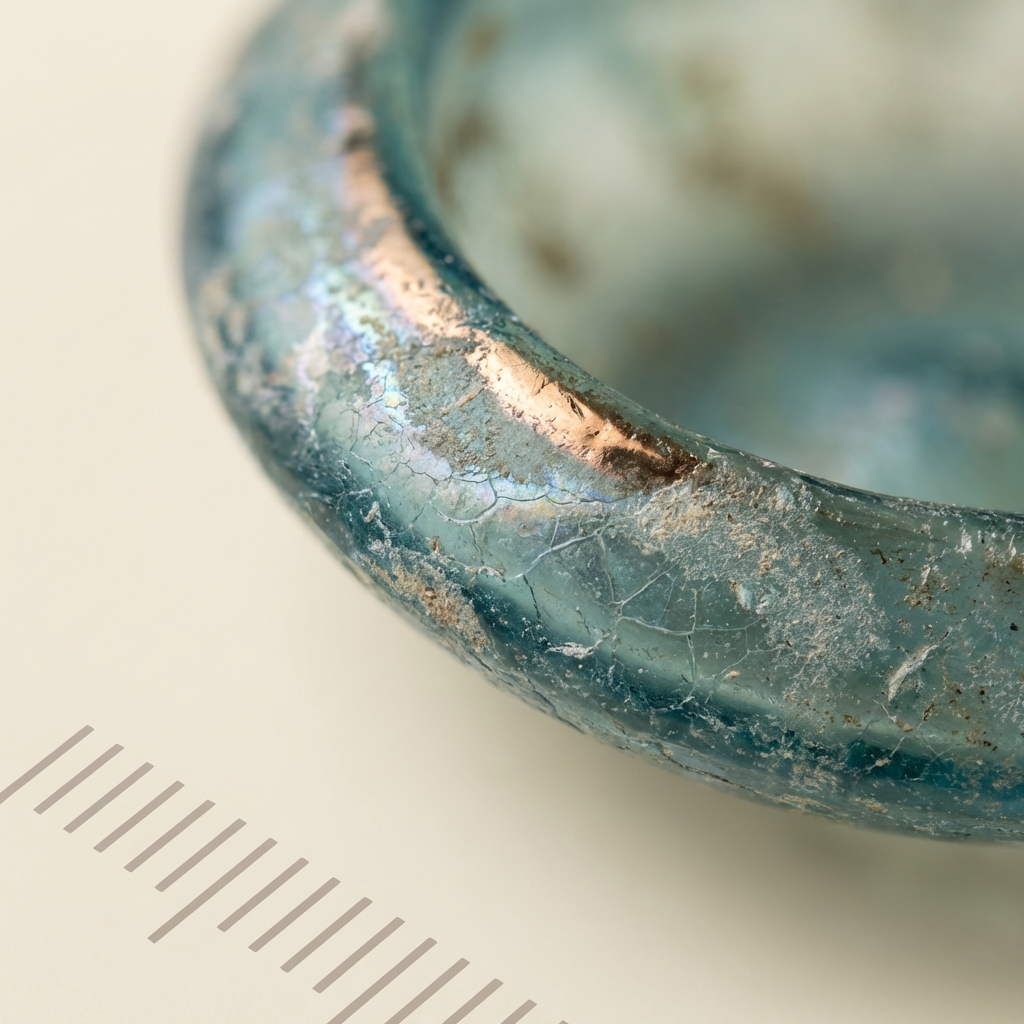
Under bright light, a loupe can reveal edge sharpness, small air bubbles, or internal reflections that hint at optical dispersion; however, weathering layers and iridescence common on archaeological glass can mask clarity and produce false impressions, so treat sparkle checks as provisional and photograph any features before further handling Corning Museum of Glass.
How burial, weathering and corrosion change appearance and mislead tests
Archaeological glass often develops crizzling, iridescence and encrustation from prolonged burial; these thin weathering layers scatter light and alter surface lustre, which can hide or mimic the optical cues used in simple sparkle or edge inspections.
Crizzling, iridescence and encrustation explained
Crizzling is a network of fine cracking in a glass surface caused by long‑term chemical alteration, while iridescence is the play of colours from layered weathering films and encrustation are mineral deposits from soil; any of these can change tactile and visual tests and should be documented carefully before interpreting results Journal review of ancient glass corrosion.
Document condition and provenance first, perform safe triage checks, use portable XRF as a non‑destructive screen for lead, and request laboratory density or refractive index tests if results are ambiguous or materially important.
Examples of misleading surface effects
A bright shimmer from iridescence can be mistaken for the high dispersion of a leaded object, and a weathered, pitted edge can hide the sharpness a collector might expect from modern crystal; when these features are present, rely on documentation and non‑destructive screening rather than home triage alone.
Non‑destructive compositional screening: portable XRF and what it tells you
Portable XRF is a field‑friendly, non‑destructive method that screens for elemental composition at the surface and is commonly used to detect lead (Pb), which, when present, supports the identification of leaded glass or crystal.
What portable XRF measures and why Pb detection matters
pXRF detects elemental signatures and can indicate Pb at the surface, providing strong evidence that a piece may be leaded; record instrument settings, spot size and the exact location of readings so the results can be interpreted alongside condition notes and provenance Getty Conservation Institute.
Limitations of pXRF on weathered or thin fragments
Because pXRF reads the surface layer, thick weathering, burial crusts or recent contamination can produce misleading signals or mask underlying composition, and specialist interpretation is often needed to decide whether an elevated Pb signal reflects original material or surface alteration Data from Multiple Portable XRF Units and further studies on spectrum processing New strategies for portable XRF spectrum processing.
Laboratory confirmation: density, refractive index and when micro‑sampling is used
Laboratory density and refractive index measurements are quantitative standards that distinguish leaded crystal from soda‑lime glass by measuring mass per volume and optical dispersion; these methods are used when attribution or conservation decisions require confirmation.

When micro‑sampling is justified, it should be performed sparingly by a qualified conservation laboratory with clear documentation; labs can run density and refractive‑index measures or small compositional analyses that provide definitive evidence of lead content Getty Conservation Institute.
How density and refractive index distinguish lead crystal
Leaded glass typically shows higher density and greater refractive index than soda‑lime glass, so matched lab measurements provide the quantitative basis for confirming a provisional identification suggested by pXRF or home checks.
When micro‑sampling or lab analysis is justified
Escalate to micro‑sampling or full lab analysis when the material determination affects conservation choices, legal status, or the value and sale of an item; a conservation lab can advise on sampling minimization and documentation.
Documenting condition and provenance before any testing
Good documentation is the foundation of interpretation: take high‑resolution photos from multiple angles, measure dimensions and weight, and write clear condition notes including patina, encrustation and any observable tooling marks prior to testing.
Photographic standards and measurement notes
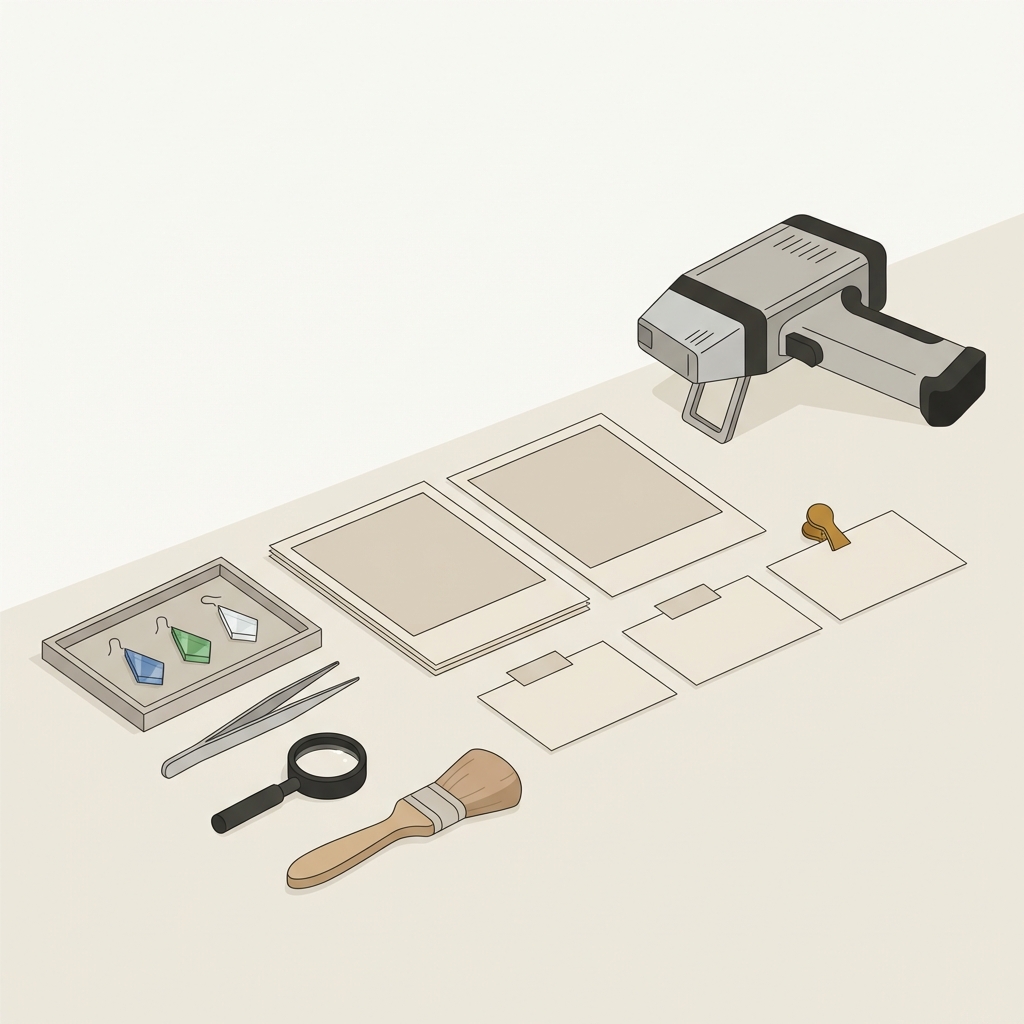
Photograph under neutral lighting, include a scale or ruler, and take close detail images of edges, mounts and any weathering; accurate records help later match pXRF spots and interpret whether a surface film may have affected results British Museum.
Restoration and preservation notes to record
Record any prior restoration or preservation work in restoration notes, including who performed it and what materials were used, because treatments can change surface chemistry and influence both visual tests and pXRF readings.
Decision framework for collectors: triage, screen, confirm
Start with documentation and safe triage tests, follow with non‑destructive pXRF screening if results are needed, and escalate to laboratory confirmation only when the material determination is important for conservation, sale or legal reasons.
Need help documenting a piece? See behind the scenes on @auroraantiqua
Download a printable checklist or contact Aurora Antiqua for guidance on documentation and how to present condition notes; we can help you understand which records matter most for testing.
A simple decision flow is: document and photograph, perform safe home checks, arrange pXRF screening, and consult a conservation lab if pXRF is ambiguous, if weathering seems to mask signals, or if the object has high provenance or value concerns Getty Conservation Institute.
Cost, effort and risk considerations
Balance the expense of lab confirmation against the importance of a definitive ID; pXRF is often an efficient intermediate step, while full laboratory analyses and micro‑sampling are justified when the outcome will materially affect conservation treatment or sale.
Common mistakes and pitfalls collectors make when testing ancient glass
Relying solely on a single consumer test such as a tap or a commercial spot test can lead to false positives or negatives on archaeological glass; combine methods and document everything to reduce error Victoria and Albert Museum (V&A).
Misreading surface effects as material properties
Interpreting iridescence or burial crusts as signs of optical dispersion can produce false conclusions; if a surface film is present, note it and prefer pXRF or lab methods for material inference.
Over‑reliance on single consumer tests
Commercial lead spot tests and casual heft or tap checks can be useful triage tools but have a moderate false‑result rate on ancient pieces and should be treated as provisional until non‑destructive screening is performed Corning Museum of Glass.
Practical scenarios: reading results for common earring conditions
Scenario A: clear, intact earring with sharp edges
If home checks show a clear interior, sharp edges under magnification and no weathering films, then a pXRF screen is the logical next step; a strong Pb signal would suggest leaded composition and lab confirmation can quantify density and refractive index if needed for sale or conservation decisions A. M. Caggiani u. a., Corroborating the autoptic identification, Wiley, Journal of Raman Spectroscopy.
Scenario B: weathered, iridescent earring with encrustation
When iridescence, encrustation or crizzling are present, home tests are unreliable and pXRF results must be interpreted with care because surface layers can mask or mimic elemental signals; in such cases documentation and referral to a specialist lab is often warranted Journal review of ancient glass corrosion.
Restoration, preservation and how interventions affect identification
Common conservation treatments such as consolidation, resin fills or removal of encrustation can change surface chemistry and optical appearance, and should always be recorded in restoration notes so later test results can be contextualized.
How to read restoration notes and their importance
Restoration notes should specify what was stabilised, what was repaired and what was left untouched, and name the conservator or lab involved; transparent restoration records protect provenance and make material testing interpretable British Museum.
Legal, ethical and collection care considerations for archaeological glass
Provenance and collection history are central to ethical sale and ownership; when provenance is incomplete or raises legal questions, consult museum guidance or legal counsel before invasive testing or transfer.
When to involve museum or university specialists
If an object's provenance is unclear, or if testing might affect archaeological information, reach out to museum conservation departments or university laboratories rather than attempting invasive procedures yourself British Museum or contact Aurora Antiqua for advice on presentation and documentation.
A practical buyer checklist: step‑by‑step for evaluating an ancient Roman glass earring
Immediate documentation and safe handling
Photograph the piece from multiple angles, note measurements and weight, record condition notes including patina and burial crusts, ask the seller for restoration notes and any provenance or collection history.
When to run pXRF and when to seek lab confirmation
Arrange non‑destructive pXRF screening when material identification matters for care or sale; if results are ambiguous or the piece shows heavy weathering that may mask signals, consult a conservation lab for density or refractive index testing Getty Conservation Institute. For examples of similar objects and comparative reference images see our artifacts collection.
Sample case studies and what they teach about testing results
Case study 1: pXRF positive for Pb but heavy weathering
Anonymized examples show that a surface Pb signal can reflect original material or contaminated encrustation; when heavy weathering is present, labs often recommend micro‑sampling of a tiny interior region or cross‑section analysis to resolve ambiguity Journal of Archaeological Science: Reports.
Case study 2: clear pXRF negative and sharp optics
When pXRF shows no Pb and the earring exhibits sharp edges and clear interior optics, the balance of evidence supports soda‑lime glass, though a lab density check can be requested if definitive attribution is required for conservation or sale decisions Getty Conservation Institute.
Conclusion and practical next steps: when to seek specialist help
In summary, follow a stepwise pathway: document condition and provenance thoroughly, perform non‑invasive triage checks, arrange pXRF screening for elemental indication of Pb, and escalate to laboratory measurements or micro‑sampling when the result matters for conservation, legal or sale reasons British Museum.
Clear triggers for specialist referral include ambiguous pXRF results, heavy weathering that may mask signals, high provenance value, or potential legal concerns; when in doubt, a conservation lab or university specialist can offer the appropriate tests and documentation.
Home tests like tap, heft and sparkle are useful as initial triage but are provisional, especially on weathered archaeological pieces; professional screening and lab tests provide reliable confirmation.
Portable XRF non‑destructively screens for elemental lead and other elements at the surface, giving evidence that supports a leaded identification but it can be affected by surface weathering and needs contextual interpretation.
Consult a lab when pXRF is ambiguous, when heavy weathering may mask signals, if the object is high value or of heritage concern, or when definitive confirmation is needed for conservation or sale.
More from Aurora Antiqua
References
- Quartz, Handbook of Mineralogy, Mineral Data Publishing / Mineralogical Society of America, USA
- A. M. Caggiani u. a., Corroborating the autoptic identification, Wiley, Journal of Raman Spectroscopy
- Gold finger ring with glass intaglio: a lioness (1995.85.2), The Metropolitan Museum of Art, New York
- SF-A79B96, Roman copper alloy and glass finger-ring from Norfolk, Portable Antiquities Scheme, British Museum
- Internet Archaeol. 40. Atkinson and Preston. Objects of personal adornment, Internet Archaeology, Council
- Echoes of Antiquity: Thorvaldsen’s Collections as a Reservoir of Motifs, Thorvaldsens Museum Archives
- Ganymede jewelry (Gold, rock crystal, emerald), Greek, Hellenistic, ca, The Metropolitan Museum of Art, New York
- Handheld XRF In Cultural Heritage: A Practical Workbook for Conservators, The Getty
- PubMed Central