


Looking for the real thing? Browse genuine ancient rings for sale, each piece one of one, individually authenticated, with documented provenance. For the background, see the guide to ancient jewelry.
What a pure silver ankh means: definition and context
Terminology: fineness, purity and common marks
When buyers ask about a pure silver ankh they are usually trying to understand how the metal content of a small wearable antiquity is expressed and verified. In trade and assay practice, silver purity is described by millesimal fineness numbers such as 925, 999 or 999.9 rather than a mathematical 1000/1000 claim, and assay offices and consumer guidance use those fineness marks to set expectations for quality and labeling Birmingham Assay Office hallmarking guidance.
Sterling silver is commonly defined as 925/1000, while fine and bullion grades are expressed as 999 or 999.9 on millesimal scales; those terms are practical labels used in commerce and legal guidance rather than absolute chemical statements, so a listing that says fine silver should usually be paired with a fineness mark or assay note FTC jewelry guides on precious metal content.
Collectors ask whether a piece is truly pure for several reasons, including concerns about corrosion behavior, color and tone, and whether modern repairs or plating are present; understanding the millesimal fineness system helps distinguish marketing language from measurable outcomes, because most assay practice stops at 0.999 or 0.9999 rather than asserting a 1.000 value https://www.assayofficelondon.co.uk/hallmarking/what-is-a-hallmark#convention, Goldsmiths' Company Assay Office.
quick seller request template to verify hallmarks and visible condition
ask for magnified photos when hallmarks look worn
In plain terms, a 'pure silver ankh' in a listing usually refers to a high fineness rating rather than a literal chemical absolute, and for historic tiny objects it is usually more useful to know whether a hallmark, assay report or condition note exists than to expect a mathematical 100 percent label.
How silver purity is reported and hallmarked for a pure silver ankh
What hallmarks and fineness stamps indicate
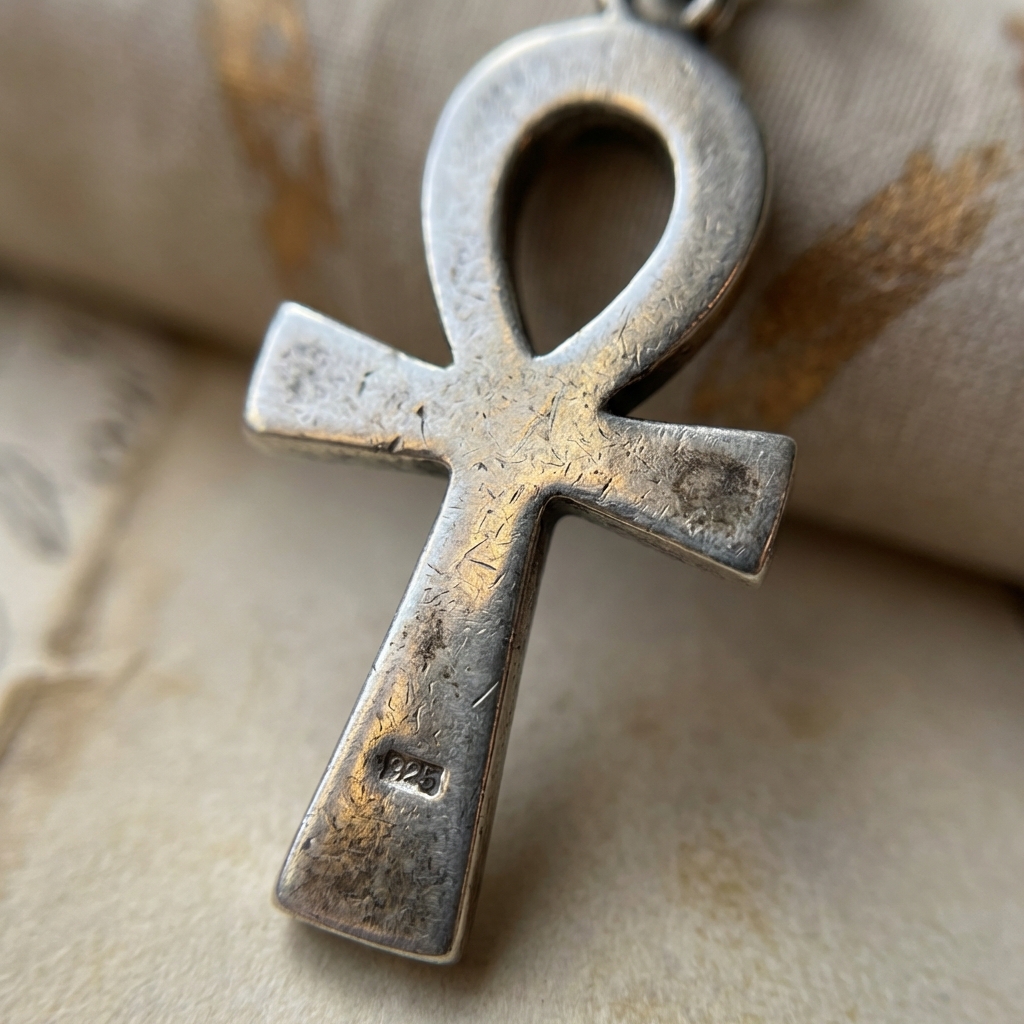
Hallmarking and millesimal fineness systems are the practical language used by assay offices and trade bodies to report silver content, and a readable mark such as 925, 999 or 999.9 is the primary evidence most sellers and buyers rely on when assessing a small object like an ankh Birmingham Assay Office hallmarking guidance.
A clear hallmark should be photographed in magnified detail in any listing, and a visible mark provides a straightforward starting point for provenance and condition notes; when a hallmark is absent or worn, buyers should expect more documentary support such as an independent assay or a laboratory report to substantiate a fineness claim FTC jewelry guides on precious metal content.
Legal and trade practices for marking silver purity
Different jurisdictions have legal rules and tolerances about how precious metal content is presented, and industry guidance treats reported fineness as a measured value with specific tolerances rather than a mathematical certainty; for commercial and consumer contexts assay offices typically recognise 0.999 or 0.9999 as top-level fineness marks rather than a 1.000 stamp Legislation, The Company of Goldsmiths of Dublin, Assay Office Dublin Castle.
For buyers evaluating a silver ankh, documentable hallmarks and provenance details should be treated as complementary evidence; in many cases the listing’s condition notes and any stated assay method are the most useful signals of reliability when a piece cannot be tested destructively.
Testing methods for silver ankhs and their practical limits
Non destructive screening: XRF
XRF is a widely used non destructive screening tool that reads the surface composition and provides quick fineness approximations, which makes it popular for initial checks on historic jewelry; however XRF is surface sensitive and can be affected by platings, surface cleaning or repairs, so it is best used as a screen rather than a definitive assay Hallmarking, The Assay Office Birmingham.
Because XRF measures the surface, buyers should be cautious when a listing reports only an XRF reading without notes on restoration or sampling, and they should ask whether the seller is aware of any plating, modern repairs or heavy polishing that could change surface readings GIA guidance on XRF testing limitations.
In practical and commercial terms a mathematically 100 percent elemental silver ankh is not a realistic expectation; assay practice and metallurgy treat fineness as a measured value with achievable thresholds such as 0.999 or 0.9999 and residual trace impurities at ppm to ppb levels are typically present.
Destructive and laboratory assays: ICP and fire assay
Laboratory methods such as ICP OES or ICP MS are more precise for bulk composition and have lower detection limits than XRF, and fire assay remains the classic destructive standard for high accuracy when sampling is permitted, but these tests require accredited labs and sometimes a small sample or invasive access to the object NIST XRF primer.
When a full assay is important to a buyer, request a report that names the test method and the laboratory accreditation, because reported fineness should include the test type, the lab that performed it and any stated limits of detection or uncertainty rather than relying on an unspecified '100 percent' claim GIA guidance on testing and lab practices.
What detection limits and error sources mean for reported fineness
All analytical methods have detection limits and matrix effects that influence how small trace elements are reported, and laboratories routinely note those limits on formal reports so the reader can see whether residual impurities were above or below measurable thresholds NIST XRF primer.
For practical buying decisions, understanding whether a fineness figure comes from a surface XRF screen or a bulk ICP assay matters more than the raw number, because the test type determines how confidently a reported value can be taken as representative of the whole object GIA guidance on XRF testing limitations.
Metallurgical reality: why a mathematically 100 percent silver ankh is impractical
Refining limits and trace impurities
Metallurgical literature shows that modern refining leaves trace impurities at parts per million and parts per billion levels in silver, so a chemically absolute 100 percent elemental silver sample is effectively unattainable in practice and commercial practice therefore uses fineness thresholds like 0.999 or 0.9999 as the high end Journal of Metallurgy review on purification limits.
This practical limit is why assay offices and industry guides use 999 or 999.9 as the meaningful top marks, because those ratings reflect achievable purity within measurement uncertainty rather than asserting an exact 1.000 value Legislation, The Company of Goldsmiths of Dublin, Assay Office Dublin Castle.
Empirical evidence from metallurgy literature
Experimental studies and reviews document residual trace elements after refining and show that at the margins of measurement 0.9999 and 1.000 can be effectively indistinguishable for many purposes, but published work still treats the residuals as present at very low concentrations rather than as an absence of impurities Journal of Metallurgy review on purification limits.
For collectors this means that asking for a reported fineness and the lab method gives a practical answer to purity, while expecting a literal 100 percent elemental statement is inconsistent with both refining science and hallmarking practice.
What to check when evaluating a silver ankh for purity and authenticity
Checklist for images, marks and documentation
Start with the basics: request clear, magnified photos of any hallmarks and a view of the whole ankh, plus condition notes that describe cleaning, repairs, or stabilisation work; a readable hallmark remains the simplest primary evidence for fineness in many historic pieces Birmingham Assay Office hallmarking guidance.
Second, ask whether the seller can provide an independent assay certificate or an XRF report and whether the report names the method and the laboratory accreditation, because a fineness figure without a test type or lab is much less informative GIA guidance on testing and lab practices.

If surface treatments or repairs are mentioned, ask for detail: what was stabilised, what was left, and whether any modern plating or inlay was applied, because surface alterations can make XRF readings unrepresentative of bulk metal content GIA guidance on XRF testing limitations.
When to request lab reports or further testing
Consider requesting a bulk assay only when the piece’s role requires it, for example when you need a certified bullion level fineness or when a major purchase hinges on exact purity; remember that ICP and fire assays can require sampling or specialist handling that sellers may reasonably resist for a historical object NIST XRF primer.
For most collectors the combined evidence of a readable hallmark, clear provenance or collection history, and transparent restoration notes will be the practical route to making a confident decision without destructive testing, though a lab report remains the strongest proof when permitted.
Decision framework: when purity matters and how to weigh evidence
Use cases where precise fineness is critical
Precise fineness matters most when a buyer intends to melt or assay the metal for bullion sale, or when exact corrosion behaviour or conservation treatment depends on minor alloying elements; in those cases ask explicitly for a laboratory assay report that names the method and limits of detection Hallmarking, The Assay Office Birmingham.
By contrast, if your goal is wearable history or adding a conversation piece to a collection, documented provenance, condition notes and stable conservation may be more important than an absolute fineness certificate, since destructive testing is usually inappropriate for historical objects.
When provenance and condition dominate the decision
When provenance and clear condition notes are present, buyers can often accept a high-quality XRF screen or a hallmark as sufficient evidence for typical collecting purposes; always confirm whether reported XRF readings were surface measurements and whether the seller disclosed any modern repairs Birmingham Assay Office hallmarking guidance.
If documentation is incomplete and the object is expensive enough to justify further expense, negotiate for an independent assay or an agreed testing protocol before completing the purchase, balancing the cost and the risk of sampling on a one of a kind historic piece.
Common mistakes and pitfalls when someone claims a pure silver ankh
Misreading surface tests and over valuing XRF screens
A common mistake is treating an XRF screen as a conclusive proof of bulk metal content without considering surface treatments; cleaning, plating or recent repairs can change surface composition and make a surface reading unrepresentative of the whole item GIA guidance on XRF testing limitations.
See hallmark closeups and condition notes on @auroraantiqua
Before you buy, consult the listing’s condition notes and ask the seller which test was used and which laboratory performed it so you can decide whether the evidence matches your collecting goals.
Another frequent pitfall is accepting an unqualified '100 percent' statement without paperwork; ask for a fineness stamp, an assay certificate, or a named lab method and accreditation rather than relying on a verbal claim.
Trusting verbal claims without documentation
When hallmarks are worn or incomplete, request magnified images and compare the mark to assay office examples, and if the seller cannot provide clear photographs or condition documentation treat the fineness claim with caution and consider whether provenance and other documentation compensate for the lack of lab evidence Birmingham Assay Office hallmarking guidance.
Where a precise fineness is critical, be ready to walk away or to agree a testing plan that the seller accepts, because buying an unverified 'pure' claim can lead to later disappointment when a formal assay shows trace alloying elements.
Practical examples: reading listings for a silver ankh
Example 1: a listed ankh with a clear 999 hallmark and condition notes
Scenario: a listing shows a clear 999 hallmark on the reverse, includes high resolution photos, and notes that the object received only conservation cleaning with no modern plating. Recommended step: accept the combined evidence as strong for collecting and wearable use, and request a named assay lab if you need confirmation for resale or melting.
Rationale: a readable fineness mark plus transparent condition notes allows a buyer to weigh authenticity and preservation concerns together rather than relying on a single numeric claim, and it matches assay office practice that treats 0.999 as a high fineness level.
Example 2: a listed ankh with an XRF result only and visible repair
Scenario: a listing quotes an XRF screen showing 99.9 percent silver on the surface but photos show a solder repair near the suspension loop. Recommended step: ask whether the XRF reading was taken near the repair, request a report naming the instrument and operator, and consider asking for a bulk assay if the purchase depends on exact fineness.
Rationale: surface repairs and soldered joins can alter XRF readings, and a single surface screen without lab accreditation or method details leaves open the question of whether the quoted fineness represents the whole object rather than a cleaned or repaired area GIA guidance on XRF testing limitations.
Summary and next steps for buyers of a pure silver ankh
Key takeaways
Absolute chemical 100 percent silver is not a practical commercial claim for historic objects, and assay offices and industry practice use fineness numbers such as 0.999 or 0.9999 as the high end; seek readable hallmarks, named assay methods, and transparent condition and restoration notes to make informed purchases Hallmarking in the UK: consumer protection, GOV.UK, British Hallmarking Council / GOV.UK.
For most collectors a combination of a clear hallmark, provenance or collection history, and detailed restoration notes will be the most useful evidence when destructive testing is inappropriate, while accredited lab reports are the proper route when precise fineness is essential.
A short buyer checklist to save or print
Checklist: 1) magnified photos of hallmarks, 2) clear condition and restoration notes, 3) named test method and lab accreditation if available, 4) ask about any plating or repairs that could affect surface readings, 5) negotiate testing only when justified by the purchase context Birmingham Assay Office hallmarking guidance.
Aurora Antiqua presents curated ancient rings and small artifacts with condition notes and provenance style documentation when available, and when listings include these elements they can help buyers understand what they are purchasing and why it matters.
A 999 mark denotes millesimal fineness, indicating the piece is described as 99.9 percent silver by the assayer; it is a practical commercial grade rather than a mathematical claim of absolute purity.
An XRF result is a useful non destructive screen but it is surface sensitive and can be affected by plating or repairs; ask for method details or an independent assay if precise bulk fineness is required.
Destructive assays provide high accuracy but are rarely appropriate for finished historical pieces; prioritize hallmarks, provenance and non destructive lab reports unless melting or exact bullion-level confirmation is essential.
More from Aurora Antiqua
References
- https://www.assayofficelondon.co.uk/hallmarking/what-is-a-hallmark#convention, Goldsmiths' Company Assay Office
- Legislation, The Company of Goldsmiths of Dublin, Assay Office Dublin Castle
- 16 CFR 23.5, Misrepresentation as to silver content, Federal Trade Commission, eCFR
- Hallmarking Guidance Notes: practical guidance in relation to the Hallmarking Act 1973, the UK Assay Offices
- Hallmarking, The Assay Office Birmingham
- Hallmarking in the UK: consumer protection, GOV.UK, British Hallmarking Council / GOV.UK
- Protecting silver cultural heritage objects with atomic layer deposited, Heritage Science (Springer Nature)
- Gesetz über den Feingehalt der Gold- und Silberwaren (FeinGehG, German law on gold and silver fineness), Bundesministerium der Justiz