


Looking for the real thing? Browse authentic Medieval & Crusader rings, each piece one of one, individually authenticated, with documented provenance. For the background, see the guide to ancient jewelry.
A short definition: what we mean by an ancient Christian ring
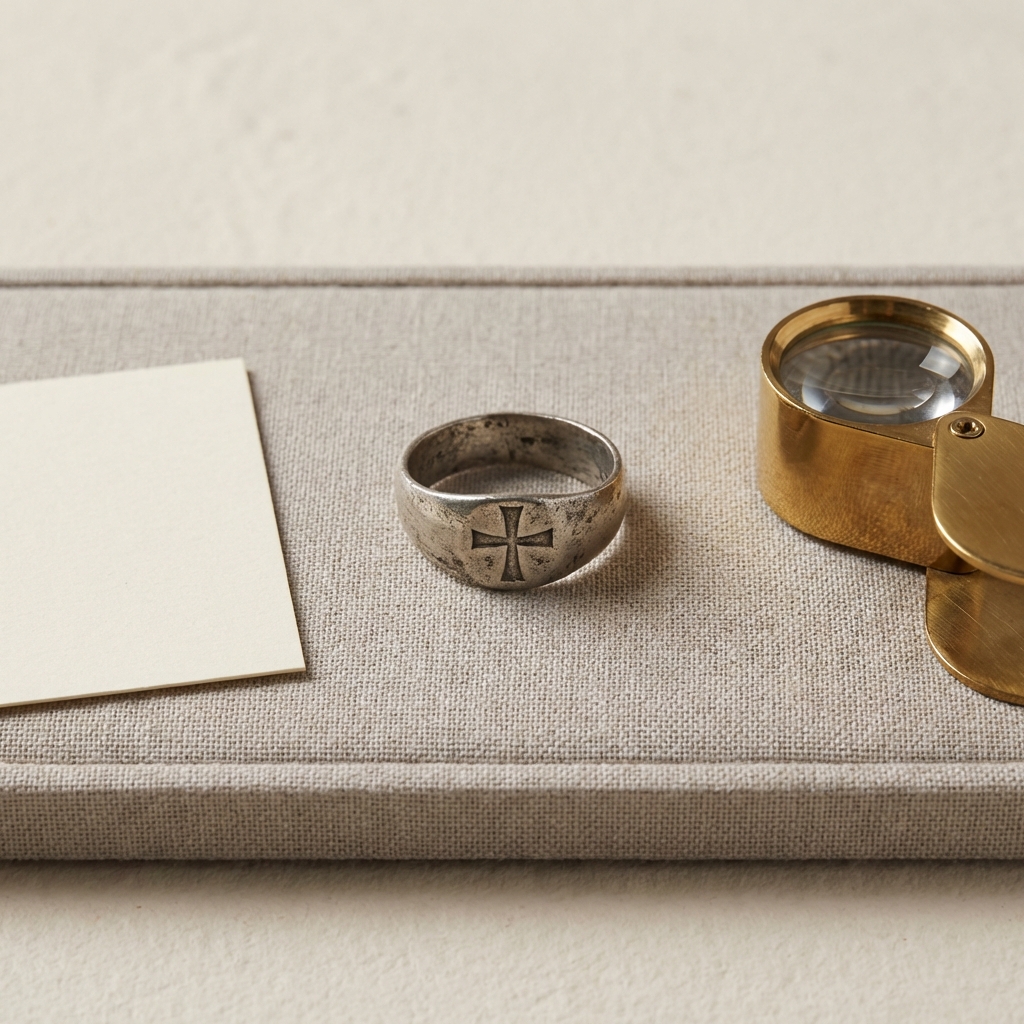
By "ancient christian ring" I mean a wearable metal band, often with an intaglio, bezel device, inscription, or iconographic motif that is dated to a historical period and presented with collection history or documentation that links it to Christian practice or imagery. Such objects are distinct from modern reproductions because they carry wear consistent with age, a patina, and ideally provenance or condition notes that explain restoration, previous ownership, or how the piece entered a collection. For collectors and for those considering devotional use, this definition keeps the focus on iconography and documented provenance rather than on whether a ring resembles a modern style.
Not every ring described as Christian will be clearly devotional. Some ancient rings carry ambiguous motifs, hybrid symbols, or later additions, and dating or material identification is often an estimate unless specific testing or documentation exists. Readers should therefore approach attributions cautiously and use the available documentation to decide whether an object is best treated as a devotional item or as wearable history for the cabinet of curiosities, as discussed in more detail below. This approach follows the object-first framing scholars use when describing early dress and ornamentation in archaeological and historical surveys Oxford Research Encyclopedia of Religion overview on adornment.
See behind the scenes at @auroraantiqua
The editorial team at Aurora Antiqua offers further guides on reading provenance and condition notes; if you plan to consider an ancient ring for wear, read the three part framework below before deciding.
What counts as an ancient Christian ring
An object counts as an ancient Christian ring when its imagery, inscription, or recorded provenance reasonably connects it to Christian practice or visual language from a historical period. That connection can include explicit Christian symbols like crosses, chi rho monograms, or saints' names, or more ambiguous iconography that appears alongside known Christian motifs in dated contexts. In practice, cataloguing decisions combine material study with collection history and comparative typologies to reach a working attribution.
How collectors and churches might treat such rings
Collectors may treat an ancient ring primarily as an artifact that communicates cultural and historical information, emphasizing provenance, condition notes, and restoration history before recommending wear. Churches, by contrast, often assess the symbol's clarity and its communicative effect within worship and witness. The same object can therefore be framed as wearable history in a private collection or as devotional jewelry in a liturgical setting depending on context and communal expectations.

What the Bible says about rings and adornment
Scripture includes both descriptive passages that treat rings as social objects and prescriptive passages that caution about outward adornment. Narrative examples include references to signet rings used as marks of authority in the Hebrew Bible and intertestamental practices that reuse ring imagery in social contexts. These narratives show that rings have long been cultural signs of office and identity in biblical literature.
When people ask whether the biblical witness allows ring wearing, a helpful posture is to hold the descriptive and prescriptive texts in conversation and then apply them within one’s own community norms. Scripture does not offer a single rule about every cultural practice, so church context and personal conscience play important roles when applying these texts to an ancient object.
Early church voices: patristic attitudes toward jewelry and modesty
Patristic writers express a range of concerns about dress and adornment, and some, like Tertullian, critique ostentation in strong terms. Tertullian’s writings on female apparel and jewelry illustrate an early ethical worry that outward display can distract from spiritual life and communal witness; historians use such texts to understand debates about modesty and status in early Christian communities Tertullian, On the Apparel of Women translation.
It can be acceptable in many contexts, but the decision should be made by weighing scripture, tradition, and local pastoral guidance, and by inspecting the ring’s provenance and condition before choosing to wear it publicly.
Despite these critiques, the early church did not speak with a single voice about jewelry, and archaeological evidence shows diversity in practice across regions and communities. Scholars therefore read patristic admonitions alongside material culture to reconstruct what people actually wore and how they used ornamentation in daily and ritual life Adornment and Dress in Early Christianity overview.
For modern readers this means that patristic caution is historically significant but not automatically determinative. Tertullian and similar voices raise prudential concerns worth considering, especially about ostentation, but they must be balanced with the full spectrum of early practice and with attention to how communities today understand modesty and witness.
How liturgical traditions treat rings today: Catholic and Orthodox practice
Major liturgical traditions historically accept rings as meaningful liturgical or devotional objects. In Catholic practice, for example, wedding rings have an established ritual role and episcopal rings serve as symbols of office and pastoral responsibility; liturgical texts and commentary outline these uses and the pastoral framing that accompanies them Gimmel Ring, Victoria and Albert Museum, London.
Eastern Orthodox practice similarly permits devotional jewelry, including crosses and rings, and interprets such items within a spiritual framework that emphasizes proper use and the ascetic formation of the wearer. Pastoral resources in that tradition explain why devotional jewelry can form part of personal piety without replacing communal worship or disciplined spiritual life Orthodox Church in America article on devotional jewelry.
Both traditions include pastoral caveats: ritual acceptance of rings does not remove the need for conscience and context, and clergy frequently advise caution where symbols might cause misunderstanding or become occasions for display rather than devotion.
How some modern denominations treat jewelry and modesty
In contemporary practice there is significant denominational variation. Some communities, especially those with Anabaptist roots or those that emphasize plainness, recommend simplicity and may discourage conspicuous jewelry as a matter of witness and communal discipline. Similar guidance appears in other groups that read New Testament admonitions about adornment as an ongoing ethical standard. See a related discussion at Adventist Biblical Research.
Other communities treat rings as culturally neutral or see them as permissible when they serve devotional or relational functions, such as wedding bands. Because denominational teaching varies, individuals often rely on local pastoral counsel to translate broad principles into daily practice.
short checklist to assess community fit and object readiness
Use as a quick conversation aid with your pastor
Some groups explicitly advise caution or discourage jewelry on grounds of modesty and witness; for example, Jehovah’s Witnesses have published guidance that urges members to weigh the impact of jewelry on their public witness and to prefer simplicity in personal adornment Jehovah’s Witnesses guidance on jewelry.
Because denominational positions range from permissive to restrictive, the safest practical step for a person considering an ancient ring is to inquire of local leaders and to be willing to adapt one’s practice in the interest of communal harmony and clarity of witness.
A practical three part framework for deciding whether to wear an ancient Christian ring
Deciding whether to wear an ancient Christian ring can be simplified into three connected steps. Step 1 asks the individual to reflect on theological and personal conviction. Are you comfortable with the ring’s symbolism? Would wearing it amplify or obscure your intended witness? Reflection at this level need not be private; journaling the reasons you value the object can clarify whether your interest is devotional, aesthetic, or primarily historical.
Step 2 recommends seeking community and pastoral guidance. Because scripture offers both descriptive examples and prescriptive cautions, congregational norms and pastoral counsel often determine how principles are applied locally. Bringing clear provenance and condition notes to that conversation helps leaders see whether wear is primarily devotional or chiefly collectible in intent Bible Gateway passage for 1 Peter 3:3-4.
Step 3 is an object level assessment. Check the ring’s iconography, inscriptions, materials, restoration notes, and provenance. Look for clear Christian motifs versus ambiguous symbols, documentation of collection history, and transparent restoration reports that note what was stabilized or repaired. These checks help separate devotional candidates from objects better suited to display or occasional wear.
Putting the three steps together produces a repeatable decision method: reflect, consult, and inspect. This framework aims to respect both conscience and community, while taking seriously the material realities of aged metal, fragile settings, and ethical collecting practices.
How to assess iconography, materials, and provenance of an ancient Christian ring
Reading symbols and motifs carefully is the first practical skill. Common motifs on ancient rings include simple crosses, chi rho forms, abbreviated inscriptions, and saints' names, while intaglio scenes can range from explicitly biblical episodes to generalized devotional images. Interpreting a motif often relies on comparative typology and the context provided by the seller or catalogue.
Provenance and documentation notes change how a ring is treated. A ring with clear collection history and a verification letter is more easily framed as a documented artifact and less likely to be taken as a devotional heirloom in communal worship. Aurora Antiqua describes provenance and condition notes in listings to help buyers make that distinction; when available, such documentation should be part of the conversation before deciding to wear a piece

Restoration notes typically explain what was stabilized, what was repaired, and what was intentionally left untouched. Those notes are crucial for conservation: fragile bezels, thin hoops, or loose intaglios may make frequent wear inadvisable, and transparent restoration descriptions allow owners and conservators to decide whether occasional wear or museum-style display is the responsible choice.
Common mistakes and stumbling blocks readers make
A frequent mistake is confusing provenance with devotional value. An object that is demonstrably ancient does not automatically function as an devotional heirloom; its cultural context and the original use may differ from modern devotional practices. Treating a ring as liturgical simply because it is old risks projecting contemporary intentions onto past objects.
Another stumbling block is assuming scriptural silence equals permission. Because scripture presents both descriptive uses of rings and cautions about outward adornment, drawing broad applications requires care and attention to community norms. When provenance is unclear or when iconography is ambiguous, erring toward preservation and transparent labeling is prudent.
Finally, ethical concerns arise when provenance is missing or when objects may be modern forgeries presented as ancient. Asking for condition notes, restoration records, and collection history reduces the likelihood of unintentionally supporting questionable practices in the antiquities trade. For discussion, see The Use of Jewelry: Biblical and Ellen White's Views.
How to raise the topic with your pastor or church community
When you decide to discuss an ancient ring with a pastor or small group, prepare a short explanation of what the piece is, why you value it, and what you hope wearing it would communicate. Present provenance and condition notes up front and invite questions about symbolism, public witness, and liturgical appropriateness.
Suggested questions to ask a leader include: Does this symbol align with our communal testimony? Would wearing this in worship create confusion or distraction? Would the church prefer the object be displayed with a label instead of worn publicly? Bringing documentation and a posture of listening helps leaders give concrete guidance rooted in local priorities Vatican liturgical guidance on pastoral considerations for rings.
Be prepared to accept communal decisions and to adapt your practice out of deference to unity and pastoral counsel. This posture protects both your relationship to the community and the historical object itself.
Prioritize preservation over constant wear. Basic handling tips include keeping the ring dry, avoiding exposure to aggressive chemicals, and storing it in a padded box to prevent abrasion. For fragile or stabilized rings, prefer occasional wear rather than daily use, and follow any restoration notes that recommend limiting mechanical stress.

When condition or restoration history suggests fragility, choose display or occasional wear. Display with clear labeling communicates the historical value and reduces the risk of damage, while replicas may offer a way to express devotional intent without putting the original at risk. Consulting a conservator for fragile items is advisable if you plan to wear or exhibit the ring frequently.
Three short case studies: applying the framework in real scenarios
Case 1: A simple band bearing a small cross motif is offered with clear provenance and modest restoration notes. The owner values it as a symbol of family faith and plans occasional wear. Key checks include confirming the provenance, asking the pastor about wearing it in worship, and noting the restoration history. With those steps completed, occasional devotional wear may be appropriate.
Case 2: A signet style ring shows ambiguous symbols that may be Christian or secular and lacks firm collection history. Because the iconography is unclear, the recommended path is to treat it as a collectible: avoid public devotional use, document the item carefully, and seek more information before deciding to wear it in church settings Oxford Research Encyclopedia overview on dress and adornment.
Case 3: A high status ring with clear provenance and an inscription naming a saint arrives with verification letters and conservative restoration notes. Even with strong documentation, the owner should reflect on community norms and consult pastoral counsel because wearing a visibly ornate historical ring may raise questions about ostentation in certain congregational contexts.
When it may be inappropriate to wear an ancient Christian ring
There are contexts where wearing an ancient Christian ring can be problematic. Situations include settings where plainness is a communal norm, locations where the symbolism could be misunderstood, or liturgical contexts that restrict personal adornment. In such cases, the conservative option is to display the object with explanatory notes or to wear a clearly modern replica if you wish to carry the motif in public.
Alternatives to public wear include curated display, occasional private devotion, or using a replica labeled as such. When in doubt, defer to local leaders who understand the pastoral sensitivity of adornment in your particular community.
Conclusion: balancing conviction, context, and curation
Wearing an ancient Christian ring is not a question with a single universal answer. The best practice in 2026 is to balance personal conviction, local church guidance, and careful curation of the object itself. Weigh scripture, patristic cautions, and liturgical practices together and let those considerations guide how you present the ring in public.
Before deciding to wear an ancient ring publicly, use a concise checklist: reflect on your reasons, consult your community, and review provenance and restoration notes. When in doubt, prioritize preservation and transparent documentation so the object can be both respected and understood in its historical context.
Possibly, but it depends on the ring’s iconography, clear provenance, and your community’s norms; consult leaders and review condition and restoration notes before wearing it devotionally.
Request provenance and condition notes, any verification letters, and clear photographs of the motif and any inscriptions; ask whether restoration was performed and what was stabilized.
Yes, replicas reduce risk to fragile originals and can communicate the same motif without endangering the historical object or complicating ethical concerns.
More from Aurora Antiqua
References
- William Wytlesey's ring, Victoria and Albert Museum, London
- Gimmel Ring, Victoria and Albert Museum, London
- Internet History Sourcebooks: Medieval Sourcebook, Internet Medieval Sourcebook, Fordham University, New York
- Pectoral Cross, Cleveland Museum of Art
- Ring, Victoria and Albert Museum, London
- Pliny the Elder, The Natural History, BOOK XXXIII, Perseus Digital Library, Tufts University (edition Bostock)
- Aulus Gellius, Attic Nights, Book X, LacusCurtius, Bill Thayer, University of Chicago (Loeb Classical Library edition)