


Looking for the real thing? Browse authenticated ancient rings, each piece one of one, individually authenticated, with documented provenance. For the background, see the guide to ancient jewelry.
What a gold ouroboros is and why the question matters
The term gold ouroboros names two linked things at once: a motif, the serpent biting its tail, and an object made in gold that carries that motif, typically a ring, pendant or small wearable. A simple, practical definition helps: a gold ouroboros is an artefact in which a continuous snake motif is rendered in gold, whether as a full hoop ring, a bezel detail, or a decorative band; the material and object type shape how the motif was intended and used. Scholarship treats the motif as mobile across cultures and media, so asking whether the ouroboros is "evil" treats a complex symbol as if it carried a single moral label, which is often misleading; readers should start by noting function, dating and documented provenance rather than assuming a moral valence, as museum writing and reference works advise Encyclopaedia Britannica entry on Uroboros.
For collectors the difference between a decorative gold snake ring and a gold amulet ring can be decisive: material and manufacture, iconographic detail and the presence or absence of condition and restoration notes all change how we read the piece. A gold ouroboros on a ring, for example, may be an expression of continuity or rebirth, a fashionable motif, or an amuletic sign whose meaning depends on the wearer and time. Good provenance and clear condition notes are the practical starting points for interpretation; without them, moral conclusions are speculative.
a concise provenance checklist for auric serpent rings
Use as a conversation sheet with sellers
Origins: Egyptian funerary and cosmological roots of the ouroboros
The earliest sustained appearances of the ouroboros motif are attested in ancient Egyptian funerary and cosmological material, where the serpent often represents cyclical time, regeneration and the ordered repetition of cosmic events. Egyptological and reference works identify these funerary contexts as foundational for the motif, and treating the symbol as originating in Egyptian visual culture gives a clearer frame for later receptions E. A. Wallis Budge, Symbols of Eternity.
Importantly, Egyptian deployments of the snake motive tend to emphasise cycles and renewal rather than moral judgement. In those contexts the image aligned with ideas about rebirth, the solar cycle and the ordering of time, so reading an ancient Egyptian ouroboros as simply evil imposes later moral frameworks on material that does not support that reading. When a collector encounters a gold ouroboros said to be Egyptian in origin, confirm dating and provenance documentation before adopting any interpretive claim.
Greek, Hellenistic and Late Antique receptions: mobility of the motif
As the motif travelled into Greek and Hellenistic contexts it was adopted and transformed into decorative, philosophical and occasional amuletic registers. In the Hellenistic world the ouroboros appears on small objects and in intellectual texts with meanings that broaden away from strictly funerary uses; this cultural mobility is well attested in collection and curatorial literature British Museum curatorial essay on serpent motifs.
The same visual device could be read differently depending on object type. On an intaglio or ring bezel the ouroboros might sit beside other iconography that signals a protective or personal meaning; on a decorative band it may mark aesthetic fashion aligned with particular workshops. For buyers, distinguishing a Hellenistic decorative ring from an amulet requires attention to accompanying documentation and to iconographic detail rather than a quick moral judgement.
Watch provenance and restorations on @auroraantiqua
If you want to compare documented examples and condition notes for rings with serpent motifs, viewing curated ancient rings with clear provenance can help show how context changes interpretation.
Alchemy, Jung and the modern symbolic lineage
From the medieval and early modern periods into the history of alchemy, the ouroboros was reframed as an emblem of unity, the reconciliation of opposites and the process of transmutation. This alchemical strand treats the serpent as a concise emblem for philosophical operations rather than a straightforward moral figure, and it has been influential in modern symbolic readings scholarship on ouroboros and alchemical symbolism.
C. G. Jung later popularised a psychological reading that cast the ouroboros as an archetype of self-renewal and the merging of opposites, a move that brought the motif into twentieth century discussions of psyche and symbolism and helped shape contemporary popular interpretations Princeton University Press edition of Psychology and Alchemy.
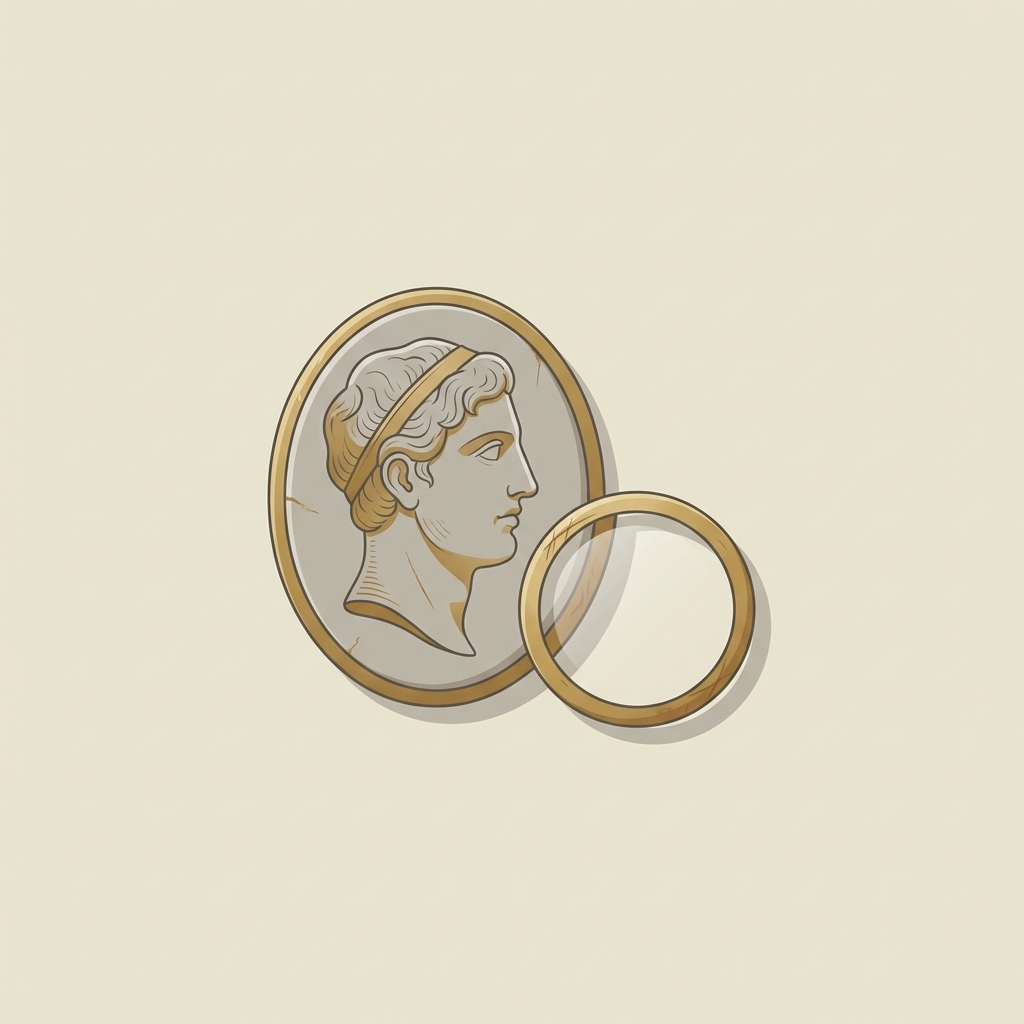
When modern readers encounter a gold ouroboros ring today, these later layers of meaning often inform popular impressions. That influence is real and important for reception history, but collectors should recognise that alchemical or Jungian readings are interpretive overlays that differ from the symbol's earliest funerary and decorative usages.
How museums and scholars interpret the motif today and why context matters
Curators and scholars approach the ouroboros by prioritising context: function, dating, provenance and condition notes guide interpretation more than a single symbolic dictionary entry. Museum cataloguing practice emphasises these elements because the same motif may serve as amulet, decorative motif or philosophical emblem in different settings; curators stress this contextual method to avoid projecting modern moral categories onto objects Encyclopaedia Britannica entry on Uroboros.
For collectors this means checking documented provenance, examining condition and restoration notes, and reading the object alongside comparable examples in museum collections. Provenance and collection history often clarify whether a gold ouroboros ring was made for personal protection, decorative display or as a workshop novelty, and modern scholarship warns against assuming a uniform moral valence without evidence Journal of Popular Symbolism article on contemporary meanings.

How to assess a gold ouroboros ring: a practical checklist for buyers and collectors
Start with the images and measurements: request clear photographs of the ring from multiple angles, including close views of the bezel, shoulders and any hallmarks. Look for wear consistent with age in areas that would show handling, and ask for close-ups of the motif to determine whether the ouroboros is integral to the original fabrication or a later addition. Photographic and measurement clarity is a basic but decisive element in assessing an object.
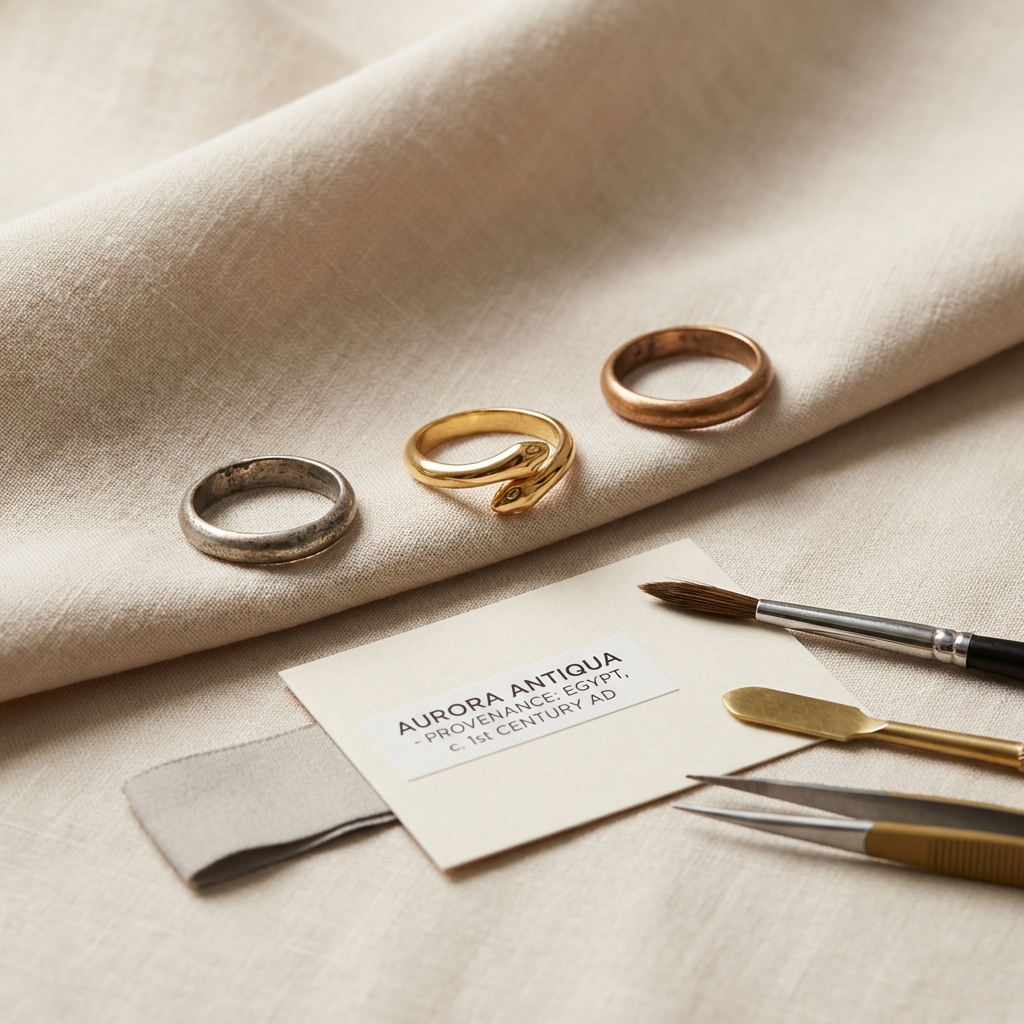
Next, request documentation that clarifies dating and ownership history: catalogue entries, previous collection records, export paperwork where applicable, and any third party reports. Provenance and condition notes are central to reading a gold ouroboros; they allow collectors to see whether the ring was historically described as amuletic or decorative, or whether such readings are recent interpretations without support. When available, restoration notes should explain what was stabilised or repaired and whether features were added in later periods Journal of Popular Symbolism article on contemporary meanings.
Finally, examine iconographic cues that suggest amuletic use: the presence of other protective symbols, inscriptions invoking protection or names, or pairing with funerary paraphernalia in documented find contexts. In the absence of such supporting cues treat interpretive claims about moral valence as provisional. Restoration notes and reports from conservators can indicate whether the ouroboros motif is original or the result of later alterations, which changes how we read the ring.
Common misreadings and pitfalls: mistakes collectors make
One common error is projecting modern moral frameworks onto a symbol without supporting evidence. The ouroboros has been used across cultures with varying senses, and assuming it means "evil" ignores how the motif functions in different periods and regions; curatorial practice advises caution and reliance on documented context before making moral claims British Museum curatorial essay on serpent motifs.
Another frequent pitfall is over-interpreting minor features or later repairs as original iconography. Repairs, substitutions and later additions can mislead buyers into reading a ring as more ancient or more symbolically charged than it is; ask for explicit restoration notes and, where possible, conservator reports. Finally, ignoring provenance and condition notes in favour of an attractive narrative can lead to misattribution and disappointment.
Short case studies and hypothetical readings of gold ouroboros rings
Example A, funerary-rooted reading: imagine a ring with a clear findspot in a funerary assemblage, documentation linking it to burial goods, and iconography showing solar or rebirth motifs alongside the serpent. In this scenario the ouroboros is plausibly related to ideas of cyclical renewal, and that reading rests on provenance and contextual information rather than a default moral label E. A. Wallis Budge, Symbols of Eternity.
Example B, Hellenistic decorative ring: a ring with stylistic features common to Hellenistic workshops, found in a domestic context or without clear amuletic markers, may use the ouroboros as an aesthetic or philosophical ornament. Here the motif functions within a decorative vocabulary and the absence of protective inscriptions or funerary association weakens claims that it was intended as a moral or apotropaic device Encyclopaedia Britannica entry on Uroboros.
Example C, modern maker using an ancient motif: contemporary makers often reference ancient motifs for aesthetic reasons, and a modern gold ouroboros ring may deliberately evoke ancient symbolism without the same historical meaning. In such cases clear seller descriptions and provenance are essential; the object can be appreciated as wearable history while being understood as recent in manufacture.
Conclusion: a balanced answer to 'Is the ouroboros evil?', and next steps for collectors
The short, balanced answer is that the ouroboros is not inherently evil. Across its long history the motif has been polyvalent, carrying meanings of cyclical renewal, unity, protection, philosophical unity of opposites, or simple decoration depending on time, place and object function, so moral readings must be tethered to context rather than assumed Encyclopaedia Britannica entry on Uroboros.
Ask yourself what documentation would change your view of a ring's moral valence and whether the seller can supply those documents.
No. The ouroboros is historically polyvalent and its moral valence depends on context, function and documentation rather than the motif itself.
Practical next steps are straightforward: request detailed photographs and measurements, insist on provenance and condition notes, and when possible consult a curator or conservator for a second opinion. For collectors interested in curated ancient rings, Aurora Antiqua presents pieces with condition and provenance notes to help buyers evaluate meaning and function without relying on simplistic moral labels.
Yes. A gold ouroboros ring can function as an amulet in some contexts, but whether it was amuletic depends on provenance, inscriptions, associated finds and documented function rather than the motif alone.
Check detailed photographs, measurements, hallmarks, documented provenance and restoration notes; consult conservator reports or specialist catalogues when available to assess dating.
Jungian readings frame the ouroboros as an archetype of renewal and unity, which is an interpretive layer rather than a universal moral judgement applicable to all historical examples.
More from Aurora Antiqua
References
- Hallmarking Guidance Notes: practical guidance in relation to the Hallmarking Act 1973, the UK Assay Offices
- https://www.assayofficelondon.co.uk/hallmarking/what-is-a-hallmark#convention, Goldsmiths' Company Assay Office
- Hallmarking Act 1973, The National Archives / legislation.gov.uk, UK
- 16 CFR 23.3, Misrepresentation as to gold content, Federal Trade Commission, eCFR
- About us, International Association of Dealers in Ancient Art
- Gage's Instructions by Henry De Berniere and Thomas Gage, Project Gutenberg
- Ancient Gems and Finger Rings: Catalogue of the Collections, The Getty