


Looking for the real thing? Browse authenticated ancient rings, each piece one of one, individually authenticated, with documented provenance. For the background, see the guide to ancient jewelry.
What is the gold ouroboros: definition and historical context
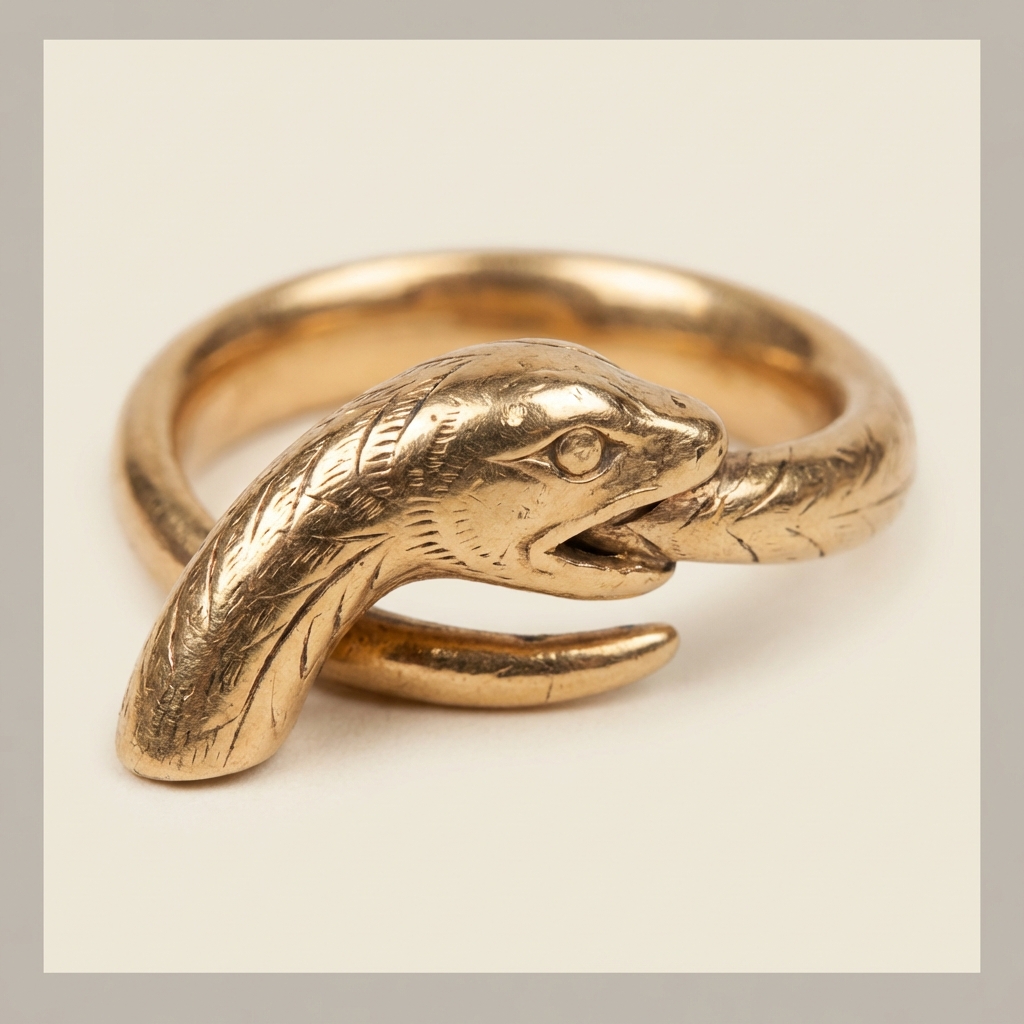
The phrase gold ouroboros names a specific visual motif: a serpent formed into a ring, commonly depicted biting its own tail to make a closed loop. In ancient material culture this image appears as a wearable form of the wider ouroboros idea, and when crafted into a ring it often functions as both ornament and symbolic device. For a concise academic overview of the ouroboros motif and its classical roots, see Encyclopaedia Britannica.
In archaeological and museum catalogues the ouroboros appears alongside other snake jewellery types, and curators describe a range of ring forms from coiled bands with stylised heads to fully modeled serpents whose tails meet in an encircling loop; these are part of the broader category of ancient ring typologies. For museum context on how snake jewellery is documented and interpreted, the Victoria and Albert Museum provides useful descriptions of forms and display examples.
Quick provenance and condition checklist for initial assessment
Use as a starting research tool
Visually, many ancient ouroboros rings share a handful of common features: a continuous hoop that reads as a serpent, a defined head and tail juncture, and sometimes scale or eye detailing on the shoulders or bezel area. Some rings are worked as narrow bands with an incised motif, others as three-dimensional models with articulated heads, and a small number include inset gemstones or intaglios. Museum records emphasise form variation when assigning likely dates or cultural attributions.
The earliest archaeological and textual references link the ouroboros image to Egyptian and Hellenistic contexts, with later adoption into Greco-Roman material culture and, by late antiquity, into alchemical and philosophical literature. This layered presence across periods means a single gold ouroboros ring can have several legitimate contextual readings depending on when and where it was made and used.
How different cultures read the gold ouroboros and snake ring meaning
Across Egypt and the wider ancient Near East, serpents often appear in roles connected to protection, regeneration and royal ideology; in wearable forms such as rings and bracelets they could function as amulets as well as status objects. For a general treatment of snakes in Egyptian collections and their interpretive notes, the British Museum collection essays are a practical reference.
In Greek and Roman contexts snake rings commonly served dual purposes: decorative jewellery indicating taste or status, and protective amuletic pieces worn against illness or harm. The Metropolitan Museum outlines the functional diversity of rings in the ancient Mediterranean and how form and function overlap in object histories.
A gold snake ring can symbolize protection, continuity, rebirth or transformation depending on cultural context, period and material; gold tends to add associations of status and, in alchemical readings, perfected matter, but confident interpretation depends on provenance, condition notes and technical analysis.
By late antiquity and in alchemical writings the ouroboros takes on more explicitly metaphysical meanings: cyclical processes, unity of opposites, and the idea of self-containment that underpins certain transformation theories. For readers wanting a philosophical synthesis of these later meanings the Stanford Encyclopedia of Philosophy gives a concise account of alchemy and related symbolic language.
It is important to stress that the same ouroboros design can mean very different things in different places and times. A coiled snake ring found in a funerary assemblage in Egypt is likely read differently from an ornate gold band worn by an urban Roman elite or a schematic ouroboros motif referenced in a late-antique manuscript. Contextual evidence therefore remains decisive for interpretation.
Why gold changes the reading of an ouroboros ring
Material matters. Gold in antiquity often signalled wealth, social rank and, in some contexts, associations with deities or funerary display. A gold ouroboros can therefore carry a social meaning that differs from the same motif in bronze or silver: it more readily suggests elite ownership and deliberate display rather than purely folk-apotropaic use. The Metropolitan Museum discussion of rings and their social roles helps frame how material choices shape likely function.
Gold also participates in symbolic vocabularies beyond social signalling. In alchemical traditions gold stands for perfected matter and completion, so when the ouroboros motif and gold coincide readers can reasonably place emphasis on themes of transformation and perfected cycles rather than solely on protection. For a modern philosophical and historical account of alchemical symbolism consult the Stanford Encyclopedia of Philosophy.
That said, the presence of gold does not automatically mean ritual or divine use; without provenance, technical analysis and condition notes it is hard to be categorical. Contemporary museum writing advises prioritising documentation and testing over visual assumption when attributing ritual or elite functions to a gold piece, a cautious stance echoed by professional curators.
How to assess a gold snake ring for dating, provenance, and meaning
Start with provenance and collection history. Provenance records, past collection references and sale or catalogue entries provide the primary anchor for dating and attribution, and museum guidelines recommend treating clear chain-of-custody and previous accession information as weighty evidence when available. The Victoria and Albert Museum emphasises documentation and collection notes in interpretive entries for jewellery.
Next examine condition notes and restoration records. Condition reports indicate whether an object preserves original joins, surface treatment and patina or whether it has been repaired and refitted. Restoration notes can reveal modern interventions that affect visual readings, so give equal attention to what was stabilised or replaced as to what remains original when assessing symbolism or chronological placement.
Technical analysis makes the assessment more robust. Metallurgical testing, such as alloy composition analysis, can suggest period-consistent recipes or later alterations; gemstone identification can place an intaglio or cabochon within likely trade and workshop networks. The Met and other institutional publications describe how combining typology with technical study strengthens dating and workshop attributions for rings.
Practical checklist for buyers and researchers:
- Request documented provenance and any collection history or catalogue citations.
- Ask for detailed condition notes and explicit restoration records.
- Seek metallurgical reports or testing proposals if the item is presented as ancient and significant.
- Confirm gemstone identification where applicable and ask whether gem settings are original.
- Where possible, obtain high-resolution images of joins, hallmarks and wear patterns.
Following this sequence reduces the risk of overinterpreting a motif and helps place a gold snake ring within a defensible historical context rather than a purely modern projection of meaning.
Typical mistakes and pitfalls when interpreting or buying a gold ouroboros
A common error is overreading symbolism without adequate context. Modern narratives around eternity or personal transformation are attractive, but projecting such meanings onto an ancient object without provenance or period-specific evidence can mislead collectors and scholars alike. Museum guidance repeatedly stresses that motif alone is rarely sufficient for confident interpretations.
Ignoring condition and restoration impacts is another frequent pitfall. Patina, solder lines and later fills can change how a ring reads visually; what appears to be an original join or engraving might be a later repair. Restoration notes are therefore essential to separate original intent from later interventions.
Finally, accepting unverifiable provenance claims puts buyers at risk. Statements without collection history, catalogue citations or third-party reports should be treated with caution. Where documentation is absent or vague, independent technical testing and external expert opinions are practical next steps before committing to purchase or drawing symbolic conclusions.
Practical examples and scenarios: reading specific gold snake ring types
Case scenario: Roman gold ring with intaglio
Imagine a gold band set with a carnelian intaglio showing a deity or portrait. In many Roman examples, such combinations suggest personal identity, status and a function as a signet or display ring rather than a pure amulet. The Met's essay on ancient rings outlines how intaglios and settings contribute to likely use and dating in Roman contexts.
In such a scenario, the carnelian and iconography may be as decisive as the snake motif. If the intaglio is a classical deity and the workmanship matches Roman goldsmithing conventions, the reading shifts toward social and administrative functions. Conversely, if the band carries worn apotropaic marks and the intaglio was added later, the interpretation changes. Detailed condition notes and a metallurgical report would clarify whether the intaglio and band are contemporary to one another.

Case scenario: Hellenistic ouroboros band without gemstones
A plain gold band formed as an ouroboros, lacking gemstone settings or elaborate intaglio, invites a different set of questions. Without associated iconography the emphasis moves onto form, alloy and wear. Hellenistic bands can be stylistically simple yet carry local meanings tied to continuity or household protection; museum catalogues often use close stylistic comparison to date such plain bands.
Here, technical tests such as alloy composition analysis, microscopic study of tool marks and comparison with securely dated parallels are the most decisive forms of evidence. If tests show a composition consistent with Hellenistic workshop practice and the style matches dated parallels in institutional collections, an interpretive case for that period strengthens. Without such evidence alchemical or modern metaphoric readings remain possible but less secure.
How documentation or tests would change interpretation
Consider two versions of the same-looking ring: one accompanied by a continuous collection history and a recent metallurgical report, the other presented with no documentation. The first allows a measured interpretation that can link motif, material and likely use; the second forces a cautious approach and often a deferment of symbolic claims until testing is done. Contemporary museum advice is clear that documentation and technical data materially change both scholarly and market confidence about meaning and date.
Conclusion: responsible interpretations and next steps for collectors
The ouroboros motif carries layered meanings across eternity, rebirth, protection and transformation, but the exact balance among these depends on cultural context, period and material. A gold ouroboros therefore invites readings that combine motif and material: the serpent loop suggests cyclicality while gold contributes social and symbolic weight.
@auroraantiqua for behind-the-scenes provenance and condition details
If you are considering a purchase or want a second opinion on documentation and condition notes, review available provenance and ask the seller or curator for a detailed condition and testing record.
Practical next steps before purchase or display include checking for provenance and collection history, requesting explicit restoration notes, and seeking or commissioning metallurgical and gemstone analysis where the age or workshop attribution is central to your decision. Treat modern symbolic narratives as an added layer but not a substitute for technical and documentary evidence.
Aurora Antiqua presents curated ancient rings with condition notes and provenance-style documentation when available to help buyers weigh these factors. Use those materials as part of a research workflow that prioritises evidence over appearance and situates any interpretation within the known archaeology and catalogue comparisons.
A gold ouroboros combines the closed-loop serpent motif with gold's social and symbolic connotations, which can point to higher-status ownership or alchemical readings; exact meaning depends on context and supporting evidence.
Request provenance or collection history, detailed condition and restoration notes, and any available technical reports such as metallurgical analysis or gemstone identification before forming firm interpretations.
No, avoid assuming magical properties; while serpent imagery served protective roles historically, claims about powers should be based on provenance, context and credible historical evidence.
More from Aurora Antiqua
References
- Catalogue of the Engraved Gems and Finger-Rings in the Ashmolean Museum, II: Roman, BAR Publishing, via Fulcrum
- Talismans, Visitatori salutem, Szepmuveszeti Muzeum, Museum of Fine Arts Budapest
- Philip Kiernan and Klaus-Peter Henz, Rings from the Forbidden Forest, Cambridge University Press
- Amulette contre le mauvais oeil, Persée, Echos d'Orient, later Revue des etudes byzantines
- Pliny the Elder, The Natural History, BOOK XXXIII, Perseus Digital Library, Tufts University (edition Bostock)
- 16 CFR 23.3, Misrepresentation as to gold content, Federal Trade Commission, eCFR
- https://www.assayofficelondon.co.uk/hallmarking/what-is-a-hallmark#convention, Goldsmiths' Company Assay Office