


Looking for the real thing? Browse our full ring collection, each piece one of one, individually authenticated, with documented provenance. For the background, see the guide to ancient jewelry.
Quick answer: what an ouroboros snake ring can mean for a woman
An ouroboros snake ring commonly signals cyclical renewal, continuity or protection, and may also be read as an emblem of eternity or self-renewal depending on context; this pattern has deep roots in ancient sources and modern summaries of the motif Encyclopaedia Britannica.
In many modern readings the motif also carries a romantic layer shaped by nineteenth century popularity, so a woman wearing a snake ring today can be making a statement that blends ancient symbolism with later, romantic meanings Victoria and Albert Museum.
A snake ring, and specifically an ouroboros, can signal cyclical renewal, protection or eternal connection, but the precise meaning depends on period, provenance and personal intent.
For accurate interpretation, context matters: provenance, the ring's iconography and any documentation or condition notes influence what the maker or wearer likely intended, and museum guides stress these factors when attributing meaning The Metropolitan Museum of Art.
Short version: an ouroboros snake ring on a woman can mean renewal, protection or eternal connection, but you should treat that reading as conditional until you verify the ring's historical context or the wearer’s personal intent.

Historical origins and cultural context of the ouroboros snake ring
The ouroboros motif has demonstrable origins in ancient Egyptian iconography and appears in later Greek and Roman material culture as a symbol of cyclical renewal; these ancient attestations help explain why the motif resurfaces in varied periods Encyclopaedia Britannica.
In ancient Egypt and related Mediterranean contexts, the serpent frequently served as a visual shorthand for recurring cycles and protection, and museum catalogues document examples that use the snake motif in funerary and amuletic objects The British Museum.
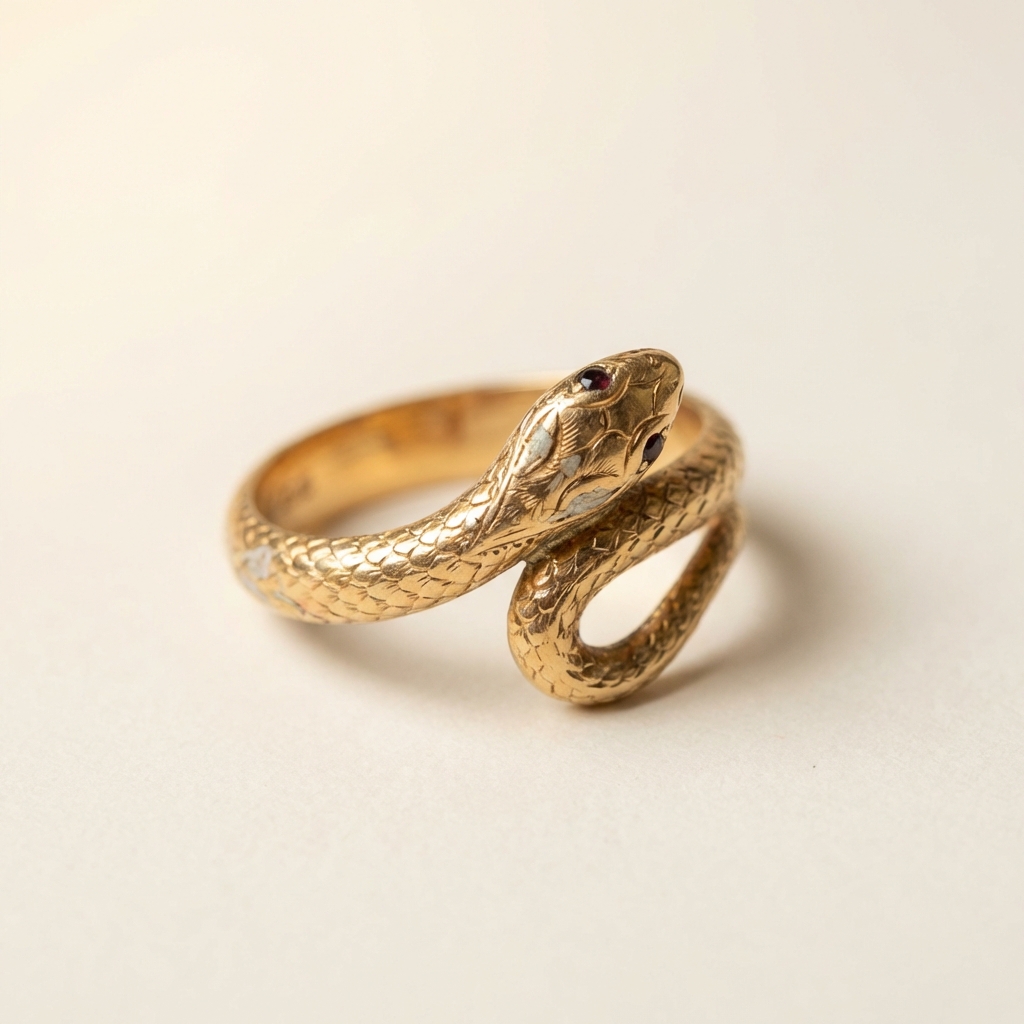
Greek and Roman jewelry absorbed and adapted earlier serpent imagery, placing snakes on rings, bracelets and intaglios where the motif could signify renewal, continuity or local beliefs about protection; material studies show the motif varies by region and workshop.
Curatorial resources note that provenance and documented context are essential when dating or interpreting an ancient ring, because the same motif can carry different meanings across cultures and centuries The Metropolitan Museum of Art.
Victorian and modern romantic meanings of snake rings
The Victorian reinterpretation as eternal love
In the nineteenth century the snake ring was widely adopted as a romantic emblem, often presented as a symbol of eternal love and commitment; museum studies and period examples show how this new social reading shaped jewelry use in that era Victoria and Albert Museum.
Compare documentation, iconography and condition when assessing a snake ring
Use for quick side by side checks
Victorian manufacturers and patrons favored the snake because it provided a visual shorthand for unending devotion while also offering a fashionable, striking silhouette; later collectors often project that romantic meaning onto older pieces unless provenance contradicts the assumption Smithsonian Magazine.
In the twentieth and twenty first centuries the Victorian reading persisted and merged with contemporary design choices, so modern owners may wear snake rings as declarations of romance, memory or continuity rather than as direct references to ancient beliefs.
Alchemical, esoteric and symbolic layers of the ouroboros
The ouroboros, the snake biting its own tail, became central to alchemical and esoteric symbolism in late antiquity and beyond, where it signaled the cyclic nature of time, self renewal and the unity of opposites; scholarly treatments of late antique texts trace that conceptual shift in detail Journal of Religious and Esoteric Studies.
These alchemical meanings often coexist with cultural or personal readings on a single object; an ouroboros ring may therefore carry layered significance that blends philosophical, protective and domestic associations depending on its context and wearer.
When identifying an ouroboros on a ring it helps to check iconographic details, because not every snake motif is an ouroboros and small differences in pose, head orientation or attributes can change interpretation; museum resources advise careful visual comparison and catalog checks The Metropolitan Museum of Art.
How to interpret an ouroboros snake ring worn by a woman today
Start with a practical three step framework: identify the iconography, check provenance and documentation, and consider the wearer’s personal or cultural context. Each step narrows the range of plausible meanings and aligns interpretation with available evidence The Metropolitan Museum of Art.
Step 1, identify iconography: note whether the snake forms a complete loop, bites its tail, holds a gem, or appears alongside other motifs. Those details can distinguish an ouroboros from a decorative serpentine band and guide which symbolic families to consider.
Step 2, check provenance and condition: request documented collection history, any verification letters and detailed restoration notes. Provenance records and condition notes help decide whether a ring is likely ancient, vintage or a recent design, and they clarify what the object can reliably tell you about original meaning The Metropolitan Museum of Art.

Step 3, consider personal intent: ask whether the wearer chose the ring for its historical associations, its look, or a private meaning such as transformation or identity. Contemporary interpretations frequently blend historical associations with personal symbolism, so conversation with the wearer or seller is often the clearest route to understanding Smithsonian Magazine.
Example questions to ask a seller or owner include: Do you have provenance documentation or prior collection history? Are there restoration or conservation reports? Has the ring been resized or refashioned? These practical queries link directly to how confidently you can attribute a historical reading The Metropolitan Museum of Art.
Aurora Antiqua presents curated ancient rings with provenance notes and restoration summaries so collectors and gifters can weigh historical meaning against condition and documented history. When those notes are present, they provide the best starting point for responsible interpretation.
Decision criteria for collectors: dating, provenance and condition
Requesting essential provenance elements should be your first step: prior collection history, any sale catalog references, photographic records, and verification letters from recognized experts all contribute to a ring’s interpretive picture, and curatorial guidance emphasizes these items for sound judgment The Metropolitan Museum of Art.
Condition notes matter because wear consistent with age, original patina and documented restoration affect what the object reveals about original use. A ring that has been heavily restored or refashioned may no longer present its original iconography clearly, so restoration notes are part of meaning assessment.
For dating and workshop attribution, compare stylistic details and materials against securely dated examples in museum collections; authoritative catalogues and reference works are useful starting points and should be consulted when available Encyclopaedia Britannica.
When to seek specialist input: consult a conservator for ambiguous condition notes, a cataloguer or academic for typological dating, and a qualified appraiser for contested provenance. Specialist views are especially important when an item’s historical meaning could influence acquisition decisions or display choices.
Keep careful records of all documentation you receive. For collectors focused on wearable history, clear photographs, exact measurements and transparent restoration notes should accompany any substantial claim about age or original symbolism.
Common errors and pitfalls when reading snake ring symbolism
A frequent mistake is to project the Victorian romantic meaning onto an ancient ouroboros; while nineteenth century practices made that reading popular, the same visual motif carried different associations in ancient contexts, so historical attribution requires evidence not assumption Victoria and Albert Museum.
Another pitfall is assuming a single fixed meaning. Across cultures and periods snake rings can connote rebirth, protection, fertility, magic or continuity, and the dominant sense depends on regional practice and specific iconography rather than on the motif alone Smithsonian Magazine.
Misreading iconography or materials is common. Small differences in pose, bead set, intaglio carving or metalwork can change interpretation, and patina or post discovery repairs can obscure original details, so visual comparison with documented examples is essential The Metropolitan Museum of Art.
See provenance and restorations on @auroraantiqua
Before you buy or gift, consult provenance and condition notes and ask for restoration records so your reading of the ring rests on documentation rather than assumption.
To avoid errors, keep a checklist when assessing a snake ring: note iconography, request documentation, inspect condition notes, and, if needed, seek specialist opinion. Those steps reduce the risk of misattribution and help align what you think the ring means with what the evidence supports Encyclopaedia Britannica.
Practical examples and reading scenarios
Example 1, an Egyptian style ouroboros ring: if a ring matches Egyptian motifs and comes with a provenance trail or museum level documentation, interpretive weight should rest on ancient cyclical and protective associations rather than Victorian romance Encyclopaedia Britannica.
Example 2, a Victorian love ring with snake motif: a nineteenth century maker, a period hallmark or an accompanying sales catalogue entry support reading the ring as a romantic emblem of eternal commitment, which is how many museum examples are contextualized Victoria and Albert Museum.
Example 3, a contemporary designer ring using the ouroboros: modern makers frequently combine historical imagery with personal meanings, so a present day wearer may choose the motif for identity, transformation or style rather than for historical fidelity Smithsonian Magazine.
Conclusion: choosing or gifting an ouroboros snake ring
Key takeaway: an ouroboros snake ring can mean cyclical time, protection, renewal or romantic eternity depending on period, context and the wearer’s intent; treat any single reading as provisional until documentation supports it Encyclopaedia Britannica.
Buyers and gifters should prioritize provenance, condition notes and restoration records when evaluating meaning and authenticity; clear documentation is the most reliable guide to a ring’s original use and likely symbolism The Metropolitan Museum of Art.
Short checklist: request provenance, ask about restoration and condition notes, and consider whether the intended recipient values historical meaning, personal symbolism or simply the design. Those steps align with careful curation and responsible collecting practices.
Compare iconography to dated museum examples, request provenance and catalog references, and check condition and restoration notes; if uncertainty remains, seek a specialist opinion.
Not always; while the Victorian era popularized a romantic reading, the motif can also signify renewal, protection or personal transformation depending on context and intent.
Look for prior collection history, verification letters, detailed condition reports and clear photographs showing hallmarking or distinctive iconographic details.
More from Aurora Antiqua
References
- Carnelian ring stone with Asclepius, the god of medicine, Acc. 81.6.94, The Metropolitan Museum of Art
- Talismans, Visitatori salutem, Szepmuveszeti Muzeum / Museum of Fine Arts, Budapest
- Finger ring, intaglio, London Museum (formerly Museum of London)
- Head of a Roman emperor, Victoria and Albert Museum, London
- Bague : satyre jouant de la double flûte devant une statue, Musee du Louvre, Paris, Departement des Objets d'art
- About us, International Association of Dealers in Ancient Art
- The Past Polluted: A Pigovian Approach to the Black Market in Antiquities, International Journal of Cultural
- World's Oldest 'Industrial-Scale' Brewery Found in Egypt, Smithsonian Magazine
- Ouroboros, Wikipedia