


Looking for the real thing? Browse genuine ancient artifacts for sale, each piece one of one, individually authenticated, with documented provenance. For the background, see the guide to ancient jewelry.
ancient egyptian rings: what they are and what they tell us
Ancient egyptian rings are portable artifacts that often combine craft, iconography and material evidence in ways useful for dating and attribution. For collectors and researchers, a ring can show a workshop tradition through its bezel work, intaglio carving, metal composition and surface patina, and museum overviews help connect those visible traits with broader craft practices British Museum galleries on Egyptian technology and craft.
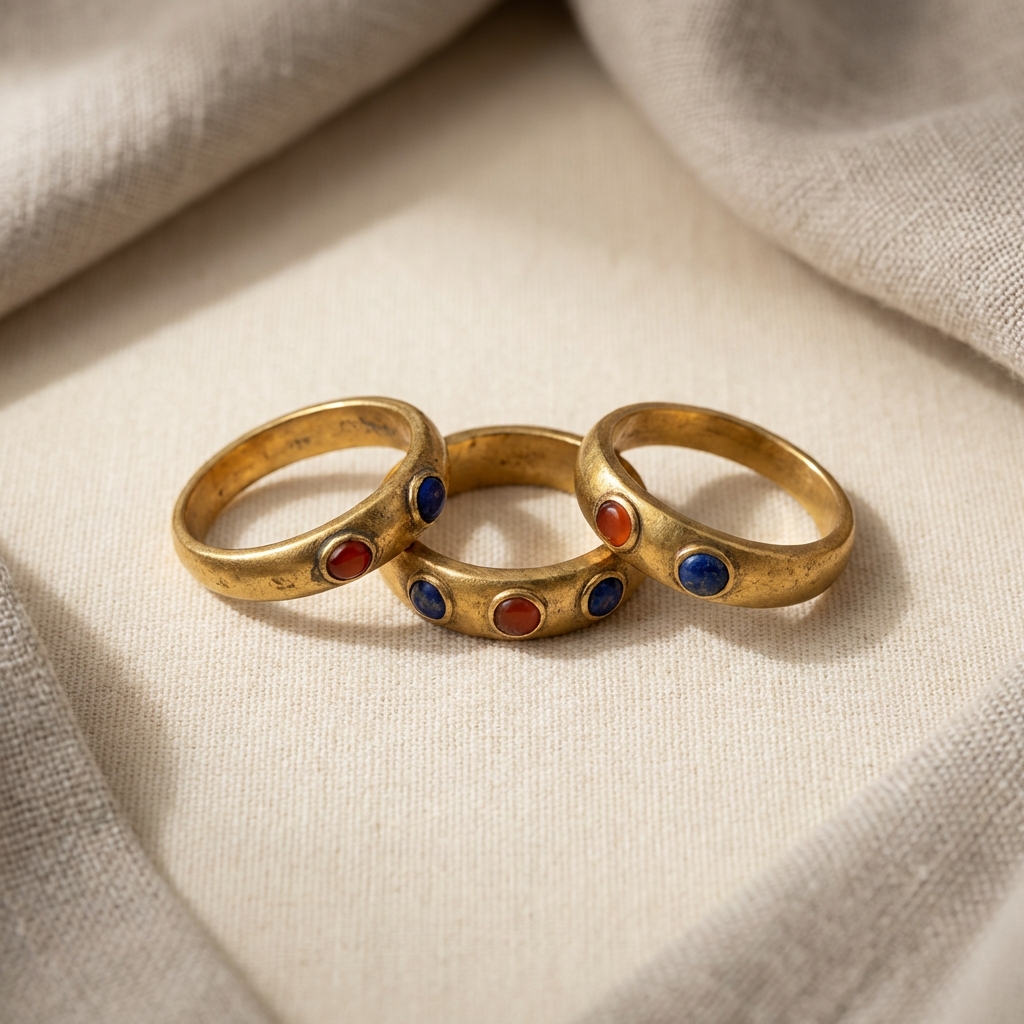
Typical materials include gold, silver, electrum, bronze and occasionally faience or stone insets such as carnelian or agate; motifs range from simple hoops to carved intaglios with deities, pharaonic names or geometric patterns. Condition notes and restoration notes are central to interpretation because repairs, solder marks or modern replacements change how a ring should be read for dating or workshop attribution.
When provenance and documentation are present, they provide context such as prior collection history, excavation records or third party reports that help distinguish a wearable antiquity from a later imitation. As with other artifacts, cautious language is appropriate: materials often appear to be described as a certain metal until tested, and dating is typically an estimate tied to style and documentation.
Papyrus based writing and record keeping
Papyrus is a reed product processed into sheets that the ancient Egyptians used widely from the late Predynastic period onward for administration, literature and technical records; this widespread use enabled durable record keeping that supported complex institutions such as temples and state administration British Library article on papyrus and early books.
As a material, papyrus made it possible to assemble archives, transmit technical recipes and preserve legal and economic records that informed craft production across generations. That continuity is why specialists rely on museum essays and peer reviewed syntheses when connecting written records to material practices in artifacts such as seals, labels and inscribed jewelry.
Prioritize clear provenance, detailed condition notes, explicit restoration descriptions and comparative references to museum collections; if these are unavailable, seek third party testing or specialist input.
How certain is the earliest evidence for papyrus in the Nile valley is a question often asked by collectors and students, and it is best approached through specialist syntheses rather than short popular summaries.
For ring collectors, traces of ink, labels or associated papyri in an object's collection history can be informative, but papyrus alone does not provide secure dating without additional provenance or scientific testing.

The 365 day civil calendar and timekeeping
The 365 day civil calendar and timekeeping
The ancient Egyptian civil calendar was organized as twelve months of thirty days plus five epagomenal days and was in use by at least the Old Kingdom, creating a practical administrative framework for taxation, ritual scheduling and agricultural planning Metropolitan Museum of Art Heilbrunn Timeline on Egyptian engineering and timekeeping.
Because agriculture and ritual observance depended on predictable seasons, the civil calendar helped coordinate labor cycles such as irrigation and harvest work and underpinned long term planning across temples and estates. When collection histories mention dated records or festival inscriptions, those references can narrow attribution windows for rings and small objects when combined with stylistic analysis.
Medical texts and practical treatments
Ancient Egyptian medical documentation, including well known papyri that record case descriptions, surgical procedures and pharmacopoeia, provides a practical view of healthcare practice rather than modern clinical trials; these texts show how remedies and techniques were recorded and transmitted Ancient Egyptian Medicine, a comprehensive study of the medical papyri.
Documents such as the Edwin Smith and Ebers papyri contain procedural descriptions and recipes that later cultures could consult, and the presence of medical knowledge in written form is part of the larger information infrastructure that supported craft and scientific thinking in the Nile valley. For material culture, medical texts can illuminate skeletal pathologies, healed injuries visible on museum objects and the practical uses of small tools sometimes found in workshop contexts.

Aurora Antiqua presents condition notes, restoration notes and provenance references for rings where available, and those documentation elements are central for understanding how a piece fits into medical, funerary or personal contexts. Where collection history is limited, seek explicit language about prior ownership and any third party testing before drawing detailed conclusions.
Irrigation and Nile water management
Basin irrigation and mechanical devices such as the shaduf were core components of Nile agriculture, creating predictable crop production in a floodplain environment and supporting the scale of labour needed for large building projects and craft specialization FAO historical overview on the Nile and irrigation systems.
Basin irrigation describes a landscape level technique where fields were flooded and managed seasonally, and mechanical aids like the shaduf moved water between basins and channels. These systems shaped settlement patterns and food security, which in turn allowed certain communities to develop sustained craft production such as bead making, metalworking and the workshops that produced jewelry including rings.
Applied geometry and surveying in construction
Practical mathematics and surveying methods appear in Egyptian building practice and land measurement, and evidence from monument construction suggests techniques that link layout, measurement and material procurement in visible ways on sites and in archives Metropolitan Museum Heilbrunn Timeline on Egyptian engineering and construction.
These practices were often pragmatic rather than theoretical, focused on measurement routines, simple geometric procedures and control points used to establish orientation, levels and boundaries for buildings and fields. For collectors, workshop attribution can sometimes use parallels between measurements on tools and standardized dimensions visible in groups of artifacts.
Practical checklist to evaluate documentation for artifact attributions
Use alongside photographs and measurements
When reading a listing or catalogue, the checklist embodied in the tool can help you note gaps such as missing collection history or unclear restoration notes that weaken confident attribution. Combining this approach with comparative study of workshop marks and stylistic parallels increases the reliability of an attribution.
Faience and early glass production
Egyptian craft technologies such as faience and early glassmaking, including glazed frit and bead manufacture, were refined in the Nile valley and became central to ornament and bead production that often appears in jewelry and ring settings British Museum galleries on Egyptian technology and craft.
Faience uses a silica based body with a self glazing surface that can resemble glass at small scale, and both technologies supported a broad market in beads and inlaid ornament. Scholars continue to refine the chronology of glass versus faience production, so attributing an individual bead or glazed inlay requires careful reading of technical descriptions and, when available, scientific analysis.
How these innovations spread and the limits of attribution
Many of the technologies discussed developed over long periods and spread via trade routes, craft exchange and imperial contacts, so simple claims of an absolute first invention should be approached with caution and contextualized by broader archaeological science.
Transmission pathways include trade in raw materials and finished goods, movement of artisans and the adoption of techniques by neighbouring societies. For collectors and researchers, this means that stylistic parallels may indicate influence rather than direct origin, and provenance documentation remains essential to any strong attribution claim.
How to evaluate claims about inventions and artifacts
Use a simple decision framework: check for clear provenance, detailed condition notes, explicit restoration notes and any third party testing reported. If documentation lacks dates or collection history, treat attribution as provisional and seek specialist input for scientific testing or comparative study.
Helpful documentation items include collection history with dates, photographs that show condition before and after restoration, and explicit language about what restorations were done. When in doubt, ask for measurements, high resolution images and references to comparable pieces in museum collections or peer reviewed catalogues.
Common mistakes and pitfalls in popular accounts
A frequent error is equating long term technical development with a single invention event; many Egyptian techniques evolved regionally over centuries and appear in different forms at different times. Readers should be wary of headlines that treat a slow evolution as a single moment of invention.
Another common pitfall is misreading material identifications such as a description that says an object "appears to be" a metal or glazing type. Restoration traces can also be mistaken for original fabric, so pay attention to restoration notes and look for consistent documentation of repairs or replacements.
Practical examples and scenarios for collectors
Practical examples and scenarios for collectors
Example 1, reading a listing: begin with the condition notes, then confirm whether restoration notes specify removed or replaced elements, then look for provenance entries that give collection history or references to excavation. If the listing mentions materials such as carnelian intaglio or faience inlay, ask for comparative images that show similar motifs in dated contexts.
Example 2, buying for wearable history versus research: if your priority is wearable history, prioritize secure structure, stable restoration and clear condition notes; if research attribution is the goal, insist on provenance documentation and third party testing where possible. For both aims, transparent seller language and access to detailed photographs increase confidence.
Sample checklist applied: verify measurement and weight, check for consistent patina on expected surfaces, confirm restoration notes explain any modern additions, ask for documented chain of custody and request references to similar items in museum or published catalogues. Use these steps to decide whether a ring suits your purpose as wearable history or as a research object.
Look for written collection history with dates, photographs that predate any recent sales, clear restoration notes and references to museum or publication comparisons; lack of these items means treat provenance as provisional.
No. While papyrus can be informative, its presence alone does not secure dating; combine it with documentation, stylistic analysis and, if needed, scientific testing.
They can look similar at small scale, but faience is a glazed silica body distinct from true glass and accurate identification may require technical description or lab analysis.
More from Aurora Antiqua
References
- Faience Technology. In: UCLA Encyclopedia of Egyptology (Paul T. Nicholson), University of California, Los
- Exploring the Composition of Egyptian Faience (Falcone, Aquilino, Stoppa), Minerals (MDPI)
- Egyptian faience glazing by the cementation method part 1 (Matin & Matin), Elsevier, Journal of Archaeological
- Gemstones. In: UCLA Encyclopedia of Egyptology (James A. Harrell), University of California, Los Angeles
- Scarab. In: UCLA Encyclopedia of Egyptology (Kathlyn M. Cooney), University of California, Los Angeles
- Ring, Victoria and Albert Museum, London
- Finger Ring with Frog, The Cleveland Museum of Art
- Research report: export licensing and provenance, GOV.UK, Department for Culture, Media and Sport (DCMS)
- Papyrus, Wikipedia