


Looking for the real thing? Browse genuine ancient rings for sale, each piece one of one, individually authenticated, with documented provenance. For the background, see the guide to ancient jewelry.
What are ancient masonic rings? A clear definition and overview
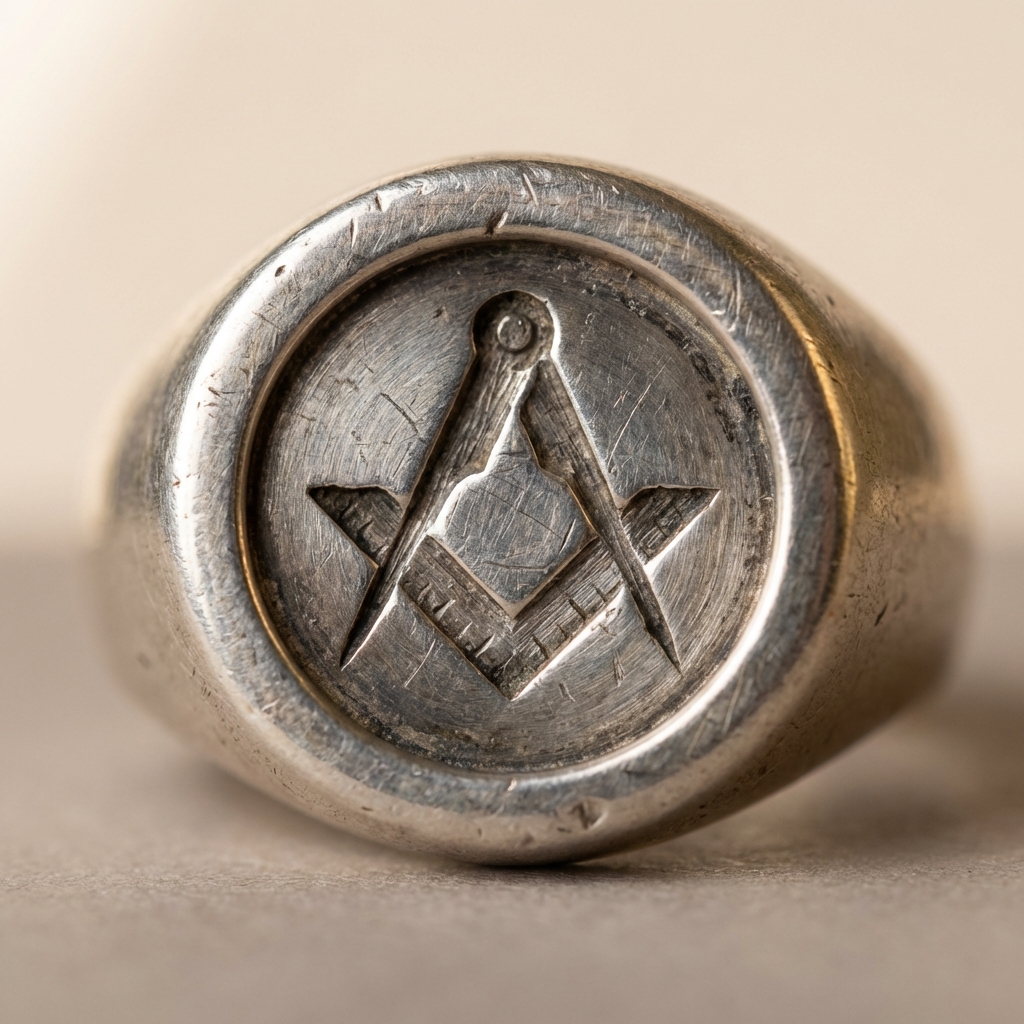
An ancient masonic ring is best defined as a fraternal, signet-type ring worn to indicate membership, office, or symbolic affiliation within Freemasonry, a usage documented in lodge guidance and institutional collections. This working definition helps separate these objects from general signet rings by the deliberate use of canonical symbols and their role as regalia rather than solely as personal seals; for an institutional overview of Masonic symbolism see United Grand Lodge of England guidance United Grand Lodge of England about Freemasonry.
In practice, the term ancient masonic rings typically refers to examples tied to the 18th and 19th century rise of fraternal regalia in Britain and North America, though makers often worked from older signet and intaglio techniques inherited from earlier periods. This continuity with earlier engraving traditions means collectors should treat form and technique as comparators rather than direct proof of Masonic origin; comparative notes from museum collections can clarify similarities and differences Fund des Monats August 2019 (Find of the Month), Landesamt für Denkmalpflege und Archäologie Sachsen-Anhalt.
See behind-the-scenes at @auroraantiqua on Instagram for examples and provenance discussion
Before relying on a listing description, consult the seller s documentation notes and ask for clear condition and provenance information to support any Masonic attribution.
Who wore these rings, and why, is important to the definition. Members, officers and degree-holders used rings as visible signs of affiliation and rank within lodge life; the wearing of such rings became a more visible and codified practice in the fraternal culture of the 18th and 19th centuries, reflecting the broader social role of regalia during that period Encyclopaedia Britannica on Freemasonry.
For collectors, the distinction matters because a ring described as an ancient ring with Masonic motifs carries different expectations about documentation, common motifs, and conservation needs than a general antique signet. Treat the description as a starting point and seek the documentary basis for any Masonic claim.
Common symbols on ancient masonic rings and what they mean
Core motifs recur across lodge manuals and museum catalogues. The compass and square is the most widely recognized emblem, often combined with the letter G; other frequent devices include the all-seeing eye, apron motifs, and degree-specific emblems used to denote office or degree. When identifying a ring, consider how the motif is rendered and placed on the bezel, since placement and combination of symbols carry institutional meaning United Grand Lodge of England about Freemasonry.
Canonical meanings are recorded in lodge sources and referenced in curated collections, but local and period variations appear in many examples; see Masonic symbolism guides The Ultimate Guide to Masonic Symbolism. A symbol present on its own does not always confirm lodge origin; compare the motif to institutional catalogues and object essays for context Kunera, laatmiddeleeuwse insignes en ampullen (late medieval badges and ampullae), Radboud Universiteit Nijmegen.
Canonical motifs and their lodge meanings
Compass and square: usually signifies the moral and speculative aspects of the fraternity and is commonly paired with the letter G in Anglo-American contexts. Letter G: often associated with geometry or the Great Architect in lodge literature. All-seeing eye: used for vigilance or divine oversight in some lodge iconography. Apron motifs and degree emblems: these can indicate specific offices or levels within lodge structures and are often rendered as small, stylized devices on bezels.
Regional or period variations to watch for
Regional practice means a given motif may look different depending on place and date, with variations in engraving depth, stone choice and bezel style. Period trends also affect how motifs were manufactured: later 19th century pieces sometimes show machine-assisted engraving while earlier hand-cut intaglios retain variable tool marks. For reliable comparison, consult museum cataloguing entries that document variation across collections Catalogue of the Engraved Gems and Finger-Rings in the Ashmolean Museum, II: Roman, BAR Publishing, via Fulcrum.
Materials, engraving and construction: technical comparators with older signet and intaglio rings
Early practitioners adapted established signet and intaglio techniques, meaning that the workmanship of these rings often resembles earlier artifacts in metalwork or engraving methods, and to related ancient Roman rings ancient Roman rings. See a comparative example in the V&A collections Ring | V&A. Yet the social meaning of the ring as regalia and identity marker sits within the specific cultural history of Freemasonry in the 18th and 19th centuries; museum object essays and catalogues illustrate this continuity and the shift in function Metropolitan Museum collection entries.
Engraving techniques provide important clues. Hand-cut intaglios and tool marks, bezel construction, and the way a stone is seated can indicate a workshop practice consistent with a period; similarly, patina and wear patterns on the metal provide context for age and use. However, these comparators are informative rather than definitive because similar techniques persisted across different periods and contexts Apport de l'analyse statistique des produits de corrosion à la compréhension, Revue d'Archeometrie.
By combining iconographic comparison with museum and Grand Lodge records, checking provenance and auction histories, and using technical and conservation assessments to resolve remaining ambiguities.
When comparing listed photographs to museum examples, look for consistent tool marks, bezel profiles and evidence of old repairs rather than expecting a single telltale sign. These combined observations help separate a ring likely made as Masonic regalia from a later accessory that borrows motifs without historical association.
Wear consistent with age often appears in expected places, such as on the inner shank where the finger contacts the ring, and as softened edges on high-relief engraving. Note also whether a stone has modern glue or new settings, which can signal later restoration or alteration rather than original construction Institute of Conservation guidance on signet rings.
Brief history: how Masonic rings developed from 18th-19th century fraternal practice
The wearing of rings bearing Masonic symbols became widespread across Britain and North America during the 18th and 19th centuries as fraternal regalia evolved alongside lodge ritual and public social life. This rise is best understood as part of the broader growth of fraternal societies rather than a sudden invention of a new kind of jewelry Encyclopaedia Britannica on Freemasonry.
Early practitioners adapted established signet and intaglio techniques, meaning that the workmanship of these rings often resembles earlier artifacts in metalwork or engraving methods. Yet the social meaning of the ring as regalia and identity marker sits within the specific cultural history of Freemasonry in the 18th and 19th centuries; museum object essays and catalogues illustrate this continuity and the shift in function Metropolitan Museum collection entries.
Geographic centers for production and usage included urban workshops in Britain and the United States where lodge activity and trade converged. Regional workshop practices and later reworkings complicate precise dating by style alone, which is why cross-referencing documentary records remains essential for confident attribution.
How museums and Grand Lodges document Masonic symbols and variations
Institutions such as the Museum of Freemasonry maintain catalogues that describe canonical symbols, contextualize variations and note documented provenance where present; these curated records are a first line of comparison for collectors and researchers Museum of Freemasonry collection overview.
Grand Lodges often publish guidance on symbolism and standard uses of devices like the compass and square and the letter G; these institutional descriptions help standardize interpretation but also record known local variants United Grand Lodge of England about Freemasonry.

For practical identification, catalogue entries and object essays that describe technique, materials and collection history are especially useful because they commonly document when an item was acquired, any restoration notes, and how its iconography was interpreted by curators.
How experts identify and authenticate ancient masonic rings: a step-by-step framework
Experts use a layered, evidence-based workflow rather than a single diagnostic. Start with iconography: compare the ring s motifs to museum and lodge records to see whether the combination and rendering of symbols match known examples Talismans, Visitatori salutem, Szepmuveszeti Muzeum / Museum of Fine Arts, Budapest.
Second, cross-check provenance. Seek contemporary lodge records, auction catalogue entries or collection history notes and any verification letters the seller can provide; these documentary elements materially increase confidence when available Metropolitan Museum collection entries.
Third, use technical and stylistic comparison. Examine metal composition, bezel construction, engraving technique and wear patterns against dated examples. When questions remain, non-destructive material tests and independent condition reports can clarify manufacturing techniques or later interventions without harming the object Institute of Conservation guidance on signet rings.
Fourth, combine the evidence. No single step is usually decisive. A coherent match across iconography, provenance and technical signs is the strongest basis for attribution, while mismatches in one area call for caution and possibly further testing or professional conservation assessment.
When to seek lab work or third-party reports: commission independent testing for high-value or ambiguous items, or when restoration history is unclear. Tests and conservation reports raise confidence but rarely produce absolute certainty because documentary gaps and workshop overlaps persist in many 18th and 19th century cases ICOM collecting ethics resources.
A visual checklist for collectors: what to inspect in photos and in hand
Use a short checklist to screen listings quickly. Good photos and clear condition notes let you filter likely candidates from those needing more scrutiny (see the rings collection rings); focus first on hallmarks, the inside shank, bezel detail, and high-resolution views of the engraved motif https://www.assayofficelondon.co.uk/hallmarking/what-is-a-hallmark#convention, Goldsmiths' Company Assay Office.
Checklist items to request or inspect: clear images of hallmarks and the inner shank, close-ups of the bezel and engraving, macro photos of tooling marks, and detail shots of any solder lines or re-mounted stones. Ask sellers to describe any restoration work and to provide measurement and weight data.
Quick photo and condition screening checklist for ring listings
Print or save a copy to compare listings
In hand, examine surface texture and patina, check the interior for maker s marks or civilian hallmarks, and test how the stone sits in the bezel without forcing any movement. Record everything with dated photographs to create a traceable record for later expert review.
When photographing, include a scale and take images from multiple angles. If hallmarks are faint, request a magnified image. These steps make subsequent comparisons to museum catalogue photos and object essays much easier and more reliable Metropolitan Museum collection entries; for related coverage see the blog blog.
Condition, restoration and conservation: preserving value and scholarship
Preserve original patina and document any stabilisation, soldering or stone re-mounting in clear restoration notes; conservation practice favors minimal and reversible interventions that retain as much original material as possible Institute of Conservation guidance on signet rings.

Avoid aggressive polishing which can remove surface evidence used for dating and assessment. When restoration has occurred, request a detailed report that explains what was done, why it was necessary, and which methods were used; that record is essential for scholarly assessment and ongoing care ICOM collecting ethics resources.
If a seller cannot describe restoration steps or provide photographic evidence of condition before and after work, treat the absence of such documentation as a reason to pause or to request an independent conservator s assessment.
Provenance, documentation and dating: decision criteria for confident attribution
Desirable documentation includes contemporary lodge records, auction catalogues, clear collection history, verification letters and catalogue entries from institutional collections. Each of these raises confidence when present because they provide independent context for dating and attribution Metropolitan Museum collection entries.
Dating and provenance should be treated as estimates unless they tie directly to contemporary records. Secondary documentation such as auction listings or prior collection notes can increase confidence but typically do not substitute for original lodge records; use them as supporting evidence rather than proof Institute of Conservation guidance on signet rings.
Practical steps to verify records: request scans or transcriptions of lodge entries, ask sellers for auction lot references, and check whether museum catalogue numbers or essays mention the same object. When in doubt, seek independent verification from a conservator or a qualified appraiser who is comfortable working with fraternal regalia.
Ethical collecting and buying guidance for ancient masonic rings
Ask sellers for provenance, restoration notes and high-resolution images before purchase. Prefer items with documented collection history and with transparent restoration records. If documentation is missing, seek additional information and consider walking away from the sale if essential evidence cannot be produced ICOM collecting ethics resources.
Respect cultural heritage standards and avoid acquiring items with unclear legal status. Ethical collecting emphasizes documentation and traceability over speculative purchase, and it supports the research and conservation communities that preserve these objects for future study Institute of Conservation guidance on signet rings.
After purchase, follow conservational care: avoid harsh cleaners, store items in stable humidity and temperature, and consult a conservator for any treatment beyond gentle cleaning. Good care preserves scholarly information as well as the object itself.
Decision criteria: when to buy, when to ask for more verification
Proceed if iconography, provenance and condition notes align coherently; pause if key documentation is missing or if restoration history is unclear. This checklist approach helps balance risk against the value of a piece to your collection Museum of Freemasonry collection overview.
Commission independent testing or conservation reports when the item is high value, when provenance is ambiguous, or when restoration may have altered diagnostic features. Testing can be costly, so weigh the expense against the object s importance and the degree of uncertainty present Institute of Conservation guidance on signet rings.
Stage decisions: initial screening using the visual checklist, direct questions to the seller, review of provided documentation, then independent review for unresolved issues. This staged approach reduces unnecessary cost while preserving due diligence.
Typical mistakes and authentication pitfalls to avoid
Common errors include over-relying on a single symbol for attribution, ignoring evidence of later reworking, and failing to note modern restorations that can mislead visual assessment. These pitfalls often lead to misattribution or disappointing purchases Bague : satyre jouant de la double flûte devant une statue, Musee du Louvre, Paris, Departement des Objets d'art.
Another mistake is trusting unclear provenance or incomplete photographs. If crucial angles or hallmark details are missing, request them. Small details such as mismatched solder lines or modern adhesives on a bezel can be decisive red flags that merit professional inspection Institute of Conservation guidance on signet rings.
Practical examples and scenarios: how the framework is used in real cataloguing cases
Museum catalogue entries and object essays are practical comparators when a listing s motif, bezel style and material appear similar to a documented example; use those entries to form hypotheses about manufacture and likely period before seeking further evidence Getty Provenance Index, J. Paul Getty Trust, Getty Research Institute, Los Angeles.
Auction records and prior collection histories function as useful secondary documentation when lodge records are absent. They do not always provide final proof, but they can create a plausible chain of custody that increases confidence in attribution when combined with technical comparison Metropolitan Museum collection entries.
In many ambiguous 18th and 19th century cases, combined evidence raises confidence but seldom gives absolute certainty. Treat attribution as a reasoned estimate and record the steps you took to reach that estimate for future researchers.
Conclusion: how to approach ancient masonic rings as a collector
Recap the workflow: start with iconography and museum comparisons, verify provenance with lodge or auction records where possible, and use technical and conservation reports to resolve remaining questions. This layered approach provides the best balance of care and evidence when assessing ancient masonic rings Museum of Freemasonry collection overview.
Next steps: use the visual checklist to screen listings, ask targeted questions about documentation and restoration, and commission independent reports for high-value or ambiguous pieces. Treat dating as an estimate unless tied to contemporary records, and prioritize conservation-minded handling for any object you acquire.

A ring is generally considered Masonic when it was made or used to indicate membership, office or affiliation within Freemasonry and bears canonical symbols such as the compass and square, often supported by documentation or museum comparison.
Look for consistent patina, tool marks, bezel and shank wear that match period techniques, and seek provenance or catalogue references; independent conservation or non-destructive testing can add confidence when needed.
No, avoid aggressive cleaning; preserve original patina and request restoration notes. If cleaning is needed, consult a conservator to ensure reversible and minimal interventions.
More from Aurora Antiqua
References
- Signet Ring, Victoria and Albert Museum, London
- Catalogue of the Engraved Gems and Finger-Rings in the Ashmolean Museum, II: Roman, BAR Publishing, via Fulcrum
- Fund des Monats August 2019 (Find of the Month), Landesamt für Denkmalpflege und Archäologie Sachsen-Anhalt
- Kunera, laatmiddeleeuwse insignes en ampullen (late medieval badges and ampullae), Radboud Universiteit Nijmegen
- Talismans, Visitatori salutem, Szepmuveszeti Muzeum / Museum of Fine Arts, Budapest
- Bague : satyre jouant de la double flûte devant une statue, Musee du Louvre, Paris, Departement des Objets d'art
- https://www.assayofficelondon.co.uk/hallmarking/what-is-a-hallmark#convention, Goldsmiths' Company Assay Office
- Hallmark Identification, The Company of Goldsmiths of Dublin, The Assay Office (Dublin Castle)
- Getty Provenance Index, J. Paul Getty Trust, Getty Research Institute, Los Angeles
- Standards and guidelines, International Council of Museums, ICOM