


Looking for the real thing? Browse genuine ancient rings for sale, each piece one of one, individually authenticated, with documented provenance. For the background, see the guide to ancient jewelry.
Definition and context: what do two hands holding a heart mean
The standard symbolic reading
The two hands holding a heart, most familiarly rendered as the Claddagh motif, is commonly read in reference works as a compact emblem of three related ideas: the heart for love, the hands for friendship or faithful service, and the crown for loyalty or fidelity. This is the accepted reading shown in major overviews of the motif and used routinely in museum labels and reference entries Encyclopaedia Britannica, and regional overviews such as CladdaghRings.
How museums and reference works present the motif
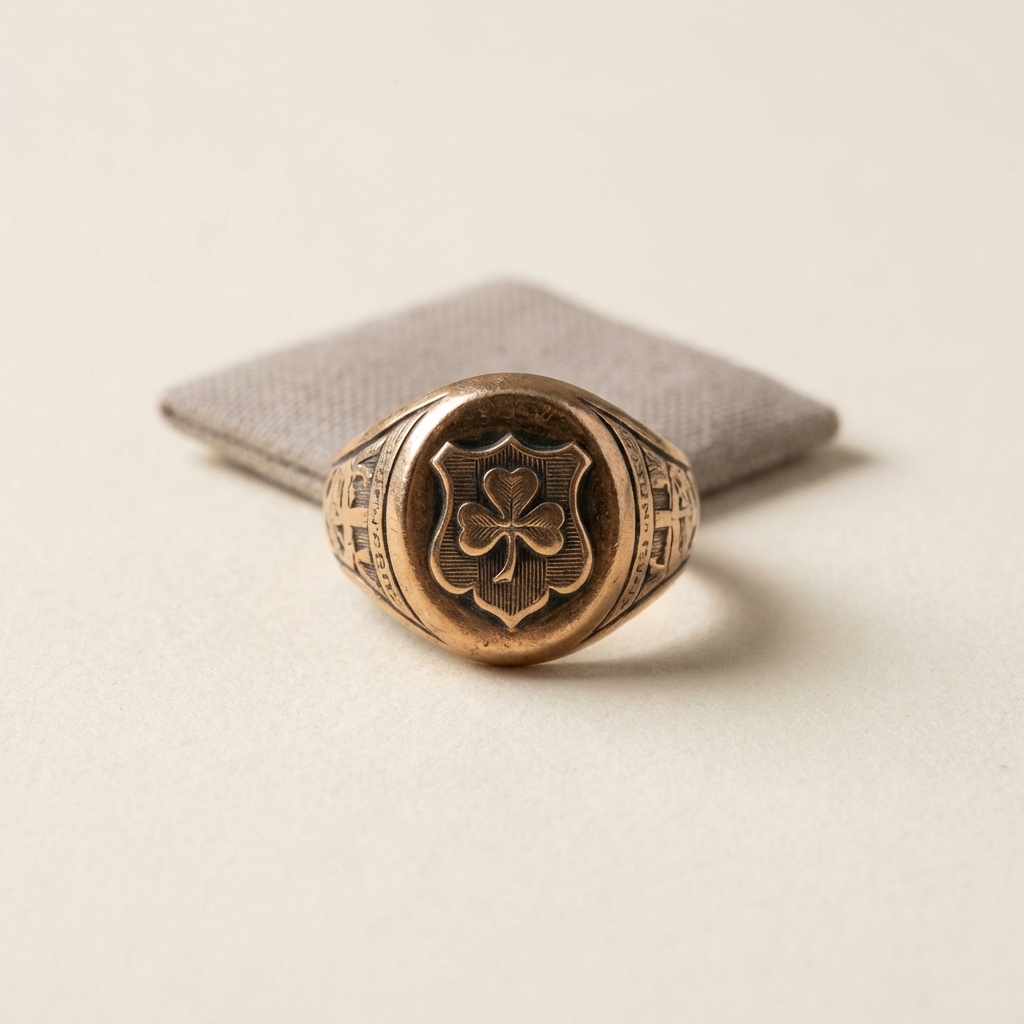
Museums and summary references typically present the three-part meaning as the standard interpretation, and they often use that reading when cataloguing objects or explaining the iconography to visitors. Curatorial labels therefore provide a useful shorthand for understanding what the symbol can indicate without implying any single, universal meaning.
Origins and dating: where the Claddagh motif crystallised
Galway and the Claddagh area
Scholarly and heritage literature traces the motif's crystallisation to the Claddagh area near Galway, with the image becoming recognisable in the 17th to 18th centuries in regional material and oral accounts; such dating is usually presented as approximate rather than exact Claddagh Rings, National Museum of Ireland, Dublin. Further discussion is available at National Geographic.
The motif, commonly called the Claddagh, is widely read as heart = love, hands = friendship or faithful service, crown = loyalty; the Ancient Order of Hibernians adopted the emblem in fraternal and Irish-American contexts to signal community bonds and solidarity, and collectors should prioritise provenance, hallmarks and condition notes when evaluating rings.
Timeline and nineteenth-century popularisation
Wider popularisation of the Claddagh motif occurred in the 19th century, when increased jewellery production and diaspora networks helped spread the design; the evidence base for this chronology comes from museum catalogues and historical surveys that emphasise gradual diffusion rather than a single invention point.
The Ancient Order of Hibernians and the Claddagh: meanings in fraternal use
How the AOH used the symbol
The Ancient Order of Hibernians adopted the Claddagh motif in Irish-American and nationalist fraternal settings, where the emblem functioned as a marker of community bonds, mutual support and faith-based solidarity; this use is visible in organisational materials and regalia descriptions from the nineteenth century onward Ancient Order of Hibernians materials.
Cultural and associative identity in Irish-American contexts
Within AOH circles the symbol could appear on badges, pins or ring-style regalia to signal shared identity, but that associative use is one strand among many in the wider life of the Claddagh motif and does not change the emblem's general symbolic reading in reference sources.
Breakdown: heart, hands and crown - what each element commonly signifies
Heart = love
In most standard accounts the heart is the central signifier of love in its emotional and romantic sense; museum descriptions and reference texts use this element to highlight personal affection as a core meaning of the motif Wikipedia overview of the Claddagh ring.
Hands = friendship or faithful service
The hands are usually explained as representing friendship, faithful service, or mutual support, a reading that places social bond and reciprocal commitment alongside private affection.

Crown = loyalty or fidelity
The crown that often tops the heart in Claddagh imagery is typically interpreted as a symbol of loyalty or fidelity, completing the trio of meanings that together describe a moral and social package rather than a single, narrow message.
Ring-wearing conventions: how hand and orientation have been used to signal status
Common modern rules and regional variation
Modern cultural guides and museum labels commonly describe conventions where the hand and the orientation of the heart can signal relationship status, for example indicating engaged, married or single status by which hand the ring is worn and which way the heart faces; these practices vary regionally and are social conventions rather than fixed rules Wikipedia overview of the Claddagh ring. For a short overview of common rules see common rules.
Museum label conventions and cultural guides
Museum labels typically explain these wearing customs as interpretive information for visitors, noting that local practice and personal choice mean the rules are not universally applied and should be seen as contemporary social guidance rather than a historical prescription.
How experts and collectors assess authenticity of AOH/Claddagh rings
Provenance and documentation checks
Experts recommend beginning with any available provenance or collection history, including prior ownership notes, documentation letters, and seller-provided verification; clear provenance remains one of the strongest indicators that a ring may be a period example rather than a later copy National Trust guidance on buying antique rings.
Physical inspection: hallmarks, maker's marks, construction and wear
Careful physical inspection looks for hallmarks, maker's marks, construction techniques and wear consistent with the claimed period; those technical signs combined with condition and restoration notes help distinguish historic pieces from modern reproductions Claddagh Rings, National Museum of Ireland, Dublin. For hallmark explanations see Claddagh ring hallmarks explained.
a short provenance and condition checklist for ring listings
use with seller messages
Decision framework: a checklist to decide whether a ring is worth buying
Must-have documentation
Before committing to a purchase, ask for clear photos showing the full ring, a close-up of any hallmarks or maker's marks, written provenance or collection history, full measurements, and explicit restoration or condition notes; these items form a practical baseline for most collector decisions National Trust guidance on provenance and hallmarks.
Red flags and acceptable compromises
Red flags include vague or non-existent provenance, dating claims that do not align with construction details, and seller descriptions that avoid showing hallmarks; acceptable compromises might be limited paperwork for wearable-history pieces where condition notes and honest restoration descriptions are provided.
Common mistakes and pitfalls when interpreting Claddagh and AOH rings
Over-relying on stylistic resemblance
Stylistic resemblance to museum examples alone does not prove period authenticity because many historic motifs were locally copied and later reproduced; always seek supporting documentation or technical testing rather than relying on visual similarity as the primary evidence Claddagh Rings, National Museum of Ireland, Dublin.
Confusing reproduction marks with period hallmarks
Buyers sometimes misread modern maker's marks or decorative imitations as genuine hallmarks; when in doubt, request high-resolution hallmark photos and, if necessary, an independent report to verify metal and marking conventions for the claimed period.
Practical examples and scenarios: reading listings and museum labels
Example 1: well-documented AOH-associated ring
Imagine a listing with full provenance: a clear chain of prior ownership, photos showing a period-appropriate construction, readable hallmarks, and a seller-signed verification letter; in such a case the documentation usually supports a reasoned purchase decision for a collector who values wearable history Ancient Order of Hibernians materials.
Example 2: good photos but limited provenance
By contrast, a listing with excellent photography but vague provenance requires caution: ask for close hallmark images, detailed condition notes, and, if necessary, a short period-appropriate technical report before proceeding; the effort may be worthwhile for a desirable piece, but lack of documentation increases uncertainty National Trust guidance.
How museum labels phrase wearer conventions
Museum labels tend to frame wearing conventions as modern interpretive guidance, noting both the common practice and its variability; reading those labels alongside a seller's listing helps put claims about hand and orientation into context Encyclopaedia Britannica entry on the Claddagh.
Buying checklist for collectors: what to ask sellers and what to expect
Questions to ask sellers
When contacting a seller, use specific requests: ask for full-ring photos and measurements, close-ups of hallmarks or maker's marks, provenance or prior ownership notes, detailed restoration and condition statements, and any available verification letters; a helpful seller will supply most of these on request National Trust buying advice.
When to request third-party testing
Request scientific testing, such as metal analysis or an independent hallmark review, when provenance is incomplete, dating is consequential for your decision, or the seller cannot provide readable hallmarks; third-party reports add confidence but are not always necessary for wearable-history purchases.
Restoration, preservation and condition notes: what to read in a listing
Common conservation treatments and how they are described
Listings often use standard conservation language: stabilised indicates work to halt deterioration, repaired or restored describes visible repairs, and undisturbed patina signals minimal intervention; clear disclosure of what was done and why helps buyers assess long-term suitability for wear or display National Trust guidance.
How restoration affects display and wearable use
Restoration can make a piece safer to handle or wear, but it can also change appearance; ask for before-and-after photos or a short condition report when restorations are claimed so you can judge whether the work suits your collecting aims.
Conclusion: summarise the meaning and the collector’s next steps
Key takeaways
The standard symbolic reading of the two hands holding a heart places love at the centre, framed by friendship or faithful service and a concluding sign of loyalty or fidelity, and the Ancient Order of Hibernians' use of the motif represents an important fraternal strand in the design's social life Encyclopaedia Britannica.
Practical next steps for interested buyers
Collectors should prioritise documentation, readable hallmarks, condition and restoration notes, and transparent seller communication before deciding; when documentation is incomplete, ask targeted questions or consider a third-party report to reduce uncertainty National Trust advice.
Appendix: key sources and suggested further reading
Reference list
The core sources for this article include standard reference entries and museum cataloguing that summarise the Claddagh motif and its history, organisational materials from the Ancient Order of Hibernians that show fraternal adoption of the emblem, and museum-style buying guidance that outlines provenance and hallmark checks. For detailed object records consult museum catalogues and hallmark databases relevant to your jurisdiction Claddagh Rings, National Museum of Ireland, Dublin.
Where to look for provenance and hallmark databases
Start with museum collections, national hallmark registries, and established collecting-guidance pages when tracking provenance or verifying hallmark images; local specialists can provide final technical confirmation when required.
The common reading is heart = love, hands = friendship or faithful service, and crown = loyalty or fidelity; museums and reference works use this interpretation as a standard guide.
Yes, AOH materials show the emblem used in Irish-American and fraternal regalia as a marker of community bonds and faith-based solidarity from the nineteenth century onward.
Request full photos and measurements, close-up hallmark images, written provenance or prior ownership notes, and explicit restoration or condition statements; if uncertainty remains, consider a third-party hallmark review or metal analysis.
More from Aurora Antiqua
References
- Claddagh Rings, National Museum of Ireland, Dublin
- Richard Joyce and the oldest known Claddagh ring, Galway City Museum
- Gimmel Ring, Victoria and Albert Museum, London
- The King of Claddagh · Mainistir Phádraig Naofa · Bailiúchán na Scol, Dúchas.ie, National Folklore Collection
- Ring, Victoria and Albert Museum, London
- The History of The Assay Office, The Company of Goldsmiths of Dublin, The Assay Office (Dublin Castle)
- Hallmark Identification, The Company of Goldsmiths of Dublin, The Assay Office (Dublin Castle)
- Research report: export licensing and provenance, GOV.UK, Department for Culture, Media and Sport (DCMS)
- Claddagh ring, Wikipedia