


Looking for the real thing? Browse our full ring collection, each piece one of one, individually authenticated, with documented provenance. For the background, see the guide to ancient jewelry.
What the sign 𓂀 (wedjat) means: a concise definition
Quick answer, eye of horus ring
The sign 𓂀 is widely known in Egyptological literature as the wedjat, often called the Eye, and it appears in ancient material culture both as a written sign and as a protective amulet symbol that can be found on rings and other jewelry. This reading, transcribed wḏȝ, frames the element as a sign linked to protection and healing in ancient Egyptian practice, and it is the basis for many museum and catalogue descriptions of amulets and rings Metropolitan Museum of Art.
The simplest takeaway for collectors is that the wedjat functions both as a lexical and cultic motif: it can stand in writing for concepts like wholeness and it also served as a wearable emblem intended to protect the bearer. That dual role explains why the symbol appears on small intaglios and amulets that were used in daily life as well as in funerary contexts Oxford Reference.
Why this matters for rings and amulets
When you see the motif on a ring listing, the symbol’s cultural history matters because it usually signals a functional meaning beyond decoration, namely protection or intactness, and because museums record it repeatedly across long chronological ranges in Egypt British Museum collection entries. Compare with our rings collection.
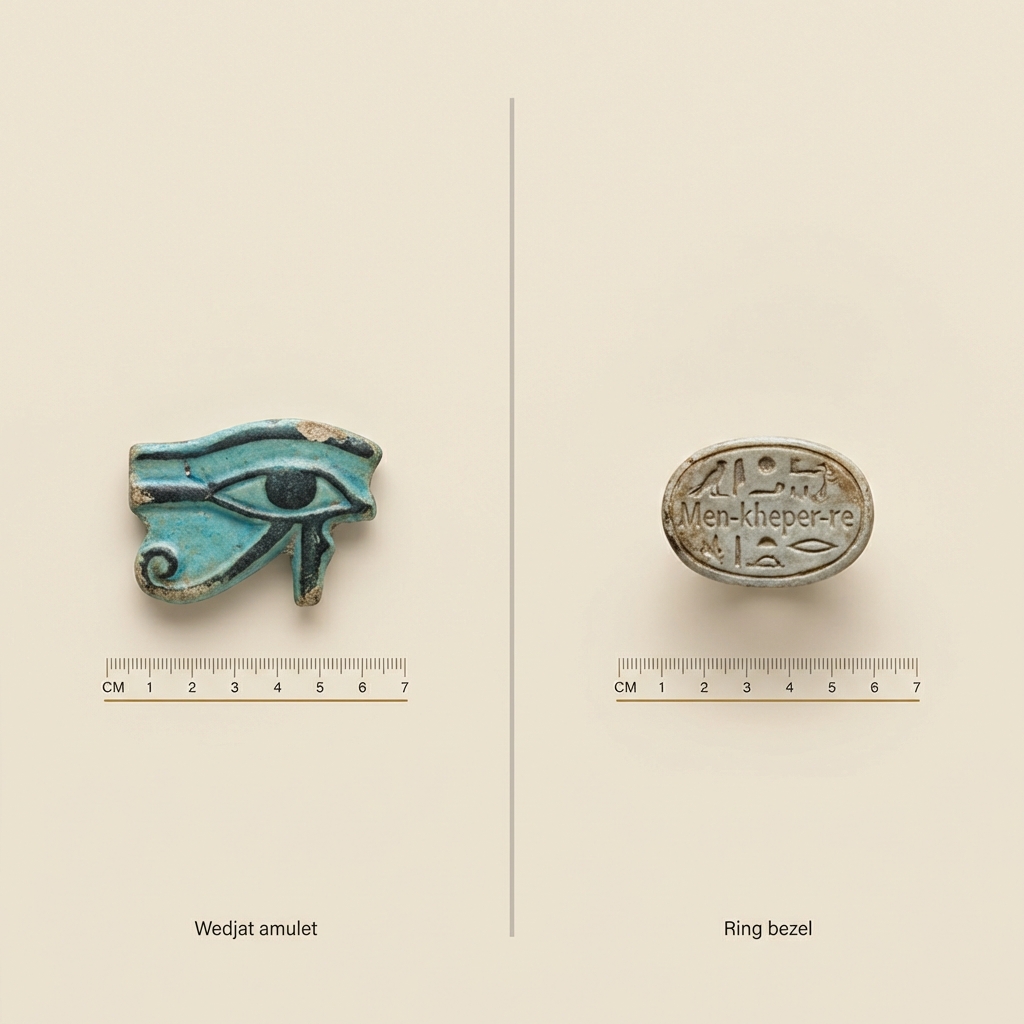
Knowing that wedjat is transcribed wḏȝ and that catalogues link the motif to protection and the idea of being whole helps you read listing text more critically and to ask the right provenance and condition questions for any candidate eye of horus ring.
How museums and object records show the wedjat in jewelry
Museum examples and cataloguing
Large public collections document the wedjat across object types, recording amulets and intaglios found in burial assemblages, temple deposits, and domestic contexts; these entries are a primary reference for curators and collectors working to identify similar small rings and amulets Metropolitan Museum of Art.
See provenance and restoration notes behind the scenes on Instagram
See curated listings that include condition notes and collection references to compare examples and understand how the symbol appears in wearable pieces
Catalogues typically note material, dimensions, findspot when known, and any associated documentation, and they remain one of the most reliable comparison tools because typology, size, and manufacture yield objective points of comparison with trade listings British Museum collection entries. (see a V&A entry V&A amulet)
For collectors this means museum entries can often supply a direct comparison for a particular ring’s bezel shape, intaglio style, or mounting, and they can clarify whether a piece is consistent with ancient amulet types or more likely a modern adaptation UCL Digital Egypt.
Contexts: funerary, protective, daily wear
Museum object records show that the wedjat appears in funerary assemblages, as protective jewelry worn in life, and as small amulets included with offerings; these different contexts influence how often the motif is found as a ring intaglio versus a loose amulet or bead British Museum collection entries. (see example Toledo Museum)
Understanding context is important because a ring with a clear burial association or a documented collection history is easier to evaluate than one offered with no supporting information; curators often rely on contextual notes when attributing a small object to a period or workshop Metropolitan Museum of Art.
What scholars say: linguistic readings and symbolic roles
Phonogram, determinative and lexical meanings
In standard Egyptological grammars the wedjat sign functions in multiple roles: as a phonogram, as a determinative, and as an element linked to lexical stems meaning whole or intact, typically transcribed wḏȝ in studies of Middle Egyptian Cambridge University Press.
That grammatical versatility helps explain why the motif is sometimes noted in inscriptions and sometimes described as an amulet symbol: its written role overlaps conceptually with its protective function, and scholars use grammars and reference entries to make these distinctions in catalogue descriptions Oxford Reference.
The Eye as measure: the fraction tradition
A well known later interpretation links the Eye to the Egyptian system of unit fractions, where parts of the eye are associated with fractional measures; this interpretation appears in museum and reference literature, although scholars caution against reading the fractions as the only symbolic layer of the motif Encyclopaedia Britannica.
Putting the fraction tradition alongside the grammatical and cultic meanings gives a fuller sense of the symbol: it could serve practical, symbolic, and lexical functions at once, and museum notes typically present these layers with appropriate caution rather than as a single definitive explanation Metropolitan Museum of Art.
How the wedjat appears on rings and amulets: identification cues for collectors
Three quick visual and material ID checks
Collectors can use three practical cues to assess whether a ring likely bears an original wedjat motif: first, the stylized human-eye profile with an extended cheek or teardrop line and a hook-like marking; second, material and manufacture that match known amulet types, such as faience, carved stone, or worked metal; and third, contextual evidence like a findspot, collection history, or a clear museum comparison British Museum collection entries.
The sign 𓂀 is the wedjat, an Eye motif transcribed wḏȝ in Egyptology; it functioned as both a written sign and a protective amulet. Collectors should assess such rings using museum comparisons, detailed condition and restoration notes, and documented provenance rather than visual similarity alone.
For visual cues, compare the intaglio or carving against museum photos focusing on the eye profile, the orientation of the hook mark, and the bezel shape; for material cues, look for evidence of age-appropriate wear, consistent patina, and manufacturing marks rather than a perfectly sharp modern finish UCL Digital Egypt. (see a Met object Wedjat Eye Amulet)
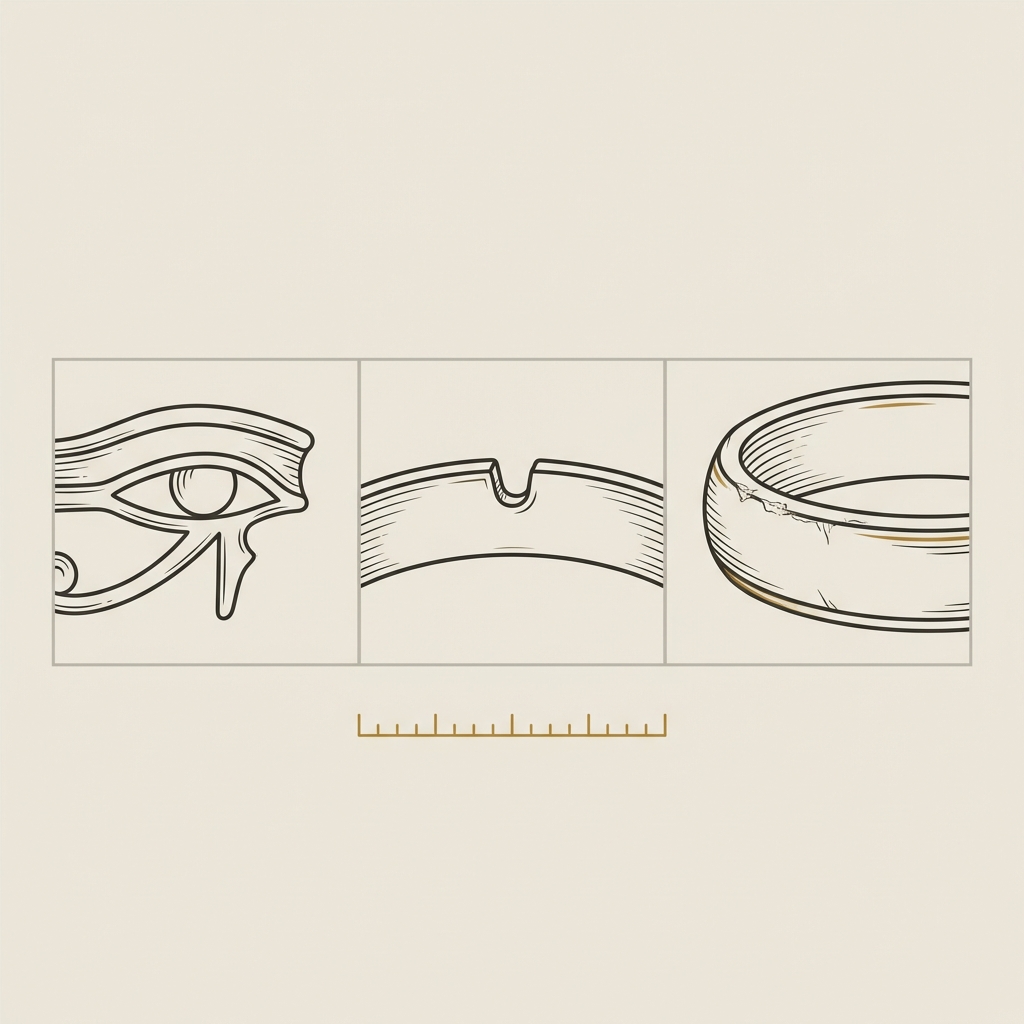
These checks do not replace scientific testing or archival provenance, but they provide an immediate, research-based starting point you can apply to photo-based listings and preliminary inquiries Metropolitan Museum of Art.
Comparing typology with museum examples
When possible, place a candidate ring next to a museum catalogue entry for comparison: bezel proportions, intaglio depth, and typical bead or mounting types can all be diagnostic and museum object records are often the best public source for these comparisons British Museum collection entries. See similar examples in our ancient Roman rings collection.
Ask sellers for scaled photos, clear shots of the bezel from multiple angles, and a measurement of the intaglio surface so you can match those details against a museum image or published catalogue; curators often rely on these same dimensions when classifying small objects Object ID, International Council of Museums.
Condition, restoration and provenance: what to ask before you buy
Reading condition notes and restoration entries
Condition descriptions should be specific: look for statements that explain whether repairs were made, what was stabilized, and whether something was cleaned or left untouched; clear restoration notes let you judge how much intervention affects the piece’s original surfaces and structural stability UCL Digital Egypt.
Common practical phrases you might see include references to consolidated edges, filled losses, reattached mounts, or preserved patina, and each one has an implication for display and wearing regularity; ask for close detail shots that show the exact area discussed in the notes Metropolitan Museum of Art.
What provenance statements should include
Useful provenance entries name previous collections, prior ownership notes, and any verification letters or catalogue comparisons; when a seller can point to a documented collection history or a museum catalogue number, collectors have a stronger basis for evaluating an eye of horus ring British Museum collection entries.
Vague claims such as old private collection without dates or sources are a red flag; instead request dated documentation, photographs from previous sales or collections, and any expert reports that accompany the piece to support stated origins Metropolitan Museum of Art.
For wearable ancient rings, condition notes and provenance combined create the context that allows a reasoned judgement; Aurora Antiqua frames pieces with condition and restoration notes and highlights collection history when available to help buyers assess an item responsibly.
Common mistakes and red flags when assessing Eye amulets and rings
Modern reproductions and misleading descriptions
Modern reproductions and novelty pieces can mimic the wedjat motif in ways that confuse buyers; listings that rely on visual similarity alone without material description, measurements, or provenance are common places where misidentification occurs UCL Digital Egypt.
Watch for language that emphasizes style over substance, such as claims that a piece is ancient based purely on motif without independent documentation; museum comparisons and object records are the right next step when a listing lacks precise notes British Museum collection entries.

Other red flags include inconsistent or changing provenance statements, images that show modern tool marks on what should be worn edges, and polishing that removes age-related surface detail; when these signs appear, request additional documentation or a professional condition report Metropolitan Museum of Art.
Overstated dating or provenance claims
Be wary of listings that provide a precise original findspot or museum-style catalogue language without supporting evidence; authoritative dating and provenance typically come with verifiable documentation or a clear collection history rather than an unqualified assertion British Museum collection entries.
When sellers use phrases like likely ancient but offer no images of the original find or any prior catalogue reference, that is a cue to ask for comparative images and measurements that can be checked against museum records or published references Amulet with the wedjateye of the god Horus, Victoria and Albert Museum, London.
Practical examples: reading three sample listing descriptions
Example A: well-documented small ring
Sample description: "Small silver ring with worn intaglio showing an eye motif, reported from a 20th century private collection, measurements of bezel 10 mm by 8 mm, condition notes: small fill at the bezel edge, stabilized." Cues present: clear measurements, a named prior collection, and a specific restoration note. Next step: request comparative images and any archival photos or sale catalog entries to match the description against museum typologies British Museum collection entries.
Example B: attractive listing missing provenance
Sample description: "Intaglio ring with Eye motif, attractive patina, old appearance." Cues missing: no measurements, no prior ownership named, and no restoration information. Next step: ask the seller for scaled photos, the intaglio dimensions, and a condition report that specifies any repairs or stabilization so you can compare with museum examples before deciding Metropolitan Museum of Art.
Example C: probable modern reproduction
Sample description: "Eye ring, modern cast copy, lightweight alloy, perfectly uniform finish." Cues present: modern material and finish, vague age claims. Next step: avoid purchase until the seller provides material analysis or allows inspection by a qualified restorer, and compare the image to museum intaglios to note differences in carving depth and wear patterns UCL Digital Egypt.
Concluding checklist and next steps for responsible collecting
Three priority checks before purchase
Before buying an eye of horus ring, complete these three priority checks: obtain clear, scaled images and measurements of the intaglio and setting; request detailed condition and restoration notes describing any fills, attachments, or cleaning; and confirm provenance elements such as named prior collections, dates, or catalogue comparisons so you can verify claims against museum records Metropolitan Museum of Art.
Using museum catalogues and standard grammars as comparison tools can materially improve your confidence in an attribution; when in doubt, ask for additional photos and documented comparisons rather than relying on surface appearance alone British Museum collection entries.
a quick comparison checklist to request from a seller
Ask for scale in photos
Finally, remember that Aurora Antiqua presents pieces with condition notes, restoration notes, and collection history when available to help buyers make informed decisions without asserting absolute certainty about provenance or dating.
Look for specific cues: a stylized human-eye profile, materials consistent with known amulet types, clear wear patterns, and named provenance or museum comparisons. Ask for scaled photos and condition notes to support claims.
A helpful listing will provide measurements, detailed condition and restoration notes, any prior ownership or collection history, and high resolution images showing the bezel and intaglio from multiple angles.
Many reproductions show modern tool marks, uniform finish, or inappropriate materials. When uncertain, request material tests or independent condition reports and compare images to museum examples.
More from Aurora Antiqua
References
- Finger Ring with Frog, The Cleveland Museum of Art
- Amulet with the wedjateye of the god Horus, Victoria and Albert Museum, London
- Eye of Horus (Wedjat) Amulet, Egypt, Ptolemaic Period, Art Institute of Chicago
- Ring, Victoria and Albert Museum, London
- Object ID, International Council of Museums
- About us, International Association of Dealers in Ancient Art
- Research report: export licensing and provenance, GOV.UK, Department for Culture, Media and Sport (DCMS)
- Amulet, Victoria and Albert Museum