


Looking for the real thing? Browse authentic Byzantine rings, each piece one of one, individually authenticated, with documented provenance. For the background, see the guide to medieval jewelry.
What an ancient byzantine ring can tell us: definition and historical context
An ancient byzantine ring typically refers to a personal ring produced in the late Roman through Byzantine world, made and worn between roughly the fourth and the fifteenth centuries and carrying visual signals of belief, affiliation and social standing. Museum overviews show that rings from this span often combine devotional imagery, imperial markers and protective signs, so that a single object can serve multiple social purposes Metropolitan Museum of Art
In practice the term covers a wide range of objects, from modest bronze hoops with incised crosses to elaborate gold rings set with garnet cloisonn茅 or carved intaglios; these pieces were used in public display, private devotion and as talismans for personal protection. Curators emphasize that this coexistence of devotional and status functions is a recurring feature across collections British Museum
Collectors should approach the term with a measured expectation: a ring described as an ancient byzantine ring can indicate an estimated geographic and chronological window, but deeper claims about workshop, workshop attribution or precise dating require close study of iconography, technique and provenance documentation. Compare examples in the Byzantine rings collection for reference.

Rings from late Roman into middle Byzantine contexts also demonstrate continuity with earlier decorative vocabulary: geometric and celestial patterns persist alongside an evolving repertoire of explicitly Christian signs, which helps explain why stylistic dating often relies on layered visual evidence rather than a single motif Oxford Handbook of Byzantine Studies
Step 1: start with the bezel and central image. The bezel is the primary carrier of meaning on a ring, and images carved, cast or set there usually reflect the owner's intended message. Look for crosses, portraits, saints or intaglios and note whether the image appears carved into a gemstone, cast in metal or set as an inlay; each mode carries different implications for production and use Victoria and Albert Museum and for comparative catalogues see the Getty catalogue on ancient gems and rings Ancient gems and finger rings.
Step 2: read surrounding motifs and inscriptions. Secondary motifs on the shoulders or hoop, such as monograms, crowns or short incised marks, can change how the central image is read, shifting emphasis from personal devotion to affiliation or rank. Comparing these features with museum catalogues and object studies is a reliable next step rather than relying on the motif alone
Step 3: consider materials and technique for symbolism. The choice of gemstone, the presence of cloisonn茅 garnet, enamel or niello, and details of filigree and soldering often reflect workshop practices and intended visual effects, and they may support a preliminary dating or regional attribution Victoria and Albert Museum
A simple workflow to use when examining a listing or a museum record is to record bezel type, list secondary motifs, note material and technique then compare those notes to published object records. Treat dating as an estimate created by layered observations rather than a single diagnostic sign
Late Roman to early Byzantine continuity is visible where classical and geometric motifs persist on rings alongside new Christian imagery, which makes transitional pieces important for understanding chronology. Museum surveys show that early pieces frequently retain earlier decorative habits even as new symbols appear Metropolitan Museum of Art and scholarship on cameo aesthetics provides useful comparative examples BYZANTINE CAMEOS AND THE AESTHETICS OF THE ICON.
Between Late Antiquity and the middle Byzantine period there is a recognizable shift toward more explicit Christian and imperial imagery, with crosses, Christological signs and monograms becoming more prominent on rings used for public identification and private devotion Oxford Handbook of Byzantine Studies
Use a three step approach: examine the bezel image, read secondary motifs and inscriptions, and assess materials and technique, then compare those observations to museum records and ask for condition, restoration and provenance documentation.
Regional workshop practices also shape motif and technique: cloisonn茅 garnet work, certain enamel styles, or regional carving traditions can indicate production areas or trade connections, but these signals are not absolute and require comparison with securely dated examples and conservation reports Victoria and Albert Museum
Because stylistic and iconographic change is layered and often regionally diverse, any preliminary dating should be considered provisional and corroborated with condition and provenance notes where possible
Materials and techniques as symbolic language
Goldwork and filigree were social signals as well as technical choices, communicating wealth and access to specialized workshops; fine filigree and elaborate mountings often appear on higher status pieces and are therefore part of the ring's language of status Victoria and Albert Museum
Cloisonn茅 garnet inlay and enamel produce a vivid visual brilliance that curators link to symbolic effects such as sanctity or light, particularly on devotional pieces where color and shine reinforce the image's intended meaning Victoria and Albert Museum
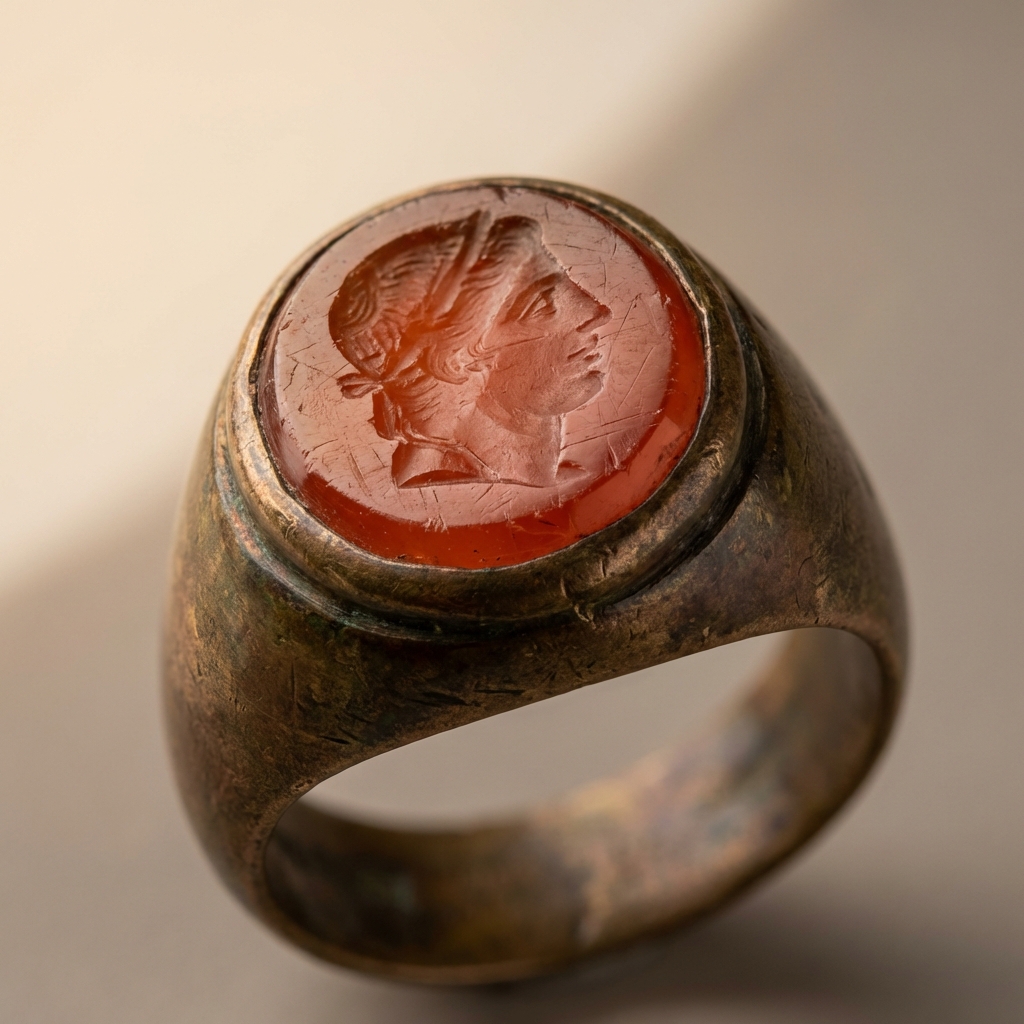
Carved intaglios and niello present a different tactility and reading: an engraved scene or saint carved into carnelian or agate invites close, personal viewing and can function as a portable image for devotion or identification, while niello contrasts and line work can highlight iconographic details
Not every technical choice is symbolic in a single way; techniques also reflect workshop traditions, resource access and regional tastes, so materials and workmanship should be read in combination with iconography and provenance to form a coherent interpretation Oxford Handbook of Byzantine Studies
Crosses, Christ and saints appear persistently on rings across Byzantine collections, where they functioned both for private devotion and public display; such imagery could mark the wearer as part of a devotional community or express personal piety Metropolitan Museum of Art
Apotropaic motifs and talismanic signs are another layer of meaning, and many rings were intended to protect the wearer from harm or illness by combining saints, crosses or simple talismanic marks with everyday wear. This dual role means a ring can be simultaneously devotional and protective British Museum

It is common to find a single ring that combines devotional imagery with protective signs and status markers, so read the bezel, the hoop decoration and any inscriptions together to understand the layered message. Documentation such as condition notes and provenance entries can help explain which elements are original and which may be later interventions
Imperial, monogram and status symbolism on rings
Crowns, monograms and the labarum functioned as markers of affiliation or patronage when they appear on rings, and such insignia are frequently interpreted by curators as signals of relationship to court circles or local elites Metropolitan Museum of Art
Portraits and elite insignia on high-status jewellery operated in both public and private contexts: a ring could advertise loyalty to an imperial household or to a local elite patron, while still serving private devotional needs. Context and documentation affect how strongly one should read these status claims
When monograms or crowns are present, they narrow the range of plausible readings but do not automatically identify a named individual; museum catalogues and comparative studies remain essential to avoid over-assertive attributions Victoria and Albert Museum
Start with condition notes: look for descriptions of surface wear, patina, intentional polishing and any documented repairs or stabilizations. Clear condition notes indicate whether restoration is minimal, reversible or extensive and help you judge how much of the ring's visible language is original ICOM-CC, International Council of Museums, Committee for Conservation
Restoration notes should explain what was done and why, whether metal consolidation, stone resetting or minor solder repairs were performed. A transparent record that distinguishes original joins from later additions is important for evaluating symbolic readings that depend on bezel composition and setting technique
Quick provenance and condition checklist for a ring
Keep copies of documentation
Useful provenance entries list prior ownership, collection history and any verification letters or catalog references; where possible compare the listing to museum object records or published studies to see if similar motifs or techniques are documented in secure contexts Ring, Dumbarton Oaks Research Library and Collection, Trustees for Harvard University. For product-level comparisons see the Aurora Antiqua Ancient Roman rings collection.
When provenance is sparse, pause and ask for high resolution images, full measurements and any available conservation reports. Unclear provenance does not prove inauthenticity, but it increases the need for careful comparative study and, when appropriate, third-party examination
Over-reliance on a single motif without technical study is a frequent error; a cross motif alone does not guarantee a middle Byzantine date or a devotional use without supporting evidence from technique and mounting Protection in Life and Death: Pendant Crosses from the Cemetery of Apollo Klarios at Sagalassos, Cambridge University Press
Confusing later repairs, modern alterations or pastiche additions with original elements leads to misreadings. Restoration can mimic older styles if carried out in the past, so check restoration notes carefully and request conservation reports when something seems inconsistent
Assuming provenance without documentation is another common pitfall. Private listings sometimes conflate oral history with documented collection history, so insist on written provenance entries, catalog references or verification letters before drawing firm conclusions
Practical comparisons: reading three typical motifs on rings
Cross types and variations, from simple incised forms to cruciform or Chi-Rho treatments, change interpretation: a small incised cross on a hoop may be a maker's mark or protective sign, while a detailed crucifixion scene on an intaglio bezel is more likely devotional and intended for personal viewing Metropolitan Museum of Art
Monograms and imperial signs such as crowns or labarum are read differently: a monogram on the shoulder may suggest affiliation or ownership, while the same symbol combined with a portrait on the bezel implies a more active claim to patronage or identity Victoria and Albert Museum
Geometric and celestial motifs can survive from late Roman taste and may be decorative or symbolic, depending on context. When these motifs appear alongside explicit Christian images the reading shifts; context is decisive, which is why museum comparisons are indispensable
A practical checklist for collectors: before you buy an ancient byzantine ring
Documentation checklist: request clear photos from multiple angles, exact measurements, readable condition notes, a description of any restoration and any provenance entries or catalog references. These items form the minimal dossier for a reasoned evaluation About us, International Association of Dealers in Ancient Art
Questions to ask the seller: what is the documented collection history, are there conservation or condition reports, and has any scientific testing been performed? Three direct questions like these often reveal the level of documentation behind a listing
When to pause: if images hide crucial details, if restoration notes are vague, or if provenance is asserted without documentation, pause and seek independent comparison with museum records or a conservator's opinion before committing
Safe wearing practices include avoiding exposure to water, chemicals and strenuous activity; fragile bezels, thin hoops or previously repaired areas are particularly prone to damage if worn regularly. Treat rings described as antiquities with caution when deciding to wear them
For storage and display keep rings in stable humidity, away from direct sunlight and in separate compartments to avoid abrasion. Use soft supports and avoid household cleaners that can alter patina or accelerate corrosion Victoria and Albert Museum
Ethical collecting means retaining provenance documentation, disclosing restoration history and avoiding purchases where documentation is implausible or absent. Good documentation helps future study and supports the object's cultural context
Non-destructive materials analysis and surface characterization can be informative for metal composition and manufacturing technique, and conservation reports often summarize technical findings that support or limit stylistic claims. These approaches are discussed in museum literature on object-level studies The techniques of Byzantine gold jewelry, Paul and Alexandra Canellopoulos Museum, Athens and advanced imaging studies illustrate how digital methods reveal underlayers Revealing the unseen.
Scientific reports can confirm aspects of manufacture and materials but rarely deliver a single conclusive date on their own; combine technical results with iconographic study and provenance research for a balanced interpretation Oxford Handbook of Byzantine Studies
When privately held items lack published technical analyses, the absence should be treated as a gap in documentation rather than as proof of inauthenticity; request any available conservation notes and consider third-party examination when the provenance or condition raises questions
Aurora Antiqua acts as a curatorial reference for collectors by presenting curated ancient rings with clear condition notes, restoration notes and provenance references when available. Listings aim to provide the context a buyer needs to assess symbolism and condition
Typical documentation we prioritise includes detailed condition notes, explicit restoration histories, measurements, photographic documentation and any collection history or verification letters; editorial context explains possible iconographic readings without asserting absolute attribution
We avoid absolute claims about museum status or guaranteed provenance and encourage independent verification when deeper attribution is required. Treat our editorial notes as guidance for further research rather than final certification
Rings from the Byzantine world speak in a layered language that combines devotional imagery, apotropaic signs and status markers, and interpreting that language requires attention to bezel iconography, supporting motifs, material and technique, and documented provenance Metropolitan Museum of Art
Use museum records, object catalogues and handbooks to compare motifs and techniques, and treat stylistic dating as provisional unless supported by conservation reports or clear provenance. The most reliable readings come from combining iconographic comparison with condition and documentation
For collectors the best next steps are to require clear photos and condition notes, seek provenance entries and when in doubt request third-party or conservation input before purchase
Also consult broader reference catalogues for gems and rings when available, such as the Getty catalogue on ancient gems and rings Ancient gems and finger rings.
Compare the cross form, level of detail and its placement with known museum examples; devotional crosses tend to be more detailed and placed on the bezel, while simple incised crosses can be maker marks or protective signs.
Garnet cloisonn茅 often appears on higher status pieces but must be considered with mounting quality, filigree and provenance rather than as a single proof of rank.
Require clear photographs, measurements, detailed condition and restoration notes, and any provenance entries or verification letters before completing a purchase.
More from Aurora Antiqua
References
- Necklace with Pendants, The Cleveland Museum of Art, Ohio
- Earring, Victoria and Albert Museum, London
- Ring, Dumbarton Oaks Research Library and Collection, Trustees for Harvard University
- Protection in Life and Death: Pendant Crosses from the Cemetery of Apollo Klarios at Sagalassos, Cambridge University Press
- Amulette contre le mauvais oeil, Persée, Echos d'Orient, later Revue des etudes byzantines
- Octagonal Pendant, The Cleveland Museum of Art, Ohio
- The techniques of Byzantine gold jewelry, Paul and Alexandra Canellopoulos Museum, Athens
- ICOM-CC, International Council of Museums, Committee for Conservation
- About us, International Association of Dealers in Ancient Art
- Ancient Gems and Finger Rings: Catalogue of the Collections, The Getty