


Looking for the real thing? Browse genuine Byzantine rings for sale, each piece one of one, individually authenticated, with documented provenance. For the background, see the guide to medieval jewelry.
What is a Byzantine bracelet? Definition and historical context
Time span and geographic range, ancient roman bracelet
Byzantine bracelets are a varied family of personal adornments produced roughly between Late Antiquity and the medieval Byzantine world, commonly dated from the 4th to the 15th centuries CE, and examples of these forms are documented across major museum collections, which supply the comparanda used for dating and typology Metropolitan Museum Heilbrunn Timeline.
The term embraces a range of objects, from rigid hoops and armillae to multi‑link chain work; many pieces continued stylistic threads from late Roman metalwork into regional medieval productions. In practice, curators and catalogues use secure finds and dated examples to anchor narrower attributions, rather than the modern label alone Protection in Life and Death: Pendant Crosses from the Cemetery of Apollo Klarios at Sagalassos, Cambridge University Press.

Collectors should understand that dates given in catalogues are usually ranges informed by typology and archaeological context, and that overlap with late Roman forms is common where workshops and tastes evolved gradually. For a buyer, the presence of clear comparanda in museum records strengthens a typological attribution Metropolitan Museum Heilbrunn Timeline.
Common forms and typologies seen in collections
Armlets, cuffs, rigid hoops and flexible chains
Museum catalogues group bracelets into familiar forms: rigid hoops or cuffs, segmented cast bracelets that articulate, articulated chain bracelets, and armilla style bands; these categories help curators and conservators compare an object with securely dated exemplars Gold bracelets with enamel decoration, Museum of Byzantine Culture Thessaloniki.
Rigid hoop bracelets often survive with minimal joins and rely on form and decoration for dating, while segmented cast pieces show clear evidence of moulding and joining; chain bracelets reveal specific link construction that is diagnostic when intact Metropolitan Museum Heilbrunn Timeline.
Museum typologies and dated exemplars
Dumbarton Oaks and other collections provide typologies and dated exemplars that serve as comparanda for attribution, but typologies are a starting point and not an absolute label: they indicate likely date ranges and workshop traditions when matched to technical details and find contexts Gold earring, Museum of Byzantine Culture Thessaloniki.
When a listing cites a specific museum entry as a comparator, buyers gain context for decoration, proportions and technical marks to look for; where such comparators are absent, attributions should be treated as tentative until supported by condition notes or testing The techniques of Byzantine gold jewelry, Paul and Alexandra Canellopoulos Museum, Athens.
Materials and decorative techniques
Common metals and gemstone use
Typical materials for bracelets in the Byzantine and late antique world include gold, silver and copper alloys, and when stones are present they are often semi‑precious types such as carnelian, agate or amethyst, used in settings or as intaglios; noting materials cautiously helps set expectations for conservation Dumbarton Oaks collection overview.
Techniques: granulation, filigree, repoussé, cast segments
Decorative methods frequently recorded in museum catalogues include granulation, filigree and repoussé, alongside cast segment construction for articulated bands; these techniques leave characteristic tool marks and joins that specialists use to evaluate date and workshop practice Metropolitan Museum Heilbrunn Timeline.
Check solder joins and link construction, inspect patina and tool marks in macro photos, compare to museum examples, request provenance and restoration notes, and consider scientific testing if available.
For a buyer examining images, ask whether close photos show granulation spheres, fine filigree wires, or the distinctive seams of cast segments, because those details can shift an attribution from modern reproduction to an authentic workshop legacy Journal of Archaeological Science report on chain construction.
Why the name 'Byzantine' chain can be misleading
Modern jewellery labels vs archaeological classification
In modern trade and popular jewellery writing, the term 'Byzantine' or 'rope' chain describes an interlinking multi‑link weave that recalls ancient multi‑link techniques, but that modern label is descriptive and not a strict archaeological classification; technical studies stress precise link geometry and construction when making historical attributions Journal of Archaeological Science report on chain construction.
Readers should therefore treat evocative chain names as shorthand: they indicate a visual family rather than proof of age. Instead, focus on link construction, solder presence and wear consistent with long burial or handling when assessing a listing The techniques of Byzantine gold jewelry, Paul and Alexandra Canellopoulos Museum, Athens.
How experts and curators identify Byzantine bracelets
Visual markers: patina, solder lines, tool marks
Curators commonly rely on a set of visual markers to assess a bracelet: consistent patina that matches expected burial chemistry, solder joins and their morphology, visible tool marks from finishing, and the construction of links or segment joins; these elements combined with museum comparanda form the basis for confident attribution Bronze disease, Conservation Wiki, AIC Wiki, American Institute for Conservation.

Below is a practical identification checklist you can apply when viewing a listing, followed by the role of scientific tests when available. When using the checklist, document observations carefully and compare them to dated museum examples Object ID, International Council of Museums.
Comparative method using museum examples
When possible, match a listing to securely dated museum examples and note which features correspond: similar solder morphology, comparable granulation patterns, matching link profiles and consistent wear patterns all increase confidence in an attribution Metropolitan Museum Heilbrunn Timeline.
Scientific methods such as XRF can confirm alloy composition and support typological assessments, though testing may not always be available for private sales and must be performed with appropriate permissions; where testing is cited, ask for the report or a summary of results Journal of Archaeological Science report on chain construction. JSTOR article
Dating and workshop attribution: what is possible and what is uncertain
Where dating is well supported
Dating is most reliable when typology and technology match securely dated comparanda or archaeological contexts, for example when a segmented cast technique links closely to dated forms in a museum catalogue; in such cases a date range rather than a single year is the realistic outcome Trésor hellénistique trouvé à Délos en 1964, École française d'Athènes, via Persée.
Open questions and limits in workshop attribution
Precise workshop attribution for many chain types and small finds often remains uncertain because similar techniques were used across regions and workshops, and because small finds rarely carry maker marks; scientists and conservators note that link geometry and alloy signatures can help, but these require comparative material and testing to be decisive Journal of Archaeological Science report on chain construction.
Conservation and care for metal bracelets
Recommended handling and storage
Recent conservation guidance recommends gentle mechanical cleaning, avoidance of aggressive chemical treatment, and stable humidity for metal armlets and chains, measures that protect patina and structural joins while reducing the risk of further corrosion ICOM conservation guidance.
quick pre-assessment checklist for metal bracelets
Use this checklist before requesting specialist testing
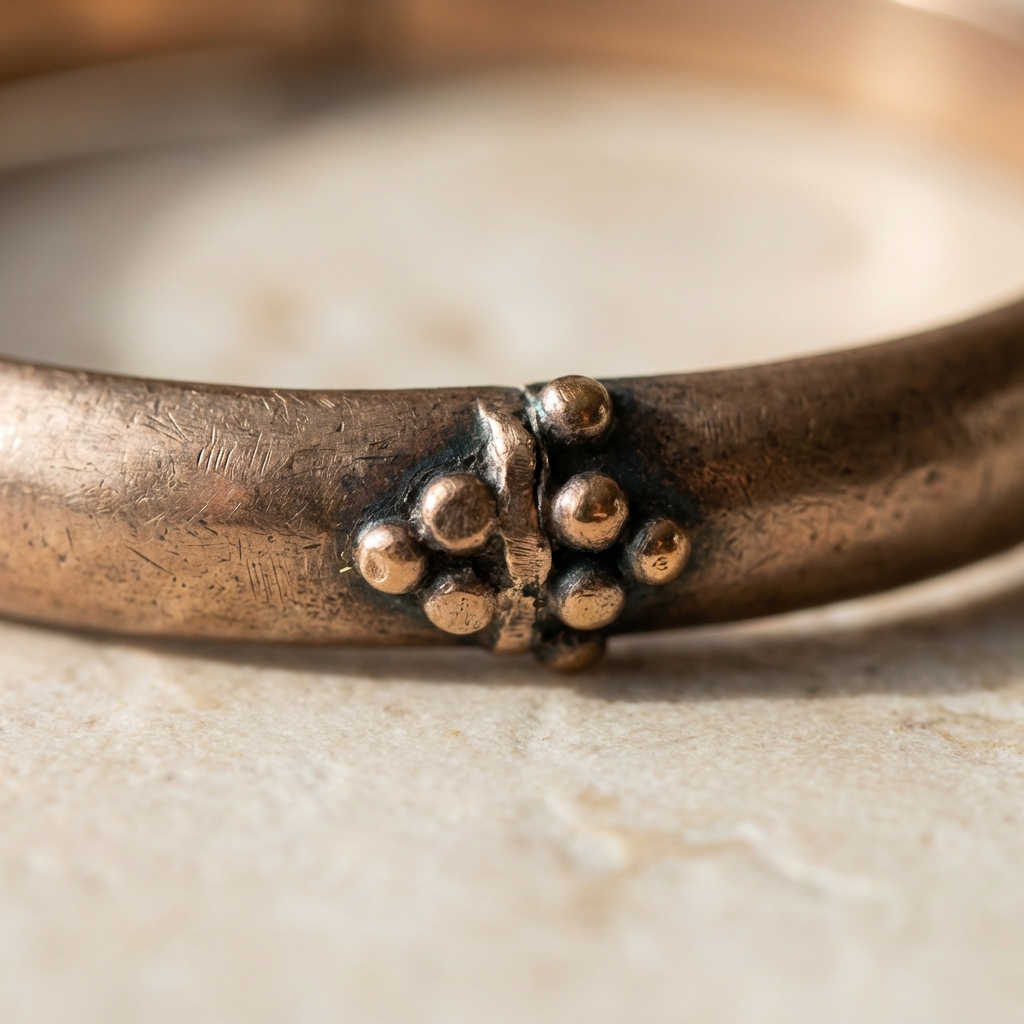
Handle bracelets with clean, dry hands or gloves, store them flat and supported to avoid stress on fragile joins, and keep them in stable humidity away from direct sunlight or fluctuating temperatures; detailed restoration notes should accompany any treated piece ICOM conservation guidance.
What to expect in restoration and restoration notes
Good restoration notes specify what was stabilised, what repairs were made, which joins were reflowed or consolidated, and what was intentionally left untouched; these notes should be clear enough for a prospective buyer to understand the interventions and to consult a conservator if needed ICOM conservation guidance.
Provenance, documentation and market considerations
Why provenance matters
The antiquities market in the mid 2020s shows increased emphasis on provenance documentation and export legality checks, and reputable listings typically include collection history, prior ownership notes or verification letters to help establish context and reduce legal risk Research report: export licensing and provenance, GOV.UK, Department for Culture, Media and Sport (DCMS).
Export legality and due diligence
When provenance is unclear, request documentation of prior export permits, collection history or any auction or catalogue references; sellers who are transparent about provenance and legal checks enable buyers to make responsible decisions without relying on suggestive labels alone Research report: export licensing and provenance, GOV.UK, Department for Culture, Media and Sport (DCMS).
Reading a listing: condition notes, photos and measurements to check
Essential condition note elements
Key condition note elements to expect are a description of patina, any corrosion or active deterioration, detailed statements about old repairs or stabilisation, and clear restoration notes that explain what was done and why; absence of these details is a reason to ask follow up questions ICOM conservation guidance.
Photo angles and measurement details
Useful photos include full shots for scale, close ups of joins and solder lines, macro images of patina and granulation, and a clear scale for size; measurements should give internal diameter, width and any gap measurements for cuffs, which aid in assessing fit and structural condition Object ID, International Council of Museums.
Red flags include vague restoration language, blurry close ups that hide joins, or missing provenance statements; when these appear, request targeted photos showing solder lines and link profiles, and ask whether any testing has been done About us, International Association of Dealers in Ancient Art.
Common misidentifications and typical pitfalls
Confusion with modern reproductions
Modern reproductions or recent repairs can mimic ancient techniques, so buyers should be cautious when a piece looks overly crisp or when decorative techniques are presented without accompanying technical detail; ask for microscopic images of joins to reduce uncertainty Journal of Archaeological Science report on chain construction.
Overreliance on labels and unclear photos
Evocative labels such as 'Byzantine' or 'rope' chain used alone are not sufficient evidence; rely on technical descriptions, condition notes and comparanda instead, and treat any listing that offers only a dramatic label and no documentation with caution Protection in Life and Death: Pendant Crosses from the Cemetery of Apollo Klarios at Sagalassos, Cambridge University Press. Related publication
Practical scenarios: comparing three example listings
Scenario A: well-documented chain bracelet
Step 1: The listing includes high resolution photos showing link profiles, a restoration note that describes a stabilised broken link, and a provenance entry citing a private collection; these elements together increase confidence, and you can request an XRF report if alloy confirmation is desired About us, International Association of Dealers in Ancient Art.
Step 2: Compare the images to dated museum examples with similar link geometry; if the construction details and patina align, the attribution is more plausible and you can proceed to ask for condition specifics and shipping documentation Metropolitan Museum Heilbrunn Timeline. Further references
Scenario B: attractive but poorly documented cuff
Step 1: The cuff shows attractive repoussé and appears complete, but the listing lacks close ups of solder lines and provides no provenance. Treat the attribution as tentative, ask for targeted macro images and a conservator statement before committing ICOM conservation guidance.
Step 2: If the seller cannot supply targeted photos or documentation, consider declining or arranging an independent condition assessment; absence of clear restoration notes or comparanda reduces confidence Research report: export licensing and provenance, GOV.UK, Department for Culture, Media and Sport (DCMS).
How Aurora Antiqua presents ancient bracelets and what buyers should expect
Aurora Antiqua's curatorial approach emphasises clear condition notes, restoration notes and provenance references when available, and editorial content that explains cultural context and common motifs to help buyers understand a piece's likely background.
The brand presents curated ancient rings and select small artifacts with measured descriptions and conservative language about attribution; Aurora Antiqua does not claim absolute authenticity beyond documented evidence and avoids promises about value or museum grade status.
Conclusion: key takeaways and practical next steps for buyers
Concise checklist: examine joins and solder lines, inspect patina for consistency with age, request targeted macro photos of tool marks and granulation, compare to museum exemplars, and ask for provenance and testing when appropriate Bronze disease, Conservation Wiki, AIC Wiki, American Institute for Conservation.
Next steps: request condition and provenance documents, ask whether any scientific testing such as XRF has been performed, and consult a conservator for valuable pieces; approach collecting as an evidence based practice that values clear documentation and careful handling ICOM conservation guidance.
Look for consistent patina, characteristic solder joins, tool marks from period techniques and comparison with museum exemplars; request targeted macro images and provenance documents to increase confidence.
Scientific testing such as XRF can confirm alloy composition and support attributions, but it may not always be available; request reports when possible and consult a conservator for interpretation.
Ask which repairs were made, what was stabilised, which joins were reflowed, and what was intentionally left untouched; clear restoration notes aid future conservation decisions.
More from Aurora Antiqua
References
- Gold bracelets with enamel decoration, Museum of Byzantine Culture Thessaloniki
- Gold earring, Museum of Byzantine Culture Thessaloniki
- Protection in Life and Death: Pendant Crosses from the Cemetery of Apollo Klarios at Sagalassos, Cambridge University Press
- The techniques of Byzantine gold jewelry, Paul and Alexandra Canellopoulos Museum, Athens
- Bronze disease, Conservation Wiki, AIC Wiki, American Institute for Conservation
- Object ID, International Council of Museums
- Trésor hellénistique trouvé à Délos en 1964, École française d'Athènes, via Persée
- Research report: export licensing and provenance, GOV.UK, Department for Culture, Media and Sport (DCMS)
- About us, International Association of Dealers in Ancient Art