


Looking for the real thing? Browse our full ring collection, each piece one of one, individually authenticated, with documented provenance. For the background, see the guide to ancient jewelry.
What an ancient ruby ring is and why it matters
Definition and core features
An ancient ruby ring is an object that combines an antiquity's metalwork with a red gemstone and shows wear consistent with age; the phrase is used here in a conditional sense to describe pieces likely produced in antiquity or the medieval era rather than modern reproductions. Readers should expect descriptions to reference provenance, condition notes, restoration notes, and visible patina when a seller or catalogue uses the term.
Why context and documentation change meaning
Understanding an ancient ruby ring depends less on a single label and more on supporting documents and physical evidence, because lab testing and conservation records together help explain what a ring can tell us about its past and use, as described by gemological authorities like the GIA GIA.
Historically, ruby rings often symbolized power, protection, and love, but a specific ring's meaning depends on documented provenance, conservation history, and laboratory findings; modern buyers should combine these lines of evidence with conservation-first care to make informed decisions.
This introduction is explanatory and does not assert authenticity for any specific piece; it offers guidance on reading documentation and visual cues so collectors can make informed judgments rather than rely on claims alone.
Snapshot: how cultures have read ruby rings across history
Shared themes: power, protection, love
Across many cultures, red gemstones have commonly been associated with power, protection, and love, and those themes appear repeatedly in institutional and gemological literature; this cross-cultural pattern helps explain why similar symbolic language recurs in descriptions of rings.
Regional emphases in brief
Meanings shifted by period and place: for example, classical and medieval European sources often treated red gems as protective or status-bearing, while South Asian and Southeast Asian traditions layered additional rulership or martial ideas onto the stone's symbolism, as summarized in reference works such as Encyclopaedia Britannica Encyclopaedia Britannica.
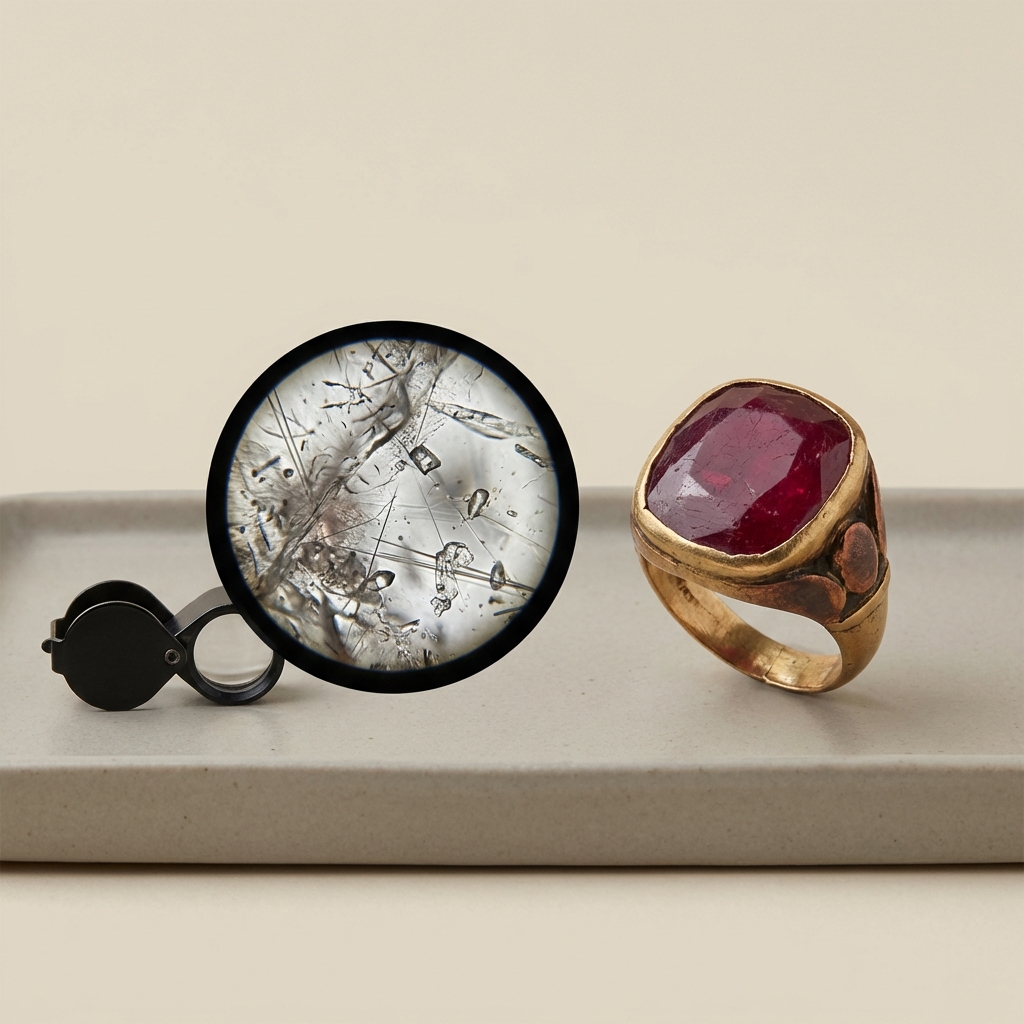
These shared themes provide a starting point for interpretation, but they do not produce a single, definitive meaning for any given ring; context, including documented use and collection history, changes the reading.
Regional stories: South Asia, Burma, the Mediterranean and beyond
South Asian traditions and the ratnaraj idea
In South Asian tradition rubies often appear in classical texts under names like ratnaraj or king of gems, and such language links stones to rulership and vitality in regional literary and astrological commentaries.
Burmese (Mogok) rubies: historical accounts
Historical writing about Burmese rubies stresses their distinct cultural status; accounts describe beliefs that certain rubies from Mogok carried protective or martial virtues for warriors and elites, a theme reinforced in modern historical summaries Smithsonian Magazine.
These regional narratives show why an object's claimed origin matters to interpretation: provenance that suggests a Mogok origin will mean something different to a historian than a general attribution to 'antique' material.
See provenance and lab-report examples on @auroraantiqua
When assessing a piece from a particular region, review provenance summaries and any available lab-report excerpts; these documents help connect cultural meaning to physical origin without relying on assumption.
Roman and Mediterranean practice
In Roman and Mediterranean contexts, red gemstone rings frequently appear in museum collections as both personal ornament and amulet, where they signal social status and sometimes personal beliefs about protection or identity, as seen in curatorial work at institutions such as The Metropolitan Museum of Art The Metropolitan Museum of Art and our Ancient Roman rings collection Ancient Roman rings collection. Read more on our Roman Empire blog Roman Empire blog.
Because regional practices differ, a Mediterranean ring with a red cabochon may represent civic status or decorative taste more than the same stone would in a South Asian or Burmese context.
How ancient ruby rings functioned: status, amulet, and personal ornament
Overlapping roles in daily life and ritual
Red gemstone rings often held overlapping roles: a single object could serve as jewelery, a marker of rank, and a talisman for personal protection or health; museum evidence shows these functions coexisted rather than belonged to separate categories.
How wear and repair tell stories
Signs of wear, soldered repairs, or replaced bezels can indicate prolonged use and changing owners; reading those physical clues alongside condition notes helps reconstruct how a ring was used and what it meant to past wearers, a point emphasized in gemological and curatorial literature GIA.

Interpreting such material evidence requires cautious language: repairs may reflect conservation or past repairs of unknown provenance, and visible patina can be historically informative rather than an aesthetic flaw.
How experts identify an antique ruby ring today
Laboratory methods and what they show
Modern identification relies on combined laboratory methods; microscopic inclusion analysis reveals internal growth features, spectroscopy identifies chemical and optical properties, and LA-ICP-MS and other trace-element work can support origin assessments in conjunction with other data Gems & Gemology.
Compare basic lab report elements to listing claims
Use as a quick checklist
Each method contributes different information: inclusions can distinguish natural from synthetic habits, spectroscopy can reveal treatments or unusual absorptions, and trace-element work and pattern studies may suggest geographic provenance though treatments complicate attribution. For published examples of analytical approaches see work on trace element chemistry Analytical Proof of Origin.
Why lab reports and provenance must be read together
Because treatments such as heat can alter the stone's internal features and complicate origin determination, a laboratory report is most informative when read alongside provenance and clear restoration notes rather than in isolation.
When a listing claims a geographic origin, request the lab report or an independent analysis and compare the document's findings to the seller's provenance statements to build a combined picture of the object's history and treatment.
Provenance, documentation and reading condition and restoration notes
What provenance lines typically look like
Typical provenance statements include collection history, prior ownership notes, and any available verification letters; collectors should look for specific, dated ownership records rather than vague attributions to improve confidence in an object's chain-of-custody, a practice aligned with gemological guidance GIA.
How to interpret condition and restoration statements
Restoration notes that distinguish stabilization from replacement are especially useful: transparent language about which repairs were undertaken, and whether work was reversible, helps preserve the object's historical information and supports future study.
Ask for photographs that document repairs and any conservator reports; clear restoration notes are part of good practice and help readers weigh both historical meaning and present condition carefully.
Conservation and care: preserving patina and structural integrity
Conservation best practice for historic jewelry
Current conservation guidance favors minimal intervention and the preservation of original patina; conservators recommend stabilization and clearly documented, reversible interventions rather than aggressive cleaning that removes historical surface evidence, as outlined by conservation authorities Getty Conservation Institute.

What to avoid when caring for an ancient ruby ring
Avoid harsh polishing, ultrasonic cleaners, or uncredentialed soldering that can remove patina or mask repair history; such actions reduce the ring's value as an historical object and can erase evidence that would otherwise inform dating and use.
Prefer documented, reversible conservation carried out by qualified professionals and request restoration notes that specify methods and materials used so future owners can understand what was changed and why.
How to read a listing: a quick practical checklist
Photos, measurements, and condition cues
Request detailed photos: close-ups of the bezel and shoulders, clear images of any hallmarks, and shots that show scale; measurements and finger size should be listed with tolerances so you can understand fit and any alterations. (See our rings collection rings collection.)
Documentation you should ask for
Ask for lab reports, provenance statements, and restoration notes; when a seller provides a laboratory certificate, compare the report's language to the listing claims and to the visible condition cues in photographs to form a coherent view of the piece, a practice supported by gemological method guidance Gems & Gemology.
Keep a running checklist as you review listings: sharp photos, readable measurements, explicit condition statements, and any certificates or letters of verification improve confidence in an online viewing.
Common mistakes and red flags when buying an ancient ruby ring
Over-interpreting vague provenance
Vague provenance lines such as 'old private collection' without dates or prior owner names are a caution: they do not automatically disqualify a piece, but they reduce the amount of verifiable information you can rely on when interpreting meaning and origin.
Ignoring restoration and condition language
Failing to note restoration language is a common error; missing repair descriptions, or a lack of close-up photos of repaired areas, make it hard to assess how much of the ring is original and how much was changed, which in turn affects both meaning and conservation needs.
Another red flag is a listing that claims a precise origin without any lab report or supporting provenance; when origin affects meaning, insist on documentation before accepting the seller's statement.
A decision framework: how to evaluate whether a piece is right for you
Priority checklist: meaning, condition, documentation, budget
Begin by ranking what matters most to you: cultural meaning, condition and wear, extent of restoration, and how much documentation you require; this prioritization helps align a purchase with your collecting goals rather than a single attribute like origin or appearance.
When to seek third-party reports or specialist advice
If origin or treatment materially affects your decision, request an independent gemological report or specialist conservation advice; third-party reports are especially useful when a piece has ambiguous restoration history or when the seller's provenance lacks detail, reflecting best practice in gem testing and attribution Gems & Gemology.
Use the decision framework: if documentation and condition align with your priorities, proceed with care; if key evidence is missing, weigh whether the piece's personal meaning justifies the additional risk or expense of testing.
Practical examples: three short scenarios
Scenario A: a ring with strong provenance and partial lab data
Imagine a ring offered with dated collection history and a lab report noting natural ruby characteristics but not full trace-element analysis; in this case the documented provenance strengthens the cultural reading while the partial lab data suggests further testing could clarify origin if that is important to you.
Scenario B: a visually convincing ring with no paperwork
A ring that looks convincing in photographs but comes without provenance or lab testing increases uncertainty; the buyer must decide whether the object's visual and personal appeal outweighs the lack of documentation or whether to request an independent inspection before purchase.
Scenario C: a ring with clear restoration and a lab report
If a listing discloses substantial restoration but offers a transparent conservator report and a laboratory certificate describing treatments, the combination of openness and technical data allows a buyer to make a measured decision about historical meaning and conservation needs Getty Conservation Institute.
Each scenario shows that different mixes of evidence produce different levels of confidence; transparency and documentation are the common currency that make those judgments possible.
Wearing and interpreting a ruby ring today
Personal meaning versus historical context
Historical symbolism can inform how you wear or interpret a ring, but personal meaning is valid; a collector might value a ring for its iconography while another wears it as a talisman, and both readings coexist without negating scholarly context.
Styling and practical care tips
When wearing an ancient ruby ring, handle it gently, avoid moisture and detergents, and remove it for manual labor; document any changes in condition or additional conservator work so future owners will have a clearer provenance and restoration record.
These steps preserve both the object's physical integrity and its narrative value as a wearable antiquity, aligning modern use with conservation-aware practice.
Ethical considerations: seller and buyer responsibilities
Due diligence and legal-ethical sourcing
Buyers and sellers share responsibility to document provenance and to follow applicable laws and export rules; gaps in chain-of-custody are common and reduce certainty, which is why combined lab testing and documentary evidence are the best current practice for attributing origin and meaning Gems & Gemology.
Recording condition and provenance for future collectors
Keep clear records of condition, restoration, and any certificates to aid future attribution and scholarship; good record keeping preserves the object's story and supports responsible collecting over time.
Transparent documentation benefits the wider community of collectors, curators, and scholars by reducing ambiguity about an object's history.
Conclusion: balancing cultural meaning, evidence and care
Short summary of takeaways
Wearing a ruby ring historically could mean power, protection, love, or some combination of these themes; assessing what a specific ancient piece means today relies on provenance, lab testing, clear restoration notes, and conservation-aware handling, as advised by gemological and conservation authorities GIA.
Next practical steps for readers
Ask for detailed photographs, request any available laboratory reports and provenance statements, prefer minimal restoration and documented conservation, and consider independent testing when origin or treatment materially affects your decision.
With careful documentation and conservation-first care, an ancient ruby ring can be both a wearable object and a piece of material history worthy of thoughtful stewardship.
A reliable assessment combines microscopic inclusion analysis and spectroscopy with an independent laboratory report; request the report and compare its language to the listing and any provenance statements.
Not automatically, but missing provenance increases uncertainty; ask for close-up photos, restoration notes, and consider independent testing before buying.
Handle it gently, avoid chemicals and ultrasonic cleaners, store it in preservation-grade materials, and document any wear or conservation actions.
More from Aurora Antiqua
References
- Pliny the Elder, The Natural History, BOOK XXXIII, Perseus Digital Library, Tufts University (edition Bostock)
- Aulus Gellius, Attic Nights, Book X, LacusCurtius, Bill Thayer, University of Chicago (Loeb Classical Library edition)
- Philip Kiernan and Klaus-Peter Henz, Rings from the Forbidden Forest, Cambridge University Press
- William Wytlesey's ring, Victoria and Albert Museum, London
- Ring, The Cleveland Museum of Art
- 16 CFR Part 23, Guides for the Jewelry, Precious Metals, and Pewter Industries, Federal Trade Commission, eCFR
- Chart of Commercially Available Gem Treatments (Gems & Gemology, Winter 2002), Gemological Institute of America
- How to Care For Your Jewellery: The Ultimate Guide by the National Association
- Ruby Gemstone, Gemological Institute of America
- The Ten Best Photography Books of 2023, Smithsonian Magazine