


Looking for the real thing? Browse our full ring collection, each piece one of one, individually authenticated, with documented provenance. For the background, see the guide to ancient jewelry.
Quick answer: Aphrodite rings in the context of ancient greek rings
An Aphrodite ring is, in curatorial and scholarly usage, an ancient intaglio or engraved gem set in a small metal ring with a female deity motif that can indicate Aphrodite or Venus, most often assigned to Classical through Hellenistic periods.
Collectors care about these rings because the combination of iconography and technical markers helps establish likely date and cultural origin, while provenance and condition notes determine the level of confidence a buyer should have when considering a purchase. Browse our Ancient Greek Rings collection.
Behind-the-scenes: follow @auroraantiqua for fresh finds and restoration insights
A short note for readers: consider pieces with clear images, condition notes, and documented collection history before making a decision; these details are central to responsible collecting.
What is an Aphrodite ring? Definition and museum context within ancient greek rings
In museum catalogues the term Aphrodite ring commonly identifies rings whose engraved gems show attributes or scenes associated with the goddess, and curators typically present this identification alongside technical descriptions of the gem and mount rather than as a stand-alone label; this practice places iconography and material description together in the object record The Metropolitan Museum of Art object records.
When museums date and attribute these rings they usually limit their assignments to a broad range such as Classical to Hellenistic, c. 5th to 1st centuries BCE, and they rely on stylistic comparison and the mounting form as part of their reasoning British Museum collection entry.

How museums and collections label examples of Aphrodite rings
Typical object records include fields for material, a short engraving description that highlights the depicted figure and attributes, bezel and hoop form, dimensions, condition notes and any collection history; these fields help a reader understand which elements supported the museum's attribution Ashmolean Museum collection entry.
Collection entries often pair a concise title such as "Intaglio of a female head (Aphrodite) in a bezel" with photographs and condition comments, which provide comparators for collectors evaluating market listings.
Compare high-resolution images with museum object records, request full measurements and condition notes, ask for provenance documentation or prior cataloguing, and seek independent testing or specialist consultation if uncertainty remains.
When you compare a market listing to a museum object record, focus on the same catalogue fields the museums use: material, engraving description, bezel form, and condition notes.
Iconography: how Aphrodite is depicted on engraved gems
Common motifs that can indicate Aphrodite include a nude or diademed female figure, a shell, a dove, and the presence of Eros or related attributes; curators typically infer identity from combinations of these signs rather than a single emblem Journal of Hellenic Studies article on gem iconography.
Because many motifs overlap with other female deities or represent generic beauty scenes, attributions based on iconography are cautious and often stated as likely or probable rather than certain, so collectors should compare motifs across dated examples in museum literature when possible The Metropolitan Museum of Art object records.
Technical features to examine on ancient greek rings: gems, cuts and mounts
Gem material and the way it has been cut or engraved are central technical markers; for example, carnelian intaglios with a particular engraving style are common in rings assigned to Greek workshops and are recorded in museum object descriptions Ashmolean Museum collection entry.
Look closely at bezel shape, how the gem sits in its setting, and the hoop form; these metalwork features are the kinds of details curators note when assigning a likely period or workshop attribution.

When evaluating images, request macro photos that show the intaglio in profile and the junction between gem and bezel so you can judge whether the setting is original, later, or repaired.
Dating and attribution framework: how experts assign period and origin
Dating is a multi-factor exercise: curators combine motif style, engraving technique, gem cutting, and metalwork form to place a ring within a typological sequence rather than relying on a single diagnostic trait British Museum collection entry.
Scholars use comparisons with well-dated parallels and typologies to suggest workshop attributions and to argue for likely origins; attributions are often presented with degrees of confidence and can change with new evidence or analysis Ashmolean Museum discussion of dating criteria.
Provenance, documentation and why they matter for ancient greek rings
Provenance elements that increase confidence include a clear collection history, prior cataloguing or publication, acquisition notes with dates, and any third-party verification such as expert letters or lab reports; museums and auction houses emphasise these points in their records The Metropolitan Museum of Art collection overview.
A lack of chain-of-custody, vague acquisition statements, or missing documentation should be treated as a warning sign and lowers the confidence a collector can reasonably have in an attribution.
a simple worksheet to record a ring's provenance and condition when assessing a listing
keep entries short and date-stamped
When sellers provide provenance and documentation, ask for scans or photos of prior catalogue entries, letters, or invoices; museum object records are often the best comparators for framing a claim.
Scientific tests and third-party reports: what can and cannot be determined
Laboratory analyses such as gemological reports and metallurgical assays can provide objective data about material composition and treatment, but they are not universally available for market items and may be costly to obtain Ashmolean Museum notes on object records.
Because many market listings lack third-party testing, strong provenance and detailed condition notes become more important, and collectors should treat the absence of lab reports as a reason to request further documentation or an independent examination.
Conservation and condition notes: best practices for intaglio rings
Conservation guidance for small metalwork and gem-engraved objects favours minimal, reversible intervention, and control of storage conditions to protect patina and engraved surfaces; museums document any stabilisation or repair work in condition notes Getty Conservation Institute guidance.

A proper condition description will specify what was stabilised, what remains unrestored, visible losses, and any areas of active corrosion or fragile joins; photographic documentation of repairs should be available when restoration is reported.
Storage, handling and routine care for wearable antiquities
Handle rings with clean hands and avoid abrasive contact on the intaglio face; fragile rings are best tried on only briefly and returned to protective storage after handling.
Long-term storage should be stable, with controlled humidity and temperature, soft supports for rings to avoid pressure on the bezel, and photographic records for insurance or future study; consult a conservator before any attempted cleaning or repair.
Buying checklist and decision criteria for collectors of ancient greek rings
Minimum documentation to require from a seller includes high-resolution images from multiple angles, full measurements, explicit restoration notes, a provenance statement, and any available third-party reports; having those items allows a more informed assessment (see our article on why intaglio meaning matters).
Decision criteria should be explicit: acceptable condition ranges, the level of restoration you are willing to accept, and how much uncertainty in attribution you will tolerate; if key information is missing, seek independent examination or decline a purchase.
Typical mistakes and red flags when assessing Aphrodite rings
One common mistake is over-reliance on a single motif; a shell or a draped figure alone can be suggestive but is rarely definitive for Aphrodite without supporting stylistic or contextual evidence Journal of Hellenic Studies article on gem iconography.
Other red flags include vague provenance statements, missing condition details, no multiple-angle images, and unverifiable claims of laboratory testing; when these appear, ask for more documentation or independent verification.
Practical examples and short case studies
Use a museum object record as an annotated example: note how the title, material description, engraving notes, bezel form, dimensions, and collection history combine to support an attribution in the record British Museum collection entry.
For a hypothetical market listing, follow a step-by-step checklist: 1) compare images with museum parallels; 2) check for clear measurements and close-up photos of joins; 3) request restoration documentation; 4) evaluate provenance statements; 5) decide whether to seek an independent report.
Conclusion: how to approach Aphrodite rings as wearable history
Approach Aphrodite rings as objects where iconography and technical features work together with provenance and condition notes to build a reasoned picture of age and origin.
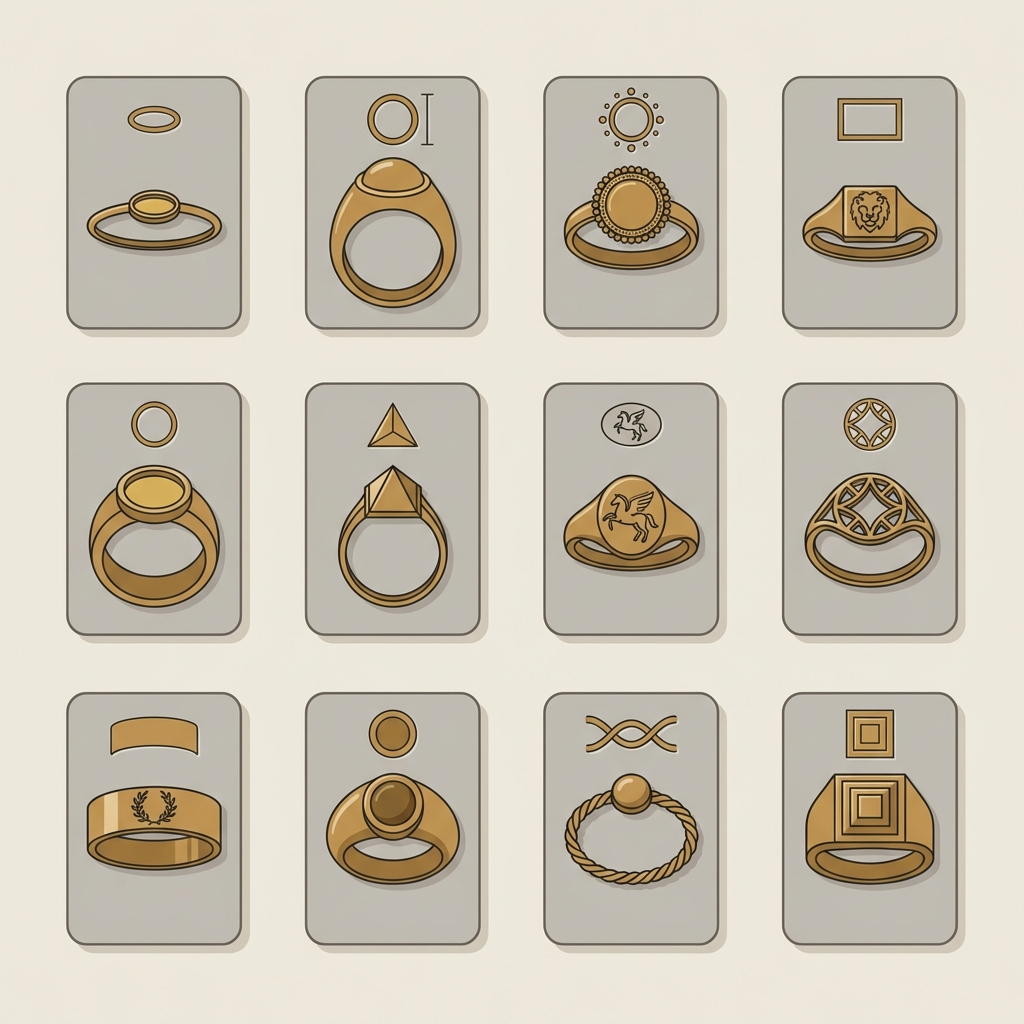
Prioritise pieces with clear photographs, transparent restoration notes, and a documented collection history, and consult specialists or request third-party reports when confidence in attribution is important.
Look for a combination of motifs such as a diademed or nude female figure, shell, dove or Eros attribute, and compare the engraving style and mount with museum examples; a single motif alone is rarely decisive.
A lab report can add objective data but is not always available; when tests are absent, rely on detailed provenance, condition notes, and high-resolution images or seek independent examination.
Store it in stable, low-humidity conditions on a soft support, keep photographic records, avoid frequent wear, and consult a conservator before any cleaning or repairs.
More from Aurora Antiqua
References
- Art & Architecture Thesaurus Full Record Display (Getty Research)
- Getty Museum Acquires Collection of Ancient Engraved Gems, J. Paul Getty Museum, Los Angeles
- A Corpus of Roman Engraved Gemstones from British Sites, University of Michigan Press / BAR Publishing
- Engraved Gem with Woman Leaning on a Column, Harvard Art Museums / Arthur M. Sackler Museum
- Head of a Roman emperor, Victoria and Albert Museum, London
- "Sappho" Earring, Harvard Art Museums / Arthur M. Sackler Museum, Cambridge, Massachusetts
- A. M. Caggiani u. a., Corroborating the autoptic identification, Wiley, Journal of Raman Spectroscopy
- Amnon Rosenfeld, Michael Dvorachek, Shua Amorai-Stark, Elsevier, Journal of Archaeological Science
- Ganymede jewelry (Gold, rock crystal, emerald), Greek, Hellenistic, ca, The Metropolitan Museum of Art, New York
- Ancient Gems and Finger Rings: Catalogue of the Collections, The Getty