


Looking for the real thing? Browse our Ancient Roman ring collection, each piece one of one, individually authenticated, with documented provenance. For the background, see the guide to Roman jewelry.
What is Roman glass from Israel? A concise definition for roman glass jewelry collectors
Timeframe and geographic span
For collectors, Roman glass from Israel refers to glass objects produced, used, or deposited in the southern Levant during the broad Roman and late antique period, roughly the 1st century BCE through the 7th century CE. These items include small personal objects as well as vessel fragments that reached the region through trade, local workshops, and reuse over many generations. Compositional studies show that much Roman-period glass in Israel has a soda-lime-silica chemistry and a mixture of imported primary glass and locally worked secondary glass, a distinction that shapes how collectors read material and context Journal of Archaeological Science article on Levantine glass composition.
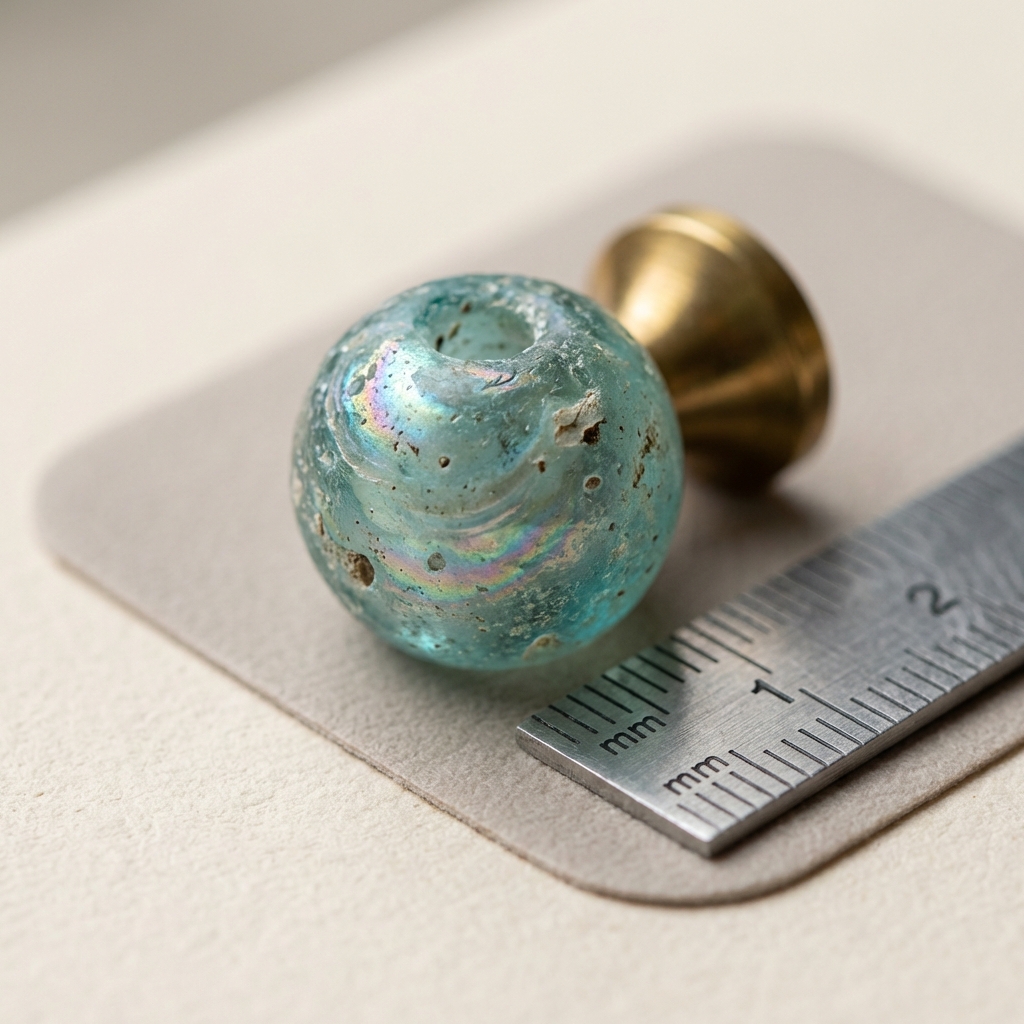
Common finds include beads, small jewelry elements, and vessel fragments recovered in urban contexts, tombs and coastal wrecks. Visually, these objects tend to appear in aqua, blue-green and olive tones and often display burial weathering such as iridescence and pitting, markers that can help separate likely ancient material from modern glass imitations when combined with documentation and analysis Israel Museum collection guide to Roman and Byzantine glass.
Behind the scenes at @auroraantiqua
If you collect ancient jewelry, use the checklist below and save a one-page visual checklist to compare photos and condition notes before buying.
Typical objects and forms
Small objects typical of the region include rounded beads, simple glass rings and inlaid elements that were incorporated into metal settings. Vessel fragments are common, and fragments of blown or blown-mould forms are often encountered in excavation assemblages. The mix of imported primary glass and local secondary working means collectors will see both finely finished blown forms and more utilitarian recycled pieces, so condition and context matter for assessment Israel Antiquities Authority overview of glass finds and glassworking in Israel.
For a practical approach, treat glass finds from Israel as archaeological material: evaluate colour and weathering, ask for excavation or collection history, and consider non-destructive analysis if the item is high value or composition is unclear.

How Roman glass was made and worked in the Levant - production and technology
Primary versus secondary glass and compositional fingerprints
Roman-period production has two linked stages collectors should understand. Primary glassmaking produced raw glass ingots at major furnaces, often far from final markets. Secondary glassworking involved melting, shaping and recycling that glass into vessels, beads and small objects at local workshops. Compositional studies from 2024 and 2025 show that Roman glass in the Levant follows a soda-lime-silica chemistry with regional trace signatures capable of distinguishing Egyptian primary glass from locally recycled Levantine glass, a distinction that helps explain variation seen in market material Journal of Archaeological Science article on Levantine glass composition and a detailed study of glass production at Jalame.
For collectors, the practical implication is that two visually similar objects can have different origins and histories: one may be made from imported primary glass and finished in a workshop, another made from locally remelted and recycled glass. When composition is available, it can shift interpretation from imported to local working, so combine compositional cues with provenance documentation before drawing firm conclusions.
Shifts in technique: blowing and blown-mould forms
From the late Hellenistic period into the Roman era, glassblowing and blown-mould techniques became widespread. These methods made characteristic forms that collectors encounter frequently, including thin-walled vessels, moulded decorations and small blown items adapted as jewelry components. Archaeological reports and curatorial records note the spread of these techniques across the Mediterranean, with local workshops in the Levant using imported glass or recycled material to feed their furnaces Israel Antiquities Authority overview of glass finds and glassworking in Israel.
The presence of blown and blown-mould features can be a helpful visual cue, but they do not alone prove a piece is ancient or tied to a specific production centre. Contextual notes, laboratory data and clear provenance remain essential for confident attribution.
How to identify roman glass jewelry: a practical checklist for collectors
Visual markers: colour, bubbles, mould seams and weathering
Start any visual screening with colour and weathering. Roman glass from Israel most commonly appears in aqua, blue-green and olive tones and often shows surface iridescence, pitting or exfoliation produced by long burial and salt interaction. Look for mould seams and small gas bubbles as manufacturing traces; bubbles, irregular thicknesses and certain mould seam patterns are consistent with older blown and moulded methods Israel Museum guide to Roman and Byzantine glass. Additional comparative studies on related glass types can help provide laboratory context research on glass tesserae and lost decorations.
Other useful visual cues are wear consistent with use rather than modern tooling marks, and the character of surface weathering. Iridescence that forms in micro-layers over long burial is different from uniform abrasions or fresh polish applied in recent times. Use good, high-resolution photos taken at multiple angles and with scale to assess these features.
Look for characteristic colours and burial weathering, request clear provenance and condition notes, and use non-destructive compositional checks like pXRF when necessary; consult a conservator for fragile or salt-damaged pieces.
Documentary markers: provenance, excavation records and lab tests
Documentation is central. Request excavation records, collection history, or any verification letters that accompany a piece. Clear provenance, especially excavation-backed documentation, substantially increases confidence in attribution. When documentation is incomplete, non-destructive testing such as pXRF can provide compositional fingerprints that support or question an attribution; use testing as part of a layered verification plan rather than the sole proof of authenticity Journal of Archaeological Science article on Levantine glass composition and consider broader compositional literature including an Alexandrian glass hafnium isotope study.
If you cannot obtain compositional data, weigh the documentary evidence more heavily and be cautious of listings with vague histories or missing condition notes. For higher-value items, consider an independent expert review or lab analysis before purchase.
Dating and archaeological contexts in Israel: where these pieces come from
Key find contexts: ports, urban sites, tombs and shipwrecks
Roman glass in Israel appears in a variety of contexts that inform dating and use. Coastal ports, including major hubs like Caesarea, shipwreck assemblages, urban occupation layers and tombs all yield glass objects; context helps narrow dates and intended use. Excavation summaries and curated collections show that ports and shipwrecks are particularly productive for glass finds that travelled through maritime trade networks Qadum excavation report on glass from Karm er-Ras.
When a piece has excavation provenance tied to a well-reported context, dating and interpretation become more secure. In contrast, unprovenanced finds or items with only vague collection histories require more scrutiny and, ideally, compositional checks.
When to use pXRF and when to seek lab analysis for glass
pXRF is non-destructive but may not resolve all source questions
Notable excavation case studies
Targeted excavation reports from recent seasons document concentrated glass assemblages at specific sites and provide useful points of comparison for collectors. For example, reports from Karm er-Ras and other targeted excavations record hundreds of glass finds that illustrate both imported and locally worked material in the southern Levant, and these assemblages help researchers build compositional baselines that collectors can consult when available Qadum excavation report on glass from Karm er-Ras.
While these reports improve our understanding, precise workshop attributions across the southern Levant remain an open research question. Compositional studies are expanding the dataset, but many smaller finds still lack published baselines that would make local workshop attribution straightforward.
Caring for ancient glass jewellery: conservation and storage best practices
Everyday handling and display tips
Conservation guidance for ancient glass emphasizes gentle, preventive care. Avoid abrasive cleaning, keep humidity stable and store on pH-neutral supports to reduce further deterioration. These simple preventive measures help protect fragile weathered surfaces and reduce the risk of salt-driven damage or exfoliation Getty Conservation Institute guide to caring for glass.
Keep handling to a minimum, use clean gloves or finger cots, and display glass pieces in enclosed cases where relative humidity is controlled. Strong, direct light can accelerate deterioration of some glass surfaces, so moderate lighting and UV filtering are advisable.

When to consult a conservator
Heavily weathered or salt-contaminated glass requires specialist treatment such as desalination, consolidation or professional stabilization. Do not attempt these procedures at home. A conservator will assess soluble salts and structural needs and recommend a treatment plan. When a piece is fragile, professional consolidation can stabilise fragments for safe handling and display Getty Conservation Institute guide to caring for glass.
For purchases, ask sellers for restoration notes or conservation histories. Transparent restoration and condition notes, rather than vague claims, allow buyers to set realistic expectations about handling and display requirements.
Buying roman glass jewelry responsibly: provenance, documentation and questions to ask
Documentation checklist for purchase
Before buying, request clear documentation: collection history, any excavation references, curator or dealer condition notes, and third-party verification letters if available. Excavation-backed provenance is especially informative because it ties objects to a secure archaeological context, which supports dating and attribution Israel Antiquities Authority overview of glass finds and glassworking in Israel. For common buyer queries see our questions and answers page.
Ask for high-resolution photos showing all sides and the scale. Request condition and restoration notes that describe what was stabilised, repaired or intentionally left untouched. When a seller provides tangible paperwork or references to a published excavation, this materially increases confidence in the object’s history. If you need seller contact details, use our contact page.
Red flags and verification steps
Beware vague provenance statements, evasive answers about restoration, or pressure sales language. Red flags include inconsistent condition descriptions that do not match the photos, sudden polishing that removes weathering layers, or refusal to allow non-destructive testing for high-value items. If something feels unclear, pause the transaction and seek an independent opinion or request compositional testing.
Use the documentation to set expectations about wear consistent with age and to understand the likelihood that an item saw local secondary working or later repairs. Good sellers will present condition notes and provenance clearly, enabling informed decisions without pressure.
Common mistakes and pitfalls collectors make with ancient glass
Over-relying on visual cues alone
Visual screening matters, but it has limits. Over-reliance on colour or iridescence alone can mislead because modern treatments or deliberate ageing can mimic some surface effects. Visual cues should be combined with documentary evidence and, when appropriate, compositional testing to reduce the chance of misattribution Israel Museum guide to Roman and Byzantine glass.
Buyers sometimes assume that apparent burial weathering always means an object is ancient. In reality, some weathered-looking surfaces result from modern chemical treatments or inappropriate cleaning. When in doubt, request expert assessment before buying.
Misinterpreting restoration and condition
Modern repairs can be stabilised in ways that mimic original joins or can be concealed by retouching. Ask sellers for explicit restoration notes and, if possible, images taken before any work was done. If a piece has been consolidated or filled, understand how that affects handling and display requirements and whether restorations are reversible.
If you suspect improper restoration, seek a conservator’s assessment. A conservator can often identify modern adhesives, fills or retouches that are not visible to the unaided eye and advise on safe next steps.
Practical examples and mini case studies of roman glass jewelry from Israel
Bead and ring examples with condition notes
Example 1, bead: A listing shows a small aqua bead with surface iridescence, minor pitting and a consistent collection history citing an excavation report. Photos include closeups of the perforation and surface layers. In such a case, good provenance plus visible burial weathering increases confidence, and a non-destructive pXRF check can clarify whether the composition aligns with Levantine secondary production or an imported primary glass signature Qadum excavation report on glass from Karm er-Ras.
Example 2, ring element: A small glass inlay in an ancient-style ring listing shows olive tone and mould seam traces but no provenance. The seller provides condition notes describing mild stabilization. Without excavation or compositional data, treat the piece cautiously: ask for higher-resolution photos, condition histories and, for a higher-price item, consider pXRF before purchase.
How compositional data influenced interpretation
Compositional testing can move an attribution from probable import to probable local working. For instance, a lab report showing trace element patterns consistent with Levantine secondary production supports local remelting and workshop finishing as a plausible history. Published compositional baselines and recent studies help place single-object results in a comparative framework, so when a test result is available it should be read alongside regional datasets Journal of Archaeological Science article on Levantine glass composition and related literature such as studies of regional production.
Compositional results are one piece of evidence; they are best used together with provenance, condition notes and photographic records to form a balanced judgment about an object.
Conclusion: next steps for collectors and open research questions
Practical next steps
Key takeaways for collectors are straightforward: ask for clear provenance and condition notes, use visual screening for colour and burial weathering, and consider non-destructive compositional checks like pXRF when the item is high value or has unclear history. These steps help buyers make informed, cautious choices when acquiring roman glass jewelry.
If you are building a collection, document every purchase, retain condition notes and photos, and consult conservators for fragile or heavily weathered pieces. When sellers provide excavation references or published comparanda, use those reports to set dating and attribution expectations rather than relying on appearance alone Qadum excavation report on glass from Karm er-Ras. You can also review items in our Ancient Roman rings collection for examples.
Research gaps collectors should watch
Open research areas include more precise workshop attributions within the southern Levant and expanded published compositional baselines for smaller finds. As researchers publish broader datasets and more excavation reports become available, collectors will benefit from improved comparative material that clarifies when an object likely represents Egyptian primary glass, Levantine secondary working, or local recycling Journal of Archaeological Science article on Levantine glass composition.
Remaining evidence-focused and cautious is the best approach: use documentation, conserve responsibly, and support transparent dealers and publications that improve our shared knowledge of these materials.
Look for aqua, blue-green or olive tones, surface iridescence and pitting consistent with burial, mould seams or small air bubbles, and ask for excavation provenance or compositional checks such as pXRF to increase confidence.
No, avoid abrasive cleaning; store items on pH-neutral supports and consult a conservator for heavily weathered or salt-contaminated pieces to avoid irreversible damage.
Request pXRF or lab tests for high-value items or when provenance is unclear; pXRF is non-destructive and useful for initial screening while full lab analysis may be needed for detailed source attribution.
More from Aurora Antiqua
References
- Gold finger ring with glass intaglio: a lioness (1995.85.2), The Metropolitan Museum of Art, New York
- Internet Archaeol. 40. Atkinson and Preston. Objects of personal adornment, Internet Archaeology, Council
- SF-A79B96, Roman copper alloy and glass finger-ring from Norfolk, Portable Antiquities Scheme, British Museum
- Uncovering Roman Carlisle 2024 autumn excavation announced, Cumberland Council
- Act on the Protection of Cultural Property (Kulturgutschutzgesetz, KGSG), English translation, German Federal Ministry of Justice
- eCFR, Office of the Federal Register and Government Publishing Office
- 1995 Convention, UNIDROIT, International Institute for the Unification of Private Law, Rome
- Archaeological materials, Icon, The Institute of Conservation (UK)
- PubMed Central
- ‘Alexandrian’ glass confirmed by hafnium isotopes, Nature