


Looking for the real thing? Browse our full ring collection, each piece one of one, individually authenticated, with documented provenance. For the background, see the guide to ancient jewelry.
What we mean by Ancient Rings: definition and historical context
When specialists use the phrase Ancient Rings they mean objects that are both old by archaeological standards and that have material or contextual traits linking them to a historical period. An ancient ring is not defined only by age in years but by a blend of form, materials, and supporting context that together provide a plausible date range and cultural attribution.
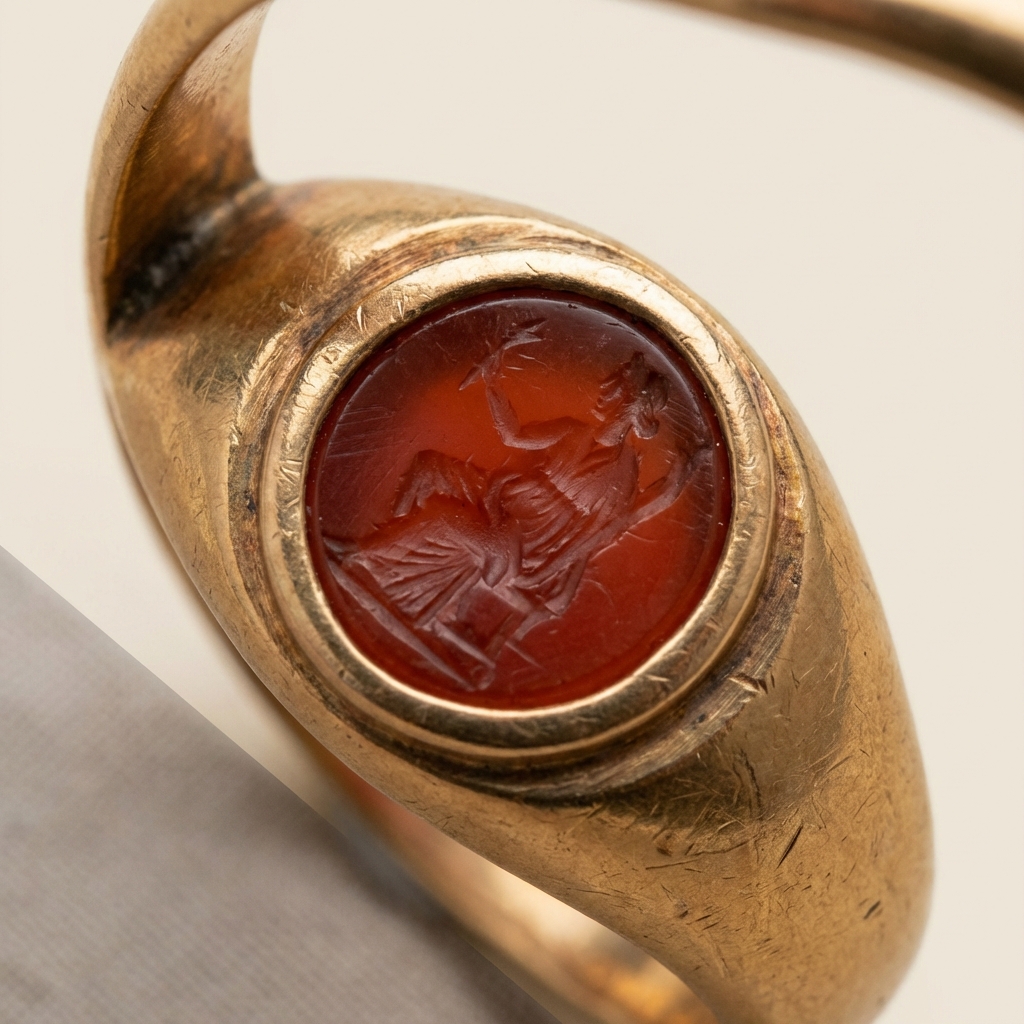
Terminology matters. Words such as antiquity, dating, and workshop attribution signal different levels of confidence. Dating estimates often rest on typology or context and can be revised; workshop attribution can suggest a regional style but is rarely absolute without further documentation.
Using calm, conditional language is a practical habit: an object may be described as likely from a particular period, or appearing to fit a workshop tradition, but such statements are tentative. Collectors who learn this vocabulary can better read descriptions and ask useful follow up questions when evaluating a listing.
How archaeologists and historians date Ancient Rings
Dating an artifact is a cumulative process that combines multiple lines of evidence rather than a single decisive test. Contextual dating, where a ring is recovered with reliable stratigraphic records or clear findspot documentation, is one of the strongest supports for a date estimate. When findspot records exist they provide the association needed to place an object within a broader archaeological sequence. See How Do Archeologists Date Sites and Artifacts? for an overview of relative and absolute dating approaches.
See rings and restorations up close on @auroraantiqua
Look for listings that supply clear condition notes, measurements, and provenance details before making decisions about age and origin.
Typological dating is another common approach. Specialists compare shapes, mount styles, bezel forms, and decorative motifs to well dated examples in museums and publications. Typology gives relative dates and can be especially helpful when contexts are missing, but similarity alone does not prove contemporaneity.
Scientific methods can supplement typology and context when undertaken responsibly. Techniques such as metallurgical analysis, X-ray fluorescence for alloy composition, and, where applicable, direct dating of organic inclusions can provide independent data points. Yet testing is not always performed for every object, and results require interpretation by specialists familiar with ancient technologies. For further context on scientific dating techniques see Smithsonian Human Origins - Dating.
Because each method has limits, the most reliable dates arise when contextual information, typological parallels, and scientific analysis converge. Listing descriptions that present multiple supporting details are generally easier to evaluate; absence of those details increases uncertainty.
Earliest reported Ancient Rings by region and why claims differ
Claims about the earliest rings vary because different scholars and stakeholders prioritize different kinds of evidence. One study or catalogue may cite a securely excavated ring as an early example, while a collector or dealer might highlight an unprovenanced object with early stylistic traits. The label oldest depends on whether the criterion is a securely dated find, continuous documented provenance, or a technological feature that suggests antiquity.
Regional differences also shape narratives. The Near East and Mediterranean yield very early metalworking traditions and a dense archaeological record, so early rings from those regions are often well discussed in academic literature. Northern Europe has later widespread ring forms in the medieval period, which leads scholars of that area to emphasize different chronological markers.
Strong claims rely on convergence from context, typology, scientific testing, and transparent provenance; any single line of evidence without corroboration is usually insufficient.
Because archaeological practice, publication history, and collecting traditions differ by region, a candidate described as the oldest in one literature stream may not appear in another. Scholarship evolves with new finds and new tests, so what is presented as earliest in one decade can be revised later as evidence accumulates.
For practical purposes, a useful stance is to treat claims about the single oldest ring as provisional and to look instead for the kind of evidence behind the claim. That evidence might include excavation records, peer reviewed publication, or documented collection history.

Materials, manufacture and designs in early Ancient Rings
Early rings commonly use metals such as bronze, copper alloys, and increasingly silver and gold where available. Gemstones like carnelian, agate, and occasionally amethyst appear in settings; these stones were valued for durability and ease of carving when intaglios or engraved motifs were required. Observing the interplay of metal and stone can give clues to technique and period.
Manufacturing techniques vary by time and place. Casting was common for basic hoops and decorative forms, while bezel setting and intaglio engraving required more refined skills. A bezel that is integral to the hoop often indicates a particular workshop approach, whereas a separately mounted bezel may suggest a different technological tradition.
Aurora Antiqua product listingsWear patterns, patina, and evidence of historic repairs are practical features to note. A stable, even patina on a metal surface and wear consistent with age can be informative, but restoration can obscure or alter these cues. Clear restoration notes that describe what was stabilized or repaired are therefore a helpful part of any listing.
Collectors should examine high resolution images for signs such as casting seams, tool marks around a bezel, and the profile of an intaglio. These observable traits are part of the visual vocabulary specialists use to assess manufacture and plausibility of an attribution.
Iconography, symbolism and functions of Ancient Rings
Iconography - the images and symbols on rings - provides interpretive possibilities and sometimes a dating cue. Intaglio images of deities, animals, or personal emblems can align with known a visual repertoire from certain periods. Inscriptions, when present, can supply language or letter forms that narrow a date range, though handwriting and letter forms require specialist reading.
Function is another important dimension. Rings used as seals or signets typically bear a carved or engraved negative image designed to impress on wax or clay. These functional seals often show iconography adapted for that purpose, which can be distinct from purely decorative motifs used on personal ornament.
Iconography alone has limits. Similar motifs can persist across long periods or be revived in later centuries, so an image that looks classical does not prove ancient origin without supporting documentation. Specialists therefore weigh iconographic evidence alongside materials, context, and technical analysis.
How experts verify age and provenance of Ancient Rings
Verification relies on a mix of documentary and material evidence. Typical provenance documentation includes collection history notes, previous ownership records, labels from earlier catalogues, and verification letters from recognized specialists. Each item increases confidence to varying degrees depending on its clarity and traceability.
Conservators' reports and restoration notes are also important. A conservator can describe what was repaired, whether solder was added, or whether fills were used to replace missing material. Those notes help distinguish original features from later interventions and inform valuation of condition and authenticity.
Quick checklist to screen documentation and photos for an ancient ring
Use as an initial screening aid
Scientific testing can add independent data. Metallurgical analysis can show alloy recipes that match known historical practices, while surface analysis can detect modern tooling. Yet tests require good sampling, interpretation by experts, and sometimes comparison to reference collections; they rarely provide simple yes or no answers on their own.
When provenance remains uncertain, experts look for convergence: consistent typology, credible condition notes, and any documentation that can be traced to an earlier collection or publication. Absence of these elements raises reasonable doubt rather than a definitive negative finding.
Decision criteria for collectors: buying Ancient Rings responsibly
Collectors should prioritize transparent documentation and clear condition notes when evaluating listings. Ask for high resolution photos from multiple angles, exact measurements, and any available collection history. A responsible seller or curator will provide these details and will describe restoration work rather than hide it.
Assess risk by identifying gaps in provenance and testing. Red flags include vague age claims without supporting evidence, inconsistent or missing measurements, and descriptions that rely heavily on evocative language instead of concrete documentation. When in doubt, request more images or independent opinions.
Practical steps before purchase include asking for exact dimensions and weight, close ups of junctions like the bezel-shoulder join, and any paperwork that traces ownership history. If restoration notes exist, request a brief description of materials and methods used so you can judge how much of the visible surface is original.
Another good practice is to compare the listing to published typologies or museum catalogues to see whether the form and motifs fit known parallels. This kind of comparative reading is part of a steady, cautious approach to collecting that reduces surprises after purchase.
Common mistakes and pitfalls when evaluating claims about the oldest Ancient Rings
One common error is overreliance on evocative marketing language. Phrases that promise the single oldest example or emphasize age without documentation should trigger skepticism. Descriptive charm is not a substitute for context or condition notes.
Confusing typological similarity with secure dating is another frequent pitfall. A ring may resemble known early forms yet lack contextual evidence to place it in the same period. Comparable motifs can be copied or revived in later times, so similarity must be one part of a larger argument.
Misreading restoration or later alterations as original features can mislead both buyers and novice scholars. Modern solder, added stone mounts, or aggressive cleaning can change surface appearance and obscure original tool marks. Always ask for restoration notes and, if necessary, independent images of suspect areas at high magnification.
Practical examples and scenarios for collectors of Ancient Rings
How to read a listing: start with photos, then confirm measurements and condition notes. Good listings include a clear description of provenance or collection history, an honest account of restoration, and multiple photographs showing bezel profiles, interior hoop marks, and any inscriptions or intaglios.

Interpreting a restoration report: short statements such as stabilized crack or replaced bezel foot indicate limited interventions. Detailed reports that list materials used, such as conservation grade adhesives or reversible fills, are more reliable. Vague wording about repairs should prompt follow up questions.
When to seek an independent assessment: if a listing makes a strong age claim but provides little or no documentation, consider asking a recognized conservator or an independent specialist for an opinion. This is particularly important for high value items or pieces with unusual iconography or rare materials.
Sample checklist for a single listing: confirm multiple high resolution images, ask for exact measurements and weight, request provenance notes or previous auction or catalogue references, and obtain clear restoration notes. If answers are incomplete, pause and seek more information before committing.
Summary: how to think about claims that a ring is the oldest Ancient Ring
Strong claims about an object being the oldest hinge on convergence of evidence: secure context, typological parallels, scientific testing, and transparent documentation. No single element usually suffices on its own. Treat statements that emphasize a singular superlative with caution and look for the underlying support.
For collectors, the practical path is steady: prioritize listings and sellers that provide clear photographs, condition notes, and documented provenance. When restoration notes are available, use them to understand what was altered and what remains original. When doubt persists, seek independent advice rather than rely solely on a description.
As research advances and new finds appear, scholarly views about early rings may change. A balanced, evidence based approach helps collectors appreciate objects as historical material while managing the uncertainties that are intrinsic to antiquities.
Experts combine contextual information, typological comparison, material analysis, and documentation to form a date estimate; no single test is usually definitive.
Request high resolution photos, measurements, condition and restoration notes, and any provenance or collection history that traces prior ownership or publication.
Yes, restoration can obscure original surfaces and tool marks, so clear restoration reports are important to understand which features are original.
More from Aurora Antiqua
References
- Pliny the Elder, The Natural History, BOOK XXXIII, Perseus Digital Library, Tufts University (edition Bostock)
- Aegean and Cypro-Aegean Non-Sphragistic Decorated Gold Finger Rings, American Journal of Archaeology
- Finger Ring with Frog, The Cleveland Museum of Art
- Ring, Victoria and Albert Museum, London
- Dating of Artifacts, Smithsonian Institution, Museum Conservation Institute (MCI), Washington
- Emilie Riha, Der römische Schmuck aus Augst und Kaiseraugst (Roman jewelry from Augst and Kaiseraugst), Römermuseum Augst
- Research report: export licensing and provenance, GOV.UK, Department for Culture, Media and Sport (DCMS)
- How Do Archeologists Date Sites and Artifacts? (U.S. National Park Service)
- Dating, humanorigins.si.edu