


Looking for the real thing? Browse our full ring collection, each piece one of one, individually authenticated, with documented provenance. For the background, see the guide to ancient jewelry.
Short answer: there is no single undisputed oldest gold ring
Short answer: there is no single undisputed oldest gold ring. The strongest evidence for the earliest worked gold comes from the Varna Chalcolithic cemetery in Bulgaria, which is widely cited as the earliest large assemblage of processed gold; however that observation applies to a hoard of worked gold objects rather than a single, well published ring-level find, so naming one object as the absolute oldest gold ring would be misleading in many cases Varna culture, Encyclopaedia Britannica.
Individual gold rings tied to securely dated pre-Bronze Age burials are uncommon, and many of the named museum examples people encounter in lists and displays come from Bronze Age or later contexts. That reality means the phrase oldest gold ring is often used loosely, and readers should expect nuance when encountering headlines or dealer descriptions Pliny the Elder, The Natural History, BOOK XXXIII, Perseus Digital Library, Tufts University (edition Bostock).
Why a single definitive ring is hard to name: gold itself cannot be radiocarbon dated, so age estimates rest on excavation context, associated datable organics, typology and accession documentation. When those lines of evidence are missing or incomplete, a confident single-object claim is difficult to sustain Gold: Its use and symbolism in the ancient world, The Metropolitan Museum of Art.
The outline of this article will provide the definitions and methods researchers use, survey the main candidate contexts and museum examples, explain how experts verify dates and provenance, and end with a short checklist collectors can apply when evaluating a claimed oldest gold ring.
See behind-the-scenes on @auroraantiqua
The following sections explain the evidence and provide a short checklist to help you judge claims about an oldest gold ring without relying on sensational headlines.
What researchers mean by 'oldest' and how ancient gold is dated
When researchers speak of the oldest gold they often mean one of two related but distinct claims. One is an assembly-level claim, namely the earliest securely dated context that contains worked gold objects. The Varna Necropolis is commonly described in this way because it contains the earliest large-scale worked gold assemblage currently recognized in the literature The Varna Necropolis, National Archaeological Institute with Museum.
Gold cannot be dated directly with radiocarbon, because radiocarbon dating applies to organic materials. That technical limitation means archaeologists date gold jewellery indirectly, using controlled stratigraphy from excavation, typological comparison with other dated objects, and radiocarbon dates from associated organics such as textile, wood, charcoal or bone. In practice this combination of methods is decisive when assessing which gold objects can be described as earliest with confidence L'anneau sigillaire d'Arégonde, femme de Clotaire Ier, découvert à Saint-Denis, Bulletin de la Societe.
Published excavation reports and museum accession records are central to these assessments, because they allow researchers to trace the find context and any prior analyses. Where a ring is published in a peer-reviewed context or is held with clear accession documentation, it becomes possible to evaluate the strength of the dating claim; absent that documentation, statements about a ring being the oldest are weak or speculative Gold: Its use and symbolism in the ancient world, The Metropolitan Museum of Art.
Key candidates and museum examples people cite as "old" gold rings
When people search for the oldest gold ring they typically encounter three sets of contexts: the Varna Chalcolithic finds, some early Bronze Age and Bronze Age rings from Near Eastern royal tombs such as the Royal Cemetery at Ur, and ring examples from ancient Egyptian holdings. Each of these is important to the story, but they play different roles in the argument about earliest gold. Coverage of Varna in popular media has also appeared in recent pieces LiveScience, which readers may encounter when researching the site.
The Varna Necropolis matters because it contains the earliest large-scale processed gold currently published, commonly dated to about 4600 to 4300 BCE. Those dates place Varna earlier than the major Near Eastern and Egyptian ring finds when the comparison is about the earliest processed gold as an assemblage Varna culture, Encyclopaedia Britannica. Additional technical dating discussion appears in an AMS dating study of Varna AMS dating of the Varna cemetery, Cambridge.

Royal tombs such as the Royal Cemetery at Ur and major Egyptian collections include early gold finger rings and signet rings, often tied to third and second millennium BCE contexts. These items are historically and materially important and appear in museum catalogues, but in terms of the earliest worked gold assemblage they generally come later than Varna Royal Tombs of Ur, Penn Museum.
That distribution of evidence explains why many museum-held ring examples are described as early or ancient, yet do not displace Varna as the primary candidate context for earliest worked gold. As of 2026 no single published ring has clearly overturned the Varna-era dates when judged by the strict standards of excavation context and datable organics The Varna Necropolis, National Archaeological Institute with Museum.
How archaeologists and museums verify dates and provenance for gold jewellery
Controlled excavation reports are the foundation for secure dating claims. A well documented excavation provides stratigraphic context that shows exactly where an object was found in relation to datable layers and features. Published stratigraphy, ideally with illustrations or photographs, is what allows later researchers to confirm or re-evaluate an object's proposed age Gold: Its use and symbolism in the ancient world, The Metropolitan Museum of Art.
Because metals cannot yield radiocarbon ages, archaeologists seek associated organics for direct radiocarbon dating. For example when a textile fragment or a piece of charcoal is found in the same sealed context as a gold object, dating that organic material can provide secure bounds for the object's age. This indirect dating approach is standard and explains why museum records often cite context material in their accession notes Standards: Konservatorische Behandlung von archäologischen Funden (conservation of archaeological finds), Bundesdenkmalamt Österreich.
Museum accession records and published provenance notes are also decisive. Accession entries that include excavation details, prior publications, and any conservation treatment allow researchers to follow the object's documented chain of custody. Where accession records are missing or vague, an object's age claim is harder to verify and should be treated cautiously Gold: Its use and symbolism in the ancient world, The Metropolitan Museum of Art.
A practical checklist: deciding whether a claimed "oldest gold ring" is convincing
When you encounter a claim that a ring is the oldest gold ring, apply a short set of questions that focus on documentation and context. The following checklist condenses the criteria researchers prioritize; use it to assess listings, headlines or catalogue entries.
A brief checklist to assess claims about an ancient gold ring
Use this as an initial evaluation guide
Five quick questions to apply to any claim: Was the object recovered in a controlled excavation with published stratigraphy; is there direct association with datable organics; does a museum accession record or catalogue entry exist; is there peer-reviewed analysis or a reputable museum catalogue entry; are condition and restoration notes provided for the piece. If the answer to these is mostly yes, the claim is more credible Gold: Its use and symbolism in the ancient world, The Metropolitan Museum of Art.
Red flags to watch for in market listings and popular articles include lack of excavation context, vague provenance language, claims based solely on stylistic similarity without associated dating, and listings that omit restoration or condition notes. These signs are reasons to request more documentation or a professional assessment before accepting an extraordinary age claim Royal Tombs of Ur, Penn Museum.
Common mistakes and misleading headlines about "oldest" rings
One common mistake is conflating earliest worked gold objects as an assemblage with a single oldest ring. Headlines that say the oldest gold ring has been found sometimes compress a longer argument about early gold-working into a single object-level claim, and that compression misleads readers about the actual strength of the evidence. The Varna finds are often the source of this confusion because they are rightly celebrated as an earliest gold context, yet they do not equate to a single published ring-level example for most readers Varna culture, Encyclopaedia Britannica.
Another mistake is over-reliance on stylistic dating without context. Stylistic comparison can be useful, but when it stands alone and is not backed by stratigraphy or associated radiocarbon dates it yields tentative conclusions. Popular articles and market descriptions can repeat stylistic attributions without noting their limitations, which creates misleading impressions about how securely an object is dated Royal Tombs of Ur, Penn Museum.
Finally, pay attention to condition and restoration. Many ancient rings show repairs, later modifications, or conservation work, and those interventions can complicate interpretations of age and use. Restoration notes, when provided, help readers understand what was stabilized or altered and why that matters to the object's interpretation Gold: Its use and symbolism in the ancient world, The Metropolitan Museum of Art.
Practical examples: comparing Varna objects, Ur finds and Egyptian rings
Varna's significance rests on the character and dating of the hoard. The site contains large quantities of worked gold objects found in a cemetery context that has been analyzed and summarized in excavation literature and exhibition notes. This strong assemblage-level documentation is why Varna is central to discussions of the earliest worked gold The Varna Necropolis, National Archaeological Institute with Museum. More accessible discussion of the finds appears in a Smithsonian feature on Varna Smithsonian.
By contrast, ring finds from the Royal Tombs of Ur and from Egyptian collections are often published as individual objects with good accession records and clear archaeological contexts, but their dates usually fall in the third or second millennium BCE, which places them after the Varna assemblage when comparing earliest processed gold on a broad chronological scale Royal Tombs of Ur, Penn Museum.

No single object has unambiguously satisfied the highest standards of stratigraphic publication and associated dating to be called the undisputed oldest gold ring; the Varna assemblage is the primary early gold context, while securely published ring-level examples tend to date later.
When you read a museum label for a ring, check whether it states the excavation context, whether associated organics were dated, and whether the accession record cites a prior publication. These elements are the quickest way to judge how tightly an age claim is supported by evidence Gold: Its use and symbolism in the ancient world, The Metropolitan Museum of Art.
To read a museum catalogue entry use this approach: locate the accession number and any excavation citation; read the short provenance statement for context; note whether radiocarbon or other scientific analyses are mentioned; and check condition and conservation notes. Applying these steps will make it clearer whether a given ring can reasonably be described as among the earliest known Royal Tombs of Ur, Penn Museum.
What collectors should take away and how Aurora Antiqua frames listings
Simple takeaways are these: there is no single undisputed oldest gold ring, and the Varna Necropolis represents the earliest large-scale processed gold currently discussed in the literature. Individual ring-level claims require strong excavation context and associated dating to be persuasive, so treat absolute statements with caution The Varna Necropolis, National Archaeological Institute with Museum.
Aurora Antiqua presents curated ancient rings spanning Roman, Greek, Byzantine, Islamic, Celtic, medieval, and post medieval periods, and where we can provide provenance and documentation references we do so as part of condition notes and restoration notes. This approach helps collectors evaluate items based on published context and accession-style documentation rather than headline claims. Our role is to provide curated ancient rings, select small artifacts and relic objects offered alongside jewelry, restoration and preservation notes that describe what was stabilized, repaired, or left untouched, and provenance and documentation references when available Gold: Its use and symbolism in the ancient world, The Metropolitan Museum of Art.
When considering a purchase, prefer listings that include condition descriptions, restoration notes, and any provenance or prior publication references. Such transparency allows collectors and history-minded buyers to decide how convincing an age claim is, and to understand the limits of the evidence when radiocarbon dating cannot be applied directly to gold About us, International Association of Dealers in Ancient Art. For browsing curated offers and featured items see our highlighted collections.
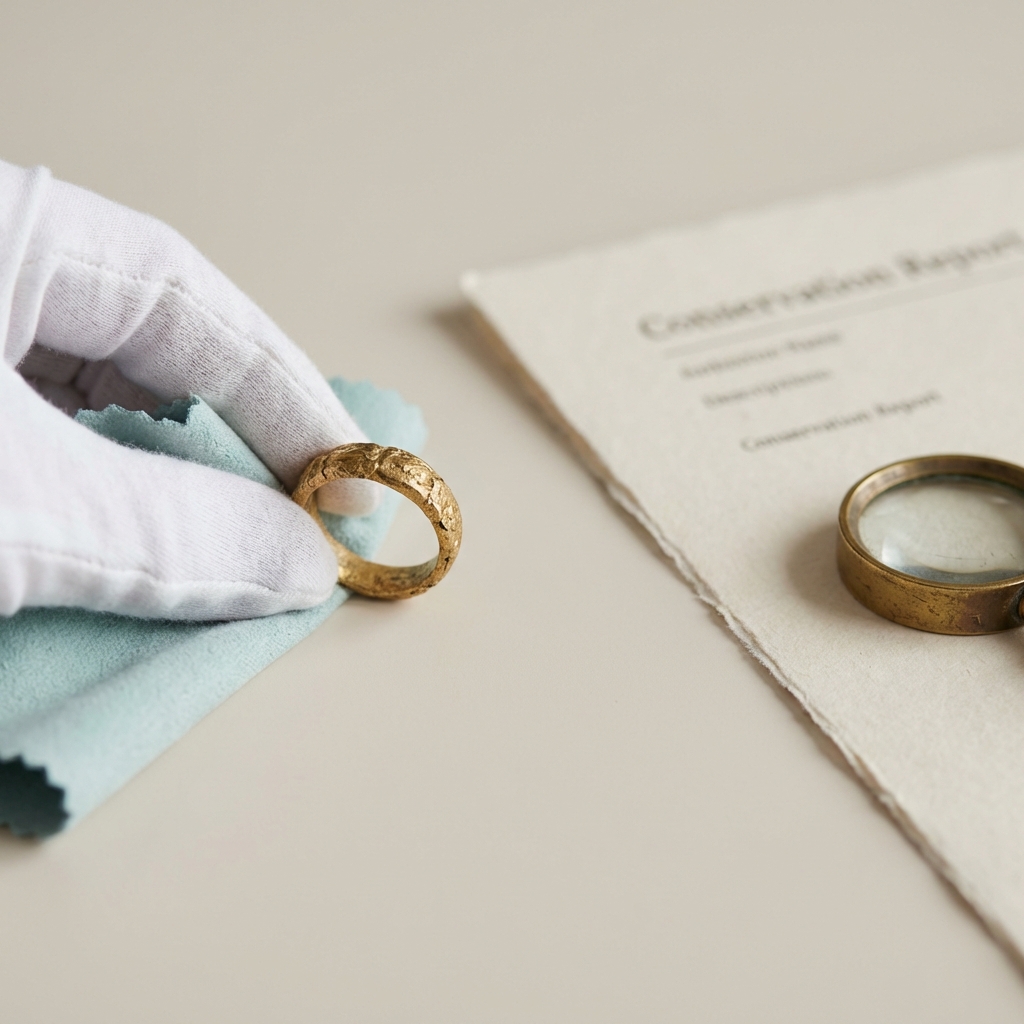
When people search for the oldest gold ring they typically encounter three sets of contexts: the Varna Chalcolithic finds, some early Bronze Age and Bronze Age rings from Near Eastern royal tombs such as the Royal Cemetery at Ur, and ring examples from ancient Egyptian holdings. Each of these is important to the story, but they play different roles in the argument about earliest gold.
We also list rings and related items on dedicated category pages so collectors can filter by period and type; for example our rings collection and Roman ring selection are available for browsing rings collection and Ancient Roman Rings.
When considering a purchase, prefer listings that include condition descriptions, restoration notes, and any provenance or prior publication references. Such transparency allows collectors and history-minded buyers to decide how convincing an age claim is, and to understand the limits of the evidence when radiocarbon dating cannot be applied directly to gold Research report: export licensing and provenance, GOV.UK, Department for Culture, Media and Sport (DCMS).
Gold is dated indirectly, using excavation stratigraphy, typology and radiocarbon dating of associated organic materials; the metal itself cannot be radiocarbon dated.
Varna is the earliest large-scale worked gold context known, but it is not commonly represented by a single widely published ring that can be named without qualification.
Request published excavation information, associated radiocarbon dates if any, museum accession or catalogue references, and clear condition and restoration notes.
More from Aurora Antiqua
References
- Pliny the Elder, The Natural History, BOOK XXXIII, Perseus Digital Library, Tufts University (edition Bostock)
- L'anneau sigillaire d'Arégonde, femme de Clotaire Ier, découvert à Saint-Denis, Bulletin de la Societe
- Standards: Konservatorische Behandlung von archäologischen Funden (conservation of archaeological finds), Bundesdenkmalamt Österreich
- Archaeological materials, Icon, The Institute of Conservation (UK)
- About us, International Association of Dealers in Ancient Art
- Research report: export licensing and provenance, GOV.UK, Department for Culture, Media and Sport (DCMS)
- Finger Ring with Frog, The Cleveland Museum of Art
- Ring, Victoria and Albert Museum, London
- AMS Dating of the Late Copper Age Varna Cemetery, Bulgaria, Cambridge University Press
- Mystery of the Varna Gold: What Caused These Ancient Societies to Disappear?, Smithsonian Magazine