


Looking for the real thing? Browse genuine ancient rings for sale, each piece one of one, individually authenticated, with documented provenance. For the background, see the guide to ancient jewelry.
Definition: what counts as the 'oldest wedding ring'
The phrase ancient wedding rings can refer either to the oldest surviving ring object or to the earliest ring demonstrably used as a marital token, and those are distinct questions with different evidentiary demands.
Archaeology records finger rings as personal objects from at least the third millennium BCE, but asserting that a given ring served as a betrothal or wedding token requires contextual or documentary support beyond the object itself; textual and legal sources are often necessary to make the social claim credible Encyclopaedia Britannica overview on wedding rings. For an overview of dating techniques see Archaeological Dating.
a short framing tool to compare "oldest" claims when reading listings
Use to prioritise documentary evidence
For collectors and curators, the key distinction is between physical antiquity and social function. An ancient ring may survive in excellent condition yet have no evidence linking it to marriage rituals; conversely, a later ring can be well attested as a betrothal token in contemporary texts.
Because dating methods and cultural practices vary, the cautious approach frames any claim about the "oldest wedding ring" as a hypothesis that depends on provenance, typology and, where available, supporting texts or inscriptions.
Special Image Description: Aurora Antiqua Logo
Physical evidence across ancient cultures: an overview
Rings appear across many regions and time periods, with secure finds stretching back to the third millennium BCE in the Egyptian and Near Eastern archaeological records, where they functioned as personal jewellery and sometimes as amulets British Museum collection overview on Egyptian jewellery, and they are also represented in the Ancient Greek Rings collection.
Common materials recorded in museum catalogues and object studies include bronze and gold for metal rings, reed and other organic forms that sometimes survive in burial contexts, and stone intaglios set into metal bezels; the material choice affects both preservation and the type of evidence available for interpretation British Museum collection overview on Egyptian jewellery.
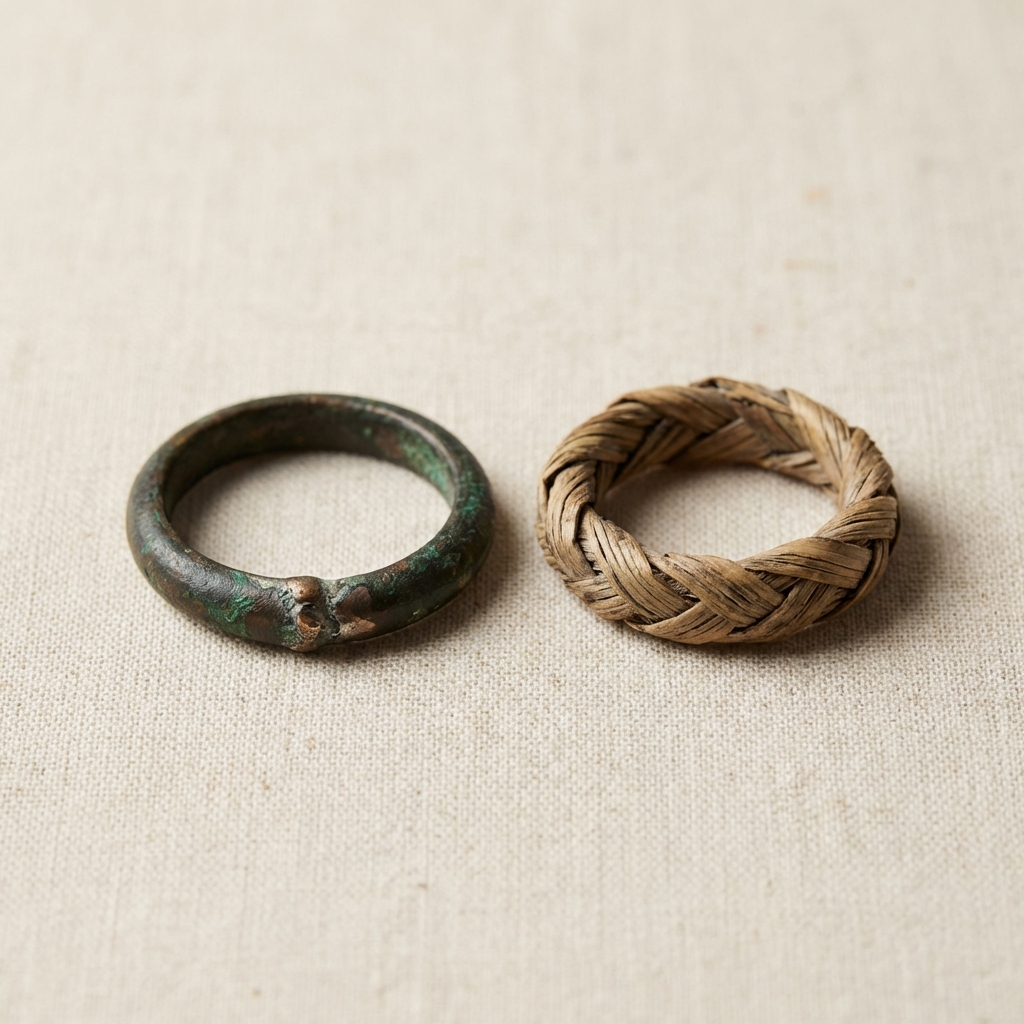
Form types also vary by region and period: simple hoops, bezel-mounted intaglios, flat signet rings and openwork bands are all documented, and typological catalogues remain an essential comparative tool when stratigraphic or laboratory dating is not possible.
Early Egyptian and Near Eastern examples: what survives
Some of the earliest physical rings that survive in the archaeological record come from Egyptian burials dated to the late Predynastic and Early Dynastic periods; these include metal hoops and reed rings that are typically presented in museum collections as personal jewellery or amulets rather than explicitly marital tokens British Museum collection overview on Egyptian jewellery.
Museum entries commonly describe these pieces with careful qualifiers, noting provenance, context and possible functions, and curators usually avoid stating marital use without supporting funerary or textual evidence.
Because many early Egyptian examples come from graves, they inform us about personal adornment and symbolic practice, but they rarely carry direct documentary links to betrothal or wedding ceremonies, so assigning them a marital function remains interpretive rather than decisive.
See provenance and condition details on @auroraantiqua
See curated listings that include condition notes and provenance details to compare well-documented examples with typical market entries.
Roman textual and legal evidence: ring-giving as betrothal and marriage
The annulus in Roman law and funerary contexts and ancient wedding rings
Roman legal, funerary and literary sources document the annulus and related ring-giving rituals as part of betrothal and marriage practice by the late Republic and Imperial periods, making Rome a key case where text and object can be combined to support social interpretation; see the Ancient Roman Rings collection as a reference for typological comparators Metropolitan Museum of Art overview on rings in the ancient world.
How texts inform social meaning beyond objects
Where small metal finds lack context, contemporary texts such as legal codes, funerary inscriptions and writers describing ritual practice provide the missing social dimension; in Roman cases this documentation allows scholars to treat some rings as demonstrably linked to marital rites, while also reminding us that textual records are region- and class-specific and may not represent popular practice everywhere Oxford Research Encyclopedias entry on Roman marriage and ritual. For dating frameworks see relative and absolute methods described at HRAF Yale.
How researchers date and interpret small metal rings
Dating small metal rings combines typological comparison with contextual information and, when available, scientific analysis such as metallography; typology and comparative catalogues remain primary tools for assigning a chronological range when direct dating is absent Journal of Archaeological Science review on dating small metal finds, and for a general audience overview of archaeologists' dating approaches see how archaeologists date sites and artifacts.
Typological work compares hoop forms, bezel types and intaglio motifs to dated museum examples; this comparative step is why catalogues and published museum records are essential to the process.

When scientific methods are possible, metallurgical analysis can indicate alloy composition and manufacturing technique, and contextual dating uses stratigraphy or associated organic material to provide additional constraints; radiocarbon dating can help when organics are present, but it is often not available for isolated metal finds Journal of Archaeological Science review on dating small metal finds.
Because many market pieces lack stratigraphic context, reliable dating for collectors depends heavily on trustworthy provenance and on published typological comparisons with museum holdings.
Museum catalogues, typologies and public interpretation
Museum object records typically describe typology, estimated dating, condition notes and provenance, and they are frequently the reference point for comparators used in private sales and catalogues British Museum collection overview on Egyptian jewellery.
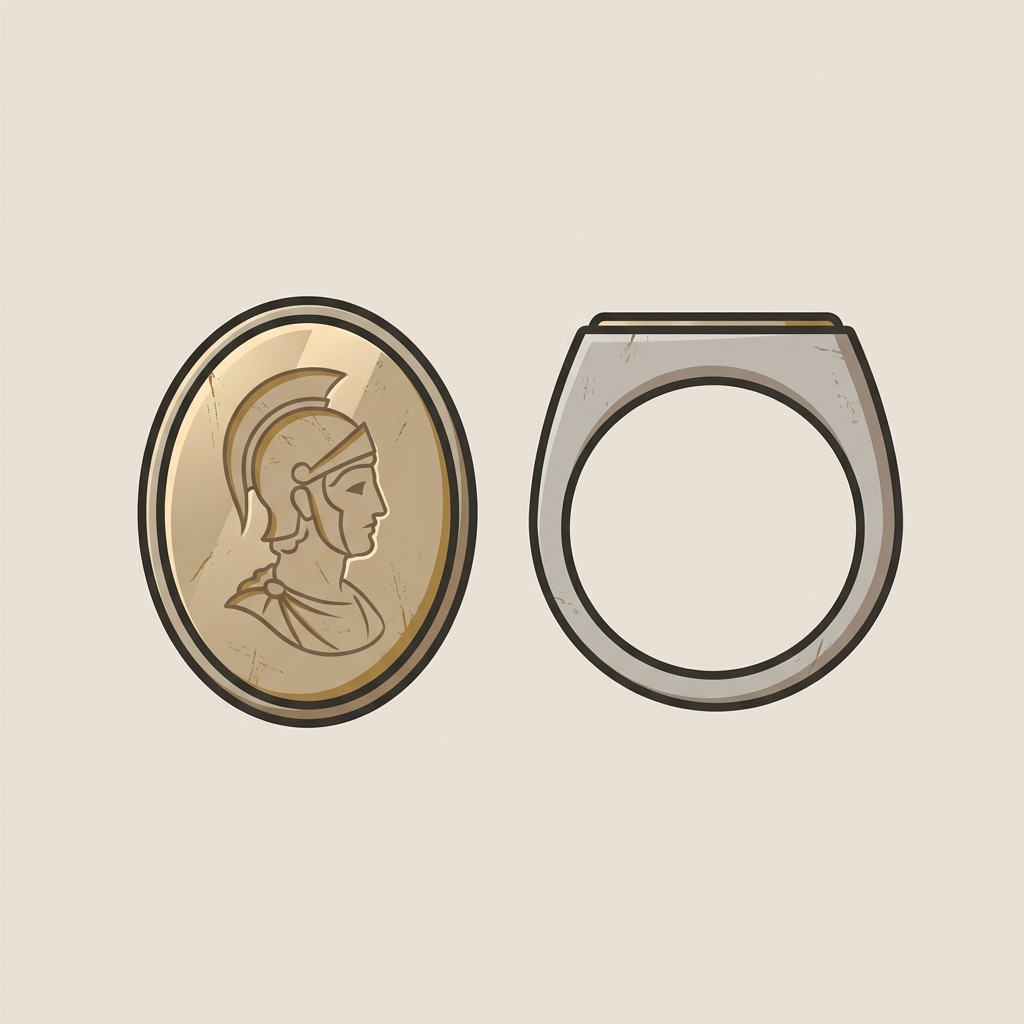
Reading a catalogue entry with attention to phrasing matters: dates are often expressed as a range or estimate, condition issues and restorations are noted, and provenance is summarized; these elements together form the best available public documentation for many small metal rings.
For collectors, the practical step is to match any listing's typological claims against a museum example such as the rings collection and to treat catalogues as comparative guides rather than definitive dating tools when direct scientific analysis is absent.
Provenance, documentation and why it matters for dating and meaning
Clear provenance and object documentation materially improve confidence in both dating and social interpretation; good documentation lists collection history, prior ownership, acquisition dates and any verification or laboratory reports Research report: export licensing and provenance, GOV.UK, Department for Culture, Media and Sport (DCMS).
A claim that a ring is the oldest wedding ring relies on both secure dating of the object and contextual or documentary evidence that it was used as a marital token; without both, such claims remain interpretive.
Documentation that includes condition and restoration notes, photographs of the object in previous collections, and any independent verification letters allows researchers and collectors to link an object to comparanda and to judge claims about function, including marital use.
When provenance is incomplete or vague, confidence in assigning a social function such as a wedding token falls sharply, because provenance underwrites both dating and the contextual reading of an artefact.
How to evaluate claims: decision criteria for collectors
Start by prioritizing provenance and documentation: a clear chain of ownership, dated photographs and verification letters are the most important single items for improving confidence in a seller's claim about an ancient ring Research report: export licensing and provenance, GOV.UK, Department for Culture, Media and Sport (DCMS).
Next, assess typological fit: compare the ring's hoop form, bezel type and any intaglio motifs to published museum examples and typological catalogues; if a listing claims a function such as a wedding token, look for documentary traces or comparable objects with secure context Journal of Archaeological Science review on dating small metal finds.
Finally, seek condition and restoration notes. Transparent reporting about stabilisation, repaired areas and any reconstruction helps distinguish original features from later interventions and reduces the risk of misreading repairs as original design.
Typical errors and common misinterpretations
A frequent error is mistaking later repairs or added solder for original features, which can shift typological assessment; without detailed restoration notes, repairs are easily misread as age-related traits About us, International Association of Dealers in Ancient Art.
Another common mistake is conflating signet and seal use with marital function. Signet rings carry personal or administrative meaning and, while they can appear in funerary contexts, their presence does not automatically indicate betrothal or wedding use Metropolitan Museum of Art overview on rings in the ancient world.
Be cautious if a listing uses broad historical summaries as proof; authoritative claims require specific provenance, typological matches or contemporary texts that tie a ring to marriage rituals.
A practical buying checklist for ancient rings
Ask for high-resolution, well-lit photographs from multiple angles that show the hoop, bezel interior and any hallmarks or maker marks; these images are essential for typological comparison and assessing wear consistent with age Object ID, International Council of Museums.
Request the full provenance chain and any documentation: previous collection records, dated photos, auction or catalogue citations and any laboratory reports. Weak provenance typically consists of vague statements without dates or named collections.
Insist on clear condition and restoration notes that state what was stabilised, repaired or reconstructed; if available, seek independent laboratory analysis or metallurgical reports to corroborate typological dating.
Case studies: notable museum examples and what they teach us
Egyptian burial rings in major collections illustrate how objects preserved in well-documented contexts are described cautiously by curators, who typically frame function as personal adornment or amulet rather than making definite claims about marital use British Museum collection overview on Egyptian jewellery.
Roman intaglio and gold rings, when attested in funerary contexts and supported by contemporary texts, become stronger candidates for wedding or betrothal associations because the documentary record provides social context that raw finds alone do not Metropolitan Museum of Art overview on rings in the ancient world.
These case studies show that combining object, context and text produces the most persuasive interpretations, while gaps in any one area reduce confidence and increase interpretive ambiguity.
Special Image Description: Aurora Antiqua Logo
Conservation, restoration and condition notes for collectors
Good restoration notes disclose whether an object was stabilised, minimally consolidated or reconstructed, and they describe materials and techniques used in restoration so readers can judge how interventions affect the original fabric ICOM-CC, International Council of Museums, Committee for Conservation.
Conservation choices can change how an object appears and how it is interpreted; transparent reporting that differentiates conservation for stability from reconstruction for display is essential to assessing originality and historic value.
Common interventions on metal rings include cleaning to reveal inscriptions, stabilising corrosion on iron or bronze, and careful soldering to reattach loose bezels; each should be noted and dated in condition reports.
Legal and ethical considerations when buying ancient rings
Clear provenance is not just academically useful, it is a legal and ethical safeguard. Records that demonstrate a lawful chain of ownership and documented export or deaccession history reduce the risk that a piece was illicitly traded Dealing in Cultural Objects (Offences) Act 2003, The National Archives, legislation.gov.uk.
Red flags include sellers who cannot provide verifiable ownership history, vague or implausible origin statements, or pressure to accept incomplete documentation; for high-value items, consult specialists or legal counsel when provenance is unclear.
Responsible collecting supports transparent markets and helps preserve archaeological context by discouraging looting and illicit trade.
Conclusion: practical takeaways on the search for the oldest wedding ring
Physical rings are demonstrably ancient, with surviving examples dating back to the third millennium BCE, but asserting that any specific ring is the "oldest" wedding ring requires documentary or contextual evidence tying it to betrothal practice rather than relying on object age alone Encyclopaedia Britannica overview on wedding rings.
For collectors, the priorities are clear: provenance and documentation, detailed condition and restoration notes, typological comparison with museum catalogues, and scientific dating where available significantly improve confidence in claims about social function and dating ICOM guidance on object documentation and provenance.
When in doubt, rely on peer-reviewed scholarship and museum records and treat statements about the "oldest wedding ring" as evidence-based interpretations rather than absolute certainties.
Physical rings appear in the archaeological record by the third millennium BCE, especially in Egyptian and Near Eastern contexts, though dating often depends on stratigraphy and typological comparison.
No. Many ancient rings functioned as personal jewellery, amulets or signets; assigning a marital function requires supporting documentary or contextual evidence.
Ask for full provenance, dated photos, auction or catalogue references, condition and restoration notes, and any laboratory or metallurgical reports if available.
More from Aurora Antiqua
References
- Pliny the Elder, The Natural History, BOOK XXXIII, Perseus Digital Library, Tufts University (edition Bostock)
- Internet History Sourcebooks: Medieval Sourcebook, Internet Medieval Sourcebook, Fordham University, New York
- Finger Ring with Frog, The Cleveland Museum of Art
- Aegean and Cypro-Aegean Non-Sphragistic Decorated Gold Finger Rings, American Journal of Archaeology
- Research report: export licensing and provenance, GOV.UK, Department for Culture, Media and Sport (DCMS)
- Object ID, International Council of Museums
- About us, International Association of Dealers in Ancient Art
- ICOM-CC, International Council of Museums, Committee for Conservation
- Dealing in Cultural Objects (Offences) Act 2003, The National Archives, legislation.gov.uk
- Relative and Absolute Dating Methods in Archaeology, hraf.yale.edu