


Looking for the real thing? Browse authenticated ancient rings, each piece one of one, individually authenticated, with documented provenance. For the background, see the guide to ancient jewelry.
What collectors mean by the three ring rule: definition and context
The phrase three ring rule is a colloquial guideline used by collectors, dealers, and enthusiasts when they encounter groups of rings offered together. It does not refer to an archaeological law or a single method of proof, but rather to a set of practical checks and etiquette ideas that can help someone decide whether a group of pieces is coherent enough to buy, display, or study.
In the context of ancient roman rings, collectors may use the rule in more than one sense. Some use it to think about how rings work together as wearable objects, others as a quick comparative test for condition and patina, and some as a way to judge whether a seller's provenance claims about a small set are internally consistent.
See the desk behind the curation on Instagram
If you prefer curated lots with clear condition notes, consider listings that state restoration notes and provenance style details so you can compare pieces side by side.
Different uses of the phrase in collecting, jewelry styling, and historical description
One common use is purely stylistic, a rule of thumb for ring stacking. Here the idea is simple: three rings can form a balanced stack, and buyers often look for complementary widths, profiles, and finger placement when imagining wearable combinations. In buying, that same visual logic helps prioritize which rings in a group will be most wearable together.
Collectors who think in comparative terms use the phrase to prompt close photographic inspection. When three rings are shown together, differences in metal surface, tool marks, and patina can indicate varied histories that deserve questions. This use treats the grouping as a diagnostic sample rather than definitive proof of origin.

The phrase matters because many people entering the market for ancient ring forms will see sets offered as lots. Understanding that three ring rule can reduce simple mistakes, for example assuming uniform origin from appearance alone. It can also reshape expectations about condition notes and provenance documentation, which are central to responsible collecting.
Historical and cultural background relevant to ancient Roman rings

When assessing a set of rings, useful background helps. Roman societies produced a range of ring types that collectors often label as Roman, including signet rings with a bezel, plain bands, and rings decorated with carved stones. These categories are useful starting points but not exhaustive labels.
Rings could function as personal identifiers, status markers, or protective amulets. A signet ring with an engraved device can indicate personal use, while plain bands appear in many contexts. These roles explain why rings are frequently grouped together in the marketplace and why a simple three ring check can help frame initial questions.
Because dating and function are inferential without documentation, any historical claim should be connected to listing documentation or specialist attribution. Condition notes and provenance references often provide the evidence basis for more confident statements, so treat visual similarity alone as a hypothesis that needs corroboration.
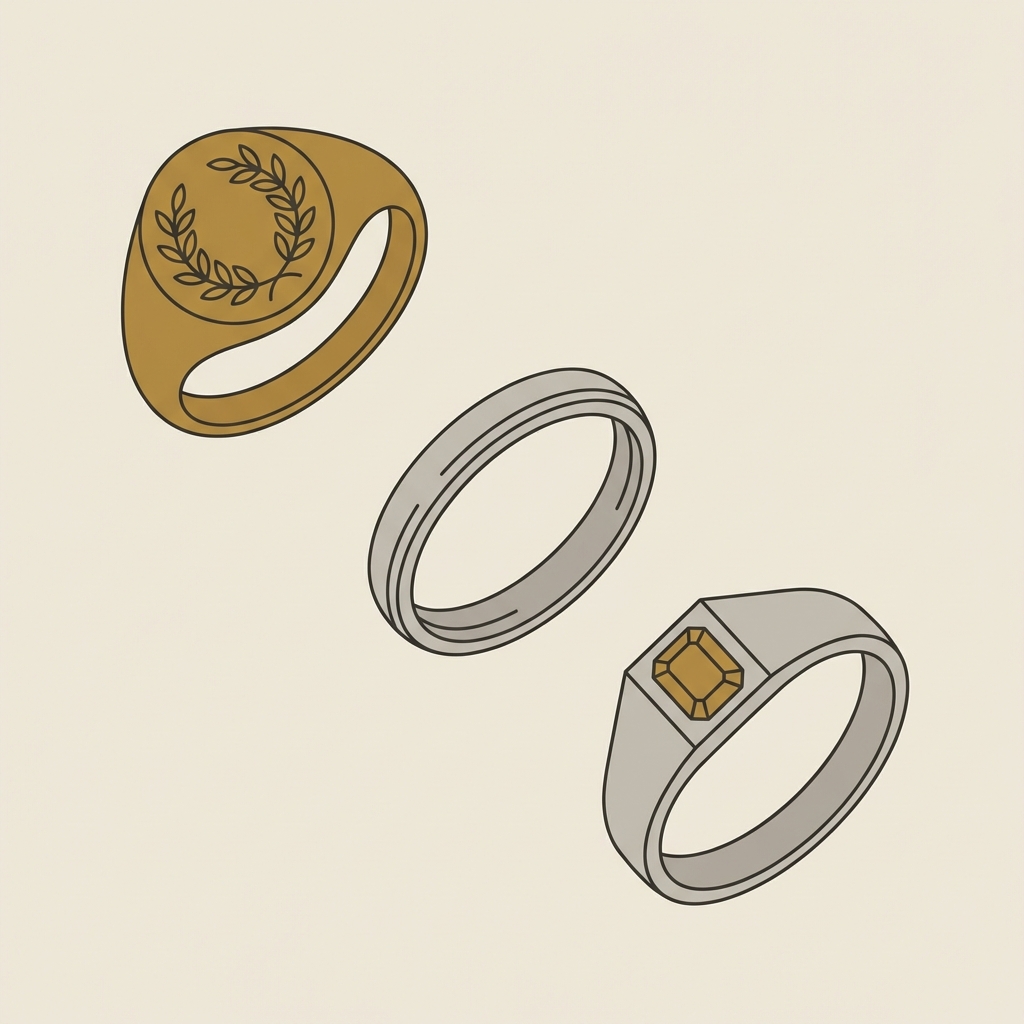
Common ring types in the Roman world
Typical forms described as Roman include signet rings with a flat or slightly convex bezel, plain hoop rings, and band rings that vary in cross section. Bezel shapes and mounting styles can suggest different workshops or periods, but those observations are starting points rather than conclusions.
Material choices and stone types described in listings, such as carnelian or agate for intaglios, shape expectations. In many cases, sellers provide materials descriptions and condition notes to help buyers evaluate whether a ring fits their collecting goals.
Social and symbolic roles of rings in Roman society
Rings could serve as intimate identifiers, sometimes incorporating a carved device used to seal documents, and at other times functioning as visible marks of social position. Religious or amuletic imagery also appears in many examples, which can influence how collectors value iconography when comparing pieces in a set.
These social roles explain why matching iconography across three rings might be suggestive, but not decisive, evidence of shared context. Such similarities should prompt questions about provenance and prior ownership rather than immediate attribution.
Three practical meanings of the three ring rule for buyers
The three ring rule commonly surfaces in three practical ways: as stacking guidance, as a comparative condition check, and as a suggestion that related rings sold together may support a shared provenance hypothesis. Each meaning leads to different actions when you evaluate listings.
For wearable combinations, focus on scale, comfort, and how the rings will sit on the finger. For comparative checks, look at patina, tool marks, and consistent wear. When sets are offered as possible provenance groups, treat the claim as a lead to investigate, not as a proof of common origin.
Apply the three ring rule as a set of practical checks: compare measurements and photos, read condition and restoration notes, request provenance documentation, and seek specialist input when needed to reduce uncertainty before purchase.
Meaning 1: stacking and wearable combinations
As a styling rule, three rings can create a balanced stack. Buyers who plan to wear ancient pieces together should check measurements and hoop thickness to ensure comfort and appropriate visual weight. Ask for clear photos showing rings next to a scale or a ruler so you can judge how they will layer.
Consider whether any single ring will dominate the stack, for example a large signet bezel that prevents the other rings from sitting flush. Wearability is a personal decision, and the three ring idea helps buyers think through which pieces they will actually wear.
Meaning 2: comparative condition and patina checks
Comparing three rings side by side makes it easier to spot inconsistencies. Differences in patina tone, abrupt shifts in surface texture, or mismatched solder repairs can indicate distinct histories. Use that comparison to ask targeted questions about which repairs are original, which are modern, and whether any stabilization work was done.
Photographs under consistent lighting and detail shots of joins and inner hoops are especially helpful. When condition notes are clear, they should describe what was left untouched and what was stabilized, so you can interpret visual cues alongside written documentation.
Meaning 3: using sets to corroborate provenance
Sellers sometimes offer rings together that they suggest came from a single find or collection. Offering related pieces can be helpful, but shared sale does not itself prove shared origin. Use the set as a starting point to request provenance documentation or collection history notes that explain how the pieces were found, acquired, and cared for.
Where documentation exists, it can strengthen a claim of shared context. Absent documentation, treat a set as a compositional grouping and ask specific questions about prior ownership and any third party reports that might exist.
A step by step framework to evaluate three or more ancient Roman rings
When you see three or more rings offered together, follow a repeatable process. The aim is to move from visual impression to documented understanding, using photos, notes, and questions as the main tools.
Step 1: begin with photos, measurements, and scale. Request multiple angles, macro shots of bezels and inner hoops, and a scale reference. Consistent photographic documentation reduces guesswork and supports more accurate pacing through the next steps.
Step 1: check photos, measurements, and scale
Good listings show clear, in-focus images with a ruler or a consistent object for scale. Measurements should include internal diameter or ring size and band width. If the listing lacks scale, ask the seller to add it before you commit to decisions about wearability or conservation needs.
Check for punch marks, hallmarks, or workshop attributions visible inside the hoop. These small marks can provide clues and are useful to note when comparing multiple rings in a set.
Step 2: read condition and restoration notes
A careful read of condition notes helps you understand what has been preserved and what was intervened on. Restoration notes that explain stabilized repairs, replaced sections, or surface cleaning should be present when a seller has done conservation work. Clear language about repairs can make the difference between a confident purchase and an uncertain one.
When restoration notes are sparse or absent, ask specific questions: Was any pinning, soldering, or filling done? Was the stone removed and reset? Who performed the work and when? Answers help you assess whether additional conservation will be needed and how that affects display or wear.
Aurora Antiqua product listingsStep 3: assess provenance statements and documentation
Provenance and documentation references can range from previous collection notes to third party reports. Check what is offered: a collection history, ownership notes, or a letter of verification. Each piece of documentation adds context, but documentation quality and specificity vary.
Consider whether the documentation explains how the pieces were acquired and whether there are supporting images from prior ownership. Where claims are vague, request more detail and be clear about why the information matters for your collecting goals.
Step 4: consider specialist input or third party reports
If the set is expensive or appears to have unusual features, consider seeking specialist input. A condition report from a conservator or a third party academic opinion can clarify dating, workshop attribution, or the nature of repairs. These reports cost time and sometimes money, but they reduce uncertainty for higher value decisions.
Balance the cost of verification with your collecting goals. For many personal collectors, careful photographic comparison and thorough questions to the seller provide a reasonable basis for purchase. For institutional or high value acquisitions, independent reports are often appropriate.
Decision criteria: when to buy three related rings, one, or none
Deciding whether to buy a set, a single piece, or pass requires aligning the evidence with your goals and risk tolerance. Think in terms of a simple matrix linking documentation, condition, and price to likely actions.
If a set comes with strong provenance documentation and consistent condition notes, buying the set may be appropriate for collectors interested in contextual groups. If documentation is partial and condition varies widely, prioritize the best-documented or best-preserved piece. If documentation is absent and condition notes are vague, consider passing or seeking inspection.
Risk tolerance and collecting goals
Wearers seeking a few pieces to enjoy may accept a higher level of uncertainty for lower cost items, provided restoration notes are transparent. Collectors seeking attribution, workshop attributions, or clear provenance should set higher thresholds for documentation and third party reports.
Price is part of the decision equation. A lower priced lot with uncertain provenance still requires reading condition notes carefully, since conservation or display costs can change the effective price. Budget for any stabilization work you would accept as the buyer.
Documentation thresholds and price considerations
Set simple thresholds for action, for example: strong documentation and clear condition notes equals consider set purchase; partial documentation or mixed condition equals buy the best piece; no documentation and obvious modern repairs equals pass. These rules of thumb help you avoid emotional buying decisions.
When splitting a set is possible, prioritize pieces with better provenance or less invasive restoration. Ask sellers whether they will consider selling items separately and whether documentation will be provided for an individual sale.
Common mistakes and pitfalls when applying the three ring rule
There are common errors that lead collectors astray when using the three ring rule. Being aware of these pitfalls helps you ask better questions and avoid mistaken attributions.
One mistake is overreading patina. Surface color alone does not prove age or common origin. Patina can form differently based on storage conditions, soil chemistry, or cleaning history, so look for consistent wear patterns rather than relying on hue alone.
Overreading patina or surface wear
Ask for detail photos of inner hoops, joins, and areas typically worn by the wearer. Consistent wear on inner edges and around bezels is more meaningful than surface tone. When in doubt, request magnified images or a short video to reveal texture and repair scars.
Another mistake is assuming stylistic compatibility equals shared origin. Craftsmen borrowed motifs and shapes across regions and periods, so similarity is suggestive but not decisive. Use stylistic compatibility as a prompt for further documentation checks, not as a final answer.
Using modern assumptions about style
Modern taste can bias interpretations. Do not assume that pieces that look good together now were made or used together historically. Treat attractive combinations as curatorial options, separate from claims about common origin.
Finally, ignoring restoration history is risky. Small modern repairs can be necessary for display, but they change the object's story. Read restoration notes closely and ask whether any modern materials were used that could affect future conservation.
Ignoring restoration and repair history
Good restoration notes specify what was stabilized, who performed the work, and whether reversible techniques were used. If those details are missing, ask directly. Clear communication about repairs is a sign of responsible curation and helps you anticipate conservation needs.
When sellers provide transparent restoration notes, use that information to judge how a piece will behave in wear or display. If notes are missing or vague, consider an independent assessment before purchase.
Practical examples and short scenarios for applying the rule
Scenarios make the three ring rule tangible. Below are three short, realistic cases and a compact checklist you can use while viewing listings or photos.
Scenario A: three small Roman bands offered as a lot. Imagine three plain bands shown together with close photos of inner hoops. Apply the step by step framework: check measurements, ask for magnified shots of joins, and read condition notes carefully. If all three show similar inner wear and the seller provides a clear collection history, the set may be worth considering for display.
a printable checklist to compare three rings on a listing
Use while viewing photos
Scenario B: a signet ring paired with two plain bands. A signet with an intaglio can dominate the visual grouping. Check that the bezel sits flush and that the bands will layer without wobble. Ask whether the signet has been cleaned or the stone reset, and request any documentation about prior ownership for the signet in particular.
Quick checklist to use on a listing
- Require clear scale and measurement for all rings
- Request macro shots of bezels, inner hoops, and joins
- Ask for explicit restoration notes and dates of any work
- Request provenance statements or prior ownership notes
Prompts for follow up questions to ask sellers include: Who previously owned these rings, are there images from prior collections, what exactly was stabilized, and can a conservator report be provided if available. These questions help turn the three ring idea into concrete due diligence.
In summary, the three ring rule is a flexible, informal tool that can mean stacking guidance, comparative condition checks, or a prompt to investigate claimed provenance. It helps collectors move from initial visual impressions to documented confidence by focusing attention on measurable details.
Conclusion and next steps for the interested collector
Practical next steps include requesting clear photographs with scale, asking for full condition and restoration notes, and seeking provenance documentation when it is claimed. Consider specialist input for high value purchases and prioritize transparent listings that explain any interventions.
Aurora Antiqua presents curated ancient rings with condition notes and provenance style references when available to help collectors make informed choices. If you are exploring groups of rings, use the framework above to turn the colloquial three ring rule into a structured set of checks before you buy.
It is a styling and practical guideline suggesting three rings can form a balanced stack; check measurements, band width, and bezel depth to ensure comfort and fit.
No, visual similarity is suggestive but not conclusive; use comparisons to generate questions and then seek provenance documentation or expert input to corroborate origin.
Request clear restoration notes that specify what was stabilized or repaired, who performed the work if known, and whether reversible techniques or modern materials were used.
More from Aurora Antiqua
References
- Emilie Riha, Der römische Schmuck aus Augst und Kaiseraugst (Roman jewelry from Augst and Kaiseraugst), Römermuseum Augst
- Bagues et anneaux à l'époque romaine en Gaule, Persée, Persee (CNRS, ENS de Lyon, Ministere francais)
- Internet Archaeol. 40. Atkinson and Preston. Objects of personal adornment, Internet Archaeology, Council
- A Corpus of Roman Engraved Gemstones from British Sites, University of Michigan Press / BAR Publishing
- Quartz, Handbook of Mineralogy, Mineral Data Publishing / Mineralogical Society of America, USA
- Reproducing bronze archaeological patinas through intentional burial, Heliyon (Elsevier, Open Access)
- About us, International Association of Dealers in Ancient Art
- Research report: export licensing and provenance, GOV.UK, Department for Culture, Media and Sport (DCMS)