


Looking for the real thing? Browse genuine ancient rings for sale, each piece one of one, individually authenticated, with documented provenance. For the background, see the guide to ancient jewelry.
What 'one-time purchase' means for antique Roman jewelry
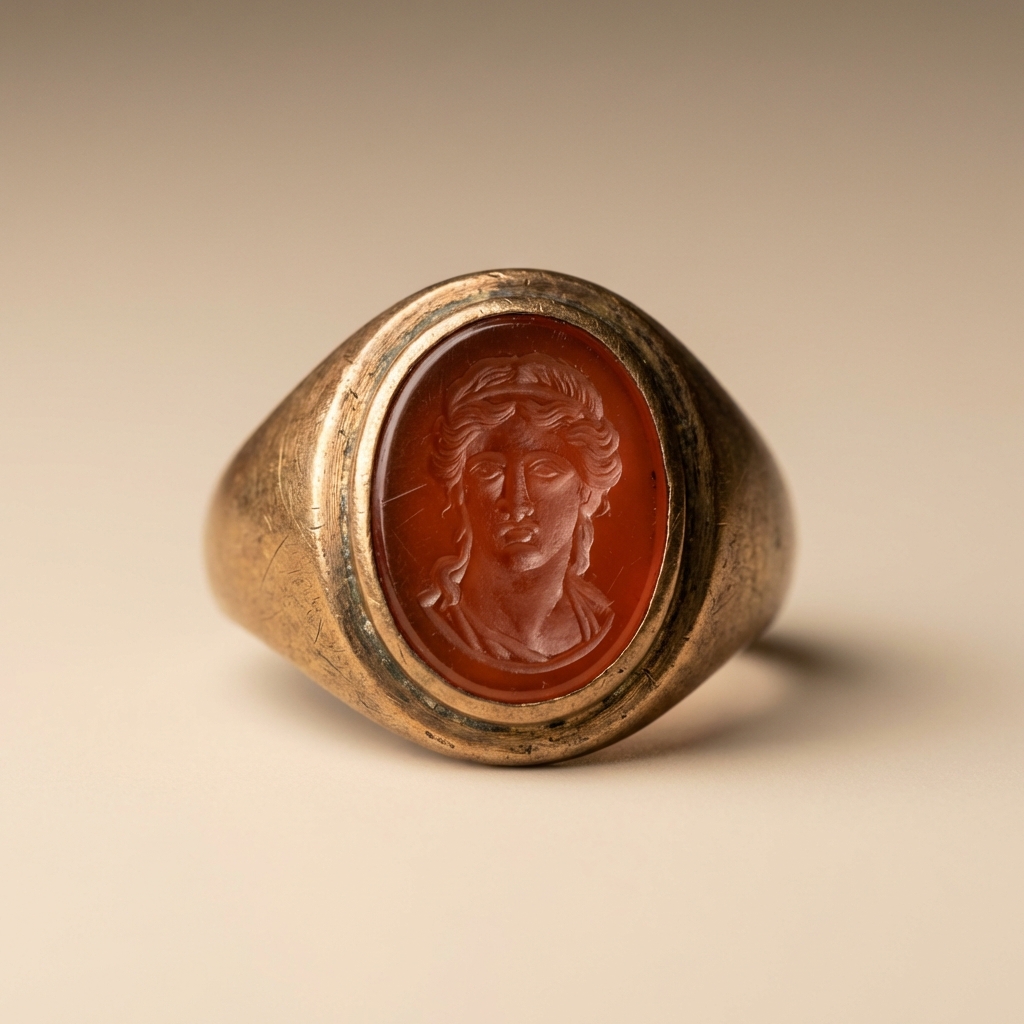
The phrase antique roman jewelry describes objects that are materially singular: a Roman intaglio ring, a gold hoop, or a gemstone set in a bezel has a history of use, repair and context that cannot be reproduced exactly. Understanding this helps buyers treat an acquisition as more than a modern accessory and more like a discrete object of history; provenance and condition notes become central to that decision. Guidance from provenance specialists explains how documentary and conservation records together form the core of responsible buying practice, and why buyers should expect these details to be shared when they exist Getty provenance research guidance.
In practical terms, a one-time purchase means accepting the permanent nature of ownership: the object may show wear consistent with age, patina, and repaired breaks that are part of its story. Buyers should anticipate that any replacement would be a modern reproduction or a different ancient object, not an identical copy. The vocabulary that buyers will see in listings should include terms such as antiquity, provenance, condition notes and patina, used to describe the object's state and collection history.
Behind the scenes with @auroraantiqua
If you want a compact reference, download a one-page provenance checklist that highlights the listing elements to check before you enquire. It is optional and designed to help you prepare questions for a seller.
To set expectations: accept that visible wear, hairline repairs or patina are often noted neutrally in condition statements rather than described as a flaw. When provenance entries are present, they should outline prior ownership, collection history and any supporting letters or conservation reports; when absent, treat that absence as an open question to resolve before purchase.
Defining uniqueness for antiquities
An antiquity is unique not only because of its form and materials but also because of the chain of events it has passed through since manufacture. Tool marks, the way a gemstone was cut, evidence of reworking, or an old repair all contribute to an object's individual biography. These features are typically recorded in restoration notes or conservation reports and should be part of the listing. When a seller provides that documentation, it helps identify the object's particular technical and historical profile.
How archaeological context makes items non-replicable
Archaeological context is what links an object to a place, layer or find group; context carries information that cannot be reproduced by crafting a visually similar ring. Even when a modern maker copies a motif, the original object's patina, micro-wear and collection history remain singular. For buyers, this means the genuine article is not a style that can be ordered again but a discrete artifact with an irreplaceable material history.

Why authentic ancient pieces cannot be exactly replaced
Original materials and centuries of handling create combinations of surface, alloy composition and micro-damage that are unlikely to match in another item. An intaglio's carving, a bezel's soldering pattern and a hoop's cross-section are subtle technical fingerprints that point to workshop practices and individual tool use. Scholarly provenance work explains how these technical details contribute to an object's unique identity and help specialists attribute or date a piece Getty provenance research guidance.
Replicas and modern commissions occupy a different category: they can replicate motifs or iconography but not the same history of use. A modern carnelian intaglio carved with Athena's head is a legitimate jewelry object when presented as a reproduction, but it will not be the same object as a Roman intaglio with centuries of wear and documented collection history. Market reports show that documented originals attract concentrated attention among specialist buyers, which is why provenance and condition transparency often influence demand and pricing Art Basel and UBS market report.
Material, craftsmanship and archaeological context
Materials such as electrum or specific gold alloys, and techniques like hand-engraved intaglio cutting, create technical fingerprints. These features, together with repairs and patina, form a layered record of manufacture and use. Sellers who include descriptive restoration notes and measurements help buyers understand how these material and technical features shape an object's identity.
Why replicas and modern commissions are different
A modern commission is a new object made to a client’s specifications: it lacks archaeological context and the accrual of age. That makes it a distinct, transparent product category. Buyers who want a wearable piece that looks ancient should expect clear separation in listings between an original antiquity and a modern work inspired by ancient models.
Legal and ethical context: UNESCO, export rules and illicit trafficking
International bodies and national authorities caution that objects lacking secure provenance may be associated with illicit excavation or trafficking, and they urge careful provenance checks prior to acquisition. This framing is central to responsible collecting and to understanding the wider legal and ethical stakes for buyers UNESCO position on illicit trafficking.
Many countries use export licensing and restrictions to control the movement of cultural property; these rules affect what can legally leave or enter a jurisdiction and therefore influence whether a cross-border purchase is feasible and lawful. Buyers should consult national export guidance relevant to the object's country of origin before committing to a purchase Exporting or importing objects of cultural interest, GOV.UK, Department for Culture, Media and Sport.
Because each authentic piece carries unique material evidence, a documented history and archaeological context that cannot be exactly replicated, making provenance and conservation records essential to any responsible purchase.
Because of law-enforcement interest in trafficked objects, inconsistent or missing provenance can lead to seizure or restitution actions even after a sale. Agencies that investigate cultural property stress that buyers should treat gaps in chain-of-custody as serious red flags and pursue documentary clarification before payment is made FBI art theft guidance.
International frameworks and national export licensing
UNESCO frameworks frame illicit trafficking as an international concern and encourage cooperation; national export licensing systems are the practical tools that enforce restrictions at the borders. For a buyer this means checking both international guidance and national rules tied to the object's likely origin, and asking sellers whether export documentation exists for cross-border shipments.
Risks of undocumented objects and law enforcement action
When provenance is thin, post-sale legal risk becomes real: historical objects without clear chain-of-custody can be subject to seizure or restitution if evidence emerges of illicit removal. Buyers should therefore factor legal clarity into their decision and consider delaying purchase pending verification.
How provenance, documentation and conservation records work
Provenance evidence can take several forms: a chain-of-custody statement showing previous sales or transfers, collection history notes, invoices or catalog references, verification letters from recognised specialists, and archival images or catalog entries. Each element strengthens the overall case for lawful, documented ownership and is the basis of good provenance research Getty provenance research guidance.
Conservation and restoration records describe what was stabilised, what was repaired, and what was intentionally left untouched. These reports may list materials used in conservation, photographic condition records before and after treatment, and recommendations for future care. Well-documented conservation notes are an indicator that the seller has engaged professional care and that the piece has a traceable treatment history.
Types of provenance evidence
A useful provenance entry will typically include dates of sale or transfer, prior collection names, auction or catalogue references where applicable, and any curator or specialist reports. Where a listing cites a verification letter, ask to see the text of that letter and the credentials of the person who wrote it. Missing or vague statements that simply say an item came from 'an old collection' without specifics are insufficient for serious buyers.
What a conservation or restoration record typically shows
Conservation notes should clarify what was stabilised and why, whether adhesives or fills were used, and whether original surfaces were consolidated. Transparent reports also explain what was not done, which helps buyers assess how invasive past treatments may have been. When a listing includes a conservation report it can materially inform both assessment of condition and the piece's potential for safe wear.
Condition and conservation: what to inspect on an ancient ring
When assessing condition, start with the language sellers use. Phrases such as wear consistent with age, small historic repairs, or patina present are not value judgments but descriptive shorthand. Look for measurements, clear detail photographs of the hoop, shoulders and bezel, and notes on any loose stones or unstable elements. If a listing documents conservation work, it should say what was stabilised and what remains fragile.
Consider structural features before thinking about wearability: the hoop's roundness and thickness, the bezel's stability, and whether the shank has been reinforced are practical considerations. Prioritise pieces where the seller provides clear, focused photos of these features and explicit condition notes describing any repairs or modern interventions.

When a curated listing includes a conservation report, expect to see the conservator's observations on patina, previously stabilised fractures and whether any modern soldering or fills were used. Those notes help determine what kind of daily wear is safe and which items should remain primarily for display or occasional use.
Visual signs to assess: patina, wear and repairs
Photographs should show close-ups of the intaglio, the bezel edge and the hoop intersection. Patina differences, hairline fills and old solder are all relevant; a conservation report helps translate these visual signs into a treatment history. If photos are unclear, request additional high-resolution detail shots under neutral lighting.
How restoration choices are documented and what they mean for care
Transparent restoration notes will describe what was done and why, whether modern materials were used for fills, and whether interventions were minimal or structural. Sellers who include this level of detail are providing the buyer with the information needed to assess potential risks for wear or continued preservation.
A step-by-step buyer checklist for verifying an ancient Roman ring
Before you enquire: scan the listing for clear photos, accurate measurements, scoped condition notes, and any stated provenance or collection history. A good listing will show the ring from multiple angles, give ring size or internal diameter, and detail any visible repairs or patina.
After you ask: request provenance documentation, copies of conservation reports, and any verification letters or prior auction/catalogue references. If the seller offers a chain-of-custody statement, check that it names dates and prior owners rather than general claims. If in doubt, ask for the conservator's or verifier's contact details so you can follow up, or use our contact page so you can follow up.
Use institutional checks in parallel: consult recognised red lists, check national export licensing rules that may affect shipment, and ask whether the seller has performed provenance research or engaged third-party experts. These steps reduce legal and ethical uncertainty before payment is made ICOM Red Lists.
- Verify the listing content: photos, measurements and clear condition notes.
- Request provenance documents and conservation reports.
- Confirm export and import rules for the object’s likely country of origin.
- Ask about third-party verification or references to prior catalogues.
- Delay payment until satisfactory documentation is provided.
Tools and public resources to check listings
Start with ICOM Red Lists to identify categories of cultural objects at risk, and ICCROM resources on related guidance, and then consult national export licensing pages for guidance on legal requirements related to cross-border movement. These public resources let buyers flag probable risk and verify whether an item requires formal export documentation before it can be moved legally ICOM Red Lists.
Quick reference for checking a listing against common provenance and legal gaps
Use as a rapid pre-enquiry filter
When a listing raises questions that public tools cannot resolve, consider requesting a non-destructive scientific analysis or a professional conservation assessment. Such testing is appropriate when attribution or material identification is central to the buyer's decision and when the seller is willing to support further checks.
Databases and red lists
ICOM Red Lists help buyers recognise object types that have been targeted by illicit trafficking and can be searched by region or category. They are a practical way to screen a listing for warning signs before investing time in further enquiries.
When to seek scientific or conservation testing
Non-invasive testing is most useful when a listing's claim hinges on a material identification that photographs cannot resolve, or when a high-value purchase warrants scientific backup. Discuss options with the seller and a conservator, and ensure any testing is non-destructive and agreed in writing.
Where authentic pieces are sold and what to expect from sellers
Authentic ancient jewelry typically appears in specialist markets: curated shops that focus on antiquities (Ancient Roman Rings collection), private dealers with documented inventory practices, and specialist auction listings. In each channel, expect different norms around documentation; curated sellers often include more context and condition detail, while other channels may supply less transparent records. Market analysis suggests that well-documented pieces are concentrated in specialist segments where buyers expect rigorous listing standards Art Basel and UBS market report (see Aurora Antiqua news).
From a reputable seller expect clear photos, a ring size or internal diameter, condition notes that describe patina and repairs, and provenance entries that specify prior ownership or catalogue references. Sellers who provide copies of conservation reports or verification letters are offering a higher level of transparency that helps due diligence.
Specialist dealers, auction houses and curated shops
Specialist dealers and curated shops often include restoration notes and provenance statements in listings; that transparency is part of what separates a curated market from a mass market. Where possible, ask for the precise text of any verification letters or conservation reports so you can assess their relevance.
Standards of documentation and listing transparency
Acceptable listing standards include multiple high-resolution photos, clear condition statements, and explicit provenance entries. Vague phrases and stock photography are red flags; insist on item-specific images and documentation when assessing a purchase.
Decision criteria: a practical scoring checklist
Use a simple scoring approach to weigh documentation, condition and legal clarity. Assign points for documented provenance, the presence of a conservation report, high-quality photos and explicit export guidance. Third-party verification and named collection history should increase a piece's score, while gaps or generic statements should reduce it.
When weighing gaps, consider whether missing elements can be resolved quickly: a named conservator who will share their report is a solvable gap, while an entirely absent chain-of-custody that the seller cannot explain is a more serious problem. Institutional checks and third-party reports can move an ambiguous case toward a buy decision; absent those, the safer route is to walk away or seek more time for verification Getty provenance research guidance.
Score items on documentation, condition and legal clarity
Documented provenance: strong chain-of-custody and named prior owners score highest. Conservation records: an independent conservator's note adds confidence. Photos: multiple angles and scale references are essential. Legal clarity: an explicit statement about export status or licensing is a material factor.
How to weigh gaps in provenance
Acceptable gaps are those that can be verified with named third parties or records; unacceptable gaps are vague claims without specifics. If a seller cannot provide verifiable information or refuses reasonable follow-up, treat the listing as high risk.
Common mistakes and red flags buyers should avoid
Relying on persuasive photos alone is a frequent error. Good pictures help, but they cannot replace documented provenance or conservation records. Another mistake is accepting vague provenance language such as 'private collection' without dates or named sources; that phrasing is insufficient for establishing chain-of-custody and should prompt further questions.
Marketing language that highlights a piece's appeal without accompanying documentation is not a substitute for provenance. Law-enforcement guidance shows that missing or inconsistent provenance can trigger seizure or restitution processes, which is why buyers should treat unclear documentation as a serious red flag FBI art theft guidance.
Over-reliance on persuasive photos
Photos can conceal interventions or misrepresent scale. Ask for scale references and detail shots of joins, solder lines and the intaglio surface. If a seller resists providing item-specific photos, be cautious.
Ignoring provenance gaps or vague documentation
Missing chain-of-custody details increase legal risk. When sellers cannot produce named sources, auction references or verifiable past ownership, consider that gap a substantive concern that needs resolution before purchase.
Three practical scenarios: applying the checklist to real cases
Scenario 1: A ring with named collection history, a conservator's report and catalogue references. Applying the checklist, this case scores highly: multiple lines of provenance and a conservation note reduce legal and condition uncertainty. If export licensing is clear for the object's origin, the buyer may proceed with appropriate documentation retention.
Scenario 2: An attractive listing with good photos but only an informal provenance note. Here the checklist points to actionable follow-ups: request the conservator's report, ask for prior ownership dates, and check national export guidance. If those steps fail to produce verifiable records, the buyer should treat the listing as borderline and consider walking away or seeking third-party verification Research report: export licensing and provenance, GOV.UK, Department for Culture, Media and Sport (DCMS).
Scenario 3: A ring offered as a modern reproduction. The listing clearly states it is a modern commission inspired by ancient motifs. This is a different category: the buyer can assess it by modern jewelry standards and should not conflate it with an authentic antiquity in terms of provenance or legal risk.
Well-documented ring with collection history
A well-documented ring will include catalog entries, past sale records or curator notes. Those records help trace ownership and reduce the risk of post-sale claims. Retain copies of all documents as part of your acquisition record.
Attractive listing with minimal provenance
When a listing is visually convincing but lacks documentation, insist on named references, conservator contact details and export clarity before payment. Visual appeal alone is not sufficient for a responsible purchase.
How Aurora Antiqua frames listings and the right questions to ask sellers
Aurora Antiqua positions itself as an expert curation reference and trust layer for buying ancient jewelry online, offering curated ancient rings and select small artifacts with restoration and provenance notes when available. This type of presentation helps buyers by making condition notes and collection history visible and by describing restoration actions in clear terms.
Sample questions to request from any seller include: Can you provide the chain-of-custody or named prior owners? Is there a conservation report or restoration notes? Has the object been referenced in any catalogues or prior sales? Is there clarity on export licensing from the country of origin? These targeted questions help clarify gaps and set expectations for documentation.
What to look for in a curated listing
Look for explicit condition notes, named conservators, clear provenance entries and photographic documentation of any repairs. A curated listing that provides these elements reduces uncertainty and supports an informed decision.
Sample questions to request from a seller
Ask for the conservator's report, the text of any verification letters, copies of prior catalogue entries, and explicit statements about export status. If a seller declines to provide these details, treat that response as a material concern.
Conclusion: responsible stewardship after purchase
After acquiring an authentic piece, keep copies of all provenance and conservation documents and store them with the object’s records. Good stewardship includes appropriate storage, controlled wear if the piece is used, and consulting a conservator for any future treatment. Retaining documentation is essential for future owners and for any legal clarity that may be needed.
Share provenance responsibly: if you display or publish an object, include the documentation summary, conservation notes and any catalogue references. When in doubt about care or legal questions, consult a conservator or a provenance researcher who can advise on preservation and record keeping Getty provenance research guidance.
Ask the seller for provenance documentation, conservation records and any verification letters; request clear, item-specific photos and consult public resources to check for legal or ethical risks.
Treat incomplete provenance as a material concern: request named references, conservator reports and export clarity; if these are unavailable, delay or decline the purchase.
No, modern reproductions lack archaeological context and chain-of-custody; they should be assessed as contemporary pieces and listed as such.
More from Aurora Antiqua
References
- E.C.C.O. Professional Guidelines (II): Code of Ethics, European Confederation of Conservator-Restorers'
- Leitfaden Standards Bewahren, Deutscher Museumsbund e.V
- Archaeological materials, Icon, The Institute of Conservation (UK)
- Brooch, Victoria and Albert Museum, London
- The Past Polluted: A Pigovian Approach to the Black Market in Antiquities, International Journal of Cultural
- About us, International Association of Dealers in Ancient Art
- Stolen Works of Art Database, INTERPOL
- Exporting or importing objects of cultural interest, GOV.UK, Department for Culture, Media and Sport
- Research report: export licensing and provenance, GOV.UK, Department for Culture, Media and Sport (DCMS)
- Fighting the illicit trafficking of cultural property, UNESCO