


Looking for the real thing? Browse our full ring collection, each piece one of one, individually authenticated, with documented provenance. For the background, see the guide to ancient jewelry.
Quick answer and why this question matters
ancient babylonian wedding rings appear in both legal texts and the archaeological record by the early second millennium BCE, but asserting that any particular ring was used as a marital vow requires careful contextual support rather than assumption, because rings in Mesopotamia served multiple functions including seals, amulets and personal ornament.
For collectors and history minded buyers this matters because a claim that a ring is a "wedding ring" changes how the object is presented, what documentation is appropriate, and how provenance and condition notes should be read; the balance between textual evidence and object context is therefore central to evaluating such claims. Code of Hammurabi translation
Textual and material evidence indicates that objects that can be interpreted as rings were exchanged in marriage contexts in Mesopotamia by the early second millennium BCE, but attributing a specific ring as a wedding ring requires contextual support such as provenance, associated finds, or explicit documentary mention.
In short, the combination of marriage contracts and legal clauses provides a secure historical horizon for exchange practices in Babylonian societies, while museum catalogues and archaeological surveys supply material parallels that make nuptial readings plausible in some cases. British Museum overview on marriage in ancient Mesopotamia
Read on to see how scholars combine texts and objects, what criteria are used to decide a nuptial attribution, common pitfalls for buyers, and practical examples that model careful listing language and documentation expectations.
Definition and historical context: what counts as an ancient Babylonian wedding ring
Terms and how scholars use them
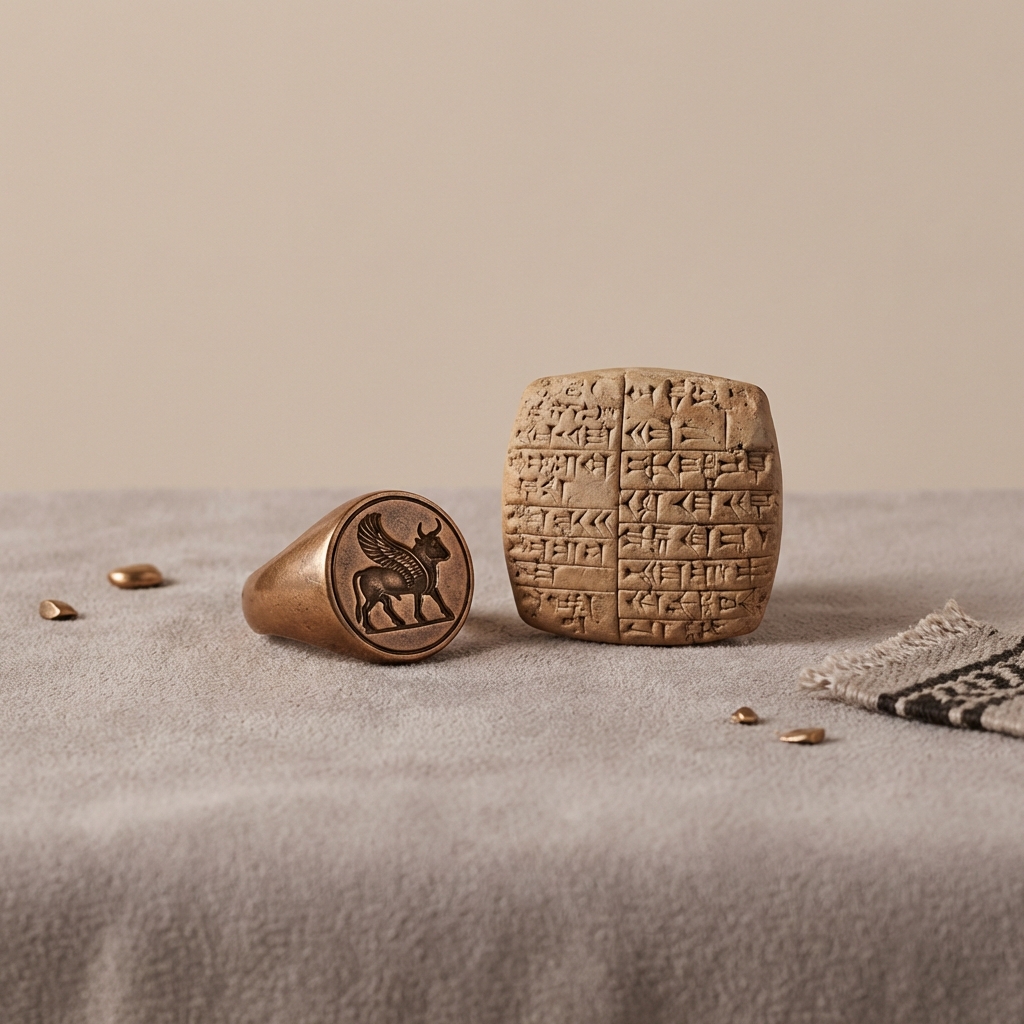
In specialist language an "ancient ring" can be a seal ring, a decorative hoop, or an amulet, and these categories overlap: a signet ring could be worn as personal ornament while also carrying administrative authority, and a small metal hoop might function as jewelry without a sealing surface; distinguishing these roles is part of scholarly attribution. Metropolitan Museum of Art timeline on jewellery in the ancient Near East
Short timeline: 3rd to 2nd millennium BCE through later millennia, ancient babylonian wedding rings
Material culture surveys and museum catalogues show rings and signet rings present across Mesopotamia from the third into the second millennium BCE, providing secure archaeological context for discussions about their social functions. Metropolitan Museum of Art timeline on jewellery in the ancient Near East
At the same time, Babylonian legal texts and marriage contracts from the early second millennium BCE record exchanges of objects in marriage settlements, and scholars often interpret some of those objects as rings or ringlike seals when the wording and transfer contexts align. British Museum overview on marriage in ancient Mesopotamia

Because the term "wedding ring" carries a modern set of meanings, it is helpful to use it cautiously for antiquities and to prefer descriptions like signet ring, personal ring, or nuptial token unless the object has clear textual or archaeological confirmation linking it to a marriage event.
Types of evidence scholars use: texts, objects, and museum records
Textual sources: contracts, legal codes, administrative tablets
One important strand of evidence is the corpus of Babylonian legal texts and marriage contracts that record transfers of property, dowry arrangements and other items exchanged at the formation of household alliances, which provide an inferential basis for claiming that rings or ringlike objects could form part of such transactions. Code of Hammurabi translation
Archaeology and museum catalogues: rings, signets, materials and contexts
Museum catalogues and archaeological summaries document that rings and signet rings were common personal and administrative objects in Mesopotamia, and these collections provide the material comparanda scholars use to interpret textual mentions; the objects themselves vary in material from metal to stone and faience and show a range of functions. Metropolitan Museum of Art timeline on jewellery in the ancient Near East
Follow @auroraantiqua for sourcing and provenance insights
Review the checklist that follows in the next section to see which pieces of evidence matter most when a seller or catalogue claims a ring is a nuptial object.
Catalogued specimens alone do not always resolve the question of nuptial use, because many rings lack secure findspot documentation and may have been collected or traded without archaeological context; that limitation is why provenance and collection history matter when reading labels that claim a ring is connected to marriage. L'anneau sigillaire d'Arégonde, femme de Clotaire Ier, découvert à Saint-Denis, Bulletin de la Societe
Comparative regional evidence from Egypt, the Levant and Anatolia
Comparative evidence from neighbouring regions demonstrates that jewelry exchange at marriage was a widespread practice in the ancient Near East, but the specific meaning of a finger ring as a marital vow develops unevenly by region and period, so direct analogies must be drawn carefully. Penn Museum article on love and marriage in ancient Mesopotamia (history of the wedding ring)
Using comparison helps highlight where Mesopotamian material and texts align with or diverge from nearby traditions, which in turn informs how confident scholars can be when assigning a nuptial reading to a particular piece.
Core framework: how scholars decide if a ring was used for marriage
Contextual criteria scholars apply
Scholars typically rely on a set of contextual criteria when evaluating nuptial attributions: archaeological context or secure excavation data, associated finds that indicate a domestic or funerary ritual, explicit mention in contemporaneous texts that ties a named object to a marriage, and a verifiable provenance or collection history that connects the item to a documented source. British Museum overview on marriage in ancient Mesopotamia
None of these criteria alone is decisive in every case; for example, a ring found in a domestic context may be suggestive but not conclusive without supporting documentary evidence, and textual mentions can be general about "objects exchanged" without specifying a shaped finger-ring.
Limitations and open questions
Legal documents such as the Code of Hammurabi provide a terminus ante quem by demonstrating that laws and clauses governing marriage and dowry existed in the eighteenth century BCE, which frames the period in which such exchanges were formalized, but these texts do not always describe the visual form of the objects exchanged as a finger-ring made of metal or stone. Code of Hammurabi translation
Modern scholarship therefore treats nuptial attributions with caution and recognizes open questions about when a ring specifically became a standardized emblem of marital vow rather than one of several token types used in exchange, a point emphasized in recent reviews of marriage in the ancient Near East. Oxford Research Encyclopedias entry on marriage in the ancient Near East
Decision criteria for buyers and collectors: evaluating a claimed ancient Babylonian wedding ring
Questions to ask the seller or catalogue
Ask for clear provenance and documentation such as collection history, prior ownership notes, and any available verification letters or catalogue entries; these elements are essential for supporting a nuptial attribution and for understanding how the piece entered the market. Metropolitan Museum of Art timeline on jewellery in the ancient Near East Also request full collection histories such as a published inventory or a clear collection history entry when available.

Prioritize clear photographs showing the band, bezel or intaglio face, any remaining patina, and images of hallmarks or tool marks, together with measurements and stabilization or restoration notes so you can assess wear consistent with age and what was conserved. Metropolitan Museum of Art timeline on jewellery in the ancient Near East
What documentation and images matter most
Documentation that ties an object to a documented excavation, a museum catalogue entry, or a dated collection inventory adds considerable weight to a nuptial claim; absent such documentation, a seller citation of a legal text such as Hammurabi is contextual but not definitive proof that a given ring was a wedding token. Code of Hammurabi translation

Condition notes and restoration notes should specify what was stabilized, what was repaired, and what was left untouched, because restoration can obscure original features that might help determine function, such as a sealing surface or wear patterns where a ring was used daily.
Common mistakes and pitfalls when interpreting or buying alleged nuptial rings
Overreading signage: seals versus nuptial symbols
A frequent mistake is to read an administrative function back into a nuptial claim; many signet rings were used primarily to seal documents or mark property and only secondarily as personal ornaments, so an administrative interpretation may be the default unless contextual signals point to marriage use. Metropolitan Museum of Art timeline on jewellery in the ancient Near East For further reading on related administrative motifs see a study on the rod and ring motif: A New Look at the Mesopotamian Rod and Ring.
Marketing language that uses modern wedding symbolism can mislead buyers when the seller lacks provenance or when the object lacks supporting text; treat such labels as interpretive rather than evidentiary unless documentation is supplied.
Problems with unprovenanced objects and assumptions
Objects without secure provenance or museum catalogue context present significant challenges: without findspot data or collection history it is difficult to tie a specific ring to nuptial practice, and such gaps often prevent confident attributions that would otherwise rely on context. Encyclopaedia Britannica entry on wedding ring
For these reasons, scholars and curators repeatedly caution against certainty when provenance is missing, and buyers should ask for the same kind of documentation that specialists would require before publishing a nuptial interpretation. Oxford Research Encyclopedias entry on marriage in the ancient Near East
Practical examples and scenarios collectors can use to test claims
Example 1: A ring that comes with a collection history citing a known excavation, a dated inventory entry, and a related cuneiform contract mentioning the transfer of a named object gives the strongest case for a nuptial reading, because the conjunction of text and object creates corroborating lines of evidence. British Museum overview on marriage in ancient Mesopotamia A useful catalogue entry or catalogue entry that links object and context strengthens a listing.
Illustratively, a catalogue entry that links a ring to a documented household deposit and cites a marriage contract from the same site offers a credible interpretive pathway, though scholars would still note degrees of certainty and any remaining ambiguities.
Quick listing checklist for assessing nuptial claims
Use this to request missing information
Example 2: An unprovenanced signet ring offered as a "wedding ring" in sale copy is a common red flag; absent collection history and with a generic description, the claim is interpretive marketing rather than evidence based, and buyers should seek independent verification or decline to accept the nuptial reading. Metropolitan Museum of Art timeline on jewellery in the ancient Near East
Below is model listing language in a neutral Aurora Antiqua voice that highlights the right elements without asserting unwarranted certainty: "Described as a Mesopotamian signet ring, possibly early second millennium BCE; provenance: private collection, acquired before 1980 with published catalogue entry; condition notes: stable patina on band, small chip to bezel stabilized; interpretation: some documents cite exchange of objects in marriage settlements in this period, which can make a nuptial reading plausible but not definitive." Aurora Antiqua voice
Conclusion: cautious takeaways for history minded buyers
Textual and archaeological evidence combine to make early second millennium BCE Mesopotamia a secure context in which rings could be exchanged in marriage settlements, but whether a particular ancient ring served as a marital vow depends on contextual criteria such as provenance, associated finds, and explicit documentary references. Code of Hammurabi translation
For buyers, the best practical steps are simple: seek provenance and collection history, request clear condition and restoration notes, and treat nuptial claims as interpretive unless they are backed by direct archaeological or textual links; this cautious approach aligns with current scholarship and protects both the buyer and the historical record. Metropolitan Museum of Art timeline on jewellery in the ancient Near East
Textual sources and legal codes from the early second millennium BCE record exchanges of objects in marriage settlements, which scholars sometimes interpret as including rings when contextual evidence supports that reading.
No; signet rings often served administrative or personal identification functions, and a nuptial interpretation requires supporting context such as documentary citation or secure provenance.
Request collection history or provenance, catalogue entries or publication references, clear photographs and measurements, and any restoration or condition notes that explain what was conserved or left original.
More from Aurora Antiqua
References
- Pliny the Elder, The Natural History, BOOK XXXIII, Perseus Digital Library, Tufts University (edition Bostock)
- Internet History Sourcebooks: Medieval Sourcebook, Internet Medieval Sourcebook, Fordham University, New York
- Finger Ring with Frog, The Cleveland Museum of Art
- Ring, Victoria and Albert Museum, London
- Aegean and Cypro-Aegean Non-Sphragistic Decorated Gold Finger Rings, American Journal of Archaeology
- L'anneau sigillaire d'Arégonde, femme de Clotaire Ier, découvert à Saint-Denis, Bulletin de la Societe
- Research report: export licensing and provenance, GOV.UK, Department for Culture, Media and Sport (DCMS)
- About us, International Association of Dealers in Ancient Art
- The Avalon Project : Code of Hammurabi, avalon.law.yale.edu