


Looking for the real thing? Browse genuine ancient rings for sale, each piece one of one, individually authenticated, with documented provenance. For the background, see the guide to ancient jewelry.
What counts as an ancient wedding ring? Definition and context
What we call ancient wedding rings are objects that scholars and museums interpret as finger-worn tokens associated with marriage or betrothal in specific historical contexts. The phrase names a functional reading rather than a single material type, and it is important to treat the term as historically specific rather than universal. Museums and reference works often frame such rings by combining object form, context of discovery, and documentary evidence before describing a ring as marital in purpose, so a cautious working definition helps collectors and readers set expectations.
Museums describe rings both by physical features and by social use, and they typically avoid asserting a marital function unless there is supporting evidence in provenance or catalogue notes. For a practical museum-oriented definition consult the Victoria and Albert Museum discussion of wedding rings and their changing social role over time Victoria and Albert Museum article.
Several cultural regions did not traditionally use finger-worn rings as the principal marital symbol; instead they used betrothal gifts, textiles, necklaces, body markings or ritual contracts, and each case requires contextual evidence and provenance to interpret material culture responsibly.
In museum catalogues a ring becomes plausibly a wedding ring when independent contextual cues align: an association with matrimonial ceremony in a written source, repeated iconography tied to marriage, consistent burial or hoard contexts, or a clear collection history linking the object to documented marital use. Without those elements, a ring is usually described more generally as an ancient ring or an artifact with uncertain social function.
Definitions used by museums and scholars
Scholarly definitions favour conditional language, noting that attributions to marriage are often probable rather than certain. Encyclopaedia Britannica and similar reference treatments distinguish rings used as personal ornaments from rings used in social or legal transactions, and they stress material, context and documentation when assigning social meaning Encyclopaedia Britannica entry on rings. You can also compare labelled museum examples such as the British Museum wedding-ring entry for cataloguing practice British Museum wedding-ring.
How museums distinguish wedding rings from other rings
Museums use a combination of readings: form and wear consistent with finger use, iconography suggestive of partnership or legal exchange, and provenance that situates the object within matrimonial contexts. Catalogue entries that label a ring as a wedding object typically cite comparative examples, archival evidence, or ethnographic parallels. For collectors this means the catalogue label is a starting point, not a single proof.
Origins: how ring exchange began in the classical Mediterranean and Europe
Many historians locate the practice of exchanging finger-rings as marital tokens in the classical Mediterranean, where rings had a range of social functions and where certain forms became associated with betrothal and legal exchange. Museum studies and long-form histories trace a lineage from Roman practices through later European Christian rites, noting how institutional rituals helped standardize the practice in some societies Victoria and Albert Museum article. For comparison with Roman catalogued examples see the Ancient Roman rings collection Ancient Roman rings collection.
In antiquity, rings served as legal tokens, personal seals, or visible marks of social relation. Over time, the association of a finger-worn band with marriage became more widespread in parts of Europe as Christian matrimonial rites incorporated ring exchange into formal ceremony. This is not a single straight trajectory; dating and specific local usages vary considerably, and careful cataloguing is needed for confident historical claims.

Classical antecedents: Roman and Greek practices
In Roman legal and social contexts, rings could signify vows, legal agreements, or membership in a household. Some rings, especially those with intaglio or seal faces, served as personal identifiers and could be used in contractual settings that included marriage-related transactions. Museum catalogues frequently discuss these multifunctional uses when presenting Roman rings; one illustrative museum example is a ring with a cameo of clasped hands in the MFA collection MFA ring with cameo of clasped hands.
Christian matrimonial rites and their institutional role
From the medieval period onwards, Christian matrimonial rites in parts of Europe increasingly formalized ring exchange as part of the public ceremony. Where churches recorded marriage customs and where legal practice referenced ring exchange, the finger-worn token acquired a more recognized ritual status. Still, the timing and precise meaning of ring exchange differed among regions and communities, so institutionalization should be read as regional development rather than global prescription Byzantine Marriage Ring at the Met.
East Asia: why finger rings were not always the principal marital symbol
Across much of historic East Asia the principal tokens of marriage often differed from finger rings. Scholarship on marriage in China and neighbouring areas notes that contractual exchanges, gift-giving, and specific ritual objects frequently carried the social weight that rings held in the Mediterranean world Oxford Research Encyclopedia overview on marriage in East Asia.
Historic Chinese marriage practices varied by time and locality, but common elements included negotiated exchanges, dowry and bridewealth items, and ritual gifts that were legible as legal or social tokens without reliance on finger-worn rings. These betrothal goods and contractual rituals functioned as public markers of obligation and alliance rather than as personal finger-worn bands.
ToolType: | Purpose: | Fields: | Notes:
Japanese marriage customs and those of other regional societies similarly favoured objects and acts distinct from ring exchange. Where rings were used at all, their social prominence and symbolic meanings shifted across periods and social classes, and ring adoption increased unevenly over time and through contact with other cultures Smithsonian Magazine feature on the long history of the wedding ring.
Historic Chinese marriage tokens and betrothal exchange
Documentary and ethnographic sources emphasize gifts, contracts and family negotiations in Chinese marriage customs. Objects such as textiles, household goods, and inscribed contracts could serve as the legally significant exchange, reducing the need for a finger-worn ring as the main public symbol of union.
Japanese and other regional practices that favored non-ring symbols
In parts of Japan and surrounding areas, marriage symbolism often used family registers, ceremonial guest lists, and exchange of specific gifts rather than a standardized ring. Over the modern period, and especially in urban and transnational contexts, finger rings became more visible, but the historical record shows diverse local practices.
Indigenous Americas and African traditions: alternative marital tokens and ceremonies
Ethnographic literature records a wide range of non-ring marital tokens across Indigenous American and African communities. Objects such as necklaces, woven textiles, beadwork, and body markings have served as primary signals of marriage or betrothal in many contexts, and museum catalogues often describe these items with reference to local ritual and material practice Encyclopaedia Britannica entry on rings.
These traditions underscore that ringless marriage customs are well attested and that forms of marking social bonds are shaped by local materials, aesthetic systems, and ritual logic. In some cases garments or exchange ceremonies held social meaning equivalent to or stronger than a finger-worn token.
Necklaces, textiles, body markings and ceremonial exchange
In both continents the form of marital exchange is often embedded in wider systems of craft and display. For example, woven belts, cloth panels, or specially commissioned beadwork could be produced and exchanged as part of marriage alliance-making, and body painting or scarification might mark ceremonial status in ways that functionally paralleled ring exchange.
How ethnographic literature records ringless marriage traditions
Anthropological surveys and museum catalogues emphasize local variation and the centrality of ritual context. Collectors and readers should be attentive to catalogue descriptions that situate objects within living practices, and avoid projecting ring-based assumptions onto collections from cultures where other tokens predominate.
South Asia: mangalsutra, sindoor, and the shifting role of rings
In many South Asian communities objects such as the mangalsutra and the application of sindoor have long served as primary marital symbols. These elements operate within specific ritual and religious frameworks and carry meanings that a single finger-worn ring does not always substitute for. Contemporary reporting and ethnographic summaries describe these practices and their enduring social significance BBC Culture piece on the mangalsutra and sindoor.

Across South Asia there is considerable regional variation. While the mangalsutra or sindoor are primary markers in many communities, the use of rings has increased in urban and transnational contexts, and modern practices may blend several symbols. For collectors this historical layering means that rings described as marital in catalogue entries should be supported by clear documentation rather than modern assumption.
Traditional South Asian marital symbols and regional variation
The mangalsutra is typically a necklace worn by married women in certain Hindu communities and carries ritual and symbolic associations that differ by region and caste. Sindoor, or vermilion applied at the hair parting, functions as a visible marital marker in many settings. Both elements have histories that predate widespread Western-style ring use in those societies.
Contemporary ring adoption in urban and transnational contexts
As global social practices mix, rings have become more common in cities and among diasporic communities, but this does not mean rings replaced traditional symbols uniformly. When assessing claims that an ancient ring is a ‘‘wedding ring, collectors should weigh historical context and documentary support carefully.
Other global alternatives: bracelets, cloth, oaths and household gifts
Across the world a wide range of objects and practices have functioned as marital tokens: bracelets, special garments, public oaths, or household gifts transferred between families. Cultural histories and museum catalogues emphasise that the material form of a token depends on local ritual and economic practices rather than on a universal standard Encyclopaedia Britannica entry on rings.
These alternatives remind us that the absence of a finger ring does not indicate the absence of structured marital exchange. In many societies a domestic object or shared household good could signify union more clearly than personal jewellery.
Common alternative tokens across regions
Examples include bracelets or armlets exchanged in some African contexts, robes or cloth panels in parts of Asia, and publicly declared household gifts in many agrarian societies. Museum collections often preserve these items alongside written or oral histories that explain their marital role.
Why material form depends on ritual and local practice
Material availability, craft specialisation and ritual economy shape what objects become appropriate tokens. Museums and cultural histories therefore read objects within these broader systems rather than assuming a one-size-fits-all meaning.
How to read an ancient ring: criteria to evaluate marriage-related claims
For collectors evaluating whether a ring was used as a marital token, start with physical and contextual criteria and browse our rings collection for comparable examples. Look for consistent wear that indicates long-term finger use, iconography linked to partnership or household, clear provenance connecting the object to marriage contexts, and catalogue notes that cite comparative examples. These elements together strengthen a marriage-related reading of an object.
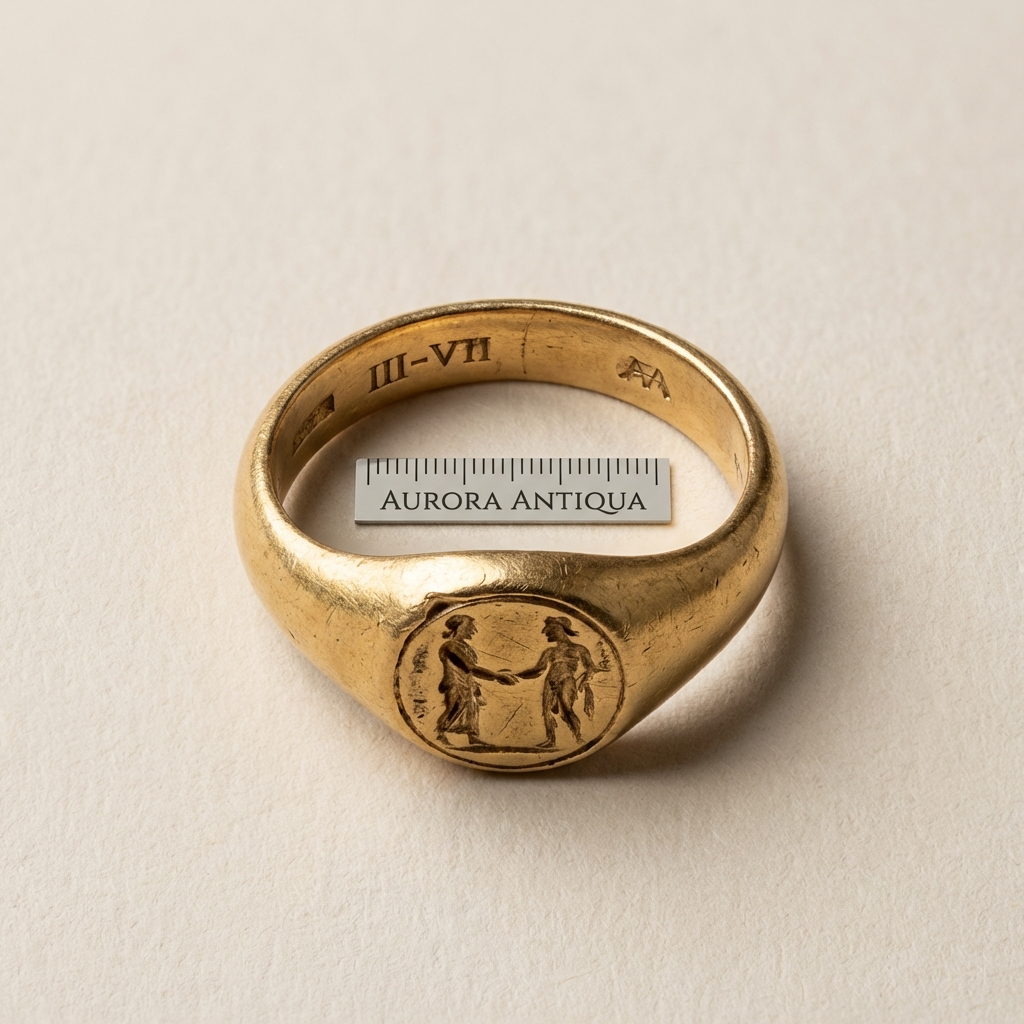
Some typical physical signs that museums consider include size and wear patterns consistent with domestic wear, intaglio scenes or motifs associated with partnership, and evidence that a ring was kept in contexts linked to household or family exchange. When catalogue entries make marital claims they usually cite such converging lines of evidence Victoria and Albert Museum article.
Provenance and restoration notes matter as much as surface iconography. A ring with little documented collection history or vague ownership claims needs stronger corroborating context before it should be read as a wedding object. Condition and restoration notes often explain what was stabilized or left untouched, which helps interpret signs of use versus later repair Encyclopaedia Britannica entry on rings.
Physical signs and iconography linked to marriage
Iconographic clues may include paired motifs, references to household gods or household scenes, or inscriptions that indicate vows or legal exchange. None of these by themselves prove marital use, but when combined with provenance and contextual documentation they can be persuasive.
Provenance, documentation and contextual evidence to look for for ancient wedding rings
Good provenance includes clear collection history, acquisition dates, and any available verification letters or archival citations. Museum catalogues that draw on archival records or comparative material supply a stronger basis for marriage-related attributions than isolated listings without documentation Encyclopaedia Britannica entry on rings.
When a seller or catalogue offers condition notes, restoration notes, and photographs showing measurements and wear patterns, collectors can better assess the likelihood that a ring functioned as a matrimonial token. Ask for detailed measurements and high-resolution images of the bezel, shoulders and inner band to compare with documented examples. If you need assistance, please use our contact page to reach the curatorial desk contact page.
Dating and attribution: workshop, period, and provenance issues
Museums date rings by a combination of stylistic comparison, manufacturing technique, and any documentary evidence that links an object to a find context or collection history. Stylistic dating is useful but approximate, and attributions to particular workshops are frequently probabilistic rather than certain Victoria and Albert Museum article.
Provenance and documented collection history materially improve confidence in attributing a ring to a period or social function. Where provenance is weak, stylistic dating should be treated as an estimate that benefits from archival corroboration or scientific testing when available.
Common mistakes and pitfalls when identifying ancient wedding rings
A common error is to infer marital use from decorative motifs that may have had multiple meanings historically. Another pitfall is to read modern ring norms back into past societies without considering local practices and material systems. Restoration and later repairs can also obscure original form and confuse readings based on surface appearance Encyclopaedia Britannica entry on rings.
Avoid overreliance on a ring's current wear or patina alone. Patina and wear can indicate age and use, but without contextual documentation those signs do not definitively identify social function. Cross-check catalogues, compare to museum examples, and request provenance paperwork when possible.
Practical checklist for collectors: what to ask and what to document
When considering a ring described as an ancient wedding ring, request the following: collection history with dates and prior owners, condition notes and restoration records, high-resolution photographs showing inside band measurements and bezel detail, and any verification letters or catalogue citations. These items form the core of responsible due diligence.
Red flags include vague or absent provenance, inconsistent measurements across photos, claims of marital function without documentary support, or restoration notes that conceal original features. A transparent seller or catalogue will provide measured evidence and clear condition reporting Victoria and Albert Museum article.
- Ask for collection history and dates
- Request condition and restoration notes with images
- Compare measurements to museum catalogues
- Seek verification letters or archival references
Case studies and practical examples: reading rings and alternatives in context
Museum catalogues sometimes present rings alongside documentary or archaeological context that makes marital interpretation plausible. For instance, rings from burial contexts tied to known household assemblages or rings mentioned in correspondence that links them to a betrothal offer stronger evidence for marital use Encyclopaedia Britannica entry on rings.
Conversely, museum examples of non-ring marital tokens illustrate how objects such as necklaces or textiles are catalogued with ethnographic context to support marital attributions. These cases reinforce the need to assess each object within its specific cultural and material frame rather than by generalized expectation.
Conservation, restoration notes and ethical sourcing for collectors
Restoration notes typically record what was stabilized, what repairs were undertaken, and what was intentionally left untouched. Such records help determine whether observed features reflect ancient use or modern intervention, which in turn affects social readings for the object Victoria and Albert Museum article.
Ethical sourcing depends on transparent provenance and collection history. Collectors should prefer objects with verifiable documentation and should be cautious about pieces lacking clear ownership records. Transparent condition and restoration notes form part of ethical practice by making intervention history visible.
Conclusion: key takeaways for collectors and curious readers
Ring-based marriage is a historically specific practice with strong roots in the classical Mediterranean and later Christian European rites. Many cultures did not use finger-worn rings as their primary marital symbol, and alternative tokens such as necklaces, textiles, or ritual marks are well documented in ethnographic literature Encyclopaedia Britannica entry on rings.
For collectors the practical lesson is to prioritize provenance, condition notes and restoration records before accepting attributions that an object functioned as a wedding ring. Catalogue labels and museum sources are the best first step, and where documentation is incomplete treat marital readings as tentative and require further corroboration.
It denotes rings that scholars or museums interpret as likely used in marital or betrothal contexts, usually based on object form, contextual evidence and provenance rather than on appearance alone.
No, rings can appear through trade, status display or later cultural contact; historical absence of ring-based marital symbolism does not preclude other uses of rings in that society.
A clear collection history or provenance record that traces prior ownership, acquisition dates or archival citations is typically the most informative single item.
More from Aurora Antiqua
References
- Pliny the Elder, The Natural History, BOOK XXXIII, Perseus Digital Library, Tufts University (edition Bostock)
- Pliny the Elder, The Natural History, BOOK XXXIII, Perseus Digital Library, Tufts University (edition Bostock)
- Aulus Gellius, Attic Nights, Book X, LacusCurtius, Bill Thayer, University of Chicago (Loeb Classical Library edition)
- The Form of Solemnization of Matrimony, The Church of England
- Internet History Sourcebooks: Medieval Sourcebook, Internet Medieval Sourcebook, Fordham University, New York
- Gimmel Ring, Victoria and Albert Museum, London
- Ring, The Cleveland Museum of Art
- ring, Victoria and Albert Museum, London
- How Researchers Are Protecting Great Apes From Covid-19, Smithsonian Magazine