


Looking for the real thing? Browse genuine ancient rings for sale, each piece one of one, individually authenticated, with documented provenance. For the background, see the guide to ancient jewelry.
What is a black onyx Roman soldier ring? Definition and context
In collecting and cataloguing, the phrase black onyx roman soldier ring usually describes an ancient ring set with a dark banded chalcedony that appears to be onyx and bears an engraved image that sellers or catalogue notes link to a military theme. The term itself is descriptive and may be applied differently by curators, dealers and collectors, so treat such attributions as a working label rather than a full provenance statement.
Onyx, a banded variety of chalcedony, was widely used for engraved gems in antiquity because its layered structure takes fine incised work and reads clearly in profile, a quality that made it popular for intaglios and seals in Roman contexts, as documented in reference works and museum collections Encyclopaedia Britannica entry on onyx. For further reading on onyx history see Interesting Facts about Onyx.
See provenance and condition details on @auroraantiqua
Check condition notes and any available provenance or restoration documentation before you plan to wear an ancient piece; good listings make these details easy to find and interpret.
Many Roman rings in museum collections and recent catalogues carry dark intagliated stones consistent with onyx or similar chalcedonies, and these are often described in collection entries as working seals, amulets or personal marks. However, linking a particular motif to a soldier role requires contextual find data or clear collection history rather than the stone or image alone Metropolitan Museum examples of Roman intaglio rings. See the Ancient Roman rings collection for related pieces in our catalog.
When a seller or catalogue describes a ring as a soldier's piece, ask for the documentation that supports that attribution: excavation context, prior collection notes, or verification letters. Absent those, the description can be helpful for grouping similar objects but does not establish function or owner identity.
Material and craft: why Roman intaglios used onyx
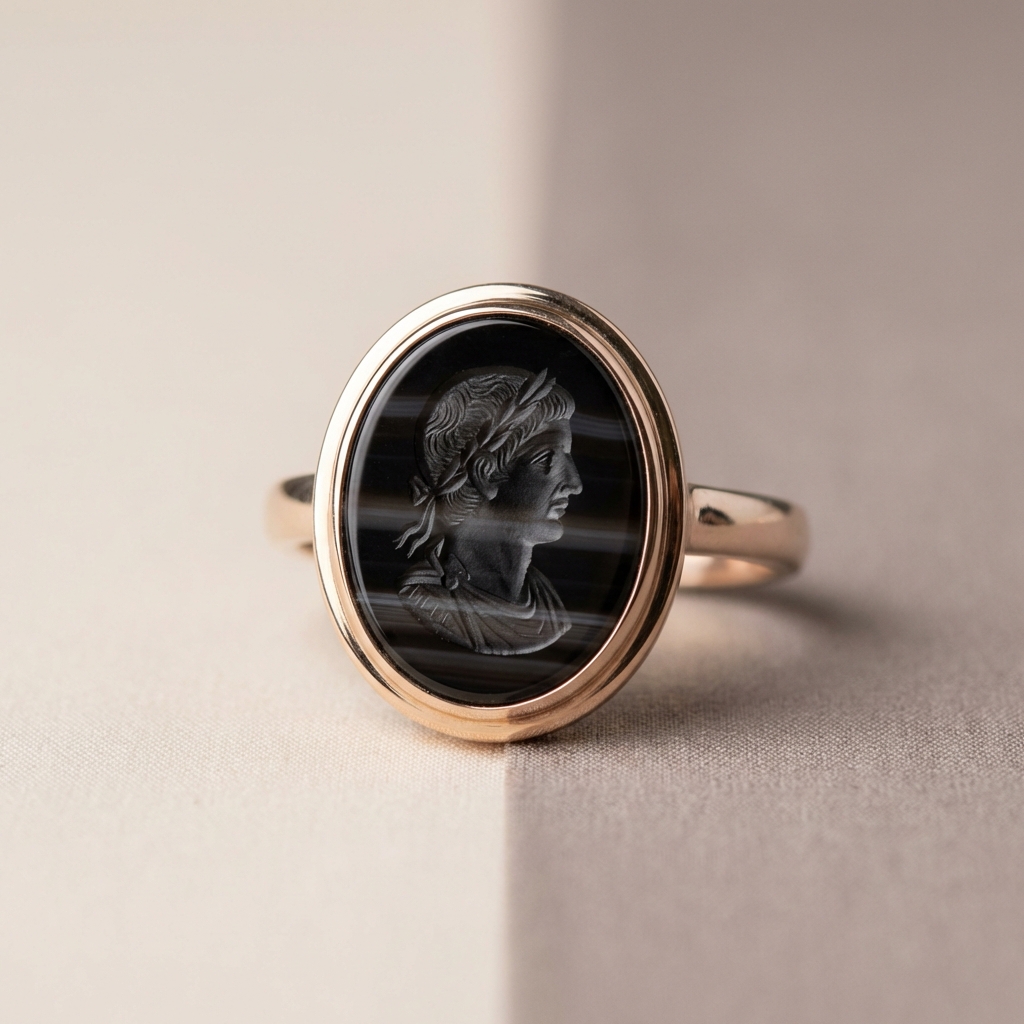
The craft reason is straightforward: onyx's banded chalcedony structure lets engravers cut firmly defined lines whose silhouettes show crisply against the stone's layers, which is particularly useful for small profile images used on signet rings and seals. This technical suitability shows up repeatedly in published collections and specialist treatments of engraved gems Encyclopaedia Britannica entry on onyx.
Museum catalogues and collection records include numerous Roman intaglios and signet rings set with dark chalcedonies that read as onyx in photographs and descriptions, and these examples illustrate how engravers exploited the material to render figures, heads and symbolic devices readable at small scale British Museum Roman ring collection.
Common motifs carried practical meaning: a carved charioteer, a martial emblem or a deity could function as a personal seal, a protective emblem, or a statement of affiliation. Interpreting a motif as evidence of military use is possible when the find context or collection history supports that reading; otherwise motif alone is a hypothesis rather than proof Metropolitan Museum examples of Roman intaglio rings.

Which hand should you wear a black onyx roman soldier ring? Practical etiquette and symbolism
Which hand should you wear a black onyx roman soldier ring? Practical etiquette and symbolism
Contemporary Western convention still typically reserves the left ring finger for engagement or wedding rings, while signet and statement rings are often worn on the right hand in many European traditions; these conventions shape expectations but do not dictate how a collector should wear a historical piece Emily Post Institute guidance on which hand to wear rings on.
If you do not intend the ring to carry a ceremonial role, many collectors choose the non-dominant hand to reduce everyday wear and accidental impact, a practical habit that helps protect stones like onyx that are moderately hard but vulnerable to chemical and mechanical stress British Museum Roman ring collection.
There is no single correct hand: follow cultural convention if symbolism matters, but for preservation place the ring on a less-active finger of the non-dominant hand or reserve it for occasional wear, guided by condition and restoration notes.
There is no single correct answer: decide whether you want symbolic placement that follows a cultural tradition, or practical placement that prioritises preservation. For a wearable ancient onyx ring, placing it on a less-active finger and on the non-dominant hand often balances visibility and protection.
Choosing the finger: fit, protection and traditional placements
Traditionally, signet and statement rings are worn on the little finger or ring finger, with the index finger sometimes used for display or office-related rings; these conventions persist because they balance visibility with the reduced likelihood of everyday knocks on those fingers British Museum Roman ring collection.
When choosing a finger for an ancient onyx ring, consider exposure: the pinky tends to be sheltered from heavy contact compared with the index, but its smaller size can make fit and stability trickier. If the ring has a tall bezel or a projection, the ring may be more prone to catching on clothing regardless of finger, so fit and bezel profile matter as much as which hand you choose.

Ancient rings are often sold with measured internal diameters and condition notes; try to match those dimensions to your finger or consult a specialist for a measurement-based recommendation rather than guessing. Be aware that resizing an antiquity, even modestly, can affect its structural integrity and should follow the seller's restoration notes and conservator guidance.
Caring for a wearable ancient onyx ring: cleaning and preservation
Onyx is a chalcedony with moderate hardness, commonly reported near 6.5 to 7 on the Mohs scale, and it is sensitive to acids, heat and ultrasonic cleaning; avoid aggressive home cleaning methods and follow guidance for chalcedony care GIA guidance on onyx properties and care. Practical care guides also outline gentle routines for daily handling and cleaning How to Care for Your Black Onyx Jewelry.
Safe cleaning begins with mild soap, lukewarm water and a soft brush used sparingly; avoid prolonged soaking, chemical cleaners or temperature shocks. If a piece has documented restoration, consult the restoration notes before any cleaning because adhesives or stabilising materials can react badly to water or solvents AGS consumer care guidance for onyx. For guidance on identifying real onyx before cleaning, specialists recommend standard tests and visual checks How to Tell If a Black Onyx Is Real.
For persistent soiling, seek a conservator or a jeweller experienced with antiquities rather than applying strong home treatments. Professional conservators can advise on dry cleaning methods, reversible stabilisation or targeted solvent work that protects both stone and historic metalwork.
Assessing condition and documentation before you wear it
Good listings include clear condition notes that identify any stabilised repairs, loose bezels, hairline cracks or replaced elements; these details are essential for deciding if a ring is suitable for regular wear or should remain for occasional handling and display AGS guidance on caring for chalcedony and onyx.
Provenance and documentation-collection history, prior ownership notes, and verification letters-help place a piece and can clarify whether an attribution such as soldier, civilian or devotional is supported by context rather than conjecture British Museum Roman ring collection.
a short checklist to review condition and provenance before wearing an ancient ring
Use images to confirm listed remarks
Red flags for regular wear include recently repaired settings without detailed notes, loose stones, or restorations that obscure original joins; if a listing lacks clear photographs or a written restoration history, ask the seller for detailed images and for a conservator report when available AGS guidance on chalcedony care and restoration considerations.
How restoration and bezel style affect wearability
Restorations range from gentle stabilisation to more invasive repairs; notes should specify adhesives used and whether any metal has been replaced or reshaped. Conservative treatments that stabilise without extensive reconstruction are generally preferable for long-term preservation, but any repair can influence how a ring tolerates repeated wear AGS guidance on caring for chalcedony and onyx.
Bezel design changes the risk profile: a low-profile bezel sits close to the finger and reduces snagging, while a higher bezel may protect the stone from direct hits but can itself catch and transmit force to the setting. Review photos from multiple angles and ask whether the bezel was altered in restoration work before committing to daily wear British Museum Roman ring collection.
When a restoration involves re-soldering or reshaping of the hoop, note whether the work used historically sympathetic materials and reversible techniques; non-reversible modern repairs may hold but can complicate future conservation interventions.
Decision framework: daily wear, occasional wear or display
Use a short checklist to decide how to use a specific ring: confirm structural stability, verify bezel protection, check for documented restorations and weigh your own tolerance for risk. If any of these areas raise doubts, prefer occasional rather than daily wear AGS guidance on chalcedony care.
Practical factors that push toward display-only include recent or unspecified repairs, a loose bezel, or an important provenance that you prefer to preserve intact. Conversely, a solidly set stone with conservative stabilisation and clear condition notes is a better candidate for careful, occasional wear.
Adopt protective habits if you decide to wear the piece: remove it for manual work, avoid detergents and acids, keep it away from heat sources, and store it in a soft padded container when not on the hand GIA onyx care guidance.
Common mistakes and pitfalls when wearing ancient onyx rings
Over-cleaning and using ultrasonic cleaners are frequent causes of damage for onyx and chalcedony; ultrasonic devices can force old fills to fail or drive moisture into porous repairs, so avoid them for historic pieces GIA guidance on onyx care.
Another common error is ignoring restoration notes: a ring that has been stabilised with modern adhesives may react to solvents or heat that would otherwise be safe for untreated stone. Always review the documented treatment history before exposing a piece to water, cleaning products or soldering heat AGS guidance on chalcedony care.
Wearing an ancient ring on a dominant, heavily used finger increases the chance of knocks, abrasion and loss; conservative placement on a less-active hand and cautious daily habits reduce these risks.
Practical scenarios: collector, casual wearer, and heirloom use cases
A collector who prioritises documentation may choose to display most of a collection and wear pieces only for short, supervised occasions; this approach emphasises provenance and condition and minimises mechanical risk to the stone and setting British Museum Roman ring collection. See our Q&A on can you wear ancient rings for related guidance.
A casual wearer who wants a wearable artifact can balance visibility and care by placing the ring on the non-dominant hand, avoiding heavy tasks while wearing it, and performing gentle cleaning following professional guidance. This user accepts a small amount of risk for regular enjoyment but follows clear handling rules to protect the piece GIA onyx care guidance.
As an heirloom, rotate wear with conservation checkups: periodic inspections by a conservator or experienced jeweller can catch developing issues early and allow you to maintain both the stone and the mounting across generations AGS guidance on chalcedony care.
How to style a black onyx ancient ring safely
Pair ancient intaglio rings with low-profile bands or wear them alone to reduce the risk of abrasion and snagging; layering multiple modern rings with an ancient piece increases the chance of contact damage and should be done with caution Encyclopaedia Britannica entry on onyx.
Avoid wearing an ancient onyx ring during activities that involve water with detergents, chemical exposure, gardening, heavy lifting, or any task that risks blunt impact. When not worn, keep the ring in a soft pouch or a lined box with separate compartments to prevent scratches and contact with harder gems.
Attribution cautions: if a ring is labelled a 'soldier' piece
Attributing a ring to a soldier depends on evidence that goes beyond motif or stone type; the most persuasive support comes from excavation context, collection history or documentation that connects the object to military use, rather than from a single carved device alone British Museum Roman ring collection.
Ask sellers for the specific provenance documents that support a soldier attribution: excavation reports, prior ownership notes or specialist verification letters. If precise material identification matters for care or study, request lab-tested stone identification rather than relying solely on a description in a catalogue entry.
Summary: choosing a hand and caring for your black onyx roman soldier ring
Deciding which hand to wear an ancient onyx ring blends cultural convention and preservation. The left ring finger remains the Western default for wedding-related rings, while many collectors and European traditions place signet or statement rings on the right hand; for preservation, the non-dominant hand is often the safer choice Emily Post Institute guidance.
Key care points are clear: avoid acids, heat and ultrasonic cleaning, follow documented restoration notes, and prioritise condition and provenance information before regular wear. When in doubt, opt for occasional wear, protective placement, and professional conservation advice GIA onyx guidance.
Daily wear is possible for well-documented pieces with stable settings, but many collectors prefer occasional wear on a non-dominant finger to reduce risk to the stone and metal.
Use mild soap, lukewarm water and a soft brush sparingly; avoid ultrasonic cleaners, acids and heat. For treated or repaired pieces, consult a conservator before cleaning.
Request clear condition notes, photos of any repairs, restoration details, and provenance or verification letters where available; these inform whether the ring is safe for regular wear.
More from Aurora Antiqua
References
- Gimmel Ring, Victoria and Albert Museum, London
- Aulus Gellius, Attic Nights, Book X, LacusCurtius, Bill Thayer, University of Chicago (Loeb Classical Library edition)
- Thumb Ring, The Cleveland Museum of Art
- Ring, The Cleveland Museum of Art
- The Gemstone Book, CIBJO Blue Book, Coloured Stone Commission, CIBJO, The World Jewellery Confederation
- Quartz, Handbook of Mineralogy, Mineral Data Publishing / Mineralogical Society of America, USA
- How to Care For Your Jewellery: The Ultimate Guide by the National Association
- Archaeological materials, Icon, The Institute of Conservation (UK)