


Looking for the real thing? Browse genuine ancient rings for sale, each piece one of one, individually authenticated, with documented provenance. For the background, see the guide to ancient jewelry.
What the ouroboros motif means and why it appears on rings
Origins of the motif across cultures
The ouroboros motif is widely understood as a visual shorthand for cyclical renewal, continuity and self-containment, and it appears across Egyptian, Greco-Roman and later alchemical contexts rather than belonging to a single culture or date range. This broad consensus is reflected in standard reference works and museum essays that trace the motif's long life and shifting interpretations, which helps set realistic expectations for how it may appear on a ring in different contexts Encyclopaedia Britannica and a general overview is available on Wikipedia.
On rings the motif can be economical: a hoop with a biting tail or a coiled serpent can communicate continuity at small scale, while carving, enamel or a bezel-mounted stone can add layers of meaning. The same image can serve religious, funerary, protective or purely decorative roles depending on time and place. Explore our rings collection.
Follow @auroraantiqua for behind-the-scenes looks at rings and restorations
Browse curated listings and editorial notes to see labelled examples and clear condition descriptions; this can help you decide whether a piece matches your collecting aims without pressure.
Why goldsmiths and gem cutters used serpent imagery
Goldsmiths and gem cutters adopted the serpent form because it compresses symbolic density into a wearable shape: a ring can show an unbroken loop, a biting tail, or a coiled body that works with a band and bezel. The motif was adaptable to intaglio carving and small metalworking techniques, which made it useful across different workshops and periods Metropolitan Museum of Art essay.
Because the ouroboros could be produced in many materials and settings, presence of the motif on a ring does not by itself provide a single, fixed meaning or an exact date; it often requires object-level information such as technique, patina and documented context to place it accurately.
Why there is no single ancient rule for which way a snake ring should face
Museum catalogues and ring assemblages
Published catalogues and assemblage studies show variation in how serpent rings were made and worn, with no consistent convention that prescribes a single 'correct' direction. Surveys of museum collections and object-level catalogues demonstrate that orientation varies by example and by context, so direction alone is rarely a reliable dating marker Metropolitan Museum of Art essay.
In short, a ring with the serpent's head pointing toward the palm in one collection may sit the opposite way in a different assemblage; investigators therefore avoid using facing as a stand-alone diagnostic for authenticity or date unless supported by published find-context or conservation records.
Variation by period, region and object function
Orientation can correlate with function or local habit in some object groups: for example, rings designed for intaglio display may favour an outward-facing head to show imagery, while rings intended as intimate tokens may be worn with the head turned in. Still, these tendencies are patchy and do not form a universal rule across antiquity Encyclopaedia Britannica.
Because facing can be influenced by later remounting, aesthetic preferences, or the ergonomics of a particular band or bezel, museum curators and archaeologists prefer corroborating evidence such as provenance, technical description, and published cataloguing over orientation alone.
How different historical periods and workshops treated snake orientation
Ancient workshops and regional tendencies
Published ring assemblages and archaeometric studies suggest that workshop taste, available tools and local fashion more often shaped orientation than an abstract symbolic code. In other words, makers' conventions within a workshop or region produced tendencies without establishing strict, broadly-applicable rules Bagues et anneaux à l'époque romaine en Gaule, Persée, Persee (CNRS, ENS de Lyon, Ministere francais). See also a figure discussion on ResearchGate.
When curators attribute a ring to a workshop or region, they look at manufacturing traces, metal composition and carving technique alongside iconography; these lines of evidence are more diagnostic than whether the snake faces in or out. Compare with our Ancient Roman rings collection.
compare period tendencies and workshop notes for a single ring
Use with catalogued objects
Victorian reinterpretation and later stylistic choices
Later periods reinterpreted the motif in ways that could affect facing: nineteenth-century jewellery makers and their clients sometimes chose orientations deliberately for sentimental display or intimacy, a practice distinct from ancient production choices Victoria and Albert Museum article.
Because revivalists often worked with older forms and new meanings, a ring's orientation can reflect later fashion or remounting rather than the original workshop decision, which is why object-level cataloguing is required to assert a period-specific norm.
The Victorian revival: deliberate meanings and orientation choices
How 19th century jewelers reframed snake rings
In the Victorian period the snake ring acquired a strong sentimental vocabulary, frequently associated with love, fidelity and eternity, and jewelers used the form in rings, bracelets and brooches that emphasised intimacy and symbolism. Museum treatments and cultural histories document this reframing and its popularity in personal jewellery Smithsonian Magazine.
Victorian makers and buyers sometimes preferred a particular facing for sentimental reasons: an inward-facing snake could be read as intimate or protective when worn, while an outward-facing snake could present the motif to an observer. These were modern conventions rather than restorations of an ancient rule.
Common sentimental uses and orientation preferences
Victorian jewelers often combined iconography with inscriptions, gemstones and hairwork to create personal keepsakes; orientation could be matched to the intended message. Still, that nineteenth-century practice does not mean the same facing had the same meaning two thousand years earlier.
When studying a snake ring for provenance, therefore, treat Victorian conventions as historically specific and avoid projecting them back onto ancient objects without direct evidence.
How modern wearers and stylists commonly read inward versus outward-facing snakes
Contemporary conventions and personal symbolism
Contemporary wearers and stylists often read an inward-facing snake, with the head toward the wearer's palm, as intimate, inward-looking or protective, while outward-facing snakes are typically read as display pieces that present to others; such readings are shaped by modern fashion and personal symbolism rather than by a single ancient prescription Victoria and Albert Museum article. See modern examples on Etsy.
For people choosing how to wear a historic or modern ouroboros, these contemporary conventions are useful as personal styling rules, but they do not substitute for object-level historical interpretation. Decide what the ring means to you today, while keeping documentation in mind if age or attribution matters.

When orientation is chosen for intimacy, protection, or display
Styling choices often factor comfort, finger anatomy and the ring's wear pattern: a heavy bezel may flip the head outward on certain fingers, while a low-profile hoop will sit differently. These practical concerns are often more important for daily wear than symbolic direction.
Collectors who value the modern symbolic reading should preserve condition and request restoration notes, but should not rely on orientation alone to argue for an ancient meaning or workshop practice.
Practical inspection checklist for an ancient snake ring
Photos, measurements and condition notes to request
When evaluating a ring, ask for high-resolution photographs that show the ring on a hand, on a flat surface, and in detail for the bezel, shoulders and inner band; include measurements and clear condition notes. These elements are essential to assess whether orientation is original or a result of remounting or wear British Museum catalogue entry.
Request close views of any engraving, intaglio, or stone setting and a description of patina and wear consistent with age; these technical details are more useful than the facing alone when assessing authenticity and provenance.
What to look for in bezels, hoops and gemstones
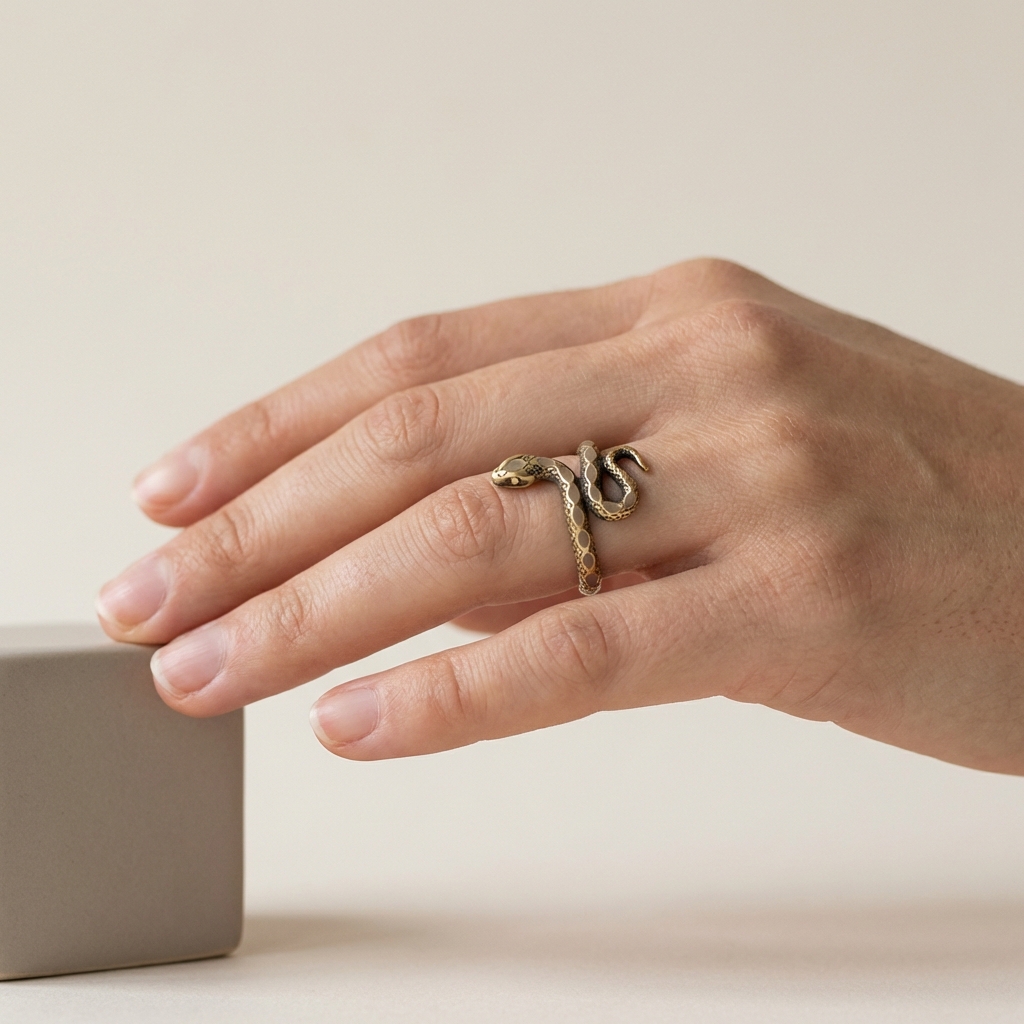
Look for tool marks, solder seams, and how the bezel connects to the shoulders: visible modern solder or a reprofiled shoulder can indicate later remounting that changed the apparent orientation. A conservator's note describing what was stabilised or replaced will clarify whether facing is original.
Ask whether stones are original or later insertions, and whether the bezel was reshaped; a photographic record before and after any restoration is especially helpful for understanding original orientation.
Decision criteria for collectors: what should tip the scale
Weighing condition, documentation and context
When deciding whether to buy, prioritise verifiable documentation: condition and restoration notes, provenance or collection history, and publication references. These elements carry more weight than orientation when judging age and authenticity Research report: export licensing and provenance, GOV.UK, Department for Culture, Media and Sport (DCMS).
Use a simple priority order: first, condition and restoration notes; second, provenance and publication; third, technical and stylistic comparisons; and lastly, orientation as a supporting detail rather than proof.
There is no single 'correct' facing for an ouroboros snake ring; orientation varies by period, workshop and later repairs, so collectors should prioritise documentation, condition and publication over facing when judging origin or authenticity.
When orientation can be a useful clue
Orientation can become informative when it is documented in a secure find context, referenced in a publication, or consistent across a well-documented workshop assemblage: in such cases facing is one more datapoint among many. But when orientation is the only evidence presented, treat it with caution and ask for further verification Metropolitan Museum of Art essay.
If a seller or catalogue cites a published find report or conservation record that notes original facing, that citation is worth checking; otherwise weight other documentation more heavily.
Common mistakes and pitfalls when judging a snake ring by facing alone
Over-reading orientation as proof
One common error is to treat orientation as definitive proof of date or cultural meaning; because orientation varies in the archaeological record and can be changed by remounting, it is a weak stand-alone argument for attribution Encyclopaedia Britannica.
Avoid assuming that a particular facing must be ancient simply because it seems to match a pictured example; always look for supporting documentation and technical notes.
Confusing modern restorations and alterations with original design
Modern repairs, reshaping and remounting can alter a ring's apparent facing; conservation notes that explicitly mention reshaping, re-soldering or replacement parts are key to understanding whether you are seeing original orientation or later change British Museum catalogue entry.
Ask sellers whether any part of the bezel, shoulders or hoop was altered, and request photographic evidence or conservator reports where available before accepting orientation-based claims. For assistance, contact us.
Practical examples and short case studies
Museum catalogue entries that show variation
Museum catalogues include examples where serpent motifs appear in different facings and settings, demonstrating that orientation alone is variable: catalogued Roman bronze rings may show biting tails, coiled loops or head-forward designs across the same period, emphasising variation within an assemblage British Museum catalogue entry.
These published entries help collectors understand that multiple legitimate forms can coexist in a single era, and they underline the value of object-level records when orientation becomes a question.
A Victorian example versus an ancient assemblage
A Victorian sentimental ring, well documented in museum essays and cultural histories, may show deliberate inward-facing choices to convey intimacy; by contrast, an ancient assemblage will often require corroborating technical data to support orientation claims rather than a sentimental reading alone Smithsonian Magazine.
Comparing published examples side by side is a useful exercise: it shows how later fashion choices can be mistaken for continuity from antiquity if documentation is ignored.
What to watch for in restoration and conservation notes
Language that indicates original orientation versus later alteration
Conservation notes that state the ring was stabilised in situ, or that specify 'no remounting' or 'original bezel retained', are indicators that the recorded orientation may be original; conversely, notes that mention re-soldering, reshaping or replacement parts suggest the facing seen today may differ from the original British Museum catalogue entry.
Look for phrases such as 'stabilised', 'replaced bezel', 'reprofiled shoulder' or 'historic repair' in condition and restoration notes, and ask for photographic documentation of any interventions.
How conservators describe stabilisation and repairs
Conservators typically describe what was left intact and what was treated; explicit statements about whether an original element was retained are particularly useful. A conservator's note that records a before-and-after view is valuable for learning if facing changed.
When a listing lacks conservation detail, request it; even a short report can help distinguish original orientation from later workmanship.
How sellers and buyers should document orientation and provenance
Minimum documentation checklist for listings
Sellers should include a set of minimum elements in any listing: high-resolution images (hand and flat), precise measurements, clear condition and restoration notes, and any provenance or publication references. These items make orientation claims meaningful and verifiable Object ID, International Council of Museums.
For buyers, asking for a simple provenance trail or verification letter when orientation is critical can prevent misattribution and provide the context needed to evaluate facing claims.
Questions to ask before purchase
Ask whether the bezel or hoop was reshaped, whether stones were replaced, and if there are conservation reports or publication references; request photographs that show the ring's interior and any tool marks. These targeted questions often reveal whether apparent orientation is original.
Remember to weigh orientation against stronger criteria such as documented provenance, condition notes and independent publication when making a purchasing decision.
Styling tips: how to wear a snake ring today
Choosing orientation for effect
Treat orientation as a personal styling choice: wear the head inward for intimate, protective effect, or outward to present the motif to others. Comfort and finger anatomy should guide which hand or finger you choose, and a low-profile band may suit daily wear better than a heavy bezel.
For mixed looks, try stacking with slim bands so the snake can be a focal point without dominating; these contemporary styling choices are valid as personal expression and do not assert historical truth.
Pair a snake ring with minimal rings for a modern, elegant look, or combine with period-inspired pieces if you prefer a historical ensemble. Consider balance and negative space: a prominent serpent motif can be grounded by subtler metals or stones.
When wearing an ancient ring, handle it as a fragile object and consult condition notes; if a ring has active wear or unstable repairs, reserve it for occasional wear rather than daily use.
Conclusion: orientation is a clue, not a rule
Key takeaways for buyers and collectors
Historical evidence does not support a single rule about which way a snake ring should face; orientation varies by period, region and object function, and it is typically a workshop or stylistic choice rather than a universal code Metropolitan Museum of Art essay.
Prioritise verifiable documentation-clear condition and restoration notes, high-resolution photos, and provenance or publication references-over facing alone when judging age or authenticity, and use modern symbolic readings as personal styling choices rather than evidence about origin.
No. Orientation varies widely in the archaeological record and can be altered by remounting or later fashion; it is not a reliable single proof of age.
Not at all. Modern readings of inward-facing rings as intimate or protective are valid stylistic choices and separate from historical attribution.
Clear condition and restoration notes combined with high-resolution photos are most useful; provenance or publication adds further confidence.
More from Aurora Antiqua
References
- Bagues et anneaux à l'époque romaine en Gaule, Persée, Persee (CNRS, ENS de Lyon, Ministere francais)
- Emilie Riha, Der römische Schmuck aus Augst und Kaiseraugst (Roman jewelry from Augst and Kaiseraugst), Römermuseum Augst
- Fund des Monats August 2019 (Find of the Month), Landesamt für Denkmalpflege und Archäologie Sachsen-Anhalt
- SF-A79B96, Roman copper alloy and glass finger-ring from Norfolk, Portable Antiquities Scheme, British Museum
- Carnelian ring stone with Asclepius, the god of medicine, Acc. 81.6.94, The Metropolitan Museum of Art
- Catalogue of the Engraved Gems and Finger-Rings in the Ashmolean Museum, II: Roman, BAR Publishing, via Fulcrum
- Research report: export licensing and provenance, GOV.UK, Department for Culture, Media and Sport (DCMS)
- Object ID, International Council of Museums
- Auction Terminology, Christie's