


Looking for the real thing? Browse our full ring collection, each piece one of one, individually authenticated, with documented provenance. For the background, see the guide to ancient jewelry.
Queen Victoria's snake ring: what it was and why it mattered
Prince Albert gave Queen Victoria a snake-shaped engagement ring in 1839, a fact recorded in royal collection notices that tie the motif to eternity and eternal love, and the Royal Collection Trust entry remains the primary institutional record for that gift Royal Collection Trust entry.
The royal example is described in collection notes as typically gold and consistent with contemporary serpent jewellery forms, sometimes shown in images with small gemstones or enamel details that were fashionable in the period. Those material observations help set expectations for how a mid 19th-century serpent ring might appear in museum photographs and auction catalogues.
Follow @auroraantiqua for behind-the-scenes finds and condition notes
Aurora Antiqua presents curated examples with clear condition notes and contextual essays; explore editorial entries to see how gold serpent motifs are documented and how condition and provenance notes are presented.
For 19th-century viewers the serpent motif and the ouroboros form carried layered meanings. Contemporary commentators and later historians read Victoria's choice as intelligible shorthand for undying love and unity, which made the ring a resonant public emblem as well as a private betrothal object.
That intersection of personal meaning and public visibility mattered: a monarch wearing a motif with such associations translated a private gesture into a widely readable sign, one that jewellers, clients and print culture could copy or adapt for wedding and betrothal jewellery.
The ouroboros and serpent in 19th century symbolism
The ouroboros, a serpent eating its own tail, has antecedents in classical literature and in alchemical texts where it signals concepts like cyclical time, unity and self-renewal, and nineteenth-century writers and designers often drew on those sources when explaining the symbolism of serpent jewellery History Today analysis of ouroboros and betrothal.
Victorian readers encountered those older meanings through Romantic-era translations, antiquarian publications and artistic reinterpretation, so the serpent could be read both as an ancient emblem and as a modernized token of fidelity. The result was a flexible image: in some contexts it suggested eternal return, in others intimate fidelity or the unity of two lives.
Scholarly studies of Victorian symbolism underline that there was rarely a single fixed meaning for the serpent; instead, jewellers and clients used the motif opportunistically, layering classical and alchemical references with more immediate ideas about love and memory.
How Victoria's ring influenced jewellery fashion
After Victoria's betrothal, the public presence of serpent imagery in royal circles coincides with an observable rise in similar motifs across British jewellery, with museum catalogues and auction records pointing to a greater frequency of serpent rings and brooches in the 1840s through the 1860s British Museum discussion of Victoria's influence, and specialist collector guides note the prominence of Victorian serpent jewellery Roseberys collectors guide.
That chronology supports the argument that royal visibility helped make the motif more fashionable, though it does not by itself prove direct causation; fashion diffusion is complex and often involves many overlapping social and commercial channels.
Queen Victoria's ring drew on longstanding classical and alchemical symbolism that Victorians commonly read as signs of eternity and unity; her visible use of the motif helped popularise serpent forms, but careful provenance, condition notes and comparators are needed to assess individual pieces today.
To weigh influence against coincidence, researchers compare dated jewellery entries, sales catalogues and printed patterns; those comparators show a clear uptick in serpent forms in the decades following Victoria's engagement, lending weight to the view that royal taste was an important amplifier.
Auction houses and museum collections published in the twentieth and twenty-first centuries have made those trends easier to study, providing named examples and dated lots that let collectors track changes in scale, setting and ornament across the period.
Materials and visual cues: identifying a Victorian serpent or ouroboros ring
Typical Victorian serpent rings were commonly made in gold and could include small gemstone settings, enamel accents or hairwork details; these material signals are recorded in several institutional descriptions and serve as practical cues when comparing an object to museum images Royal Collection Trust entry.
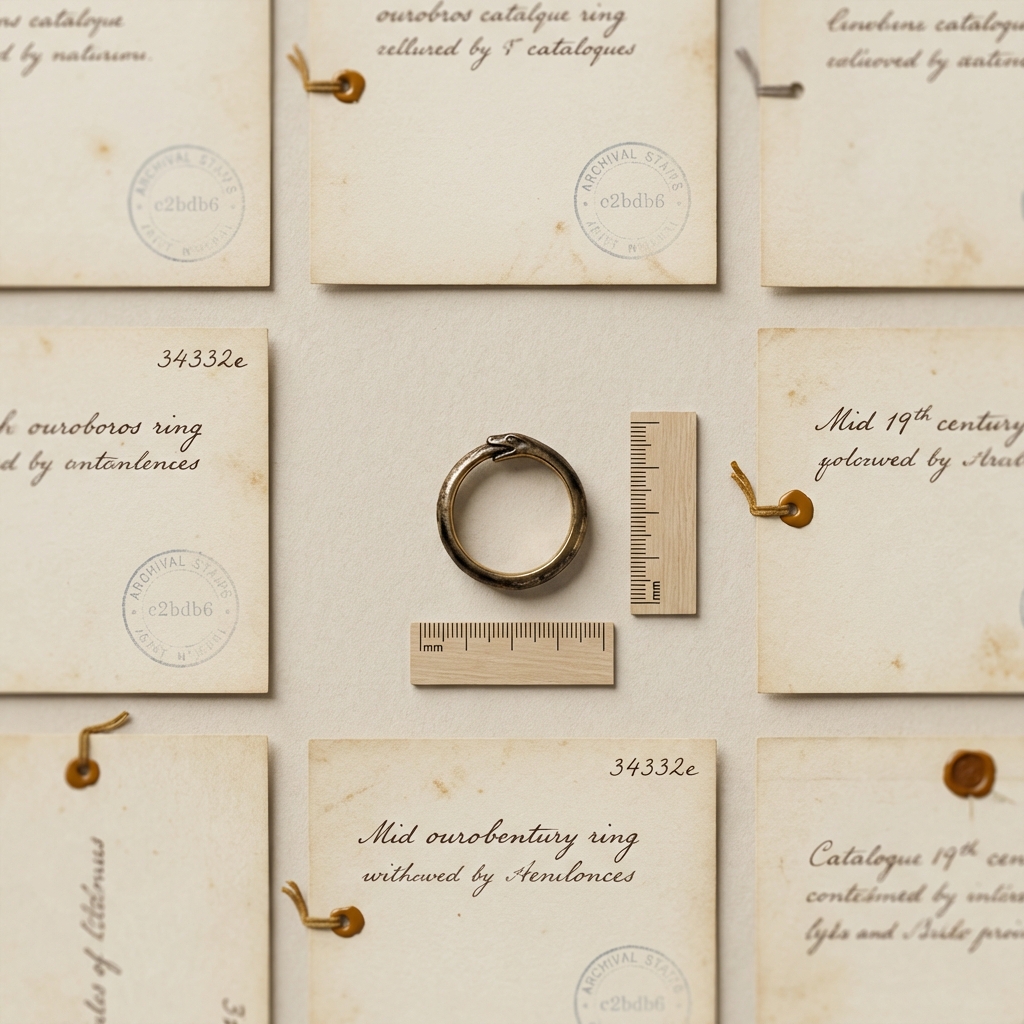
Look for a modest band profile rather than a high contemporary manufacturing finish, and for bezel forms and mounting styles consistent with mid 19th-century practice. Patina, wear consistent with age and the way a gemstone is set into its bezel are useful stylistic indicators but are suggestive rather than definitive.
Be mindful of enamel repairs or later re-setting, which can alter appearance; catalogued comparators often note whether enamel is original or a later intervention, and those notes help in forming a cautious stylistic judgment.
Provenance, documentation and scientific checks for collectors
Provenance elements that materially increase confidence include a clear collection history, prior ownership notes and verification or condition letters; institutional and seller documentation commonly lists these items and they make a practical difference when dating and attributing a piece V&A research on snake jewellery and makers.

Where provenance is incomplete, scientific tests such as X-ray fluorescence for alloy composition, and targeted gemological examination when stones are present, can add objective data that either supports or complicates a stylistic attribution. Museum comparators paired with technical data provide the most reliable route to an informed judgement about date.
Collectors should treat workshop-level attributions with caution: many surviving Victorian serpent rings lack firm workshop assignments and scholarship continues to refine attributions, so documented comparators and tested materials typically outweigh speculative workshop claims.
Deciding authenticity and dating: a practical framework
A practical sequence for buyers begins with a documentation request, then moves to stylistic comparison with museum and auction comparators, followed by a materials and marks check and, if necessary, scientific testing; this staged approach helps avoid expensive or unnecessary tests while focusing on the most informative evidence first V&A guidance on makers and meaning.
Start by asking sellers for provenance details, high-resolution photographs of joins and settings, and any conservation or condition notes. Cross-check those details against catalogued examples to see whether scale, bezel form and ornamentation match dated comparators.
Red flags include modern hallmarks or maker marks inconsistent with a claimed date, obviously fresh machining marks, or a provenance that cannot be independently verified. When in doubt, pause and consult a specialist or request targeted laboratory testing.
Common mistakes collectors make with serpent rings
One common error is relying on motif alone. Revival pieces imitate Victorian forms closely, so a serpent motif by itself is not sufficient evidence of age or origin Christie's research on serpent jewellery trends.
Another frequent pitfall is misreading restoration: later repairs, polished surfaces or re-set stones can obscure original features and mislead visual dating unless restoration notes are available to clarify interventions.
Comparison checklist for evaluating serpent ring age and authenticity
Use alongside museum comparators
Collectors often underestimate the importance of condition notes and conservator reports; a short conservator comment can change the interpretation of a repaired bezel or re-soldered hoop and should weigh into any buying decision.
Reading condition and restoration notes: what buyers should know
Condition notes commonly use terms such as stabilized, conserved, filled or replaced; each term implies a different level of intervention and should be read against photographs and, where available, a conservator's brief report.
Stabilized usually means the object was treated to prevent further damage without altering major elements, whereas repaired or replaced indicates interventions that change the original structure or materials. Those distinctions affect both display and how confidently a piece can be associated with a historical period.
Ask sellers for detailed images of repair areas and for the conservator's description when available; that documentation helps separate original features from later work and supports more accurate stylistic comparison with museum examples.
Case studies: surviving Victorian serpent rings in public collections
The Royal Collection Trust entry for Victoria's engagement ring is the primary comparator for discussions of a royal serpent ring and is a useful starting point for visual comparison because it pairs historical context with object description Royal Collection Trust entry.
Other institutional records and auction catalogues published in recent decades supply dated examples that show variation in scale and setting across the 1840s to 1860s; studying bezel form, scale and ornamentation in those images helps collectors form a provisional date estimate, including object-level records such as the British Museum's serpent bracelet entry British Museum object record.
When using case studies, focus on multiple comparative elements rather than a single feature: bezel shape, hoop thickness, enamel presence and signs of hairwork or other intimate materials all contribute to an overall assessment.
Market patterns: popularity, revivals and auction signals
Researchers tracing market patterns note a clear surge in serpent jewellery in the mid 19th century and a continued interest in later revivals; auction and museum records published in recent years make those patterns visible and provide examples for comparison Christie's overview of serpent jewellery trends, and trade coverage highlights notable modern pieces JCK overview.
Revival pieces complicate attribution because later makers often copied mid 19th-century forms; auction descriptions and provenance traces can indicate whether a lot is likely period or a revival, but buyers should read those descriptions critically and ask for supporting documentation.
Market appetite and scholarly attention both shape which examples are published and studied, so collectors benefit from following institutional catalogues and recent auction research to stay current on how specialists separate likely period pieces from later imitations.
A practical buying checklist for collectors
Before purchase, verify these essentials: clear provenance or collection history, condition and restoration notes, high-resolution photos of joins and mounts, accurate measurements, and references to museum or auction comparators that support the date claim V&A recommendations for assessing snake jewellery.
Ask sellers specific questions: has the piece been XRF-tested for metal composition; are there conservator reports for any repairs; can the seller provide prior ownership documentation or sale catalog entries? Pause if answers are vague or unsupported.
When a piece carries promising documentation but also ambiguities, consider a staged approach: buy only after obtaining written condition notes and after independent comparison to published comparators, or commission targeted testing where the potential value and confidence justifies the cost.
How Aurora Antiqua frames serpent and ouroboros pieces
Aurora Antiqua positions itself as a curator and reference layer for buyers of historical jewellery, offering curated ancient rings spanning Roman, Greek, Byzantine, Islamic, Celtic, medieval, and post medieval periods alongside select small artifacts and relic objects; listings include restoration and preservation notes and provenance references where available.
Editorial content focuses on explaining cultural context, materials and dating cues so buyers can make informed judgments without absolute authenticity claims, and includes product references like this museum-grade Roman ring.
For collectors interested in serpent motifs, the shop's approach is to pair careful imagery and condition notes with comparative references, helping readers see how a piece sits relative to museum and auction examples and to our rings collection rather than asserting an unqualified attribution.
Open research questions and what remains uncertain
Workshop-level attributions for many surviving Victorian serpent rings remain unsettled; specialists continue to debate whether specific workshops or regional traditions produced identifiable families of serpent rings, and those questions affect how confidently a single piece can be tied to a maker Victorian Studies discussion of ouroboros and symbolism.
Distinguishing early period pieces from later revivals can be difficult without firm provenance or testing; when documentation is thin, collectors should treat attributions as provisional and rely more on measurable comparators and technical data than on motif alone.
As scholarship and auction documentation expand, new comparators continue to refine the field; collectors should keep records of queries and tests so individual pieces can be reassessed as the literature develops.
Conclusions: why Victoria's snake endures in meaning and collecting
The ouroboros and serpent held layered symbolic appeal in Victorian culture, invoking eternity, cyclical time and intimate unity; these associations help explain why a snake-shaped engagement ring carried resonance when Queen Victoria accepted such a gift in 1839 History Today essay on symbolism.
Victoria's visible use of the motif coincides with a documented rise in serpent jewellery in the mid 19th century, so while causation is complex the weight of museum and auction comparators supports a meaningful role for royal visibility in popularizing the form British Museum notes on fashion diffusion.
For collectors the practical takeaways are steady: check provenance, compare to institutional examples, read condition and restoration notes carefully, and consider targeted testing when needed. Those steps will help separate likely period pieces from later revivals and form a defensible judgement without overstating certainty.
Yes. Royal collection records report that Prince Albert gave Queen Victoria a snake-shaped engagement ring in 1839, and the entry in the Royal Collection Trust is the primary institutional source for that fact.
In Victorian contexts the ouroboros and serpent drew on classical and alchemical traditions and was commonly interpreted as a symbol of eternal love, unity and cyclical time, though meanings could vary by context.
Compare materials and mount style to museum and auction comparators, request provenance and condition notes, and use targeted scientific testing for metal or gemstone composition when documentation is insufficient.
More from Aurora Antiqua
References
- Head of a Roman emperor, Victoria and Albert Museum, London
- Bague : satyre jouant de la double flûte devant une statue, Musee du Louvre, Paris, Departement des Objets d'art
- Echoes of Antiquity: Thorvaldsen’s Collections as a Reservoir of Motifs, Thorvaldsens Museum Archives
- A. M. Caggiani u. a., Corroborating the autoptic identification, Wiley, Journal of Raman Spectroscopy
- Leitfaden Standards Bewahren, Deutscher Museumsbund e.V
- Auction Terminology, Christie's
- Getty Provenance Index, J. Paul Getty Trust, Getty Research Institute, Los Angeles