


Looking for the real thing? Browse our Greek ring collection, each piece one of one, individually authenticated, with documented provenance. For the background, see the guide to ancient jewelry.
How ancient greek engagement rings fit into the history of proposals
By ancient greek engagement rings I mean rings that come from the Greek-speaking world or its artistic orbit and which are documented or described in archaeological and classical sources as being part of betrothal, marriage, or social exchange; many such rings were multifunctional and served as seals, personal ornaments, or markers of status rather than only as a token of romantic promise.
Understanding those rings is important for collectors and curious readers because what a given object meant at the time it was made can differ from modern expectations. Classical evidence shows ring use in marital and legal contexts, but does not record a standard one-knee proposal ritual as we might imagine it today, a point that affects how we interpret any single ancient ring as an "engagement" object Oxford Research Encyclopedias (Classics).
Behind-the-scenes with @auroraantiqua
Sign up for a short curator newsletter to receive monthly notes on selected ancient rings, condition and provenance summaries, and short history essays.
This article follows a layered argument. First it outlines what classical texts and archaeology say about rings in Greek and Roman contexts. Then it explains how kneeling gained layered meanings in medieval Europe and how nineteenth-century tastes reframed those meanings into romantic proposals. Finally it draws practical lessons for collectors who encounter the phrase ancient greek engagement rings in listings and museum labels.
Readers will find a mix of material culture discussion, interpretive caution, and practical checklist-style advice aimed at people who collect or consider wearing antiquities. The goal is not to provide definitive provenance claims for any object but to offer a historical frame that helps interpret descriptions and documentation.

What archaeological and literary evidence says about rings in ancient Greece
Classical sources and modern scholarship show that marriage in the ancient Greek world involved formal rituals and that rings were among the objects associated with those social practices. This scholarship treats ring use as one element in a wider set of legal and symbolic exchanges rather than as evidence of a single private ritual identical to modern proposals Oxford Research Encyclopedias (Classics).
Archaeologically, many rings recovered from Greek contexts are intaglios or bezel-set stones cut in materials like carnelian, agate, and other semi-precious stones. An intaglio is a carved gemstone used for sealing and personal identification; a bezel is the metal surround holding a stone. These forms often combine practical and symbolic functions: an intaglio might serve as a seal for documents and also display iconography that signals identity or affiliation.
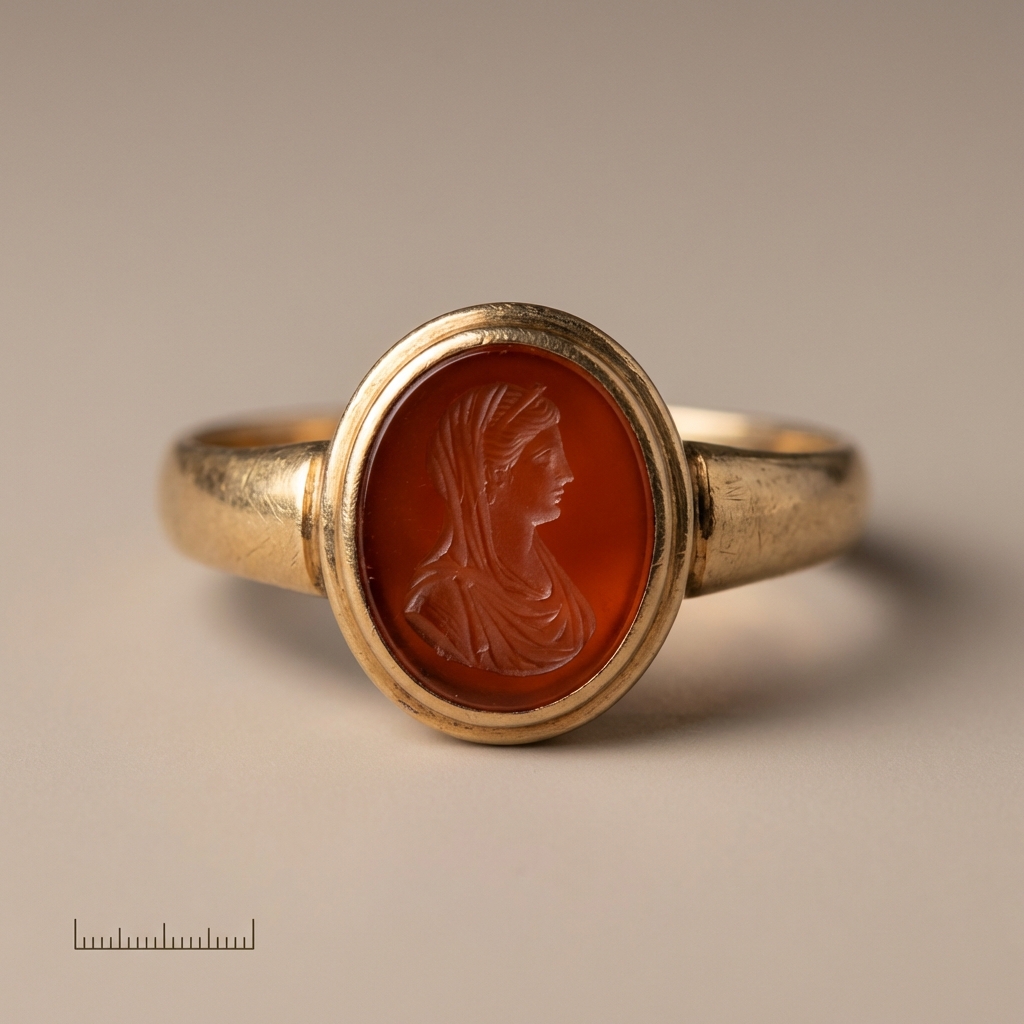
Because so many rings were multifunctional, labeling an item as an ancient greek engagement rings instance requires care. Wear consistent with age, a documented collection history, and explicit condition notes help place an object within social use categories, but they do not automatically equate a ring with a modern engagement ring concept.
Roman rings and their roles: seal, marker, and symbol

The one-knee proposal is a modern Western gesture that assembled symbolic elements from ancient ring-giving, medieval kneeling traditions, and Victorian romantic imagery; it is a cultural construction rather than a direct survival from classical antiquity.
Literary and material evidence shows Romans exchanged rings in marriage contexts, but the sources do not establish a linked posture such as kneeling as a required or documented part of betrothal ceremonies. This absence underlines the caution needed before reading modern postures back into ancient practices.
For collectors, Roman rings highlight the need to consult collection history and condition notes. A Roman intaglio worn as a seal can be attractive as a wearable history object but its original function and later uses may be layered and complex.
Why kneeling became meaningful in medieval Europe
Medieval Europe transformed kneeling into a versatile gesture of homage, fealty, devotion, and courtly respect. Kneeling could indicate submission in a feudal oath, reverence in religious settings, or deferential regard in a ceremonial context; this semantic richness provided later authors and artists with symbolic vocabulary they could rework into romantic imagery Encyclopaedia Britannica.
Within chivalric culture, acts of kneeling could be staged to demonstrate virtue, loyalty, or service. Courtly love literature and associated iconography often depict knights in postures that suggest humility before a beloved, and these depictions contributed symbolic associations between kneeling and personal devotion. For an accessible discussion of proposal traditions in later popular culture see Paullett Golden.
It is important to stress that this medieval vocabulary does not equal a direct, unchanged ritual. Rather, kneeling supplied metaphors and public actions that could later be adapted into courtship and romantic performance as social contexts evolved. Contemporary jewelry histories and trade perspectives also note the medieval roots of the bended-knee image Dales Jewelers.
The Victorian revival: how medieval kneeling turned romantic
During the nineteenth century a renewed interest in medieval culture and chivalric ideals helped popularise images of kneeling as a romantic posture. Curators and historians of the engagement ring note that Victorian visual culture, fiction, and etiquette writing often paired medievalized scenes with expressions of tender devotion, which encouraged a modern association between kneeling and romantic petitioning Victoria and Albert Museum and an accessible overview in Brides.
Victorian etiquette manuals and popular novels filtered medieval motifs into everyday expectations. The circulation of painted scenes, illustrations, and serialized fiction meant that an idealised image of a suitor on one knee could become a widely recognized stage direction for romance even if it had not been a continuous practice since antiquity.

Scholars emphasize that the Victorian moment is best read as an interpretive turning point rather than a single decisive invention. Visual and textual culture worked together to naturalize a posture that combined earlier symbolic registers with new romantic expectations.
Putting the pieces together: why the one-knee proposal is a layered development
The modern image of a partner proposing on one knee emerges from a blend of practices and images rather than from an unbroken ritual lineage. Greek and Roman ring-giving created the material preconditions for marked exchange, medieval kneeling supplied powerful symbolic meanings, and Victorian culture helped recirculate those images into popular life; the synthesis of these strands explains why the one-knee gesture feels historically resonant even if it is not literally ancient Oxford Research Encyclopedias (Classics).
Evidence limits remain. Direct documentary proof that a single posture moved from medieval homage to a standardized romantic act is thin, and scholars point to the need for focused archival work in nineteenth-century etiquette manuals and press materials to refine the timeline.
For collectors and readers this synthesis means ancient objects described as ancient greek engagement rings should be read with nuance: the ring may have participated in formal exchanges, but the gesture we call a modern proposal belongs to a complex cultural history.
Cross-cultural variation: other ways people show commitment
Comparative studies remind us that the Western one-knee image is culturally specific. Around the world, people display commitment and request partnership through a wide range of gestures and rituals, so kneeling is only one communicative posture among many BBC culture feature.
Compare gesture meaning and cultural context when planning a proposal
Keep entries brief
Anthropological and historical comparisons show examples such as ring exchange at family gatherings, negotiated brideprice rituals, formal contract signing, or public ceremonies where kneeling is not part of the interaction. These variations underscore that proposing on one knee is a culturally situated choice rather than a universal command.
When planning a proposal or choosing to wear an antiquity as a personal emblem, consider cultural context and the partners' preferences rather than assuming a single correct posture.
What this history means for modern proposals and etiquette
Kneeling carries layered symbolic meanings: it can indicate homage, supplication, devotion, or romance depending on context. Recognizing these layers helps people choose whether the posture fits a particular relationship and social environment The New York Times.
Etiquette today is more elastic than in past centuries. Some people favor the classic one-knee image for its theatrical clarity, others prefer a private conversation, and still others adapt a hybrid form that suits shared values. The historical record supports this pluralism, so personal meaning and mutual consent matter more than strict adherence to any presumed historic norm.
Media representations have shaped expectations, but they do not determine what is appropriate. A historically informed choice can make a gesture more meaningful, and understanding the rough arc from antiquity to Victorian popularization gives that choice context without prescribing it.
How to read provenance and condition notes for ancient rings
Documentation matters. Provenance and collection history entries typically aim to show an object's documented ownership trail, prior collection references, or supporting verification letters; these help build a picture of how a piece passed through time and institutions. Clear provenance notes are a vital baseline for assessing any ancient ring listed as an antiquity.
Restoration and preservation notes describe what was stabilised, repaired, or left untouched. "Stabilised" usually indicates that conservators addressed active deterioration to prevent further loss; "repaired" describes physical interventions that altered structure; "left untouched" signals that visible wear and patina remain as found. These phrases describe treatment history but do not make absolute claims about original condition.
Reasonable expectations for an ancient ring include visible patina, minor losses to inlay or thin shoulders, and evidence of past repairs when present. Red flags include an absence of any collection history for a purported antiquity, vague condition descriptions that avoid specifics, or provenance statements that rely on unverifiable anecdotes rather than documented records.
Deciding whether an ancient ring is right for you: criteria and questions
Use a short decision checklist. Key criteria include documented provenance, transparent condition notes, evidence of appropriate conservation, and a clear statement about whether the ring is being sold as an original antiquity or as a modern reproduction. These points guide both collectors and those who want a wearable piece with historical resonance.
Ask sellers: Has the object been described in any catalogues or scholarly literature? Is there a chain of custody or collection history? What specific restoration work was done and by whom? Are measurements, scale, and weight provided? Request clear photos of the bezel, hoop, and any markings that might indicate workshop attribution or later alteration.
Remember that choosing an ancient ring is often as much about narrative and personal meaning as it is about material attributes. A well-documented object with honest condition notes can be a rewarding collector piece and wearable history when treated with appropriate care.
Typical mistakes and how to avoid them when interpreting historic rings
Common errors include assuming a single original function for a ring, projecting modern romantic meanings onto ancient objects, or treating patina and wear as damage rather than as signs of age. These mistakes can be avoided by careful reading of documentation and modest interpretive claims.
Another frequent issue is vague restoration language. If a listing simply states "restored" without details, ask for specifics: what part was repaired, what materials were used, and is there documentation from a conservator? Detailed restoration notes allow buyers to assess suitability for wear and the likely impact of conservation on long-term condition.
Avoid treating any ancient ring as a guaranteed investment. Focus instead on condition notes, provenance, and whether the object's story aligns with what you want from a wearable antiquity. That approach keeps expectations realistic and preserves the object’s historical value in context.
Practical examples and scenarios: how proposal gestures and rings mattered across time
Imagine a hypothetical household in classical Athens where a ring is given at marriage as part of a familial exchange and legal recognition. The ring's role may have been practical, sealing household documents or marking dowry agreements, rather than functioning as a private romantic petition; this kind of use is well attested in classical studies and material culture summaries.
Consider a Roman example where an intaglio ring bears an image used to sign letters and also appears in wedding contexts. The dual use complicates simple readings: the ring can be a daily tool and a token associated with marital status in different registers of life The Metropolitan Museum of Art.
Fast forward to a medieval scene where kneeling is a public act of homage. In that context the posture expresses fealty, not necessarily romantic intent. A nineteenth-century reader steeped in romantic novels might reinterpret such an image as a private courtship gesture, which helps explain later popular depictions of the one-knee proposal.
Finally, a modern collector reading a listing that markets an "ancient greek engagement rings" example should parse language carefully: ask whether the listing cites collection history, what condition notes reveal about restoration, and whether scholarly attribution or dating is offered. Those questions help translate historical possibility into consumer decisions.
Responsible buying, ethical notes, and what curators recommend
Ethical collecting requires attention to provenance and lawful acquisition. Clear collection history and documentation mitigate risks associated with illicit trade, and reputable curators emphasize transparent records as the first filter for responsible purchase decisions.
Care for wearable antiquities involves basic conservation steps: store pieces away from direct sunlight and corrosive environments, avoid chemical cleaners, and consult a conservator before any attempt to reshape or resize an ancient hoop. For rings meant to be worn occasionally, monitor stress points and ask sellers about any past repairs that might affect structural integrity.
When in doubt, rely on transparent documentation and honest condition notes rather than marketing rhetoric. Aurora Antiqua presents curated ancient rings with condition and provenance summaries to help buyers understand what they are considering and why it matters.
Conclusion: kneeling as a layered symbol, not a single-origin ritual
The modern one-knee proposal is best understood as a cultural performance assembled from multiple historical threads: Greek and Roman ring usage provided the material context for marked exchange, medieval kneeling supplied symbolic registers of homage and devotion, and the Victorian revival popularised a romanticized image that circulated widely in print and visual culture Oxford Research Encyclopedias (Classics).
For collectors and curious readers, the practical takeaway is simple. Treat descriptions such as ancient greek engagement rings as interpretive labels that require careful reading of provenance, condition notes, and restoration histories. Choosing or rejecting a kneeling gesture today is a personal, culturally informed decision rather than one final requirement of history.
No direct evidence in classical texts or archaeology records a standard one-knee proposal. Rings appeared in marriage contexts, but the specific posture we call a modern proposal develops later through layered cultural meanings.
Not necessarily. Descriptions vary; rely on documented provenance, transparent condition notes, and conservator reports rather than labels alone.
Confirm clear provenance, detailed restoration notes, accurate sizing information, and whether a conservator advised on wearability before using it regularly.
More from Aurora Antiqua
References
- Pliny the Elder, The Natural History, BOOK XXXIII, Perseus Digital Library, Tufts University (edition Bostock)
- Aulus Gellius, Attic Nights, Book X, LacusCurtius, Bill Thayer, University of Chicago (Loeb Classical Library edition)
- Pliny the Elder, The Natural History, BOOK XXXIII, Perseus Digital Library, Tufts University (edition Bostock)
- Gimmel Ring, Victoria and Albert Museum, London
- Ring, Victoria and Albert Museum, London
- Law Reform (Miscellaneous Provisions) Act 1970, section 3, The National Archives, legislation.gov.uk
- Aegean and Cypro-Aegean Non-Sphragistic Decorated Gold Finger Rings, American Journal of Archaeology
- Thumb Ring, The Cleveland Museum of Art