


Looking for the real thing? Browse our Medieval ring collection, each piece one of one, individually authenticated, with documented provenance. For the background, see the guide to medieval jewelry.
Quick answer and what this guide covers
Short answer, yes: authentic ancient viking rings for sale still enter the market, but they are uncommon and typically come through specialist dealers, auction records, or curated museum disposals rather than mass retail channels.
That pattern, where specialist channels dominate supply, is reflected in museum and market reporting and helps explain why documentation and provenance matter when a piece appears for sale British Museum Viking collection.
This guide is written for collectors, history minded buyers, and luxury buyers who want one of a kind antiquities and who need practical steps to verify condition and provenance before purchase. It explains how Viking period rings are dated and identified, which sales channels are realistic, what legal and ethical rules to check, and a step by step verification framework you can use on any listing.
Questions to ask sellers before you buy
print or copy these questions when contacting a seller
Short summary answer
Authentic Viking age rings, generally dated to around the 8th to 11th centuries, do appear for sale but not commonly on general retail sites. They more often show up through specialist dealers and auction houses where provenance and documentation are part of the offering Christie’s guidance on buying antiquities.
At the same time, modern reproductions and ready made replicas are widespread on mainstream online marketplaces, and photographs alone can be insufficient to distinguish originals from replicas.
How to use this guide
Use the short checklists and scenario walk throughs to decide which steps you need for a particular listing in our rings collection. If a ring is low value and clearly a modern reproduction, fewer checks are needed. For higher value pieces, the guide shows the documentation and testing you should request before committing.
The remainder of the article follows this structure: definitions and typical materials, market channels, a verification framework, legal and ethical checks, common red flags, and practical scenarios with copy ready checklists for contacting sellers.
What counts as an ancient Viking ring: definitions and context
Scholars and museums typically use the term Viking Age to refer to roughly the 8th to 11th centuries CE. Dating an isolated ring is an estimate that generally relies on typology, find context, and comparative study rather than a single definitive test, so descriptions that tie dating to typology or find reporting are more credible than undated claims.

Typical materials include cast bronze bands, hammered or cast silver rings, and occasional gold mounts with intaglios. Carnelian and agate appear in some mounted rings, while engraved or set gemstones show different workshop traditions. Where a listing notes these materials and links them to typological features, the description is more useful for initial evaluation National Museum of Denmark overview.
Common motifs and manufacturing traces are important clues. Simple cast bands with tool marks, wear consistent with age, and stable patina can indicate long term burial and use. Intaglios and bezel mounts, when present, are assessed by stylistic comparison and by condition notes describing how a stone sits in its setting.
Patina, corrosion patterns, and microscopic traces of manufacture are used by conservators and specialists to support attribution. Statements such as wear consistent with age, specific restoration notes, or references to prior collection history improve the quality of a listing and help buyers separate likely antiquities from modern copies.
Where authentic Viking rings appear for sale today
Specialist dealers and auction houses
Authentic Viking rings most often come to market through specialist dealers and auction houses where provenance, condition reports and specialist descriptions are part of the sales process; this is where securely documented pieces are most commonly offered British Museum Viking collection.
Specialist dealers typically describe prior collection history, any conservation work, and may provide targeted scientific checks on request. Auction catalogues often include expert notes and provenance tied to sale records, which buyers can trace.
When provenance spans museum records, prior auction listings, or documented finds, that chain strengthens trust in the item. The presence of catalogued comparanda and a consistent condition history is a common feature of listings from these channels.
See documented finds and evaluations on Instagram
Browse curated listings that include condition notes and provenance summaries, or sign up for alerts to receive documented items as they appear.
Public finds databases, museum disposals and private sales
Public finds recording schemes and museum collection pages show ongoing discovery and reporting of Viking jewelry, and these records sometimes feed legitimate supply chains when an item has been deaccessioned or offered with clear documentation Portable Antiquities Scheme.
Museum deaccession and carefully documented private sales can be a source of authenticated pieces, though such offerings remain uncommon and typically come with clear provenance statements, conservation reports, and bibliographic references.
Private sales that include formal documentation such as prior sale records, collection history or conservation reports are easier to verify than anonymous listings that lack a paper trail.
Online marketplaces and the prevalence of replicas
Mainstream online marketplaces are dominated by modern reproductions and commercially produced replicas. These are often presented as decorative items and may be visually convincing in photos, which makes careful vetting essential when a listing claims antiquity Christie’s guidance on buying antiquities (for example eBay).
If a listing lacks clear provenance, restoration notes, or third party testing, assume the piece may be a replica unless proven otherwise. Many replica makers produce rings using historical motifs, so pattern alone is not sufficient evidence of age.
A step-by-step verification framework for buyers
Start with a documentation checklist, move to condition and restoration review, and escalate to scientific and specialist checks for higher value items. A staged approach reduces time and expense while offering protection against forgery and illicitly traded objects Christie’s guidance on buying antiquities.
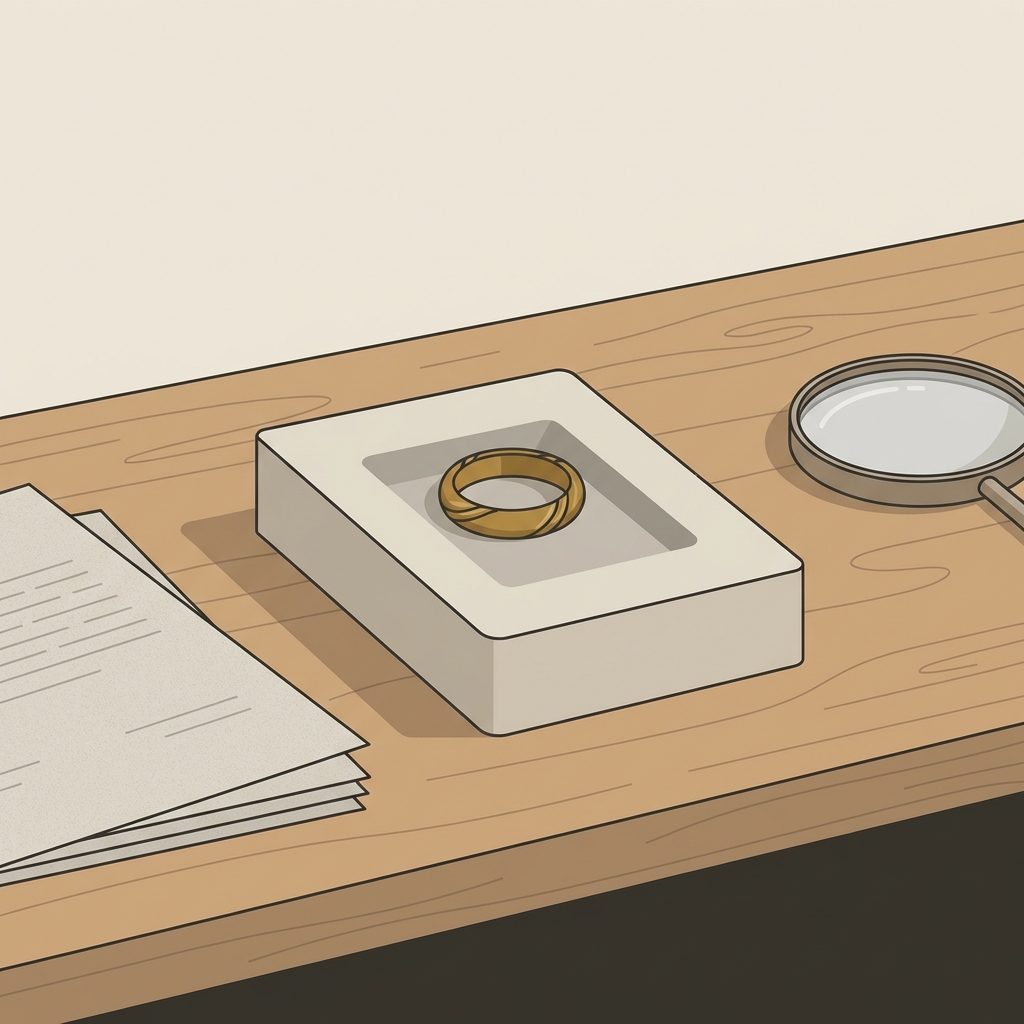
Documentation checklist items should include prior collection history, sale records or auction lots, find reporting if applicable, and any letters or certificates from recognized specialists. Requesting high resolution images and multiple views is a basic step before deeper checks.
Yes, authentic Viking rings still appear, but they are uncommon and are most reliably found through specialist dealers, auction records, and curated museum disposals; buyers should expect to verify provenance and condition before purchase.
Scientific checks and specialist reports are appropriate for higher value rings. Non destructive XRF testing can verify alloy composition, while targeted specialist reports can discuss typology, wear patterns, and comparative parallels in museum collections. Ask whether tests were carried out and whether reports can be shared.
Condition and restoration review looks for stabilisation work, modern repairs, or replaced components. A transparent restoration note will specify what was stabilised or consolidated, what repairs were made, and which areas remain untouched. If a listing lacks these notes, request them before purchase.
Keep a record of all seller responses and supporting documents. If a seller refuses to provide basic provenance or testing information for a high value item, treat that as a significant risk factor.
Legal and ethical checklist before you buy
International and national frameworks shape the trade in cultural property. The UNESCO 1970 Convention remains the primary international instrument used to discourage illicit traffic in antiquities and to encourage lawful transfer and export of cultural property UNESCO Convention 1970.
National laws, such as the UK Treasure Act 1996, also affect which finds require reporting and can influence export or sale. Buyers should confirm that an item has the necessary export documentation where required and that seller paperwork acknowledges any reporting obligations Treasure Act 1996.

Practical steps include asking the seller for export permits, collection or sale records, and any prior reporting to national finds schemes. Prefer items with clear find or collection histories, and consider deferring purchases where documentation is ambiguous.
Common red flags and typical mistakes buyers make
Relying on photographs alone is a frequent mistake. Photos can disguise modern tooling, cast seams, or new solder lines. When a listing uses a small set of studio photographs without scale, multiple angles, or close ups of patina and joins, that should prompt caution Christie’s guidance on buying antiquities.
Poor or missing documentation is another clear red flag. Vague provenance notes, no conservation history, or statements that an item is simply believed to be old without explanation all increase buyer risk. Ask for specific prior ownership, sale records, or catalogue references.
A third common error is relying on price alone as a proxy for authenticity. Low prices do not guarantee authenticity, and high prices do not guarantee provenance. Price should be one of several considerations alongside documentation, condition notes, and test results.
Practical buying scenarios, example checklists and next steps
Scenario A: lower value bronze ring with limited provenance
When a common bronze cast band appears with limited provenance and a modest asking price, treat it as a likely low value antiquity or a reproduction. Ask for high resolution images, multiple angles, and a short condition note describing patina and any repairs.
Checklist for low value bronze piece: request photographed detail of wear and join, ask whether the item has been reported to a finds scheme, and ask for any prior sale history. If the seller cannot provide even basic provenance, consider passing or buying only for decorative use rather than as a verified antiquity.
Scenario B: high value gold or intaglio ring with auction record
For a high value gold ring or an intaglio with an auction record, do not rely on the listing alone. Request the auction catalogue entry, any appended specialist reports, and XRF or other non destructive test results if offered. Auction records and catalogue entries often provide comparative literature and can be traced back to earlier sales.
If the item has been in a public collection or appears in museum records, that provenance should be documented. When a seller provides catalogued sale entries or conservation reports, review them carefully and where needed seek an independent specialist opinion before purchase.
Action checklist for a safe purchase
Copy and paste this checklist when contacting a seller: ask for prior collection history or auction lot references, request condition and restoration notes, ask whether any scientific testing was performed and if reports are available, request multiple high resolution images with scale, and ask about export documentation or reporting to national finds schemes.
For higher value items, add: request non destructive XRF results or the option to commission a targeted specialist report, and consider using an escrow service until paperwork is verified. Using curated sellers who include documentation and transparent condition notes can reduce risk while keeping expectations realistic about gaps in provenance.
Closing considerations for buyers
Authentic Viking rings do still come to market, but they are uncommon and demand careful vetting. Use the verification framework and legal checklist here to structure your enquiries and to decide when to escalate to scientific testing or independent opinions Portable Antiquities Scheme.
If you are unsure about a listing, pause and seek an independent specialist or ask a reputable curator to comment. Transparency from the seller, documented conservation history, and links to prior sales or catalogue references are the strongest practical safeguards for buyers of ancient artifacts.
They most commonly appear through specialist dealers, auction houses, and occasionally via curated museum deaccession lists or documented private sales, rather than on general retail marketplaces.
Request prior collection history, sale or auction records, condition and restoration notes, and any scientific or specialist reports; also ask about export or reporting paperwork if applicable.
XRF can confirm alloy composition and help rule out modern alloys, but it does not alone date an object; combine scientific tests with typology, provenance and specialist reports for a stronger case.
More from Aurora Antiqua
References
- Treasure Act 1996, The National Archives, legislation.gov.uk
- Treasure Act 1996, The National Archives, legislation.gov.uk (King's Printer of Acts of Parliament)
- Danefæ og andre løsfund, Slots- og Kulturstyrelsen (Danish Agency for Culture and Palaces)
- Fornfynd, Fyndfördelning och Fyndlista, Riksantikvarieämbetet (Swedish National Heritage Board)
- About us, International Association of Dealers in Ancient Art
- Stolen Works of Art Database, INTERPOL
- 1995 Convention, UNIDROIT, International Institute for the Unification of Private Law, Rome
- The Vale of York Viking Hoard returns to York, York Museums Trust (Yorkshire Museum)
- Historical knowledge, National Museum of Denmark, Copenhagen
- Fighting the illicit trafficking of cultural property, UNESCO