


Looking for the real thing? Browse genuine Roman rings for sale, each piece one of one, individually authenticated, with documented provenance. For the background, see the guide to Roman jewelry.
What is a roman glass necklace? Definition and context
A roman glass necklace commonly refers to an archaeological or antiquity necklace made with glass beads, pendants or small hollow forms that date from the Roman period and later antiquity. These objects often survive as individual beads or fitted pendants set into metal bezels and can appear in collections as single wearable pieces or as restored stringings used for display and study. The glass used is typically soda-lime-silica that was shaped by winding, moulding or cutting, and many surviving examples show surface weathering that collectors value as part of a piece's history. For practical care, treat such items as archaeological glass rather than modern costume jewellery, because their surface weathering is chemically fragile and requires restraint in cleaning; see conservation guidance for practical care from a museum perspective Corning Museum of Glass conservation guidance.
Weathering on ancient glass can produce iridescence or a crizzled surface that forms when original glass reacts slowly with burial environments. That fragile weathering and patina can look decorative, but it is not a modern finish and often represents a thin, chemically altered layer that can flake or delaminate if handled or abraded. Conservators treat these layers as part of the object's history and recommend preserving them where possible rather than forcibly cleaning them away, because mechanical removal risks irreversible surface loss Archaeological materials, Icon, The Institute of Conservation (UK).

When buying or owning a roman glass necklace, readers should understand that dating and material identifications offered in listings are typically estimates unless laboratory analysis is provided. Measurements, workshop attribution notes, condition notes and any available provenance or documentation help place a piece historically, but those descriptions are interpretive and are most useful when combined with clear restoration notes and photographs rather than taken as definitive labels.
Why conservation matters for Roman glass necklaces
Museum and major institutional guidance emphasises minimal, reversible cleaning for archaeological glass and explicitly warns against household detergents and ultrasonic cleaners, because those approaches can alter or remove fragile surfaces and accelerate deterioration British Museum collections care and conservation guidance.
Iridescence and crizzling are not purely cosmetic problems. They reflect multi-layer chemical alteration at the glass surface that can be physically weak, so aggressive cleaning or mechanical scraping can remove original material and historical evidence. Conservators therefore prioritise preserving those surfaces and documenting them before any intervention Archaeological materials, Icon, The Institute of Conservation (UK).
Follow @auroraantiqua for condition notes and behind-the-scenes conservation views
Check condition notes, restoration entries and documentation before you plan any handling or wearing; if the listing or object shows active flaking or has vague restoration notes, ask the seller for photographs and clarifications first.
When a necklace shows active corrosion such as flaking, powdering or delaminating layers, it is a sign that the material is unstable and likely to change if disturbed. Such active glass disease generally requires assessment and possible consolidation by a trained conservator, because home treatments and untested adhesives can trap moisture or cause chemical reactions that speed damage Getty Conservation Institute overview of glass conservation.
For buyers and collectors, the conservator's priority is to preserve the original surface and the object's documented history rather than to make the piece look 'cleaner'. That approach keeps historical evidence intact and helps future study, so when restoration notes are provided they should be read carefully to understand what was stabilised, what was left untouched and whether any reversible consolidants were used.
How conservators assess condition: a practical framework
Conservators begin with a magnified visual inspection to record how weathering appears across the surface, where flaking or crizzling is present, and whether any metal fittings, adhesives or stringing contact the glass. This step includes photographing the piece with scale and magnified detail shots and noting measurements to establish a baseline for future comparison; a standard starting procedure is described in museum conservation practices Getty Conservation Institute overview of glass conservation and in wider conservation treatments guidance Conservation Treatments at SHA.
Next, assessment focuses on the stability of weathering layers and mounts. Under magnification, a conservator will look for lifting layers, powdering that releases dust when gently touched, and any separation at bead holes or bezel joints. They will also inspect metal fittings for active corrosion, because corroding metals can produce acidic or saline micro-environments that promote glass deterioration, and museum handling guidance highlights the need to separate corroding metals from glass where possible The Metropolitan Museum of Art conservation recommendations for small objects.
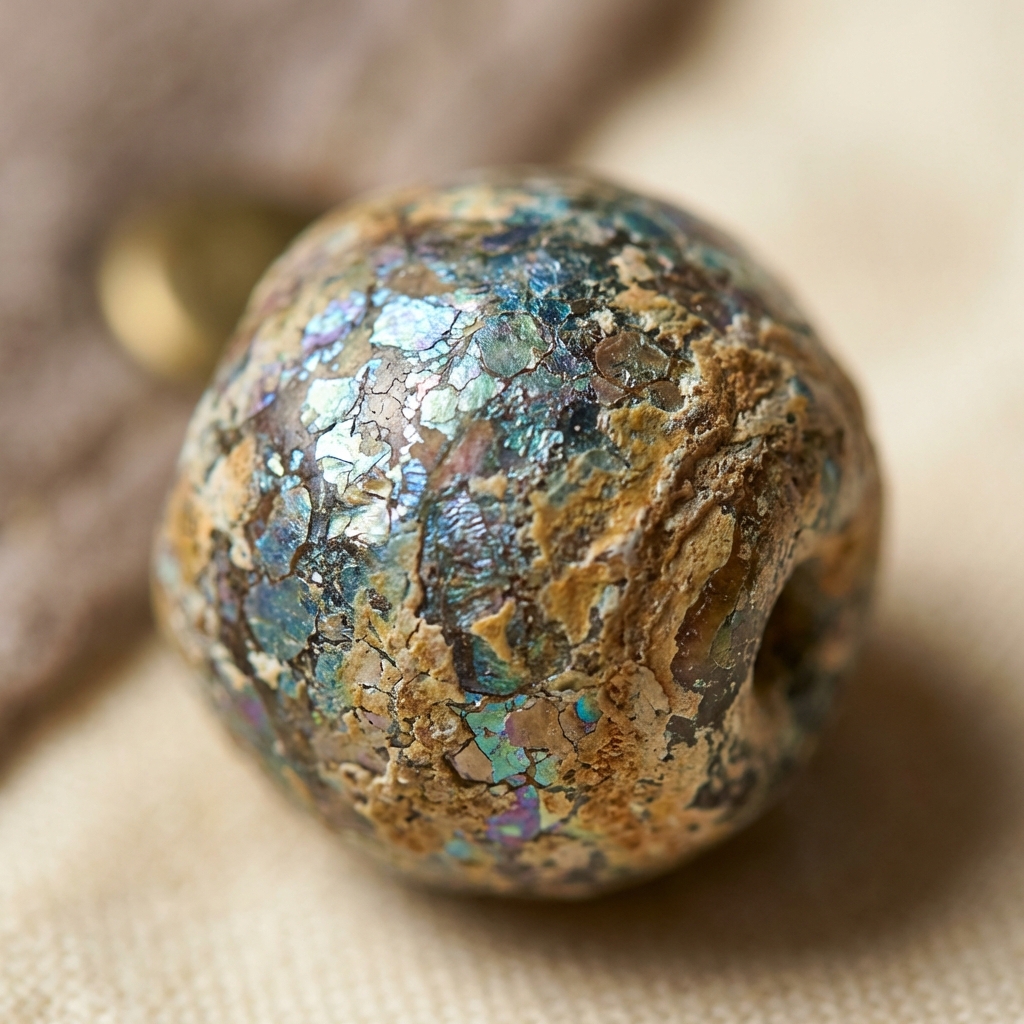
Documenting condition and any prior restoration is essential. Condition notes should include clear descriptions of patina, visible repairs, areas of flaking or consolidation, and whether any adhesives were used in mounts. When listings or sales offer provenance or restoration documentation, conservators use those records to inform whether a piece is safe to handle, wearable with precautions, or in need of professional stabilization.
Determining whether a necklace is stable enough for careful handling typically depends on whether the weathering is adherent and continuous or patchy and lifting. Continuous, well-adhered iridescence is often considered stable for supervised display, while patchy flaking or active powdering usually signals the need for treatment before any ongoing use.
Safe cleaning methods for lightly soiled Roman glass necklaces
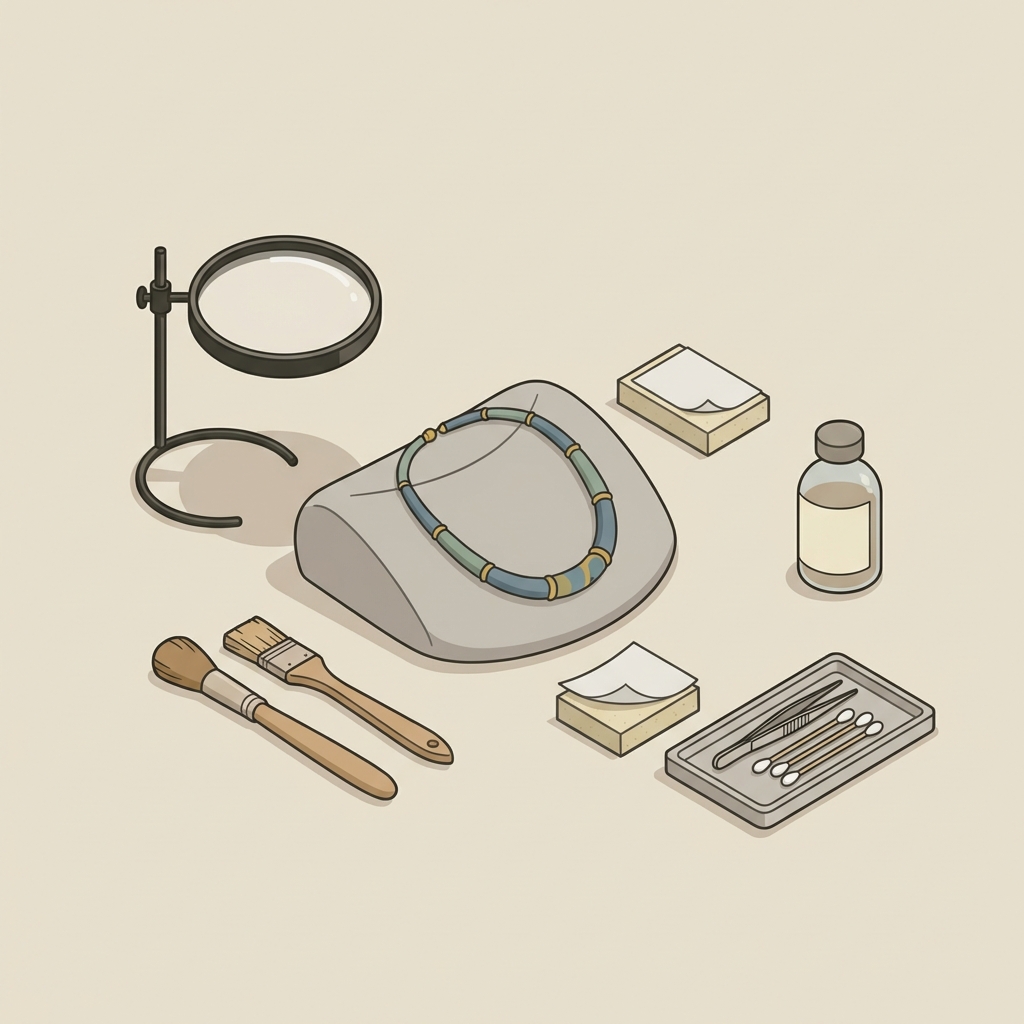
If a piece is lightly soiled but shows no active flaking or powdering, conservators allow limited dry mechanical cleaning such as soft, dry-bristle brushes, careful use of cotton swabs, and very fine tools used under magnification by a trained handler. These low-risk actions remove loose dust and particulate dirt without wetting fragile surfaces, and they are widely noted in practical conservation guidance Corning Museum of Glass conservation guidance.
Care for a Roman glass necklace by avoiding aggressive cleaning, documenting condition with photographs and notes, using only minimal dry cleaning for light dust, storing in stable moderate humidity with padded supports, inspecting fittings before any wear, and consulting a conservator for active corrosion or delamination.
When aqueous methods are considered, the safest approach is a distilled-water poultice or extremely mild localized wet cleaning performed under magnification and preferably supervised by or carried out by a conservator. Distilled water avoids ions that can react with altered glass, and poultices limit contact time and localize treatment; these controlled aqueous approaches are part of contemporary conservator practice for lightly soiled archaeological glass Getty Conservation Institute overview of glass conservation. See also V and A practical guidance on home care and distilled-water cleaning Caring for your glass at V and A.
Be careful not to assume that because a bead looks dirty it is safe to immerse. Even brief immersion can hydraulically lift fragile weathering layers or dissolve soluble salts in the glass surface. For any wet work in a non-professional setting, document each step with photos, use only distilled water, minimal exposure time, and dry immediately and gently with clean, lint-free materials.
Explicitly avoid household detergents, solvents and ultrasonic cleaners. These methods are discouraged by major museum policies because they can remove or alter weathering layers, strip patina and increase the risk of delamination rather than stabilising the object British Museum collections care and conservation guidance.
If you plan limited dry cleaning at home, work on a soft padded surface, use a new soft-bristle brush and disposable cotton swabs to avoid transferring oils, and avoid any tool pressure that causes scratching. Record what you do and keep dated photographs so a conservator can see prior attempts if professional help becomes necessary.
When not to clean and when to consult a conservator
Know the red flags: visible flaking, powdering that releases dust on touch, bubbling or lifting layers and any clear separation at bead holes or bezel joints are signs of active corrosion that require professional assessment. These symptoms often indicate chemical instability that can progress rapidly if disturbed, and scholarly conservation literature stresses that such active conditions need controlled intervention rather than home remedies Archaeological materials, Icon, The Institute of Conservation (UK).
Do not attempt home consolidation with adhesives or resins. DIY adhesives can be incompatible, introduce solvents or plasticisers that migrate into the glass, or trap moisture behind delaminating layers, which can accelerate deterioration. When consolidation is needed, a conservator will test compatible materials and apply treatment in a controlled way to achieve reversible stabilisation Getty Conservation Institute overview of glass conservation.
If you see active deterioration, stop cleaning and photograph the affected areas with scale and a brief note describing what you observed and any recent handling or environmental changes. When contacting a conservator, include high-resolution photos, magnified detail shots, measurements, any condition or restoration notes you were given at purchase and a short history of what you or others have tried to do, because that information helps professionals triage the object and recommend appropriate stabilising steps.
Storage, display and wearing advice for Roman glass necklaces
Stable storage conditions slow chemical change. Museums recommend moderate, controlled relative humidity with minimal short-term fluctuations, because large swings in humidity can drive cycles of salt migration and mechanical stress in altered glass surfaces British Museum collections care and conservation guidance.
Use padded supports and soft, inert packing materials to prevent abrasion and contact points that concentrate pressure. Padded mounts and cushions that conform to bead shapes reduce movement and abrasion during storage and display, and museum guidance advises separation from corroding metals or acidic materials that can promote localised deterioration The Metropolitan Museum of Art conservation recommendations for small objects.

Before wearing any archaeological necklace, inspect stringing, knots, metal mounts and adhesives for signs of weakness or corrosion. Conservators recommend avoiding wearing objects that show instability or untreated active corrosion, and to rely on clearly written condition and restoration notes to make informed decisions about safe use.
When displaying a wearable piece, use vibration-free mounts and consider UV-filtering glazing if the object will be in strong light for extended periods. Always label displayed items with concise condition notes so handlers know whether the piece should be handled and whether it requires periodic reassessment.
Common mistakes and what damages they cause
Household cleaning errors are widespread. Using detergents, bleach, acetone or strong solvents can remove fragile weathering layers and alter surface chemistry, producing irreversible loss of historical surface qualities. Ultransonic cleaners are especially risky because the mechanical energy they produce can dislodge flaking layers from glass surfaces Corning Museum of Glass conservation guidance.
Excessive mechanical cleaning with abrasive tools or aggressive scraping can abrade iridescence and patina rather than preserve it. In many cases owners remove important surface evidence while attempting to make a piece look newer; conservators therefore recommend restraint and documentation before any intervention that risks surface alteration.
Improper repairs, unbuffered metal contacts and acidic storage materials accelerate corrosion. Metal fittings that are actively corroding can create localised chemical conditions that promote glass deterioration, and adhesives placed without understanding compatibility can fail or cause staining, so professional assessment is recommended for any significant repair.
Practical checklist, documentation and next steps
Start with a routine inspection: note visible changes, photograph each side with scale, take magnified detail shots of any weathering and record measurements and any inscriptions. Keep a dated log of storage conditions, recent handling and any cleaning attempts; these simple records are invaluable if you need professional conservation later Corning Museum of Glass conservation guidance.
a simple condition and handling checklist for owners
keep entries dated
One-page care checklist, expanded: 1) Inspect weekly for new flaking or powdering; 2) Photograph and log any change; 3) Dry clean only with soft-bristle brush and new cotton swabs if no active corrosion is visible; 4) Store in moderate, stable relative humidity and padded supports; 5) Do not wear objects that show weakness in mounts or active corrosion. If you observe active deterioration, stop all cleaning and seek conservator advice.
When contacting a conservator, provide clear photos, magnified detail images, measurements, a history of observed changes and a record of any home treatments you attempted. A conservator will ask for that information to prioritise treatment and to recommend safe short-term stabilising measures, if any are appropriate.
If you are buying a piece online, seek listings that include condition notes, restoration notes and provenance documentation; use those materials to ask targeted questions about stability and past treatment before purchase.
Listings that include clear condition descriptions and photographs let you ask specific questions before purchase. Aurora Antiqua presents pieces with condition notes and documentation where available to help buyers understand what they are purchasing. Aurora Antiqua
You can wear a roman glass necklace only if it is documented as stable, the stringing and metal fittings are sound, and no active flaking or powdering is present; otherwise avoid wearing until a conservator assesses it.
Distilled water can be used for very limited, localized poultice or wet cleaning when no active corrosion is present, but such work should be brief, documented and ideally supervised by a conservator.
Record clear photographs with scale, magnified detail shots, measurements, written condition notes describing patina and any repairs, and any provenance or restoration documentation you have.
More from Aurora Antiqua
References
- Archaeological materials, Icon, The Institute of Conservation (UK)
- E.C.C.O. Professional Guidelines (II): Code of Ethics, European Confederation of Conservator-Restorers'
- ICOM-CC, International Council of Museums, Committee for Conservation
- Leitfaden Standards Bewahren, Deutscher Museumsbund e.V
- How to Care For Your Jewellery: The Ultimate Guide by the National Association
- Walking on eggshells: conservation treatment on Roman glass, conservation.fitzmuseum.cam.ac.uk
From Aurora Antiqua
We sell authenticated ancient & medieval pieces, each individually examined before listing and backed by a Lifetime Authenticity Guarantee. One of a kind, sold once, never reproduced.
Browse Ancient Roman Rings →